


:quality(80)/p7i.vogel.de/wcms/2f/f3/2ff3221bf7665de2d0acf83760bfd1fa/0130031523v2.jpeg "Wolfspeed presents a 300 mm silicon carbide technology platform designed to support advanced packaging and high-efficiency power delivery for AI data center infrastructure. (Source: Wolfspeed)")
:quality(80)/p7i.vogel.de/wcms/c3/16/c316e955a97f5d72d9678297b237b9e5/0129932858v2.jpeg "Left: the single-phase version of the SENTRON ECPD with RCM, right: a model of the future three-phase version of the SENTRON ECPD. (Source: Siemens)")
:quality(80)/p7i.vogel.de/wcms/ef/0a/ef0adb0acf793fe147cc27c21f6a7a67/0129954238v2.jpeg "Empower Semiconductor introduces embedded silicon capacitors designed to improve power delivery and stability in AI and high-performance computing processors. (symbolic image) (Source: © IF.arc - stock.adobe.com)")
:quality(80)/p7i.vogel.de/wcms/53/f9/53f9301dfc9292d02960f7996c79cc6e/0129927601v2.jpeg "Wolfspeed’s new 10 kV SiC MOSFET enables high-voltage power conversion for grid and industrial applications. (symbolic image) (Source: © CREATIVE- 3.4 - stock.adobe.com)")
:quality(80)/p7i.vogel.de/wcms/6e/cd/6ecd41d095d5111cf4ed37b714844487/0129930878v2.jpeg "PCIM Asia Shenzhen provides a platform for industry experts to present new developments in power electronics and electrification technologies. (symbolic image) (Source: © killykoon - stock.adobe.com)")
:quality(80)/p7i.vogel.de/wcms/02/c0/02c0e9722f70b1134dbf96fb59a9c73d/0129655179v2.jpeg "The PCIM Conference 2026 will take place from June 9-11, featuring discussions on power electronics trends, including GaN technology and AI applications. (symbolic image) (Source: © Elmira - stock.adobe.com)")
:quality(80)/p7i.vogel.de/wcms/cc/67/cc670ea2029cd2af5c641af70e1bf734/0129816392v4.jpeg "Fraunhofer IAF coordinates the EU SUPREME project to accelerate GaN and SiC power semiconductor innovation in Europe. (Source: Fraunhofer IAF)")
:quality(80)/p7i.vogel.de/wcms/ea/e6/eae6aee30071e67a5627027974437134/0129544613v2.jpeg "GlobalFoundries and Renesas strengthen their collaboration to support U.S.-based semiconductor production and supply chain resilience. (Source: © ronstik - stock.adobe.com)")
:quality(80)/p7i.vogel.de/wcms/b1/5e/b15ee02b0ba02db70cf61e37d66ad1d3/0129349127v2.jpeg "Vehicle-to-grid (V2G) chargers enable bidirectional energy flow, allowing electric vehicles to act as mobile energy storage systems that can both draw power from and feed power back into the grid. (Source: © medienvirus - stock.adobe.com)")
:quality(80)/p7i.vogel.de/wcms/26/d5/26d591cc340077026eac56a0e7564faf/0129949603v2.jpeg "Flexible: The solid silicone-based electrolyte is elastic, thereby compensating for the voids that form in solid-state batteries during charging and discharging. (Source: Empa)")
:quality(80)/p7i.vogel.de/wcms/4d/e0/4de02f76a37cbb3df30dd231de589c8e/0128866890v2.jpeg "Both legacy and vGaN show higher carrier mobility and band gap energies compared to other power semiconductors. (Source: © phonlamaiphoto - stock.adobe.com)")
:quality(80)/p7i.vogel.de/wcms/18/0b/180b7b63afc91e523592d8a5ce161c96/0129847487v2.jpeg "InGaAs-based photodetectors enable sensitive and fast detection in the short-wave infrared spectrum for modern sensing and communication applications. (Source: © VITALII - stock.adobe.com)")
:quality(80)/p7i.vogel.de/wcms/be/c8/bec8d43fc0ee73414274be44608b2970/0129748903v2.jpeg "The Infiniium XR804KA real-time oscilloscope delivers faster response time, improved stability, and streamlined workflows for high-speed digital and compliance testing. (Source: Keysight)")
:quality(80)/p7i.vogel.de/wcms/23/ee/23ee4a97790d6009dbfd7d9577ffa723/0129220424v2.jpeg "The R&S FPL1044 with the new RTSA option makes 40 MHz real-time frequency analysis available up to 44 GHz. (Source: Rohde & Schwarz )")
:quality(80)/p7i.vogel.de/wcms/3c/d1/3cd1cacbceb792ba63727199c61ca434/0127801860v2.jpeg "Thanks to cloud technology, users can collaborate on projects from anywhere and always have access to the latest planning data. (Source: SIEMENS)")
:quality(80)/p7i.vogel.de/wcms/5a/a0/5aa0436498af618297961fd54ab36cdf/0126290792v2.jpeg "Siemens accelerates student-led semiconductor innovation across Europe’s leading technical universities through Cre8Ventures’ Open Higher Education Program developed in collaboration with Arm and University of Southampton (Source: Siemens Digital Industries Software)")
THYRISTORS Are Thyristors still relevant in the power industry?
Related Vendors
:fill(fff,0)/p7i.vogel.de/companies/63/c7/63c7da97be945/diotec.png "diotec (Diotec Semiconductor AG)")
:fill(fff,0)/p7i.vogel.de/companies/60/7e/607ec89d5d9b5/white-frame.jpg "white frame.jpg (www.rohm.com)")
:fill(fff,0)/p7i.vogel.de/companies/68/08/6808a2b3b6595/het-logo.jpeg "het-logo (Heraeus Electronics)")
With CPUs and GPUs getting smaller and smaller, high-power devices continue to have a large surface area and weight. Thyristors, one of the heaviest semiconductor devices, were invented in 1956. Are they still relevant in the market? Check out the article to learn more about the thyristor market in detail.
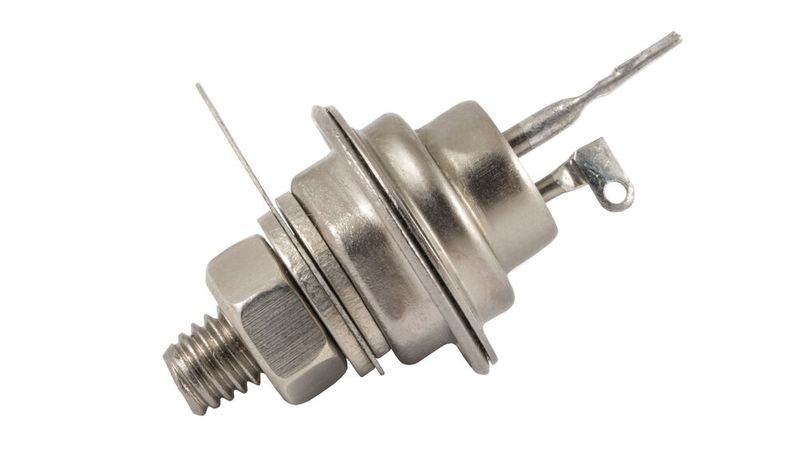
As Moore's law pressures the electronics industry to miniaturize further, the power industry is not overburdened like data centers. Transistor size has been reduced to 1/billion and 1/trillion, but discrete components have not significantly reduced their size compared to their original size. Instead of size reduction on a chip, their packaging has resulted in component size variation. Simply put, discrete components did not scale further in miniaturization like CPU and GPU chips.
Are thyristors used in the power industry like transistors?
Yes, the thyristor is still relevant in the high-power industry, something power transistors cannot pull off.
Whenever someone visits a factory or an industrial commercial setting, they can easily spot thyristors instead of transistors. The reason is the high-power handling capability of thyristors, which enables them to deal with voltages larger than 1 kV and currents more than 100 A in HVDC applications. Whereas power transistors can handle minimal voltages and currents up to 100 V and 10 A.
Another reason thyristors stay relevant despite ongoing miniaturization trends is that they exhibit a unique property of latching on. Thyristors do not need the gate current pulse to stay on, unlike power transistors that constantly need gate voltage. Hence, thyristors are still relevant in power and industrial electronics.
Thyristor as a part of the power electronics industry
The power electronics industry is segmented into three device types: power integrated circuits (chips), modules, and discrete components. Thyristors are available in all three categories, with ICs being less common (specialized operation). To understand the market share of thyristors and subtypes, let us go through the power electronics market, followed by device type segmentation.
:quality(80)/p7i.vogel.de/wcms/af/07/af073e302fcca1153bcaca553175006c/0124143921v2.jpeg "Thyristors are power semiconductor devices used in industrial power control applications. These devices are nothing new; they have been on the market for decades. Learn more about them here. (Source: jossbomon - stock.adobe.com)")
BASIC KNOWLEDGE
Thyristor: Definition, types, and more
The global power electronics industry is valued at USD50.62 billion as of 2025. Compared to 2024, it grew from USD48.26 billion — at a CAGR of 4.89 %. The global power electronics industry is expected to hit USD63.18 billion in 2032, at a CAGR of 5.7 %.
The power electronics industry started with discrete components that ruled the industry for decades. At present, power modules dominate the industry. According to Modor Intelligence report, modules had a 63 % market share in 2024. Due to the rise of the chip trend and miniaturization, power ICs have also grown throughout the years.
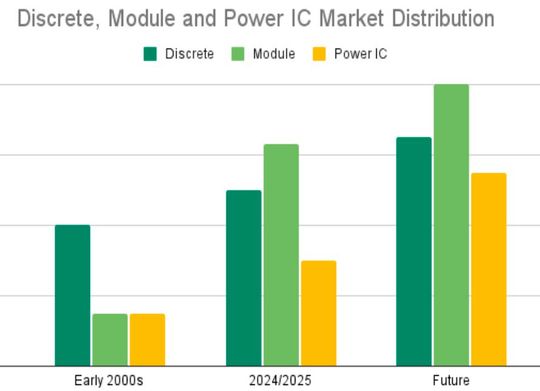
With the rise of power modules and ICs, discrete components occupy a smaller market share. Discrete component manufacturing did not scale exponentially like ICs and modules. It has slowly increased and continues to remain stable due to widespread applications.
Power module and IC manufacturing came into play. As per these reports, power ICs will take over the market with the strongest growth potential. Discrete components and modules will still be sold for their industrial applications.
Power modules market
Thyristors are not a significant portion of the power IC market. However, thyristor modules are a small portion of the power module market. IGBT and MOSFET dominate the power module industry.
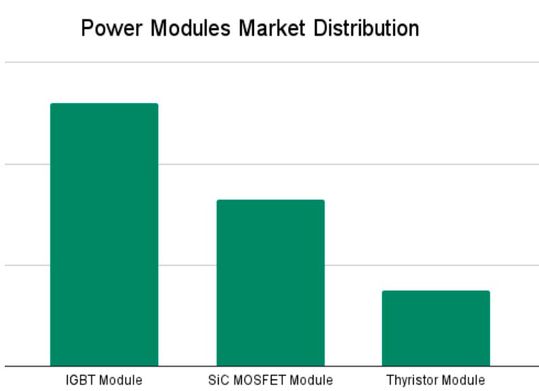
According to some reports, the thyristor modules occupy the smallest share of the power modules market. However, buyers have started to use thyristor modules. As a result, the thyristor module market is likely to remain stable in the coming years.
Discrete components market
IGBTs, MOSFETs, BJTs, thyristors, rectifiers, and other semiconductors are commercially available as discrete components. MOSFET, as ICs, modules, and discrete components, continue to dominate the electronics industry. According to a marketing insight, MOSFETs occupy 40 % of the discrete component market.
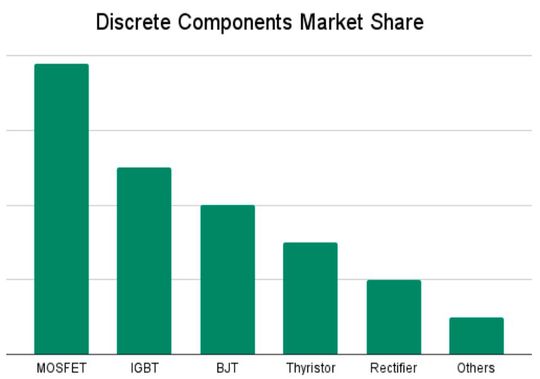
The diagram states that the thyristor market performs better as discrete components, rather than modules. Historically, thyristors have always been and continue to be sold as discrete components, even after the introduction of modules and power ICs.
:quality(80):fill(efefef,0)/p7i.vogel.de/wcms/5f/fe/5ffedb2e0ffa6/listing.jpg "listing")
Thyristor: Market breakdown
Thyristors are sold globally as discrete components and modules for applications such as variable-speed motors, high-power inverters, drivers, light dimmers, AC controllers, energy storage systems, and battery chargers. The section explains the standalone market of thyristors instead of considering them a small part of the transistor-dominated power electronics industry.
The global thyristor market is valued at USD1.55 billion — in 2025. Out of the power electronics market (valued at USD50.62 billion), the thyristor market is just 3 %. In 2024, the thyristor market was valued at USD1.49 billion. Again, the thyristor market was just 3 % of the entire power electronics industry.
According to Precedence Research, the global thyristor market is expected to hit USD2.8 billion by 2034, growing at a CAGR of 3.88 %— almost doubling in a decade. Region-wise, the Asian Pacific region dominates the global thyristor market, followed by North America and Europe.
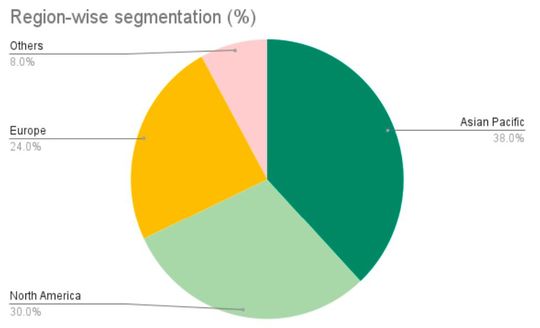
The Asia Pacific region, accounting for USD566.20 million, holds the highest revenue share and is expected to grow at 4.01 %. Based on power rating, the thyristor market is divided into three types: low-power 500 MW, medium-power 500-1000 MW, and high-power 1000 MW. At present, low-power thyristors dominate commercially.
The silicon-controlled rectifier is the most commercially prominent member of the thyristor family. In 2024, the SCR market was valued at around USD640 million— occupying a major share of the thyristor market. It is projected to reach USD884.4 million by 2030 at a CAGR of 5.6 %.
TRIAC (Triode for alternating current) and DIAC (Diode for alternating current) are types of thyristors. Both occupy a smaller but significant market share compared to other types. The TRIAC market stands at USD217 million. It will reach USD231 million in two years.
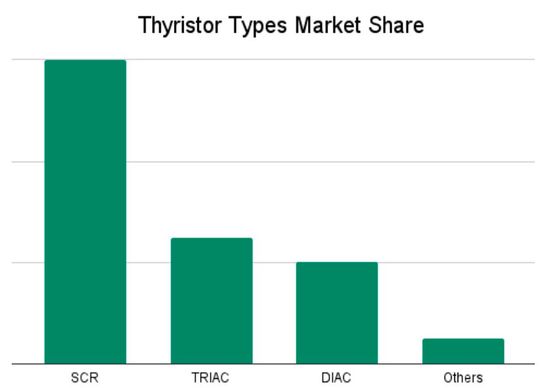
Gate turn-off thyristors, static induction thyristors, MOS-controlled thyristors, optically-triggered thyristors, and many more types do not occupy a significant portion of the market. These devices are only applicable in specialized applications.
Conclusion
The article lists various statistics to show that — the game for thyristors is not over yet. Unlike the popular opinion that ICs are the only future, discrete components remain in demand. Thyristors have built a billion-dollar industry that will grow at a smooth rate and incorporate new technologies. In conclusion, thyristors are still relevant in the power electronics industry!
(ID:50392009)
:quality(80)/p7i.vogel.de/wcms/49/c9/49c9cfa2e9da5efbf51a7c9cfcbbfa7a/0124476308v2.jpeg "The tiniest power devices are not computer chips but tiny chargers found online. Unlike chips with billions of transistors, power chips are heavy and need more area to handle high power and dissipate heat. Therefore, miniaturization is less effective in the power industry. (Source: © Galeno - stock.adobe.com)")
:quality(80)/p7i.vogel.de/wcms/b9/18/b918d8d0e447a18f7b9e983c25b96330/0125855402v2.jpeg "LDMOS amplifiers have proved their reliability and safety. They are known to perform well, even in impedance mismatches. GaN devices have now become the backbone of the power and radio frequency industries. The article explains LDMOS technologies and compares them with GaN-based devices. (Source: © Johannes - stock.adobe.com)")