


:quality(80)/p7i.vogel.de/wcms/e9/5b/e95bc9c43c57018499c83a2c91ff9764/0132237640v2.jpeg "Yageo’s KH‑AT series automotive‑grade MOVs deliver robust surge absorption and stable electrical performance for demanding vehicle environments, protecting ECUs and power rails from transients. (Source: Yageo)")
:quality(80)/p7i.vogel.de/wcms/f4/61/f461d1f6bf3a6030877d90efced438f2/0132110372v2.jpeg "Taiyo Yuden’s new HVX and HTX hybrid conductive‑polymer capacitors offer AEC‑Q200 qualification, 80 V rating and high ripple capability at 135°C for noise suppression and power smoothing in automotive systems such as ADAS and power steering. (Source: Taiyo Yuden)")
:quality(80)/p7i.vogel.de/wcms/a4/b6/a4b6256bef45368325659f926c268ebe/0132104622v2.jpeg "Toshiba’s new 80 V N‑channel power MOSFET, built on the company’s latest process, improves conduction and switching efficiency for AI server power supplies and high‑frequency data‑center converters. (Source: Toshiba)")
:quality(80)/p7i.vogel.de/wcms/c0/c5/c0c5bdbaf6df6fdd0fecc97c419ea9b4/0132022612v2.jpeg "Magnachip’s 6th‑generation 600 V super‑junction MOSFETs deliver improved efficiency and thermal performance for AI server power supplies and EV fast‑charging systems. (Source: © AntonKhrupinArt - stock.adobe.com)")
:quality(80)/p7i.vogel.de/wcms/51/72/51726a890dc35d74f494908b29681028/0132478976v2.jpeg "Bosch intends to start U.S. based commercial manufacturing in 2026 – just three years after acquiring the Roseville site. (Source: Bosch)")
:quality(80)/p7i.vogel.de/wcms/cc/f5/ccf52ac525f49330b780868db8f9565c/0132364990v2.jpeg "Infineon and LS ELECTRIC sign a memorandum to co‑develop high‑efficiency DC power infrastructure for AI data centers and next‑generation grids, targeting power conversion, energy storage integration, solid‑state transformers and semiconductor circuit breakers. (Source: © Yuliia - stock.adobe.com)")
:quality(80)/p7i.vogel.de/wcms/c6/16/c616f00139ce1575d3292524579868ed/0132241890v2.jpeg "GlobalWafers and Micron announce a strategic collaboration—including proposed financing support and a long‑term wafer supply agreement—to strengthen U.S. wafer manufacturing capacity and shore up the semiconductor supply chain for AI and data‑center demand. (Source: © Fervix Neon - stock.adobe.com)")
:quality(80)/p7i.vogel.de/wcms/ef/6d/ef6da8753871e0ea5c7b7203d31b2c9c/0132144857v2.jpeg "Keysight and WIN Semiconductor partner to reduce design risk for high‑frequency RF components by combining advanced measurement and modeling workflows with foundry‑level device validation for mmWave and high‑frequency applications. (symbolic image) (Source: © Mahmuda - stock.adobe.com)")
:quality(80)/p7i.vogel.de/wcms/83/ae/83ae0b00e573da9977ce19195d28c6b0/0132366058v2.jpeg "Researchers from EPC, The University of Hong Kong and Virginia Tech demonstrated a fully integrated GaN boost converter operating entirely at 4 K, achieving 91.6% efficiency at 7.6 W by combining monolithic GaN power ICs, on‑chip gate drivers and cryo‑qualified passive components. (Source: © Maurizio Di Paolo Emilio)")
:quality(80)/p7i.vogel.de/wcms/3c/a1/3ca1e2527a00068eb37f1db220c5463a/0132042920v2.jpeg "Energy harvesting removes the need for periodic battery swaps in hard‑to‑reach sensors — economically and regulatorily attractive as EU battery rules raise compliance and lifecycle costs. (Source: © Plaifah - stock.adobe.com)")
:quality(80)/p7i.vogel.de/wcms/81/04/8104b7c9a2ce5645d844ca4a1b9a736f/0132261940v2.jpeg "At The Smarter E 2026 Huawei launched LUTERRA, its next‑generation grid‑forming ESS platform, and showcased the award‑winning SUN2000‑506KTL 506 kW smart string inverter — technologies aimed at 1000 Vac architectures and plant‑level grid‑forming functionality. (Source: © Thares2020 - stock.adobe.com)")
:quality(80)/p7i.vogel.de/wcms/76/27/7627729494f2cddf62d276e5d6cd0aa1/0132245568v2.jpeg "Aluminum nitride crystal with a diameter of 2 inches – grown in the Joint Lab of Fraunhofer IISB and PVA TePla. (Source: Jennifer Reißig / Fraunhofer IISB)")
:quality(80)/p7i.vogel.de/wcms/7b/76/7b76005554b556df2a7a3794bdf69d44/0132365246v2.jpeg "Hioki’s ST5680A DC Hipot Tester combines CE/UKCA/CSA compliance, an integrated capacitance‑based contact check and time‑series waveform recording (voltage, leakage current, insulation resistance) to standardize hipot and insulation testing across EV cell, module and pack production lines. (Source: Hioki)")
:quality(80)/p7i.vogel.de/wcms/af/7f/af7f7b0fb7f29219fc991b1130f65477/0132241333v2.jpeg "Comprehensive laboratory testing regimens—combining thermal cycling, high‑current stress, EMC, and accelerated lifetime tests—are essential to validate advanced power designs and ensure reliability in real‑world applications. (Source: PRBX)")
:quality(80)/p7i.vogel.de/wcms/16/3d/163df69363f8125315a9826e13ea4b05/0131927425v2.jpeg "Solution will maximize data center and AI factory profitability while delivering engineering-grade insights to design and operations for more efficient, sustainable, and resilient infrastructure. (Source: Cadence)")
:quality(80)/p7i.vogel.de/wcms/85/b7/85b7e90733a2bd8f21515d8f7137f2fc/0131917677v2.jpeg "Renesas acquires Pictorus to integrate its embedded application software platform with Renesas’ MCU and MPU portfolio, helping developers shorten time‑to‑market and simplify system integration. (Source: © lucadp - stock.adobe.com)")
VOLTAGE REGULATOR Using LDO regulators in power electronics
Related Vendors
:fill(fff,0)/p7i.vogel.de/companies/6a/20/6a202a4f89a62/mrs-white-on-blue-bg.png "mrs-white-on-blue-bg ()")
:fill(fff,0)/p7i.vogel.de/companies/63/c7/63c7da97be945/diotec.png "diotec (Diotec Semiconductor AG)")
:fill(fff,0)/p7i.vogel.de/companies/60/7e/607ec89d5d9b5/white-frame.jpg "white frame.jpg (www.rohm.com)")
The job of a regulator is to keep voltages in a compatible and safe range for all circuit components. Most regulators perform this function at the trade-off between high losses, unnecessary electrical noise, and low efficiency. There isn’t a single regulator type in power electronics — of course, there are many! Unlike other regulators, low-dropout regulators are heroes who won’t generate noise, or what you call EMI, to ruin your electronic system. The article describes LDO regulators and their use in power electronics.

Low-dropout regulators (LDOs) play a crucial role in power electronics, delivering precise voltage regulation with minimal noise, making them indispensable for sensitive electronic applications
What is a low-dropout regulator?
Generally, scientists research semiconductors and electronic devices for years before their invention. Low-dropout regulators debuted directly in a magazine article called “Break Loose from Fixed IC regulators”. It was 1977, and the magazine was Electronic Design, which still runs today.
DEFINITION
A low-dropout regulator (LDO) is a type of DC linear voltage regulator that takes a high voltage from a source and reduces it to a stable lower level. It performs voltage regulation using a smart feedback control network and does not generate noise during its operation.
How does an LDO regulator work?
Just as the name suggests, a low-dropout regulator is capable of operating when the supply voltage is nearly equal to the output voltage. Engineers use LDO regulators when they need a small difference between the input and output voltages. For example, an LDO regulator converts a 5 V input voltage to 3.3 V at the output.
LDO regulator structure
An LDO regulator consists of two main components: a power transistor and a differential amplifier. The power transistor is a power FET (Power Field Effect Transistor), usually a JFET (Junction Field Effect Transistor). In some designs, the power transistor can also be a BJT (Bipolar Junction Transistor). LDOs use only an input capacitor and an output capacitor.
The differential amplifier is known as the error amplifier. The power FET is known as the pass transistor. Incorporating an N-channel power FET-based design reduces the overall power consumption of the LDO. On the other hand, bipolar LDOs are cheaper. In bipolar LDO regulators, Darlington pairs are used. Using a PMOS power FET or P-channel power FET results in effective regulation and lower power loss. Using NPN power BJT offers stable regulation with capacitive loads.
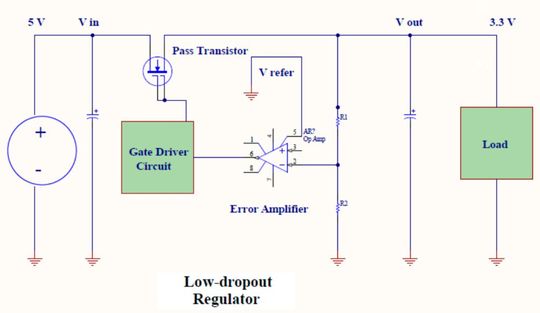
LDO regulator operation
LDOs use a feedback loop to compare the reference voltage to the actual output voltage.
Pass transistor: The input voltage enters the pass transistor. Operating in the linear region, the pass transistor passes current to the output stage.
Voltage divider network: A voltage divider network is at the output. The voltage divider network, consisting of R1 and R2 resistors, is connected to the inverting terminal (negative terminal) of the error amplifier.
The voltage divider network forms a feedback loop with the error amplifier. It scales down the actual output voltage and sends it back to the negative terminal of the error amplifier.
:quality(80)/p7i.vogel.de/wcms/9f/9c/9f9c143060f2c6192ae7ed1e0ec144f0/95056409.jpeg "In this article, please find out more about the two main types of voltage regulators: linear and switching, each with its subtypes. (Source: gemeinfrei)")
VOLTAGE REGULATORS
The working principles of voltage regulators
Bandgap reference: The non-inverting terminal (positive terminal) of the error amplifier is connected to a voltage reference circuit. The voltage reference circuit is called the bandgap reference. It is a small internal circuit that generates a stable voltage, irrespective of input voltage.
Comparator operation: The error amplifier, also known as a comparator in digital electronics, compares the reference voltage to the scaled-down voltage from the divider network. It generates an output.
Pass transistor action: Based on the output from the error amplifier, the pass transistor opens or closes to allow more or less current flow through the device— adjusting the output voltage. Simply put, the error amplifier adjusts the transistor gate for voltage regulation.
Open-drain configuration: The pass transistor uses an open-drain configuration to perform voltage regulation. In an open-drain configuration, the drain pin is either open or driven by a ground pin.
If the output voltage is too high, the open-drain control circuit opens the gate terminal of the pass transistor. The open-circuited pass transistor turns off to lower the output voltage.
If the output voltage is too low, the open-drain control circuit connects the gate of the pass transistor to the ground. The pass transistor turns on to increase the current flow and raise the output voltage. Practically, this operation is not possible.
Feedback loop: The pass transistor again passes this voltage to the voltage divider network, and the feedback process of regulation continues. Finally, the LDO regulator adjusts the output voltage near the input voltage level, meaning that when the input and output voltages are near each other. The condition is called dropout.
Dropout voltage: Dropout voltage is the minimum difference between the input and output voltages at which an LDO can maintain its regulation. Simply put, it is a measure of the output voltage that can get near the input voltage while the LDO works properly. In practice, datasheets do not list dropout voltage. Engineers have to calculate for themselves.
LDO regulator advantages
Among the benefits of using LDO regulators are several key features that enhance their appeal in tight, low-noise environments.
- LDO regulators use an internal smart control loop to regulate voltages.
- LDO regulators show a small input-output voltage differential.
- LDOs output a steady, stepped-down voltage.
- Under steady-state conditions, LDO regulators behave like simple resistors.
- Non-LDO regulators cannot operate when the input voltage is near the output voltage.
- LDO regulators can operate even when there is a minute difference between the input and output voltages. For example, an LDO regulator can take 3.6 V from a Li-ion battery and convert it into 3.3 V efficiently.
- Non-LDO regulators incorporate emitter follower or source follower configurations. It fails to regulate the voltage.
- LDO regulators do not generate electrical noise.
- LDO regulators make the design compact. Non-LDO regulators need more space between input and output stages, making the design bulkier.
- Using LDO regulators is simple and cost-effective.
:quality(80):fill(efefef,0)/p7i.vogel.de/wcms/5f/fe/5ffedb2e0ffa6/listing.jpg "listing")
LDO regulator disadvantages
Despite their many advantages, LDO regulators also present some drawbacks that can impact their effectiveness in certain applications.
- LDO regulators are designed only to step down the voltage. They cannot step up voltage or boost voltage. Boost converters are designed for such operations.
- Ground current can cause a spike in bipolar LDO regulators.
- LDOs need additional feedback compensation networks.
- Sometimes LDOs fail to respond quickly to changes in static conditions.
- When LDOs are in dropout, the error amplifier saturates. The LDO cannot regulate properly anymore.
- At dropout, LDOs pass electrical noise.
- LDO regulators still generate a very small amount of heat.
LDO regulator applications
LDOs are called low-dropout regulators because they are capable of dropping the output voltage near the input voltage. Some of their applications are listed below.
Portables
LDO regulators are suitable for battery-powered systems such as smartphones, tablets, small computers, cellular telephones, wearables, and some mobile home appliances.
Radio frequency circuits
LDO regulators offer low noise in RF circuits. Applications include phase-locked loops, voltage-controlled oscillators, analog-to-digital converters, digital-to-analog converters, and many more.
Power electronics
An LDO regulator is a type of linear regulator placed in series between the power supply and load. A linear regulator is a type of regulator that behaves as a variable resistor in a circuit. It changes the output voltage in response to changes in the input and output currents.
In simple words, a linear LDO regulator decreases the output voltage when it goes way above the input voltage. LDOs are used in linear power supplies, SMPS post-regulators, and DC-DC modules.
It is important to note that another famous power regulator, the Zener regulator, is a linear shunt regulator. Unlike LDO regulators, Zener regulators are connected in parallel between the supply and load.
:quality(80)/p7i.vogel.de/wcms/a2/c6/a2c698cb34a056c619f57eea6b4fbec7/0112928605v2.jpeg "The following article will show how zener diodes can be used as voltage regulators. (Source: Melyna Valle - Unsplash.com)")
VOLTAGE REGULATION
Zener diode as a voltage regulator
Power ICs
In power management integrated circuits (PMICs), trace resistance causes a significant voltage drop. Crosstalk exists due to capacitive coupling between traces. Such unwanted features degrade the PMIC performance. LDO regulators, in their miniaturized form, are used in PMIC power supply ICs for POL delivery (point of load delivery) and voltage regulation of microprocessors and microcontrollers.
References
(ID:50481765)
:quality(80)/p7i.vogel.de/wcms/ce/75/ce7577df9910b5affc25edd24cb853e5/0126456656v2.jpeg "Designing and calculating a basic enhancement-mode MOSFET amplifier requires a clear understanding of the device's operating region, biasing requirements, and key electrical parameters. This article provides a step-by-step guide. (Source: © Dzmitry - stock.adobe.com)")
:quality(80)/p7i.vogel.de/wcms/b9/18/b918d8d0e447a18f7b9e983c25b96330/0125855402v2.jpeg "LDMOS amplifiers have proved their reliability and safety. They are known to perform well, even in impedance mismatches. GaN devices have now become the backbone of the power and radio frequency industries. The article explains LDMOS technologies and compares them with GaN-based devices. (Source: © Johannes - stock.adobe.com)")