


:quality(80)/p7i.vogel.de/wcms/2f/f3/2ff3221bf7665de2d0acf83760bfd1fa/0130031523v2.jpeg "Wolfspeed presents a 300 mm silicon carbide technology platform designed to support advanced packaging and high-efficiency power delivery for AI data center infrastructure. (Source: Wolfspeed)")
:quality(80)/p7i.vogel.de/wcms/c3/16/c316e955a97f5d72d9678297b237b9e5/0129932858v2.jpeg "Left: the single-phase version of the SENTRON ECPD with RCM, right: a model of the future three-phase version of the SENTRON ECPD. (Source: Siemens)")
:quality(80)/p7i.vogel.de/wcms/ef/0a/ef0adb0acf793fe147cc27c21f6a7a67/0129954238v2.jpeg "Empower Semiconductor introduces embedded silicon capacitors designed to improve power delivery and stability in AI and high-performance computing processors. (symbolic image) (Source: © IF.arc - stock.adobe.com)")
:quality(80)/p7i.vogel.de/wcms/53/f9/53f9301dfc9292d02960f7996c79cc6e/0129927601v2.jpeg "Wolfspeed’s new 10 kV SiC MOSFET enables high-voltage power conversion for grid and industrial applications. (symbolic image) (Source: © CREATIVE- 3.4 - stock.adobe.com)")
:quality(80)/p7i.vogel.de/wcms/6e/cd/6ecd41d095d5111cf4ed37b714844487/0129930878v2.jpeg "PCIM Asia Shenzhen provides a platform for industry experts to present new developments in power electronics and electrification technologies. (symbolic image) (Source: © killykoon - stock.adobe.com)")
:quality(80)/p7i.vogel.de/wcms/02/c0/02c0e9722f70b1134dbf96fb59a9c73d/0129655179v2.jpeg "The PCIM Conference 2026 will take place from June 9-11, featuring discussions on power electronics trends, including GaN technology and AI applications. (symbolic image) (Source: © Elmira - stock.adobe.com)")
:quality(80)/p7i.vogel.de/wcms/cc/67/cc670ea2029cd2af5c641af70e1bf734/0129816392v4.jpeg "Fraunhofer IAF coordinates the EU SUPREME project to accelerate GaN and SiC power semiconductor innovation in Europe. (Source: Fraunhofer IAF)")
:quality(80)/p7i.vogel.de/wcms/ea/e6/eae6aee30071e67a5627027974437134/0129544613v2.jpeg "GlobalFoundries and Renesas strengthen their collaboration to support U.S.-based semiconductor production and supply chain resilience. (Source: © ronstik - stock.adobe.com)")
:quality(80)/p7i.vogel.de/wcms/b1/5e/b15ee02b0ba02db70cf61e37d66ad1d3/0129349127v2.jpeg "Vehicle-to-grid (V2G) chargers enable bidirectional energy flow, allowing electric vehicles to act as mobile energy storage systems that can both draw power from and feed power back into the grid. (Source: © medienvirus - stock.adobe.com)")
:quality(80)/p7i.vogel.de/wcms/26/d5/26d591cc340077026eac56a0e7564faf/0129949603v2.jpeg "Flexible: The solid silicone-based electrolyte is elastic, thereby compensating for the voids that form in solid-state batteries during charging and discharging. (Source: Empa)")
:quality(80)/p7i.vogel.de/wcms/4d/e0/4de02f76a37cbb3df30dd231de589c8e/0128866890v2.jpeg "Both legacy and vGaN show higher carrier mobility and band gap energies compared to other power semiconductors. (Source: © phonlamaiphoto - stock.adobe.com)")
:quality(80)/p7i.vogel.de/wcms/18/0b/180b7b63afc91e523592d8a5ce161c96/0129847487v2.jpeg "InGaAs-based photodetectors enable sensitive and fast detection in the short-wave infrared spectrum for modern sensing and communication applications. (Source: © VITALII - stock.adobe.com)")
:quality(80)/p7i.vogel.de/wcms/be/c8/bec8d43fc0ee73414274be44608b2970/0129748903v2.jpeg "The Infiniium XR804KA real-time oscilloscope delivers faster response time, improved stability, and streamlined workflows for high-speed digital and compliance testing. (Source: Keysight)")
:quality(80)/p7i.vogel.de/wcms/23/ee/23ee4a97790d6009dbfd7d9577ffa723/0129220424v2.jpeg "The R&S FPL1044 with the new RTSA option makes 40 MHz real-time frequency analysis available up to 44 GHz. (Source: Rohde & Schwarz )")
:quality(80)/p7i.vogel.de/wcms/3c/d1/3cd1cacbceb792ba63727199c61ca434/0127801860v2.jpeg "Thanks to cloud technology, users can collaborate on projects from anywhere and always have access to the latest planning data. (Source: SIEMENS)")
:quality(80)/p7i.vogel.de/wcms/5a/a0/5aa0436498af618297961fd54ab36cdf/0126290792v2.jpeg "Siemens accelerates student-led semiconductor innovation across Europe’s leading technical universities through Cre8Ventures’ Open Higher Education Program developed in collaboration with Arm and University of Southampton (Source: Siemens Digital Industries Software)")
:quality(80)/thumbor.vogel.de/iPKAUzDTs0ztw2CZ51M2B4szoOA=/500x500/p7i.vogel.de/wcms/67/98/6798e439df2bc/my-picture---copy--2-.png "Dr. -Ing. Amira Ammar")
INTERNATIONAL WOMEN'S DAY Women and Leadership
Related Vendors
:fill(fff,0)/p7i.vogel.de/companies/63/c7/63c7da97be945/diotec.png "diotec (Diotec Semiconductor AG)")
:fill(fff,0)/p7i.vogel.de/companies/68/c2/68c2b622b43e1/logo.jpeg "logo (IQ Evolution GmbH)")
:fill(fff,0)/p7i.vogel.de/companies/69/30/693022b11e5db/logo.jpeg "logo (MBS-Hodde GmbH & Co. KG)")
Leaders exist at all levels in organizations, and while women hold leadership positions, they are under-represented at most senior levels. Many surveys and research indicate that over 60 percent of respondents feel that men still have an advantage when it comes to reaching senior leadership position.

I found that lack of access to powerful informal networks, along with the ever-present issue of being a working mother, was cited as a key reason for this disparity. The article focuses on leadership style and offers some suggestions on how women could better prepare themselves for more senior leadership positions.
Many definitions of good leadership exist; typically, they include words such as – integrity, openness, humility, dedication, honesty, confidence, courage, and compassion. All these words are appropriate and yet success is about how these qualities are deployed when leading others.
It seems that on the whole women tend towards the more participative and collaborative leadership styles.
Leadership Style
When women are asked to describe their primary leadership styles, mostly I hear them talking about these approaches:
- Participative: Actively involving others in discussion and decision making
- Situational: Varying your style to suit the situation
- Visionary: Inspiring others through your energy and commitment
- Transactional: Giving directions and expecting them to be followed
- Value Based: Leading based on strong personal values
- Intuitive: A more instinctive approach where both people and situation are considered – "gut feeling"
- Hierarchical: Driven by level and status
The results indicate that participative and situational are by far the most popular styles adopted while hierarchical and transactional are used by very few women. In fact, many people indicated that they preferred a mix of participative, value based, intuitive, and situational styles.
Leadership and leadership style are not easy subjects, and much has been written about the topic. There is no “perfect” style, approach, or theory. Recently, “authentic leadership” has become popular; however, this does not describe a style preference, as any one of the styles can be demonstrated authentically, which we understand to mean being true to yourself and always acting with integrity and in a genuine and consistent manner.
My coaching style of leadership encourages team members to experiment and try out innovative ideas, but I am also very purposeful… I am not "soft".
The Styles Explained
As a leader, it is important to recognize your strengths, your blind spots, and which styles you feel most comfortable using. Each of the seven approaches to leadership has benefits and down sides.
Participative
- Benefits: Leaders seek people’s opinions, thoughts, and ideas. They have excellent communication skills and influence while working with others.
- Downsides: Some people may regard you as someone who does not know their own mind and takes too long to make decisions, and worries too much.
Situational
- Benefits: Leaders are flexible, adaptable, and capable.
- Downsides: If used ineffectively, you may be regarded as unpredictable, and people value consistency.
Visionary
- Benefits: This style relies on personal qualities – charisma, confidence, and creativity. Leaders are inspirational and use energy with enthusiasm to gain commitment to action.
- Downsides: The negative aspect is in areas of structure, objectivity, and data.
Transactional
- Benefits: Leaders issue orders and expect them to be met. They work based on structure and pay little attention to the emotional element. Under pressure, this style is safe and secure.
- Downsides: Overuse of this style is demotivating and leaves the leader isolated when things go wrong, as no one offers support.
Value-Based
- Benefits: Leaders are highly principled and hold strong personal values and this style’s success relies on collaborating with like-minded people toward a common goal.
- Downsides: Sometimes being value-based can be double-edged sword, where there is little room for flexibility.
Intuitive
- Benefits: Leaders use their innate qualities and capabilities to lead others. They are confident in their ability to demonstrate.
- Downsides: Sometimes relying on gut feeling is not appropriate, especially when situations and decisions need justification and valid reasoning.
Hierarchical
- Benefits: Leadership is based on authority, and status is important.
- Downsides: Sometimes this style can become counterproductive, as it is based on the premise that “I’m the boss; do as I say.”
:quality(80)/p7i.vogel.de/wcms/d9/99/d99965e128da882f4bd2923ec68c1601/0117092008.jpeg "Women are still underrepresented in the electronics and electrical industry. But the signs are positive. (Source: sofiko14 - stock.adobe.com)")
INTERNATIONAL WORLD WOMEN'S DAY
Girl power in electronics and electrical industry
No one style can be regarded as best. Each has merits and downsides, and certainly in today’s complex business environment, a blend of styles is often required. To understand success, you will need feedback from others. There is no effortless way of getting this – you must ask for it, listen to it, and be willing to act on it. Many of the women in the studies identified situations where they had varied their styles; this illustrates the point that, for many of you, adaptability is a feature of your leadership approach.
Orientations for Success
As a leader in business today, there are certain key skills and abilities that you must develop. Typically, these skills fall into a range of distinct categories – for instance, strategic skills, business skills, people skills, and personal skills.
Framework of Leadership Skills and Abilities
- Personal: Adaptable, decisive, innovative, personally effective, analytic person, self-developer, self-management.
- Interpersonal: Communicator, development-oriented, influencer, manages performance, team worker.
- Business: Technology awareness, process manager, marketing awareness, information manager, financial awareness, business acumen.
- Strategic: Socially responsible, strategic vision, leadership-oriented, cultural awareness, change-oriented.
What is less clear is where women should focus their attention to ensure they make best use of their talents and position themselves for career development and promotion. In many recent research studies, which focus on women in business and women leaders, two themes constantly recur – networking and confidence. The following model represents the four key areas on which women should focus that have an influence.
Women's Career Success Factor Model
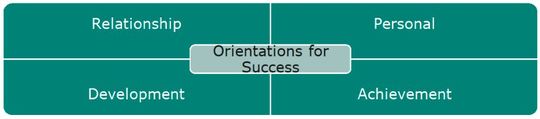
Relation Orientation: In some ways, the word "networking" does not give sufficient weight to what I mean here. Networking is a good starting point, but there is so much more to it. It is not so much that women are not networked and connected; it is more about having the right connections and leveraging these connections. Women are less likely to use their networks to help them in their career, believing that their skills, abilities, and achievements speak for themselves. Adopting more of a relationship orientation and actively developing this throughout your career will ensure that you stay connected with people. Recognize how and when people can help you, planning which networks you need and want to identify with. Internal organizational networks are, of course, of real benefit but so are external networks. This tends to be the weaker area for many women. Being more attuned to and developing a willingness and capability to network will pay dividends. An additional benefit of being well connected throughout your career relates to reputation and credibility. Your network will often prove to be your best supporters and references. So much business at senior levels is done through word of mouth and personal recommendation. Making sure that you are connected to the right people will mean that you will have a network of friends and colleagues willing to recommend you.
:quality(80)/p7i.vogel.de/wcms/ab/e3/abe36eb688ca3e516b777fee5eafc196/0110194277.jpeg "Women can take up multiple roles in Electrical and Electronics Engineering like power engineers, power distribution engineers, control engineers, IC layout designers, hardware developers, network planners, technicians, semiconductor developers, and many more. (Source: tonefotografia - stock.adobe.com)")
INTERNATIONAL WOMEN'S DAY
These four women have revolutionized electrical and electronics engineering
Personal Orientation: Lack of confidence and self-belief both play a role in holding women back. Here are some simple things you can do on your own:
- Make a list of all your achievements. Go back through the whole of your life and celebrate your success which gives a boost of self-confidence.
- Focus on those things that you do well. Once you understand more about your strengths you can then plan how to demonstrate these characteristics more frequently in your day-to-day life.
- It is also worth mentioning those things you feel disappointed about not achieving and spend some time reflecting about what it was that stopped you achieving these targets. This will you help plan to avoid similar disappointments in the future.
- Understand how you deal with failure. We all deal with failure in diverse ways; the important thing is to understand how you deal with it and how resilient you are in bouncing back.
- Know your weaknesses that require development.
Achievement Orientation: This is about knowing what you want to achieve, understanding your ambitions and being willing to express them appropriately. Many women also indicated that early in their career they have been less ambitious or less aware of the importance of demonstrating an achievement orientation as they wanted to focus on the job in hand and get to grips with this before thinking about the next stage. Of course you also have to understand what we as women mean by ambition and for many of us this isn’t simply about getting to the top or climbing the corporate ladder; it also seems to be about working with interesting people, working in an environment that matches your values, doing work that is worthwhile, building your skill and competence base and being valued for what you do by your organization, boss and colleagues. Climbing the corporate ladder, getting promotion, and being appropriately rewarded are all in there; it is just that you often have other considerations to think about as well. Having a plan for your career, knowing what you want to achieve and constantly refreshing this plan is a good starting point. It is also worth remembering that having a plan is good, but sticking rigidly to this can be bad – plans change, ideas develop, and new opportunities present themselves at the strangest times and in the strangest ways. Having a plan means that you can adapt and adjust your plan from a position of knowledge, strength, and awareness rather than just wandering through your career or moving to the next job because it is there, or the timing is right.
Development Orientation: Taking responsibility for your own development and recognizing early on in your career that it is your, and only your responsibility is important. Develop antennae to recognize and take advantage of development opportunities as they arise. Being achievement oriented and having a career plan will help you to create and select the most appropriate development opportunities as they present themselves. The key to good development orientation is to be aware of the rich variety of opportunities available to you. These opportunities can fall into two broad categories:
- Formal development: planned opportunities, including training courses, further education programs, seminars, workshops, and coaching.
- Informal development: workplace training including secondments, projects, special assignments, mentor relationships, self-managed learning including web-based training, podcasts, webinars, and online self-study courses.
To be truly development oriented not only is it necessary to be aware of the numerous opportunities for development, but also to make sure that the development method is most appropriate for the skill being developed and suits your own learning style.
The complex area of leadership is one that can rarely be completely mastered. All we can hope to do is to understand our own style, skills and approaches and know what we can develop these further to be even more effective.
Women have fewer role models than men and often find it challenging to compete on equal terms with their male colleagues for career success. So, to conclude, some of helpful tips are to develop your leadership strategy, be tougher than men, have a sharp vision, understand your preferred leadership style, be authentic and explore your leadership image with others.
Gro Harlem Brundtland, who was three times Prime Minister of Norway, when asked about her advice for young women in business she said “one thing I am sure about is that if you have a high-pitched voice, like many women have, that becomes thin and not easy to hear, you must speak up. So, I usually tell women: you must train your voice, and you must use it by being heard, because you are not going to be respected fully if people do not sense that you speak with a certain authority.”
Power Electronics in the Energy Transition

The parameters for energy transition and climate protection solutions span education, research, industry, and society. In the new episode of "Sound On. Power On.", Frank Osterwald of the Society for Energy and Climate Protection Schleswig‐Holstein talks about the holistic guidance his organization can provide.
Listen now!
(ID:50319570)
:quality(80)/p7i.vogel.de/wcms/45/bc/45bc85409d97c5ed8c946267f27cf791/0124271211v2.jpeg "Solicomp aims to lead in power electronics through innovation, sustainability, and strategic adaptability. (Source: Srinard - stock.adobe.com)")
:quality(80)/p7i.vogel.de/wcms/95/fd/95fdd73fc41170debc185889aefdeb48/0123976237v2.jpeg "On May 1, 2025, Robert Feurle, takes the helm at Wolfspeed to drive operational excellence, accelerate profitability, and advance the company’s strategic vision. (Source: Chris Titze Imaging - stock.adobe.com)")