


:quality(80)/p7i.vogel.de/wcms/7f/4b/7f4b97757cea82c0675209630577dc22/0133974130v2.jpeg "Vox Power’s EIRE600 delivers up to 600 W in a compact 5 × 3-inch package, with forced-air or conduction cooling options for industrial and medical equipment. (Source: Vox Power)")
:quality(80)/p7i.vogel.de/wcms/55/97/5597c3436e3bc92ee7ba23b6f9d289e9/0134032539v2.jpeg "Littelfuse’s TP7.0SMD-XC automotive TVS diode series uses foldback technology to provide low clamping voltage for protecting sensitive vehicle electronics. (Bild: Littelfuse)")
:quality(80)/p7i.vogel.de/wcms/51/f8/51f84448e666230bb11a02566abd1177/0133958187v3.jpeg "Microchip’s radiation-tolerant GaN point-of-load converter supplies up to 20 A for space-based processors, FPGAs, microcontrollers and ASICs. (Source: Microchip)")
:quality(80)/p7i.vogel.de/wcms/0a/7c/0a7c08f368ae1d91f758dd18d2a32e88/0133978423v2.jpeg "EPFL researchers have demonstrated a GaN transistor that withstands nearly 4 kV, using an intrinsic polarization superjunction design to distribute electric fields more evenly. (Source: EPFL)")
:quality(80)/p7i.vogel.de/wcms/5b/94/5b94232ca4183d6fcc2dccc7394d7544/0134041114v4.jpeg "Siemens and NVIDIA are testing AI applications at Siemens’ Erlangen electronics factory, using digital twins to support production planning and prepare inspection systems before physical prototypes are available. (Bild: Siemens)")
:quality(80)/p7i.vogel.de/wcms/b4/1f/b41f2731a07b608e60eca3663e280301/0133980549v2.jpeg "Multi-year agreement with Wolfspeed supports Infineon’s conversion from 150-millimeter to 200-millimeter silicon carbide (SiC) manufacturing (Source: © Ada - stock.adobe.com)")
:quality(80)/p7i.vogel.de/wcms/e3/0a/e30a8813bcf44b16f0dceb63a0747d29/0133984094v2.jpeg "The semiconductor is only one part of the design. Higher voltage, frequency and power density also increase the demands on electronic packaging materials such as die attach, substrates, top-side interconnects and module attach. (Source: Generated by AI)")
:quality(80)/p7i.vogel.de/wcms/5d/fb/5dfba5e5f38daf2b8597b05656af29c0/0133956337v2.jpeg "Wolfspeed has received a conditional commitment for a loan of up to $1.5 billion from the U.S. Department of War to support its domestic wide-bandgap semiconductor supply chain. (Source: © AspctStyle - stock.adobe.com)")
:quality(80)/p7i.vogel.de/wcms/bf/b6/bfb6ac295759be32d567df9849b6767e/0134094495v2.jpeg "Fraunhofer ISE reports that 25 Ah pouch cells with silicon-rich anodes retained more than 83% of their initial capacity after 1,000 cycles when tested under 1,000 kPa axial pressure. (Bild: Fraunhofer ISE)")
:quality(80)/p7i.vogel.de/wcms/16/dc/16dca55e6ef80e6b5da68bc628da2dcc/0133844782v2.jpeg "This article explains virtual power plants in modern renewable-heavy grids. (Source: © M@rketVisualsStudio - stock.adobe.com)")
:quality(80)/p7i.vogel.de/wcms/e8/33/e8330aae4bea3578b98ec2c1403d367a/0133980001v2.jpeg "IRENA’s 2026 World Energy Transition Outlook identifies faster electrification powered by renewables as central to meeting future global energy needs. (Source: Irena)")
:quality(80)/p7i.vogel.de/wcms/6c/b4/6cb405f47d25035e256ae90fe3a66ee6/0134032112v2.jpeg "Sungrow’s PowerTitan 3.0 energy storage platform uses onsemi EliteSiC hybrid power modules, with the companies reporting peak inverter efficiency above 99.3%. (Bild: onsemi)")
:quality(80)/p7i.vogel.de/wcms/7b/76/7b76005554b556df2a7a3794bdf69d44/0132365246v2.jpeg "Hioki’s ST5680A DC Hipot Tester combines CE/UKCA/CSA compliance, an integrated capacitance‑based contact check and time‑series waveform recording (voltage, leakage current, insulation resistance) to standardize hipot and insulation testing across EV cell, module and pack production lines. (Source: Hioki)")
:quality(80)/p7i.vogel.de/wcms/af/7f/af7f7b0fb7f29219fc991b1130f65477/0132241333v2.jpeg "Comprehensive laboratory testing regimens—combining thermal cycling, high‑current stress, EMC, and accelerated lifetime tests—are essential to validate advanced power designs and ensure reliability in real‑world applications. (Source: PRBX)")
:quality(80)/p7i.vogel.de/wcms/16/3d/163df69363f8125315a9826e13ea4b05/0131927425v2.jpeg "Solution will maximize data center and AI factory profitability while delivering engineering-grade insights to design and operations for more efficient, sustainable, and resilient infrastructure. (Source: Cadence)")
:quality(80)/p7i.vogel.de/wcms/85/b7/85b7e90733a2bd8f21515d8f7137f2fc/0131917677v2.jpeg "Renesas acquires Pictorus to integrate its embedded application software platform with Renesas’ MCU and MPU portfolio, helping developers shorten time‑to‑market and simplify system integration. (Source: © lucadp - stock.adobe.com)")
:quality(80)/p7i.vogel.de/wcms/f8/34/f834240d434a0c265a2ccafe614c8cd7/0134032109v4.jpeg "Hard- and soft-switching techniques shape voltage and current during device transitions, influencing switching losses, EMI and thermal performance in power converters. (Bild: © Mrthullab - stock.adobe.com)")
:quality(80)/p7i.vogel.de/wcms/27/07/2707280c807689b437baed3660257404/0133626052v2.jpeg "The quantum behavior of electrons shapes semiconductor devices—and the power converters that deliver electricity to modern computing systems. (Source: © Celt Studio - stock.adobe.com)")
SIC TECHNOLOGY Wolfspeed expands SiC module lineup for energy applications
Related Vendors
:fill(fff,0)/p7i.vogel.de/companies/68/2c/682c3e2e9a195/logotype-rvb.jpeg "logotype-rvb (MERSEN France)")
:fill(fff,0)/p7i.vogel.de/companies/66/8b/668becd1c07eb/dowa-logo-word--1-.jpeg "dowa-logo-word--1- (DOWA)")
Wolfspeed has introduced two new 3.3 kV silicon carbide (SiC) power module families – including high-power half-bridge baseplate modules and scalable full-bridge baseplate-less modules in industry-standard footprints — that are purpose-built to address the rapidly approaching power constraints driven by AI data centers and the broader energy transition. Meeting this moment requires power generation, conversion, and distribution that is faster, smaller, more efficient, cost-effective, and more resilient than anything silicon alone can deliver. These new module families give engineers the tools to modernize energy infrastructure across the entire energy life cycle.
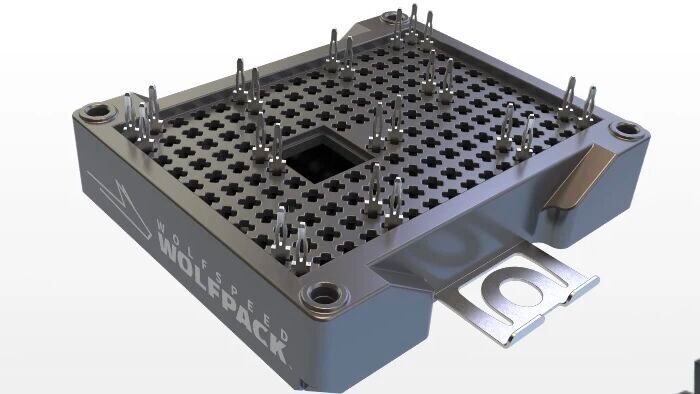
The two 3.3 kV families enable design engineers to reduce power stages and move to a 2-level topology for 2 kV and higher DC-link architectures — with the choice of baseplate and baseplate-less SiC power modules.
The high-power half-bridge baseplate SiC power module (LM platform) is designed for >800 amp (A) applications and optimized for demanding converter topologies used in solar, grid-scale energy storage, and wind-power infrastructure.
The scalable full-bridge baseplate-less (part of the Wolfspeed WolfPACK family) SiC power module is engineered for modularity, offering flexibility to configure multi-level, series-stacked, or parallel converter architectures with consistent, matched performance — and is optimized for solid-state transformers (SSTs) and modular renewable energy infrastructure.
"The release of this 3.3 kV MOSFET voltage node in two complementary footprints was a strategic decision," said Guy Moxey, vice president of Wolfspeed's Industrial & Energy business. "We understand the urgency our customers are facing to scale power infrastructure, and these two families enable both established grid-scale players and emerging players with modular architectures to move quickly. We are giving engineers the tools to build the grid of tomorrow, today — and only by working together can we successfully address the surging demand for power and unlock the full potential of AI and electrification."
:quality(80):fill(efefef,0)/p7i.vogel.de/wcms/6a/02/6a02d06fa2e86/wp-magnachip-sustainably-strong--mastering-the-reduction-of-oxides-coverbild.jpeg "WP_Magnachip_Optimizing 600V SJ MOSFETs for High-Density Server Design_Coverbild")
Purpose-built for continuous 24/7, 2 kV+ DC-link operation
Both families are engineered for the relentless demands of always-on infrastructure. The Wolfspeed WolfPACK module leverages cutting-edge sintered die attach and epoxy encapsulant material to deliver a significant improvement in power cycling performance over standard silicon gel encapsulated modules. Similarly, the baseplate module achieves improved system durability and power cycling through advanced packaging technology featuring sintered die attach and a copper die-top system. Both families feature Gen 4 technology with improved cosmic ray susceptibility.
“Amperesand is focused on critical power delivery from medium voltage to AI rack, requiring best-in-class reliability, power density, efficiency, and cost effectiveness,” said Brian Dow, Chief Executive Officer at medium-voltage solid-state transformer manufacturer Amperesand. “The latest advances in SiC technology enable maximum reliability for high variability AI factory loads, while unlocking optimized packaging that drives previously unachievable costs and best-in-industry power density and efficiency. Wolfspeed is driving innovation, scale, and quality that is ideally suited for demanding solid-state transformer critical power solutions.”
Smaller size – lower system cost
The Wolfspeed WolfPACK module enables solid-state transformer systems to deliver over 50% footprint reduction compared to traditional equipment through improved switching performance and system architecture improvements.
The new high-power baseplate module delivers up to 42% improvement in switching losses over other market-available SiC solutions and greater than 90% over IGBTs — both measured at 125°C on a 1.8 kV bus in the same package.
Both families achieve improved switching over temperature, reducing magnetics and EMI filter sizes, ultimately leading to system power density and reduced system costs
(ID:50853203)
:quality(80)/p7i.vogel.de/wcms/53/f9/53f9301dfc9292d02960f7996c79cc6e/0129927601v2.jpeg "Wolfspeed’s new 10 kV SiC MOSFET enables high-voltage power conversion for grid and industrial applications. (symbolic image) (Source: © CREATIVE- 3.4 - stock.adobe.com)")
:quality(80)/p7i.vogel.de/wcms/b9/32/b932b48e411d9f6c41a59522880b1e2c/0130564051v2.jpeg "Infineon's silicon carbide power semiconductors will enhance efficiency, power density and reliability of DG Matrix's solid-state transformer platform
(Source: Infineon)")