


:quality(80)/p7i.vogel.de/wcms/2f/f3/2ff3221bf7665de2d0acf83760bfd1fa/0130031523v2.jpeg "Wolfspeed presents a 300 mm silicon carbide technology platform designed to support advanced packaging and high-efficiency power delivery for AI data center infrastructure. (Source: Wolfspeed)")
:quality(80)/p7i.vogel.de/wcms/c3/16/c316e955a97f5d72d9678297b237b9e5/0129932858v2.jpeg "Left: the single-phase version of the SENTRON ECPD with RCM, right: a model of the future three-phase version of the SENTRON ECPD. (Source: Siemens)")
:quality(80)/p7i.vogel.de/wcms/ef/0a/ef0adb0acf793fe147cc27c21f6a7a67/0129954238v2.jpeg "Empower Semiconductor introduces embedded silicon capacitors designed to improve power delivery and stability in AI and high-performance computing processors. (symbolic image) (Source: © IF.arc - stock.adobe.com)")
:quality(80)/p7i.vogel.de/wcms/53/f9/53f9301dfc9292d02960f7996c79cc6e/0129927601v2.jpeg "Wolfspeed’s new 10 kV SiC MOSFET enables high-voltage power conversion for grid and industrial applications. (symbolic image) (Source: © CREATIVE- 3.4 - stock.adobe.com)")
:quality(80)/p7i.vogel.de/wcms/6e/cd/6ecd41d095d5111cf4ed37b714844487/0129930878v2.jpeg "PCIM Asia Shenzhen provides a platform for industry experts to present new developments in power electronics and electrification technologies. (symbolic image) (Source: © killykoon - stock.adobe.com)")
:quality(80)/p7i.vogel.de/wcms/02/c0/02c0e9722f70b1134dbf96fb59a9c73d/0129655179v2.jpeg "The PCIM Conference 2026 will take place from June 9-11, featuring discussions on power electronics trends, including GaN technology and AI applications. (symbolic image) (Source: © Elmira - stock.adobe.com)")
:quality(80)/p7i.vogel.de/wcms/cc/67/cc670ea2029cd2af5c641af70e1bf734/0129816392v4.jpeg "Fraunhofer IAF coordinates the EU SUPREME project to accelerate GaN and SiC power semiconductor innovation in Europe. (Source: Fraunhofer IAF)")
:quality(80)/p7i.vogel.de/wcms/ea/e6/eae6aee30071e67a5627027974437134/0129544613v2.jpeg "GlobalFoundries and Renesas strengthen their collaboration to support U.S.-based semiconductor production and supply chain resilience. (Source: © ronstik - stock.adobe.com)")
:quality(80)/p7i.vogel.de/wcms/3c/4b/3c4bbc68dda65c7071b4376fb57423b0/0130030465v2.jpeg "Faraday’s laws explain the fundamental behavior of magnetic fields and electronic devices in dynamic use cases. The operation of transformers, wireless chargers, induction cookers, induction motors, magnetic levitating trains (MAGLEV Trains), electric violin, and many others depends upon Faraday’s laws. (Source: © Sheraz - stock.adobe.com)")
:quality(80)/p7i.vogel.de/wcms/b1/5e/b15ee02b0ba02db70cf61e37d66ad1d3/0129349127v2.jpeg "Vehicle-to-grid (V2G) chargers enable bidirectional energy flow, allowing electric vehicles to act as mobile energy storage systems that can both draw power from and feed power back into the grid. (Source: © medienvirus - stock.adobe.com)")
:quality(80)/p7i.vogel.de/wcms/26/d5/26d591cc340077026eac56a0e7564faf/0129949603v2.jpeg "Flexible: The solid silicone-based electrolyte is elastic, thereby compensating for the voids that form in solid-state batteries during charging and discharging. (Source: Empa)")
:quality(80)/p7i.vogel.de/wcms/4d/e0/4de02f76a37cbb3df30dd231de589c8e/0128866890v2.jpeg "Both legacy and vGaN show higher carrier mobility and band gap energies compared to other power semiconductors. (Source: © phonlamaiphoto - stock.adobe.com)")
:quality(80)/p7i.vogel.de/wcms/be/c8/bec8d43fc0ee73414274be44608b2970/0129748903v2.jpeg "The Infiniium XR804KA real-time oscilloscope delivers faster response time, improved stability, and streamlined workflows for high-speed digital and compliance testing. (Source: Keysight)")
:quality(80)/p7i.vogel.de/wcms/23/ee/23ee4a97790d6009dbfd7d9577ffa723/0129220424v2.jpeg "The R&S FPL1044 with the new RTSA option makes 40 MHz real-time frequency analysis available up to 44 GHz. (Source: Rohde & Schwarz )")
:quality(80)/p7i.vogel.de/wcms/3c/d1/3cd1cacbceb792ba63727199c61ca434/0127801860v2.jpeg "Thanks to cloud technology, users can collaborate on projects from anywhere and always have access to the latest planning data. (Source: SIEMENS)")
:quality(80)/p7i.vogel.de/wcms/5a/a0/5aa0436498af618297961fd54ab36cdf/0126290792v2.jpeg "Siemens accelerates student-led semiconductor innovation across Europe’s leading technical universities through Cre8Ventures’ Open Higher Education Program developed in collaboration with Arm and University of Southampton (Source: Siemens Digital Industries Software)")
ELECTRONIC COMPONENT "Memristor": The integration of memory and resistor
Related Vendors
:fill(fff,0)/p7i.vogel.de/companies/60/7e/607ec89d5d9b5/white-frame.jpg "white frame.jpg (www.rohm.com)")
:fill(fff,0)/p7i.vogel.de/companies/62/a0/62a0a0de7d56a/aic-europe-logo.jpeg "aic-europe-logo (AIC Europe)")
:fill(fff,0)/p7i.vogel.de/companies/5f/71/5f71d5f92a5f6/2000px-rogers-corporation-logo-svg.png "2000px-Rogers_Corporation_Logo.svg.png (rogers germany)")
Just like a resistor performs the function of “resistance”, a memristor performs the function of “memristance”. The concept of a memristor stayed hypothetical for 37 years until the real component was invented. The article explains memristors and their applications in electronics.

Three main components tend to explain the circuit theory- resistor, inductor, and capacitor. The resistor operates on the relationship between current and voltage. The inductor works on the relationship between current and magnetic flux. Similarly, a capacitor works on the relationship between voltage and stored charge.
All these components, with their relationships, can be depicted in graphical format.
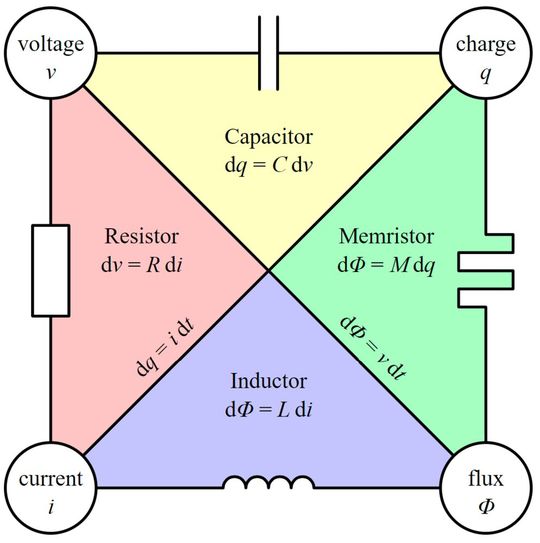
Earlier, this graph didn’t have any fourth component (memristor). To fix the fourth missing component which would work on the relationship between magnetic flux and stored charge, Leon Ong Chua, an American electrical engineer and computer scientist, described memristor in his 1971 paper.
What is a memristor?
A memristor is a two-terminal resistance-switching memory device that retains its resistance capabilities even when the power is turned off, based on historical data. In simple words, a memristor is a “resistor” with a “memory”. It is a passive device that combines the capabilities of a resistor and a memory cell.
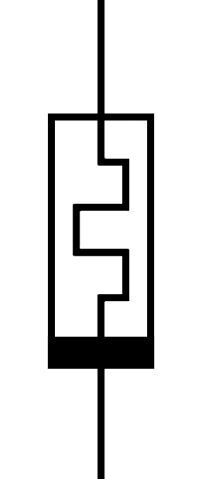
Just like a resistor, a memristor limits the flow of current to the circuit. But it continues to operate during open-circuit or switch-off conditions because it remembers the amount of the last voltage or current that once flowed through the circuit. As a result, a memristor is categorized as a non-volatile memory— The type of memory that retains data even without power for extended use.
Memristance
A resistor offers resistance, an inductor offers inductance, and a capacitor offers capacitance, similarly, a memristor offers memristance. Memristance is measured in webers per coulomb with an SI unit of ohm. However, memristance varies according to the charge passing through the device. It is different from Ohm’s law.
How does a memristor work?
Memristor construction
The first practical solid-state implementation of memristor took place around 2008 by R. Stanley Williams of Hewlett Packard, about 37 years after the research. This structure was called ReRAM (Resistive Switching Random Access Memory).
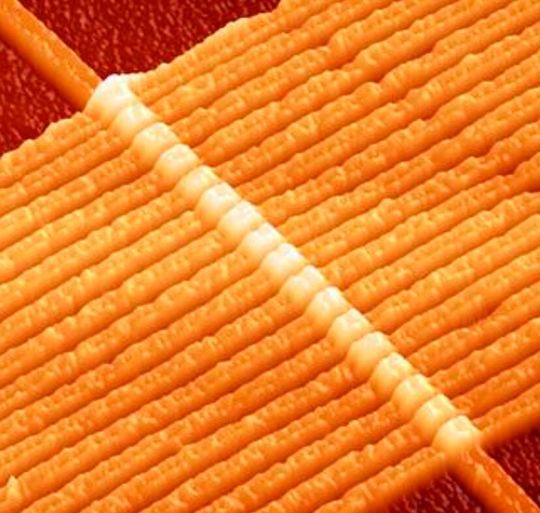
The internal structure of the memristor is a tri-layer of conductor-inductor-conductor. The conductor can be a full-fledged conductor or semiconductor while the insulator is a dielectric material.
The insulating layer made from 50 nm titanium oxide or titania is sandwiched between two 5 nm metal electrodes made of platinum or gold. One part of the insulating layer remains highly resistive while the other part is deprived of oxygen. In this layer, oxygen vacancies occur that offer free electron movement- reducing the resistance.
In simple words, one side is doped (oxygen-starved layer) and the other side remains undoped (pure titania layer). This process is known as dynamic doping. It initiates hysteresis in the loop. The thin film of insulating material is called the ion-conducting layer. An interface forms between the electrodes and the insulating layer.
Memristor operation
The titanium dioxide memristor is among the most common configurations. Other types include silicon dioxide memristors, polymeric memristors, ferroelectric memristors, carbon nanotube memristors, etc.
Drifting oxygen vacancies
Voltage is applied at both sides of the device. Initially, the memristor functions like a highly resistive component. Depending on the polarity of the voltage, atoms start to diffuse on either side. Ions at the interface start to diffuse into the conducting layer, drifting the oxygen vacancies. When the current flows through the memristor, the boundary between these undoped and doped regions moves.
Filament formation
A large input voltage forms a conduction filament that switches the memristor from the high resistance state to the low resistance state. This process is called electroforming. When the polarity of the voltage is reversed, the memristor switches from the low resistance state to the high resistance state. The conduction filaments do not break completely during the transition phase.
Memory functionality
Memristance is the sum of resistances of doped and undoped regions. The flow of current alters the thickness of these regions, causing a change in the value of resistance. The current-driven boundary movement gives the “memory” functionality to the memristor.
When the voltage is removed, the boundary remains in its new position. It enables the memristor to retain its resistance state (either high or low). In conclusion, memristor functions as a non-volatile memory. It remembers the last voltage or current flown through the circuit.
:quality(80):fill(efefef,0)/p7i.vogel.de/wcms/5f/fe/5ffedb2e0ffa6/listing.jpg "listing")
Memristor features
Non-linear behaviour
The current-voltage relationship in a memristor is non-linear. There is no phase shift introduced at zero crossing.
Non-volatility
A memristor retains data even if the power supply is cut off. It can be used in applications that require high energy density to compute and store data.
Low power consumption
A memristor is an energy-effective solution to combat power wastage. According to research, memristors are fast enough to perform functions at 1/800th or 1/1500th energy of traditional processors. They also generate less heat.
Easy integration
Memristors can integrate with standard semiconductor-based devices and processes, contributing to transistors in electronic applications.
Memristor applications
Memristors can be used in various applications to store data and perform signal processing. Applications include:
Josephson Junctions
Memristor functions can be extended to Josephson Junctions in superconductor-based applications.
Switches
ReRAM has been used in nano switching. Memristors can function like switches due to their ability to rapidly change resistance as a function of a change in voltage or polarity. In addition, memristors exhibit hysteresis after switching across their entire resistance range. As a result, they undergo hard switching.
Memristor networks
Memristor networks consist of interconnecting N memristors to perform a group operation. These networks are lightweight and made from simple and inexpensive materials.
Machine learning
Memristors are used in neural networks and neuromorphic computing to mimic the human brain functionality. This is because they have exceptional dynamics for brain synapsis.
Bayesian computing
New memristors, along with traditional CMOS, showed capabilities to recognize signatures at a high accuracy of about 97 %.
Memristor disadvantages
- A “true memristor” has not been physically realized yet.
- Manufacturing memristors is complex and costly.
- Memristors are difficult to program.
- Memristors are not thermally sound compared to traditional resistors.
- Memristors fall short of DRAM and SRAM memory standards.
- The value of memristance is limited to positive values for passive devices.
- In AC settings, the memristor functions like a constant resistor.
References
(ID:50210584)
:quality(80)/p7i.vogel.de/wcms/77/8a/778aa2874d910b701c3e9aab160aec35/0123969290v2.jpeg "Schematic illustration of the novel memristive device: Researchers from Jülich have introduced components that solve \"catastrophic forgetting\" in neural networks by maintaining information stability during new data training. (Source: Chen, S., Yang, Z., Hartmann, H. et al., Nat. Commun., https://doi.org/10.1038/s41467-025-57543-w)")
:quality(80)/p7i.vogel.de/wcms/f0/d8/f0d82f06ed1b7abb3245dfc4c317cb55/0127949994v2.jpeg "Visual representation of component ageing in power electronics, highlighting thermal and material stress effects across the system (Bild: © Surya16 - stock.adobe.com)")