


:quality(80)/p7i.vogel.de/wcms/2f/f3/2ff3221bf7665de2d0acf83760bfd1fa/0130031523v2.jpeg "Wolfspeed presents a 300 mm silicon carbide technology platform designed to support advanced packaging and high-efficiency power delivery for AI data center infrastructure. (Source: Wolfspeed)")
:quality(80)/p7i.vogel.de/wcms/c3/16/c316e955a97f5d72d9678297b237b9e5/0129932858v2.jpeg "Left: the single-phase version of the SENTRON ECPD with RCM, right: a model of the future three-phase version of the SENTRON ECPD. (Source: Siemens)")
:quality(80)/p7i.vogel.de/wcms/ef/0a/ef0adb0acf793fe147cc27c21f6a7a67/0129954238v2.jpeg "Empower Semiconductor introduces embedded silicon capacitors designed to improve power delivery and stability in AI and high-performance computing processors. (symbolic image) (Source: © IF.arc - stock.adobe.com)")
:quality(80)/p7i.vogel.de/wcms/53/f9/53f9301dfc9292d02960f7996c79cc6e/0129927601v2.jpeg "Wolfspeed’s new 10 kV SiC MOSFET enables high-voltage power conversion for grid and industrial applications. (symbolic image) (Source: © CREATIVE- 3.4 - stock.adobe.com)")
:quality(80)/p7i.vogel.de/wcms/6e/cd/6ecd41d095d5111cf4ed37b714844487/0129930878v2.jpeg "PCIM Asia Shenzhen provides a platform for industry experts to present new developments in power electronics and electrification technologies. (symbolic image) (Source: © killykoon - stock.adobe.com)")
:quality(80)/p7i.vogel.de/wcms/02/c0/02c0e9722f70b1134dbf96fb59a9c73d/0129655179v2.jpeg "The PCIM Conference 2026 will take place from June 9-11, featuring discussions on power electronics trends, including GaN technology and AI applications. (symbolic image) (Source: © Elmira - stock.adobe.com)")
:quality(80)/p7i.vogel.de/wcms/cc/67/cc670ea2029cd2af5c641af70e1bf734/0129816392v4.jpeg "Fraunhofer IAF coordinates the EU SUPREME project to accelerate GaN and SiC power semiconductor innovation in Europe. (Source: Fraunhofer IAF)")
:quality(80)/p7i.vogel.de/wcms/ea/e6/eae6aee30071e67a5627027974437134/0129544613v2.jpeg "GlobalFoundries and Renesas strengthen their collaboration to support U.S.-based semiconductor production and supply chain resilience. (Source: © ronstik - stock.adobe.com)")
:quality(80)/p7i.vogel.de/wcms/3c/4b/3c4bbc68dda65c7071b4376fb57423b0/0130030465v2.jpeg "Faraday’s laws explain the fundamental behavior of magnetic fields and electronic devices in dynamic use cases. The operation of transformers, wireless chargers, induction cookers, induction motors, magnetic levitating trains (MAGLEV Trains), electric violin, and many others depends upon Faraday’s laws. (Source: © Sheraz - stock.adobe.com)")
:quality(80)/p7i.vogel.de/wcms/b1/5e/b15ee02b0ba02db70cf61e37d66ad1d3/0129349127v2.jpeg "Vehicle-to-grid (V2G) chargers enable bidirectional energy flow, allowing electric vehicles to act as mobile energy storage systems that can both draw power from and feed power back into the grid. (Source: © medienvirus - stock.adobe.com)")
:quality(80)/p7i.vogel.de/wcms/26/d5/26d591cc340077026eac56a0e7564faf/0129949603v2.jpeg "Flexible: The solid silicone-based electrolyte is elastic, thereby compensating for the voids that form in solid-state batteries during charging and discharging. (Source: Empa)")
:quality(80)/p7i.vogel.de/wcms/4d/e0/4de02f76a37cbb3df30dd231de589c8e/0128866890v2.jpeg "Both legacy and vGaN show higher carrier mobility and band gap energies compared to other power semiconductors. (Source: © phonlamaiphoto - stock.adobe.com)")
:quality(80)/p7i.vogel.de/wcms/be/c8/bec8d43fc0ee73414274be44608b2970/0129748903v2.jpeg "The Infiniium XR804KA real-time oscilloscope delivers faster response time, improved stability, and streamlined workflows for high-speed digital and compliance testing. (Source: Keysight)")
:quality(80)/p7i.vogel.de/wcms/23/ee/23ee4a97790d6009dbfd7d9577ffa723/0129220424v2.jpeg "The R&S FPL1044 with the new RTSA option makes 40 MHz real-time frequency analysis available up to 44 GHz. (Source: Rohde & Schwarz )")
:quality(80)/p7i.vogel.de/wcms/3c/d1/3cd1cacbceb792ba63727199c61ca434/0127801860v2.jpeg "Thanks to cloud technology, users can collaborate on projects from anywhere and always have access to the latest planning data. (Source: SIEMENS)")
:quality(80)/p7i.vogel.de/wcms/5a/a0/5aa0436498af618297961fd54ab36cdf/0126290792v2.jpeg "Siemens accelerates student-led semiconductor innovation across Europe’s leading technical universities through Cre8Ventures’ Open Higher Education Program developed in collaboration with Arm and University of Southampton (Source: Siemens Digital Industries Software)")
ELECTRONIC SYSTEMS Power factor: Significance and correction strategies
Related Vendors
:fill(fff,0)/p7i.vogel.de/companies/63/c7/63c7da97be945/diotec.png "diotec (Diotec Semiconductor AG)")
:fill(fff,0)/p7i.vogel.de/companies/60/7e/607ec89d5d9b5/white-frame.jpg "white frame.jpg (www.rohm.com)")
:fill(fff,0)/p7i.vogel.de/companies/62/a0/62a0a0de7d56a/aic-europe-logo.jpeg "aic-europe-logo (AIC Europe)")
Power factor raises questions like how much power the system consumes to function versus how much power flows through the system and what percentage of it is utilized or wasted. While industrial power electronics is concerned about power factor, this article lists all the basic strategies plant engineers implement to improve the power factor. It starts to explain what the power factor is and how it can affect a system. Overall, this article is an informative go-to guide for a beginner exploring the concept of power factors.

Power Factor is one of the most critical features that ensure the efficient operation of electrical or electronic systems. In order to describe the power factor, let us understand different types of electric power.
True power
Working power, true power, or real power is the amount of energy spent on doing useful work in an electrical/electronic system. It represents the amount of power consumed in the system. The magnitude of this power shows up on the wattmeter in watts (W) or kilowatts (kW). The useful work can range from mechanical action, motion, turning on an LED, switching, heat creation, and many more operations.
Reactive power
The second type, reactive power, is defined as the power that oscillates back and forth between source and components, putting a heavy load on the distribution system. It simply circulates between the generator (input) and the load (output). Expressed in volt-amperes-reactive (VAR) or kilovolt-amperes-reactive (kVAR), reactive power only flows in the circuit. It doesn’t perform any task.
Apparent power
Apparent power is the total power existing in an electrical or electronic system, including the power flowing between the components and the power consumed to perform tasks. It is expressed in volt-amperes (VA) or kilovolt-amperes (kVA). Simply put, apparent power is the vector sum of true and reactive power.
Power factor
The power factor is the ratio between true power and apparent power. It measures real power absorbed by the load vs apparent power flowing in the circuit. A high power factor indicates good utilization of power to perform operations while a poor power factor indicates power wastage.
Power factor = True Power / (True Power + Reactive Power)
Power factor = True Power / Apparent Power
Power factor = kW / kVA
Power factor is a dimensionless quantity with no SI units. It is expressed between 0 to 1. Values near 1 represent a high power factor and values near 0 indicate a low power factor. In most cases, the power factor is never perfectly 0 or 1.

Another calculation represents the power factor through the cosine function. The value for the power factor remains the same, dimensionless, between 0 and 1.
Power Factor = Cosine Ɵ
Why is the power factor important?
The power factor is important because it is a measure of how electric power is utilized within a system. Simply put, it is a figure of merit to predict how much power a system delivers at load versus how much power it extracts from the source. It improves energy efficiency and reduces the risk of equipment failure.
The power factor is an important rating for manufacturers to consider. International standards have set a minimum power factor level for a device to be sold in the global market. This is because nobody is interested in buying an unreliable and short-lived device. From a consumer perspective, the power factor helps to save on electricity bills.
Reasons for low power factors
The section explores methods to address low power factors, which arise from reactive elements and harmonics in electronic circuits. It discusses techniques like adding capacitors or inductors to compensate for reactive power, using filters to mitigate harmonics, and optimizing power conversion modes to improve efficiency and power factor.
:quality(80)/p7i.vogel.de/wcms/39/06/39064ce5c12dc868466ce49ff01ac0d5/0105592335.jpeg "The overarching goal of high-frequency power conversion is to make power electronics smaller, smarter, and more efficient. (Source: KPixMining - stock.adobe.com)")
PCIM 2022 KEYNOTE
A look at the past, present, and future of power conversion technology
Reactive elements
In electronics, inductors and capacitors are referred to as reactive elements. When the load is resistive, current and voltage are in phase with each other. The table lists inductive, capacitive, and resistive loads with examples.
| Type of load | Current | Voltage | Phase Angle | Power Factor |
| Inductive Load (Examples: transformers, motors, relays, solenoids, and appliances like fans and washing machines) | Lagging | Leading |
| Lagging |
| Capacitive Load (Examples: overhead transmission lines, audio equipment, RF devices, medical equipment) | Leading | Lagging | 90 degrees | Leading |
| Resistive Load (Examples: lightbulbs, toasters, ovens, space heaters | In phase | In phase | 0 degrees | Unity |
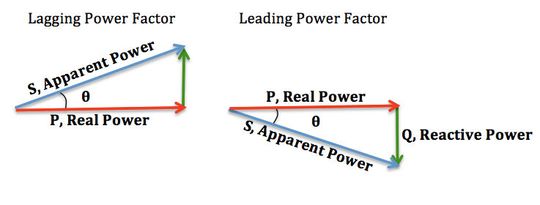
In inductive and capacitive loads, currents and voltages are out of phase. In inductive loads, the current lags 90 degrees behind the voltage. On the other hand, in capacitive load, current leads the voltage. The displacement between input current and voltage waveforms gives rise to a poor power factor.
Harmonics
Harmonics are among the main reasons that contribute to a poor power factor. They are high-frequency components found in output current and voltage waveforms. All current and voltage waveforms must be sinusoidal in nature. Harmonics reduce this sinusoidal wave to some non-sinusoidal structure.
The main reason for harmonics is non-linear loads. In today’s world, 70 % of all loads are nonlinear like rectifiers, inverters, computer-based devices, etc. The fluctuating nature of such loads draws currents in pulses, distorting the system output. As a result, harmonics tend to overheat the device and create noise. Fixing harmonics is a type of hybrid power correction practice.
Power factor correction strategies
Power Factor Correction or simply PFC are methodologies that improve the power factor of a system. A PFC circuit is a special type of circuit that tends to correct power factors. Plant engineers at manufacturing facilities implement various power correction strategies to ensure system efficiency. Some of them are detailed below.
Maintaining current and voltage phases
As mentioned above, the power factor lags in inductive loads and leads in capacitive loads. If current is lagging behind voltage in a particular case, the best way is to add a capacitor with a calculated impedance to drag the phase. When current leads the voltage, the best practice is to add an inductor with a specific impedance.
Eliminating harmonics
The easiest way to eliminate high-frequency components is to use filters at the input. In general, a passive LPF or low pass filter in LC configuration eliminates harmonics. However, it needs a compensator network and makes the system bulkier. Another filter called active harmonics filter eliminates high-order harmonic currents from the system and improves power factor.
Implementing BCM
In DC-DC power electronic converters, there are mainly three types of modes- CCM (Continuous Current Conduction Mode), DCM (Discontinuous Current Conduction Mode), and BCM (Boundary Conduction Mode). Choosing BCM is a viable alternative to commonly used CCM. BCM decreases switching losses and improves efficiency and power factor.
In BCM, switching action initiates when the inductor fully discharges. This is called zero-switching current because the switch turns on only when the inductor current becomes zero. It keeps current and voltages in phase and removes harmonic distortions. In fact, BCM is a common part of DC-DC PFC circuits.
Adding capacitor tanks
Most of the loads we encounter in our day-to-day lives are inductive in nature. In such loads, as per the table, the current lags behind the voltage. A common method to perform PFC is to add stages of capacitor banks in parallel with such loads. The word ‘bank’ indicates the presence of a group of capacitors.
These capacitors are connected either in the Delta or Wye configuration to generate reactive power that neutralizes the lagging component of the current. In order to enhance the functionality of tanked capacitors, detuning reactors and discharge resistance are added to the circuit.
Tanked capacitors are easy to install, lighter in weight and require low maintenance. They also contribute to lower losses and save on electricity bills. However, tanked capacitors have a shorter lifespan of about 8-10 years. Sudden changes in loads can give rise to current surges, leading to costlier replacement or failure.
:quality(80):fill(efefef,0)/p7i.vogel.de/wcms/60/8a/608a76a27a4e7/vorschaubild-control-loops-and-startup-for-pfc-converters.png "Vorschaubild_Control Loops and Startup for PFC Converters")
Using synchronous condensers
A synchronous condenser is a steady-state DC-excited loadless device. The shaft of this device is not connected to any device or load- it just spins freely. They are connected in parallel to loads. Synchronous condenser machines operate in three states: under-excited, intermediate-excited, and over-excited.
- Excited state: The synchronous condenser functions like an inductive load and consumes reactive power.
- Intermediate excited state: The synchronous condenser functions like a resistive load and does not consume or generate reactive power.
- Overexcited state: The synchronous condenser functions like a capacitive load and generates reactive power.
A large amount of input current from a DC source triggers the over-excitation state. In simple words, DC excitation drives the power factor. Most synchronous condensers use automatic excitation controllers to operate at desirable power factors.
One of the major advantages of the synchronous condenser PFC circuit is that it controls the amount of DC excitation. Unlike tanked capacitors, synchronous condensers do not lead to over-correction of the power factor.
Synchronous condensers have a long life span of about 20-25 years. They significantly control current-voltage displacements and harmonics. However, synchronous condensers have high maintenance costs, and losses, and lead to the usage of additional components.
Using compensators
A phase advancer is used with induction motors (inductive loads) to perform PFC. It is simply an AC exciter connected to the induction motor’s shaft. Phase advancer supplies “excited current” to improve the power factor. It is used typically where synchronous condensers are impractical to be used.
Another method is to use a Static VAR Compensator to automatically operate as per reactive power needs. This compensator is a Thyristor-controlled reactor that manages the amount of reactive power to control the power factor.
Running HIL simulations
HIL or Hardware-In-The-Loop simulation is a technology that integrates real hardware components like motors, drivers, converters, etc, with a simulated environment to test and validate systems. HIL simulation is a big part of plant engineering. The plant is a physical entity for which the power factor must be corrected. As a result, HIL simulation saves time and costs to predict PFC results in advance.
References
(ID:50168143)
:quality(80)/p7i.vogel.de/wcms/37/64/376449c482d7bc5493c77d057638fe59/0126287882v2.jpeg "At PCIM 2025, Michael Harrison unveiled Enphase Energy's groundbreaking use of GaN HEMT Bi-Directional Switches in their IQ9 PV microinverter, marking a pivotal advancement in power conversion technology. (Source: © roei - stock.adobe.com)")
:quality(80)/p7i.vogel.de/wcms/90/f4/90f487e51d95ee8cf074826c96b8f6e5/0124400898v2.jpeg "High-power devices like thyristors can fail sometimes. For example, they can turn off abruptly after turning on. High dv/dt and di/dt ratings in thyristors are among the main reasons for failure. Find out more about this here. (Source: ludodesign - stock.adobe.com)")