


:quality(80)/p7i.vogel.de/wcms/2f/f3/2ff3221bf7665de2d0acf83760bfd1fa/0130031523v2.jpeg "Wolfspeed presents a 300 mm silicon carbide technology platform designed to support advanced packaging and high-efficiency power delivery for AI data center infrastructure. (Source: Wolfspeed)")
:quality(80)/p7i.vogel.de/wcms/c3/16/c316e955a97f5d72d9678297b237b9e5/0129932858v2.jpeg "Left: the single-phase version of the SENTRON ECPD with RCM, right: a model of the future three-phase version of the SENTRON ECPD. (Source: Siemens)")
:quality(80)/p7i.vogel.de/wcms/ef/0a/ef0adb0acf793fe147cc27c21f6a7a67/0129954238v2.jpeg "Empower Semiconductor introduces embedded silicon capacitors designed to improve power delivery and stability in AI and high-performance computing processors. (symbolic image) (Source: © IF.arc - stock.adobe.com)")
:quality(80)/p7i.vogel.de/wcms/53/f9/53f9301dfc9292d02960f7996c79cc6e/0129927601v2.jpeg "Wolfspeed’s new 10 kV SiC MOSFET enables high-voltage power conversion for grid and industrial applications. (symbolic image) (Source: © CREATIVE- 3.4 - stock.adobe.com)")
:quality(80)/p7i.vogel.de/wcms/6e/cd/6ecd41d095d5111cf4ed37b714844487/0129930878v2.jpeg "PCIM Asia Shenzhen provides a platform for industry experts to present new developments in power electronics and electrification technologies. (symbolic image) (Source: © killykoon - stock.adobe.com)")
:quality(80)/p7i.vogel.de/wcms/02/c0/02c0e9722f70b1134dbf96fb59a9c73d/0129655179v2.jpeg "The PCIM Conference 2026 will take place from June 9-11, featuring discussions on power electronics trends, including GaN technology and AI applications. (symbolic image) (Source: © Elmira - stock.adobe.com)")
:quality(80)/p7i.vogel.de/wcms/cc/67/cc670ea2029cd2af5c641af70e1bf734/0129816392v4.jpeg "Fraunhofer IAF coordinates the EU SUPREME project to accelerate GaN and SiC power semiconductor innovation in Europe. (Source: Fraunhofer IAF)")
:quality(80)/p7i.vogel.de/wcms/ea/e6/eae6aee30071e67a5627027974437134/0129544613v2.jpeg "GlobalFoundries and Renesas strengthen their collaboration to support U.S.-based semiconductor production and supply chain resilience. (Source: © ronstik - stock.adobe.com)")
:quality(80)/p7i.vogel.de/wcms/3c/4b/3c4bbc68dda65c7071b4376fb57423b0/0130030465v2.jpeg "Faraday’s laws explain the fundamental behavior of magnetic fields and electronic devices in dynamic use cases. The operation of transformers, wireless chargers, induction cookers, induction motors, magnetic levitating trains (MAGLEV Trains), electric violin, and many others depends upon Faraday’s laws. (Source: © Sheraz - stock.adobe.com)")
:quality(80)/p7i.vogel.de/wcms/b1/5e/b15ee02b0ba02db70cf61e37d66ad1d3/0129349127v2.jpeg "Vehicle-to-grid (V2G) chargers enable bidirectional energy flow, allowing electric vehicles to act as mobile energy storage systems that can both draw power from and feed power back into the grid. (Source: © medienvirus - stock.adobe.com)")
:quality(80)/p7i.vogel.de/wcms/26/d5/26d591cc340077026eac56a0e7564faf/0129949603v2.jpeg "Flexible: The solid silicone-based electrolyte is elastic, thereby compensating for the voids that form in solid-state batteries during charging and discharging. (Source: Empa)")
:quality(80)/p7i.vogel.de/wcms/4d/e0/4de02f76a37cbb3df30dd231de589c8e/0128866890v2.jpeg "Both legacy and vGaN show higher carrier mobility and band gap energies compared to other power semiconductors. (Source: © phonlamaiphoto - stock.adobe.com)")
:quality(80)/p7i.vogel.de/wcms/be/c8/bec8d43fc0ee73414274be44608b2970/0129748903v2.jpeg "The Infiniium XR804KA real-time oscilloscope delivers faster response time, improved stability, and streamlined workflows for high-speed digital and compliance testing. (Source: Keysight)")
:quality(80)/p7i.vogel.de/wcms/23/ee/23ee4a97790d6009dbfd7d9577ffa723/0129220424v2.jpeg "The R&S FPL1044 with the new RTSA option makes 40 MHz real-time frequency analysis available up to 44 GHz. (Source: Rohde & Schwarz )")
:quality(80)/p7i.vogel.de/wcms/3c/d1/3cd1cacbceb792ba63727199c61ca434/0127801860v2.jpeg "Thanks to cloud technology, users can collaborate on projects from anywhere and always have access to the latest planning data. (Source: SIEMENS)")
:quality(80)/p7i.vogel.de/wcms/5a/a0/5aa0436498af618297961fd54ab36cdf/0126290792v2.jpeg "Siemens accelerates student-led semiconductor innovation across Europe’s leading technical universities through Cre8Ventures’ Open Higher Education Program developed in collaboration with Arm and University of Southampton (Source: Siemens Digital Industries Software)")
CYRO-CMOS New transistor won’t heat up
Related Vendors
:fill(fff,0)/p7i.vogel.de/companies/60/7e/607ec89d5d9b5/white-frame.jpg "white frame.jpg (www.rohm.com)")
:fill(fff,0)/p7i.vogel.de/companies/5f/71/5f71d5f92a5f6/2000px-rogers-corporation-logo-svg.png "2000px-Rogers_Corporation_Logo.svg.png (rogers germany)")
:fill(fff,0)/p7i.vogel.de/companies/66/8b/668becd1c07eb/dowa-logo-word--1-.jpeg "dowa-logo-word--1- (DOWA)")
A month before the end of year twenty-four, researchers manufactured a new transistor for cryogenic electronics. This new transistor operates near -272 degrees Celsius and generates negligible heat. The remarkable invention is all set for 2025 release and customer delivery. The article describes the newly invented transistor called “cryo-CMOS” and its role in scaling quantum computing.

In 2023 and 2024, the tech world explored potential room-temperature superconductors to meet the requirements of cryogenic electronic applications for lossless transmission and quantum computing. Various scientists and researchers came up with only theories and thought experiments.
Companies should have come forward with a practical device for their business - They didn’t. In Dec 2024, the tables have turned. SemiQon, a company based in Espoo, Finland, responsible for building semiconductor-based quantum processors, has recently announced its groundbreaking invention.
Cryo-CMOS: Latest transistor invention
SemiQon has named their creation the “cryo-CMOS” transistor. It is an abbreviation for “Cryogenic-Complementary Metal Oxide Semiconductor Transistor”. Cryo-CMOS is said to be optimized for operating in cryogenic environments. Cryogenic means a freezing environment with ultra-low temperatures near absolute zero. These ultra-low temperatures are slightly above absolute zero or -273.15 degrees Celsius.
Cryo-CMOS is an FD-SOI MOSFET (Fully depleted Silicon-on-insulator MOSFET) that has overcome the power dissipation barrier for cryogenic applications, typically below 1 Kelvin or -272.15 degrees. The manufactured transistor dissipates extremely low heat as the temperature approaches 1 Kelvin. Cryo-CMOS transistors showcase low-off state leakage currents, dynamic power loss, and subthreshold swing.
:quality(80)/p7i.vogel.de/wcms/0d/c1/0dc18e6840343893ffe77e6991fbabab/0119307179v2.jpeg "Understanding CMOS: A Core Technology for Integrated Circuits. This article explores the functionality and fabrication of CMOS inverters. (Source: Makayla - stock.adobe.com)")
BASIC KNOWLEDGE: INVERTERS
CMOS: The most basic inverter
Potential advantages of using cryo-CMOS
Practical cryogenic electronics operate near liquid-helium temperatures - 4.2 Kelvin. This 1 Kelvin stable operation cryo-CMOS is all set to fit in the traditional MOSFET-based IC manufacturing processes until their ultimate 2025 release.
Superconductor-based applications
Cryogenic environments are necessary for quantum computers to function. Another application of cryo-CMOS is large data handling and faster HPC (high-performance computing). Even some space-related applications rely on ultra-low temperatures. All of them use superconductors to operate.
Superconductors exhibit superconductive behavior at ultra-low temperatures. It extends the scope of cryo-CMOS to exascale supercomputing, MAGLEV trains, lossless power transmission, particle accelerators, nuclear energy, MRI machines, and various advanced medical equipment.
Thermal budget management
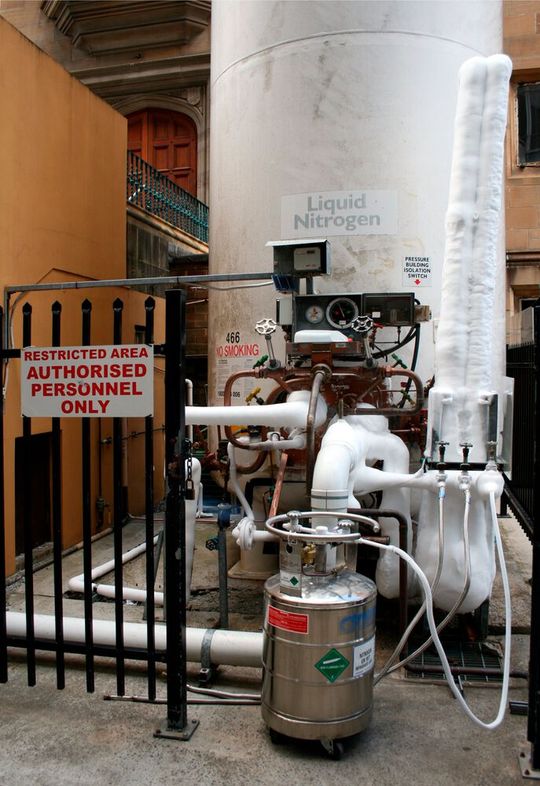
In addition to cryogenic operation, cryo-CMOS offers almost heat-free operation. Below 1 Kelvin, cryo-CMOS is said to emit almost no heat. In comparison to other devices used in cryogenic environments, this new invention is expected to consume 0.1 % power and cut heat dissipation by a factor of 1000!
Industries spend billions of dollars on maintaining cryogenic temperatures for quantum computers. Cryocoolers are mechanical refrigeration systems that maintain cryogenic temperatures. Such systems are expensive. The global cryocoolers market is valued at 2.87 billion in 2024.
Cryo-CMOS transistors are not only needed for cryogenic environments but the entire electrical and electronics industry. CMOS transistors consume large amounts of power. Miniaturization and increasing nano-scale complexity of integrated circuits call for effective heat dissipation. In the power electronics industry, heat sinks currently occupy a market share of USD 6.12 billion.
Qubit handling
As mentioned above, quantum computing devices use superconducting circuits to function. One such example is Josephson Junction-based circuits. Josephson Junctions function like transistors in cryogenic environments for quantum computers and supercomputers.
Superconducting qubits are necessary for quantum computer operation, accuracy, and security. Qubits are quantum counterparts of classical bits. Josephson Junctions enable quantum states such as entanglement or superposition in qubits. States of qubits exist as either 0, 1 or superpositioned or entanglement of both. Due to the validity of the no-cloning theorem, qubits cannot be copied or manipulated.
Cryo-CMOS makes qubit processing easier. Large qubit processing generates heat. Cryo-CMOS will handle large volumes of qubit operation without generating much heat. Cryo-CMOS-based advanced quantum computing will have reduced energy needs, leading to decreased thermal budget and lower emissions.
:quality(80):fill(efefef,0)/p7i.vogel.de/wcms/5f/fe/5ffedb2e0ffa6/listing.jpg "listing")
Enhanced compactness
Cryostat is similar to a large vacuum chamber that maintains ultra-low temperatures for quantum computers and shields them from outside heat. Control and readout electronics are parts of quantum computers responsible for managing and reading qubit states during operation. Placing them inside the cryostat is not possible currently.
Cryo-CMOS enables placing control and readout electronic components inside cryostat for enhanced performance. The integration eliminates the need for external wiring, heat load, and additional data center cooling systems. Qubits won’t need to travel through long cables, resulting in low signal loss, higher mobility, and better quantum efficiency.
VLSI: The Conclusion
Cryo-CMOS achieved a subthreshold swing of 0.3 mV/dec at 420 mK (Liquid-helium temperature). It makes cryo-CMOS compatible with VLSI (very-large-scale integration) - just like mainstream MOSFET-based chips. Cryo-CMOS can be mass-produced in semiconductor fabrication units using current manufacturing processes. As a result, manufacturers do not need to invest capital for new set-ups.
As of 2024, the cryogenic equipment market is valued at USD 22.32 billion. It is expected to hit USD 42.23 billion in 2032 at a CAGR of 7.07 %. SemiQon awaits certifications for commercialization as pilot testing with customers continues. The makers aim to target 1000 transistors and reach up to one billion in a decade.
Cryo-CMOS was analyzed for low-noise and ultra-low power switching metrics. Cryo-CMOS-engineered quantum devices may result in increased Josephson Junction count, enhanced qubit processing, fault-tolerant quantum behavior, and overall benefits of cryogenic electronic applications. They can also bring new functionalities to the existing world of processors and memory.
References
Power Electronics in the Energy Transition
The parameters for energy transition and climate protection solutions span education, research, industry, and society. In the new episode of "Sound On. Power On.", Frank Osterwald of the Society for Energy and Climate Protection Schleswig‐Holstein talks about the holistic guidance his organization can provide.
Listen now!
(ID:50265496)
:quality(80)/p7i.vogel.de/wcms/c9/5f/c95fd082477eb5f3ddafbb76b2f36c47/0129660958v4.jpeg "Due to the presence of superconducting material, SMES shows a high efficiency of more than 95%. (Source: © Faizer - stock.adobe.com)")
:quality(80)/p7i.vogel.de/wcms/cc/67/cc670ea2029cd2af5c641af70e1bf734/0129816392v4.jpeg "Fraunhofer IAF coordinates the EU SUPREME project to accelerate GaN and SiC power semiconductor innovation in Europe. (Source: Fraunhofer IAF)")