


:quality(80)/p7i.vogel.de/wcms/2f/f3/2ff3221bf7665de2d0acf83760bfd1fa/0130031523v2.jpeg "Wolfspeed presents a 300 mm silicon carbide technology platform designed to support advanced packaging and high-efficiency power delivery for AI data center infrastructure. (Source: Wolfspeed)")
:quality(80)/p7i.vogel.de/wcms/c3/16/c316e955a97f5d72d9678297b237b9e5/0129932858v2.jpeg "Left: the single-phase version of the SENTRON ECPD with RCM, right: a model of the future three-phase version of the SENTRON ECPD. (Source: Siemens)")
:quality(80)/p7i.vogel.de/wcms/ef/0a/ef0adb0acf793fe147cc27c21f6a7a67/0129954238v2.jpeg "Empower Semiconductor introduces embedded silicon capacitors designed to improve power delivery and stability in AI and high-performance computing processors. (symbolic image) (Source: © IF.arc - stock.adobe.com)")
:quality(80)/p7i.vogel.de/wcms/53/f9/53f9301dfc9292d02960f7996c79cc6e/0129927601v2.jpeg "Wolfspeed’s new 10 kV SiC MOSFET enables high-voltage power conversion for grid and industrial applications. (symbolic image) (Source: © CREATIVE- 3.4 - stock.adobe.com)")
:quality(80)/p7i.vogel.de/wcms/6e/cd/6ecd41d095d5111cf4ed37b714844487/0129930878v2.jpeg "PCIM Asia Shenzhen provides a platform for industry experts to present new developments in power electronics and electrification technologies. (symbolic image) (Source: © killykoon - stock.adobe.com)")
:quality(80)/p7i.vogel.de/wcms/02/c0/02c0e9722f70b1134dbf96fb59a9c73d/0129655179v2.jpeg "The PCIM Conference 2026 will take place from June 9-11, featuring discussions on power electronics trends, including GaN technology and AI applications. (symbolic image) (Source: © Elmira - stock.adobe.com)")
:quality(80)/p7i.vogel.de/wcms/cc/67/cc670ea2029cd2af5c641af70e1bf734/0129816392v4.jpeg "Fraunhofer IAF coordinates the EU SUPREME project to accelerate GaN and SiC power semiconductor innovation in Europe. (Source: Fraunhofer IAF)")
:quality(80)/p7i.vogel.de/wcms/ea/e6/eae6aee30071e67a5627027974437134/0129544613v2.jpeg "GlobalFoundries and Renesas strengthen their collaboration to support U.S.-based semiconductor production and supply chain resilience. (Source: © ronstik - stock.adobe.com)")
:quality(80)/p7i.vogel.de/wcms/3c/4b/3c4bbc68dda65c7071b4376fb57423b0/0130030465v2.jpeg "Faraday’s laws explain the fundamental behavior of magnetic fields and electronic devices in dynamic use cases. The operation of transformers, wireless chargers, induction cookers, induction motors, magnetic levitating trains (MAGLEV Trains), electric violin, and many others depends upon Faraday’s laws. (Source: © Sheraz - stock.adobe.com)")
:quality(80)/p7i.vogel.de/wcms/b1/5e/b15ee02b0ba02db70cf61e37d66ad1d3/0129349127v2.jpeg "Vehicle-to-grid (V2G) chargers enable bidirectional energy flow, allowing electric vehicles to act as mobile energy storage systems that can both draw power from and feed power back into the grid. (Source: © medienvirus - stock.adobe.com)")
:quality(80)/p7i.vogel.de/wcms/26/d5/26d591cc340077026eac56a0e7564faf/0129949603v2.jpeg "Flexible: The solid silicone-based electrolyte is elastic, thereby compensating for the voids that form in solid-state batteries during charging and discharging. (Source: Empa)")
:quality(80)/p7i.vogel.de/wcms/4d/e0/4de02f76a37cbb3df30dd231de589c8e/0128866890v2.jpeg "Both legacy and vGaN show higher carrier mobility and band gap energies compared to other power semiconductors. (Source: © phonlamaiphoto - stock.adobe.com)")
:quality(80)/p7i.vogel.de/wcms/be/c8/bec8d43fc0ee73414274be44608b2970/0129748903v2.jpeg "The Infiniium XR804KA real-time oscilloscope delivers faster response time, improved stability, and streamlined workflows for high-speed digital and compliance testing. (Source: Keysight)")
:quality(80)/p7i.vogel.de/wcms/23/ee/23ee4a97790d6009dbfd7d9577ffa723/0129220424v2.jpeg "The R&S FPL1044 with the new RTSA option makes 40 MHz real-time frequency analysis available up to 44 GHz. (Source: Rohde & Schwarz )")
:quality(80)/p7i.vogel.de/wcms/3c/d1/3cd1cacbceb792ba63727199c61ca434/0127801860v2.jpeg "Thanks to cloud technology, users can collaborate on projects from anywhere and always have access to the latest planning data. (Source: SIEMENS)")
:quality(80)/p7i.vogel.de/wcms/5a/a0/5aa0436498af618297961fd54ab36cdf/0126290792v2.jpeg "Siemens accelerates student-led semiconductor innovation across Europe’s leading technical universities through Cre8Ventures’ Open Higher Education Program developed in collaboration with Arm and University of Southampton (Source: Siemens Digital Industries Software)")
BATTERY TECHNOLOGY New project develops cost-effective and green alternatives to li-ion batteries
Related Vendors
:fill(fff,0)/p7i.vogel.de/companies/60/7e/607ec89d5d9b5/white-frame.jpg "white frame.jpg (www.rohm.com)")
:fill(fff,0)/p7i.vogel.de/companies/5f/71/5f71d5f92a5f6/2000px-rogers-corporation-logo-svg.png "2000px-Rogers_Corporation_Logo.svg.png (rogers germany)")
:fill(fff,0)/p7i.vogel.de/companies/66/8b/668becd1c07eb/dowa-logo-word--1-.jpeg "dowa-logo-word--1- (DOWA)")
Lithium-ion batteries are the state of the art in stationary energy storage, but parts of the raw material extraction are controversial due to environmental and social problems. The Fraunhofer Institute for Solar Energy Systems ISE has therefore joined forces with partners in the INFAB project to research an alternative technology based on zinc-ion batteries. The project covered all process stages, from the development of cell chemistry and manufacturing processes to the battery management system.
The current challenges of research into stationary battery storage lie in the conflicting areas of safety, durability, investment costs and application-specific storage costs (Levelized Cost of Energy Storage, LCOS for short), the availability of raw materials and environmental and social compatibility throughout the entire product life cycle. "The INFAB research project is focusing on high-performance zinc-ion battery technology. It stands out due to the simplicity of the system structure combined with a high level of safety, non-toxic battery components and the possibility of environmentally and socially compatible raw material extraction within the EU. The technology also offers the potential for low costs per kilowatt hour," explains project manager Harald Gentischer.
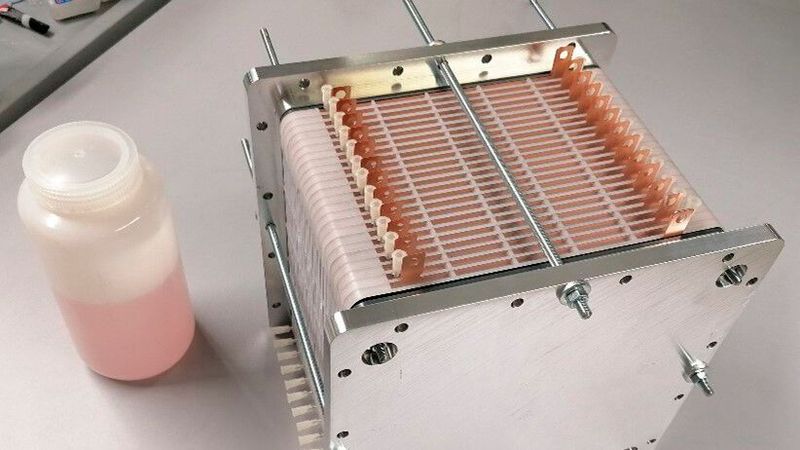
The INFAB project partners developed an innovative cell chemistry with water-based electrolytes, which formed the basis for the architecture of a stationary zinc-ion battery system. The University of Stuttgart was responsible for modeling the zinc-ion battery cell technology. The project team focused on a modular, universal module structure with bipolar interconnection, which allows simple disassembly for later recycling. One innovation is the porous electrode structures developed by Fraunhofer ISE in the project based on a dry coating process that allows high coating thicknesses on a millimeter scale. "In contrast to the current state of the art, which consists of a solvent-based wet coating, the complex and energy-intensive drying process can be dispensed with here," says Harald Gentischer.
:quality(80)/images.vogel.de/vogelonline/bdb/1942500/1942590/original.jpg "Researchers at the University of Bremen are focusing on overcoming the challenges to make aqueous zinc-ion batteries market-ready. (©deepagopi2011 - stock.adobe.com)")
BATTERY TECHNOLOGY
On the path to the next generation of energy storage systems
The project partner acp systems AG developed the innovative battery cells and modules and the production technology for the zinc-ion battery modules. Helmut Hechinger GmbH was responsible for production planning and the development of the battery management system ystems.
The battery cell and stack prototypes for stationary electricity storage applications at the 48 V voltage level were successfully built and characterized at the end of the project. "We were able to demonstrate a high cost reduction potential compared to competing technologies, especially the lithium-ion battery with LFP cathodes. There are still challenges with regard to the energy density and long-term stability of zinc-ion batteries," says Dr. Oliver Fitz, Group Leader Battery Cell Technology at Fraunhofer ISE.
In follow-up projects, the consortium is planning further research into water-based and organic cell chemistries for zinc-ion batteries and sodium-ion batteries.
Power Electronics in the Energy Transition

The parameters for energy transition and climate protection solutions span education, research, industry, and society. In the new episode of "Sound On. Power On.", Frank Osterwald of the Society for Energy and Climate Protection Schleswig‐Holstein talks about the holistic guidance his organization can provide.
Listen now!
(ID:50225327)
:quality(80)/p7i.vogel.de/wcms/c9/83/c98342208a1a08d2a70a9d9210ec52cf/0127808597v2.jpeg "Symbolic image: Lignin based biopolymers powering the future of green energy storage. (Source: © zuriya - stock.adobe.com)")
:quality(80)/p7i.vogel.de/wcms/c2/66/c26682599f5723e23280063c290a1130/0125048211v2.jpeg "KAUST and Fraunhofer ISE developed a scalable blade-coating method for high-efficiency perovskite-silicon tandem solar cells. Find out more here. (Source: © noppadon - stock.adobe.com)")