


:quality(80)/p7i.vogel.de/wcms/2f/f3/2ff3221bf7665de2d0acf83760bfd1fa/0130031523v2.jpeg "Wolfspeed presents a 300 mm silicon carbide technology platform designed to support advanced packaging and high-efficiency power delivery for AI data center infrastructure. (Source: Wolfspeed)")
:quality(80)/p7i.vogel.de/wcms/c3/16/c316e955a97f5d72d9678297b237b9e5/0129932858v2.jpeg "Left: the single-phase version of the SENTRON ECPD with RCM, right: a model of the future three-phase version of the SENTRON ECPD. (Source: Siemens)")
:quality(80)/p7i.vogel.de/wcms/ef/0a/ef0adb0acf793fe147cc27c21f6a7a67/0129954238v2.jpeg "Empower Semiconductor introduces embedded silicon capacitors designed to improve power delivery and stability in AI and high-performance computing processors. (symbolic image) (Source: © IF.arc - stock.adobe.com)")
:quality(80)/p7i.vogel.de/wcms/53/f9/53f9301dfc9292d02960f7996c79cc6e/0129927601v2.jpeg "Wolfspeed’s new 10 kV SiC MOSFET enables high-voltage power conversion for grid and industrial applications. (symbolic image) (Source: © CREATIVE- 3.4 - stock.adobe.com)")
:quality(80)/p7i.vogel.de/wcms/6e/cd/6ecd41d095d5111cf4ed37b714844487/0129930878v2.jpeg "PCIM Asia Shenzhen provides a platform for industry experts to present new developments in power electronics and electrification technologies. (symbolic image) (Source: © killykoon - stock.adobe.com)")
:quality(80)/p7i.vogel.de/wcms/02/c0/02c0e9722f70b1134dbf96fb59a9c73d/0129655179v2.jpeg "The PCIM Conference 2026 will take place from June 9-11, featuring discussions on power electronics trends, including GaN technology and AI applications. (symbolic image) (Source: © Elmira - stock.adobe.com)")
:quality(80)/p7i.vogel.de/wcms/cc/67/cc670ea2029cd2af5c641af70e1bf734/0129816392v4.jpeg "Fraunhofer IAF coordinates the EU SUPREME project to accelerate GaN and SiC power semiconductor innovation in Europe. (Source: Fraunhofer IAF)")
:quality(80)/p7i.vogel.de/wcms/ea/e6/eae6aee30071e67a5627027974437134/0129544613v2.jpeg "GlobalFoundries and Renesas strengthen their collaboration to support U.S.-based semiconductor production and supply chain resilience. (Source: © ronstik - stock.adobe.com)")
:quality(80)/p7i.vogel.de/wcms/b1/5e/b15ee02b0ba02db70cf61e37d66ad1d3/0129349127v2.jpeg "Vehicle-to-grid (V2G) chargers enable bidirectional energy flow, allowing electric vehicles to act as mobile energy storage systems that can both draw power from and feed power back into the grid. (Source: © medienvirus - stock.adobe.com)")
:quality(80)/p7i.vogel.de/wcms/26/d5/26d591cc340077026eac56a0e7564faf/0129949603v2.jpeg "Flexible: The solid silicone-based electrolyte is elastic, thereby compensating for the voids that form in solid-state batteries during charging and discharging. (Source: Empa)")
:quality(80)/p7i.vogel.de/wcms/4d/e0/4de02f76a37cbb3df30dd231de589c8e/0128866890v2.jpeg "Both legacy and vGaN show higher carrier mobility and band gap energies compared to other power semiconductors. (Source: © phonlamaiphoto - stock.adobe.com)")
:quality(80)/p7i.vogel.de/wcms/18/0b/180b7b63afc91e523592d8a5ce161c96/0129847487v2.jpeg "InGaAs-based photodetectors enable sensitive and fast detection in the short-wave infrared spectrum for modern sensing and communication applications. (Source: © VITALII - stock.adobe.com)")
:quality(80)/p7i.vogel.de/wcms/be/c8/bec8d43fc0ee73414274be44608b2970/0129748903v2.jpeg "The Infiniium XR804KA real-time oscilloscope delivers faster response time, improved stability, and streamlined workflows for high-speed digital and compliance testing. (Source: Keysight)")
:quality(80)/p7i.vogel.de/wcms/23/ee/23ee4a97790d6009dbfd7d9577ffa723/0129220424v2.jpeg "The R&S FPL1044 with the new RTSA option makes 40 MHz real-time frequency analysis available up to 44 GHz. (Source: Rohde & Schwarz )")
:quality(80)/p7i.vogel.de/wcms/3c/d1/3cd1cacbceb792ba63727199c61ca434/0127801860v2.jpeg "Thanks to cloud technology, users can collaborate on projects from anywhere and always have access to the latest planning data. (Source: SIEMENS)")
:quality(80)/p7i.vogel.de/wcms/5a/a0/5aa0436498af618297961fd54ab36cdf/0126290792v2.jpeg "Siemens accelerates student-led semiconductor innovation across Europe’s leading technical universities through Cre8Ventures’ Open Higher Education Program developed in collaboration with Arm and University of Southampton (Source: Siemens Digital Industries Software)")
BASIC KNOWLEDGE Laser diode: Definition, types, and more
Related Vendors
:fill(fff,0)/p7i.vogel.de/companies/63/c7/63c7da97be945/diotec.png "diotec (Diotec Semiconductor AG)")
:fill(fff,0)/p7i.vogel.de/companies/5f/71/5f71d5f92a5f6/2000px-rogers-corporation-logo-svg.png "2000px-Rogers_Corporation_Logo.svg.png (rogers germany)")
:fill(fff,0)/p7i.vogel.de/companies/68/c2/68c2b622b43e1/logo.jpeg "logo (IQ Evolution GmbH)")
A laser diode is an emitting device in the power industry that produces a sharp monochromatic output. The small device is very useful in power electronics due to its high efficiency, fast switching capability, and ability to transmit signals over optical media.

What is a laser diode?
Following a long history of laser diode “invention credits”, the semiconductor device is the work of Robert N. Hall, and Nick Holonyak, Jr., 1962. The “injected” electric current creates the “lasing” conditions in the device’s active region to emit photonic radiation. Hence, laser diodes are also called injection lasers, semiconductor lasers, and junction lasers.
Definition laser diode
A laser diode is a two-terminal semiconductor device that uses stimulated emission to generate an output in the form of a highly directed, ultra-focused, narrow, and coherent monochromatic beam of light.
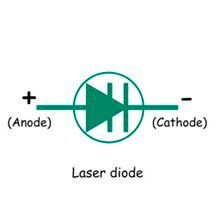
Laser diode symbol
The laser diode symbol is similar to a PN junction diode but with the depiction of another junction (Intrinsic undoped active region).
Laser diode working principles
The long section 3 ahead discusses everything in detail about laser diodes supported by relevant diagrams. It explains a bit of quantum theory behind laser diode working. Section 3 starts with a basic introduction to laser diodes, and details further the internal structure, working, optical amplification, and the characteristics curve.
Basic Introduction
The LASER in laser diode stands for “Light Amplification by Stimulated Emission of Radiation”. However, a laser diode is a “diode”- a semiconductor device. The full form of the LASER diode itself points out the mechanism of stimulated emission and amplification.
A laser diode is based on electroluminescence, the process of converting electrical energy into optical radiation. Stimulated emission is a process to create lasing conditions at the junction that enable the release of photons (E = hv). The injection of electric current supports the lasing conditions.
In a laser diode, two mirrors are placed in front of each other to form an optical cavity. The two mirrors function as a resonator to reflect photons repeatedly, boosting optical amplification. At the output, laser diode resonators amplify the light to release a narrow, highly directed, coherent, and monochromatic light as the output.
Internal structure
Laser diodes are made from three types of semiconductors: P-type, N-type, and intrinsic semiconductor. Structurally, a laser diode is not a PN junction diode, instead, it is a PIN diode. The intrinsic semiconductor is sandwiched between P and N-type semiconducting layers. Laser diode structure is epitaxial growth that starts from the N-substrate, undoped intrinsic layer, and P-doped cladding, and leads up to the contact layer.
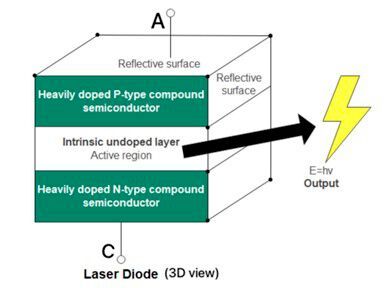
The intrinsic layer is undoped and has a low carrier concentration compared to heavily doped P and N regions. The heavily doped PN junction of the laser diode facilitates electron-hole pair recombination. The function of an intrinsic semiconductor is to function as an active region for electron-hole recombination. The active region is a place to allow stimulated emission of light. There are two reflective surfaces with mirror and partial polishing for carrying out optical amplification.
Working
To understand laser diode operation in detail, let us look back into the working of diodes. We have complete information about diodes in our basic knowledge article about diodes. However, let us look at that in brief to understand laser diodes.
A PN junction diode can either be forward-biased or reverse-biased. The diode is forward biased when P is connected to the positive terminal and N-side is connected to the negative terminal of the battery. Electrons are present at the N-side and holes are present at the P-side. Electrons from the N-side and holes from the P-side cross the junction and recombine in the middle to form the region devoid of charge carriers- the depletion region.
The laser diode is forward-biased for operation. Electric current, or charge carriers (electrons and holes) are injected into the device’s active region.

According to energy band theory, lower energy levels are more stable than higher ones. During electron-hole recombination, electrons jump from a higher energy conduction band to recombine with holes in a lower stable valence band. The process releases recombination energy either as photons or lattice thermal vibrations.
Most single-element semiconductors release heat during the electron-hole recombination process. However, direct band gap compound semiconductors, including gallium arsenide phosphide (GaAsP), and gallium phosphide (GaP) release photons upon recombination of electrons and holes.
There are three processes that contribute to releasing photonic radiation in output: Absorption, spontaneous emission, and stimulated emission.
Absorption
Suppose E1 is the lower energy level valence band and E2 is the higher energy level conduction band. Before the initiation of the absorption process, electrons are in the stable lower energy balance band E1. In the absorption process, electrons in the valence band absorb incoming energy from any source. The energy can be an incident photon (E = hv), electrical energy, or heat.
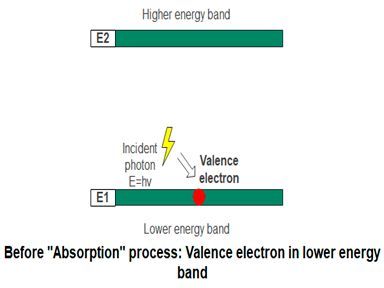
In our case, let us consider an incoming photon hitting the surface of a semiconducting material. In turn, the semiconductor absorbs the photon and raises the electron from a lower energy level to a higher energy level. The process in which the energy from a source is absorbed to excite an electron from low energy to a higher energy level is called absorption.
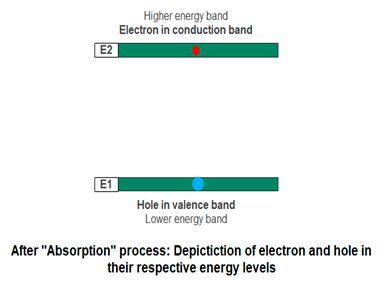
The electron reaches the E2 level from the lower E1 energy level. The electron leaves a hole behind in the valence band. Hence, free electrons are in the conduction band and holes are bound to the valence band.
Spontaneous emission
When electron-hole recombination starts in the device, the process of spontaneous emission starts. Initially, the free electrons are in the conduction band and the holes are in the valence band.
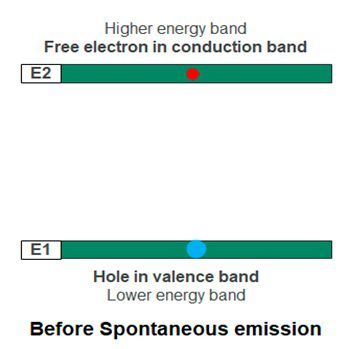
Electrons from the higher energy conduction band recombine with holes in the lower energy balance band, releasing photons. Here, electrons in E2 jump to a lower energy level E1 to recombine with holes. A single recombination event releases a photon.
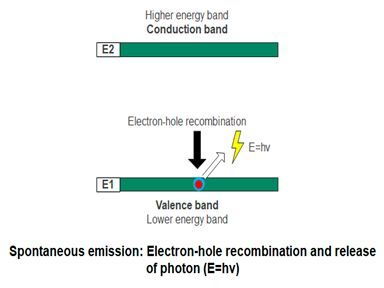
The process where electrons jump from higher energy levels to recombine with holes in the lower energy band to release photons is known as spontaneous emission. The process of spontaneous emission occurs “naturally” in a semiconductor device.
Sometimes, electron-hole recombination does not happen in the absence of spontaneous emission for a time period of about nanoseconds. Another photon with energy equal to the recombination energy can initiate recombination through a process called stimulated emission.
Stimulated emission
Stimulated emission is a process where photons collide with excited electrons in higher energy levels, causing them to recombine with holes in lower energy levels and release another photon.
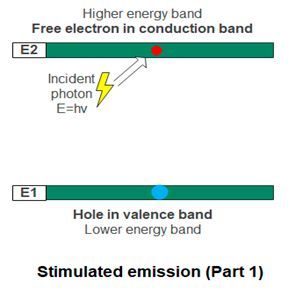
In this case, a photon collides with an electron in the E2 energy level. The electron jumps to a lower energy level E1 and releases another photon. In stimulated emission, each incident photon is able to generate two photons at the output. The produced radiation can fall under either the infrared, visible spectrum, or ultraviolet light.
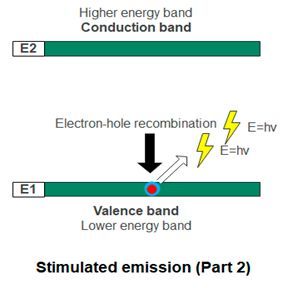
The released photon is coherent, and uniform with the wavelength and phase as it travels in the same direction to make a sharp monochromatic output beam. The action of the diode to produce coherent wavelength and phase is the function of stimulated emission. However, stimulated emission is an artificial process that produces focused light in a laser diode. The voltage drives the laser diode to create the optimal lasing conditions at the junction for achieving coherence. Lasing conditions that support stimulated emission:
- Population inversion: The number of electrons in higher energy levels is larger than the number of electrons in stable low-level shells. The population inversion condition boosts the number of photons released upon the recombination.
- Collision: When the production of photons as the recombination radiation is higher, the collision probability between electrons and photons increases. The collision energy releases another photon, boosting the radiation release.
The photons are amplified at the output to release a monochromatic laser beam.
Optical amplification
There are two mirrors placed at the end of the active region to create an optical cavity, start selective transmission, and perform amplification of output light. Both mirrors function as Fabry-Perot resonators in the laser to process the light.
One mirror is highly reflective and another is partially reflective. The fully reflective mirror, known as a high reflector (HR) has a fully reflecting surface to reflect 100% of photons. The second mirror with a partial reflective surface is known as the output coupler of a laser diode. The partially reflecting mirror is kept in the front and the fully reflective mirror is kept in the back.
Photonic radiation reflects back and forth several times in the optical cavity before the exit. The lights reflecting between the two mirrors form longitudinal modes (standing waves). Some light is lost due to absorption and problems due to partial reflection. As stimulated emission takes place in the active region, more photons are generated in the device to recover from the loss. The role of the high reflector is to compensate for the loss and perform amplification.
The partially reflective surface of the output coupler helps to select the amplified output. The resultant output is a narrow, coherent, and monochromatic beam of light that passes through the partially reflective mirror. In simple words, the laser diode output is amplified through the optical cavity to obtain light of desirable uniform wavelength and phase.
In modern laser diodes, optical waveguides are made on the crystal surface. The output light beam is subject to diffraction upon leaving the diode. At the end, a cylindrical lens ensures the extraction of the collimated beam. Choosing an appropriate optical cavity (along with the selection of compound semiconducting material) is a contributing factor to determining the wavelength of the output beam.
Characteristics
The laser diode characteristic curve is a graph of laser current “I” at the X-axis vs optical power (P) at the Y-axis. The laser diode optical power is the measure of light output produced.
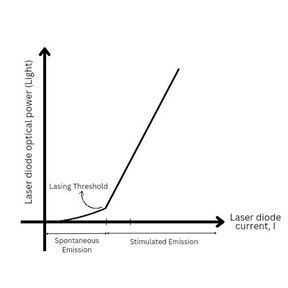
The spontaneous emission process is the working principle for LED diodes. Absorption and spontaneous emission takes place in laser diodes as well.
Below the lasing threshold limit, laser diodes operate through spontaneous emission. Post the lasing threshold limit, laser diode operation is the function of stimulated emission.
The effect of spontaneous emission is minimal in generating the laser diode output. In conclusion, stimulated emission predominantly releases the desirable radiation in laser diodes.
Types of laser diodes
Laser diodes are a versatile and essential component in modern technology, with various types tailored to specific applications based on their unique characteristics and operational principles. Below is an overview of different types of laser diodes, each offering distinct advantages and suited for particular fields.
Fabry-Pérot laser
A Fabry-Perot laser diode is the simplest type of laser in the market. Named after French scientists Charles Fabry and Alfred Perot, FP is a basic semiconductor laser device that places two mirrors on both sides of the intrinsic undoped active region. The two mirrors have an air cavity up to a few micrometers as they face each other directly. The frequency of the laser diode is the function of the distance between the two mirrors.
Photons bounce back and forth from the mirrors, oscillating up to several wavelengths. The process where laser light oscillates at the same time is called mode hopping. FP lasers offer minimal wavelength selection and short-range communication. The pros of employing FP lasers are low cost and ease of usability, and the cons include limited range and modulation speed. FP lasers are applicable in optical communications, small-range telecommunications, imaging, Fabry Perot interferometer (FPI) sensors, and silicon photonics.
Distributed Feedback (DFB) laser
A distributed feedback laser (DFB) is a stable long-distance semiconductor laser with the lowest loss windows compared to FP lasers. A periodic structure is embedded in the active region to replace FP feedback. The material that makes up the distributed feedback laser utilizes a diffraction grating element, known as Bragg reflection, in the device’s active region. In conventional lasers (FP lasers), photons bounce back and forth between two mirrors. However, in DFB lasers the two propagating waves form mutual coupling.
The optical feedback (two mirrors) is no longer needed to select wavelengths and provide the output beam. At the end, the erbium-doped fiber amplifier (EDFA) amplifies the wavelength. DFB is used in single-mode operations for long-distance communication. Applications of DFB include microwave photonics, spectroscopy, fiber optic communication, mm-wave generation, and radio antenna systems.
Vertical Cavity Surface Emitting Lasers (VCSELs)
Vertical Cavity Surface Emitting Lasers (VCSELs) are special types of laser diodes that offer a vertical emission. Most laser diodes provide an output beam parallel to the device’s surface but VCSELs provide an output perpendicular to it. VCSELs use two Bragg reflectors to support perpendicular output beam generation. Bragg reflectors are an optical mirror structure with two alternating layers of different optical materials. The structure represents two mirrors doped with p and n-type impurities.
The resultant output beam has a uniform spatial circular profile. The benefit of using VCSEL is easy integration and high power scalability up to 150 degrees Celsius. The only limitation of VCSEL is its inability to be used in high-power applications due to the presence of a p-doped Bragg mirror. VCSEL is used in laser-based applications like hair removal, laser machinery, laser printing, and data transmission.
Quantum well laser
A Quantum well diode (QWD) is among the most popular types of laser diodes. The name “quantum well” suggests the presence of quantum wells in the diode operation. In a QWD, the active region is made thin enough to support quantum confinement. A quantum well is a region surrounding the local minima of potential energy. In simple words, a quantum well is the minimum region of potential energy that confines electrons.
The electrons are confined in the well just like a person’s inability to come out of a well in the physical world (due to its depth). The formation of a quantum well is somewhat similar to a zener diode where the depletion region is small enough to support quantum tunneling. The electrons are said to enter discrete sub-energy bands in the quantum well diode. The quantum well is placed between the two mirror optical cavities to perform amplification and provide the desirable laser output.
Blue and UV lasers
Blue and ultraviolet lasers are special lasers emitting electromagnetic radiation. The semiconductor material Gallium Nitride (GaN) is used to manufacture a blue laser that emits light of wavelength 380-417 nm and indium gallium nitride for 450 nm. The human eye perceives light from a blue laser as the ‘blue color’. The applications of blue lasers include Blu-ray discs, displays, laser pointers, etc.
A UV laser emits light of wavelengths below 400 nm in the ultraviolet spectrum. UV lasers are mostly used for research purposes, medical applications, microimaging, and many other scientific applications.
Single-mode laser
A single-mode laser diode is a low-output power device. It can only support one optical mode through a single emitter. The difference between single-mode and multiple-mode laser diodes is based on the nature of the output’s far-field distribution. Single-mode laser diodes provide Gaussian distribution. In simple words, single-mode laser diodes provide a small bell-shaped distribution in the output beam. Single-mode lasers offer high quality, focus/defocus, and divergence of the output beams. As a result, single-mode lasers are used in low-power systems, microscopy, and medical applications.
Multiple mode laser
A multimode laser diode can support multiple transverse optical modes. In multimode laser diodes, an enlarged emitter is used to allow multiple modes. When the size of the waveguide in the transverse direction is wider or comparable to the wavelength of light, it can support transverse optical modes. It means multimode laser diodes provide a broad diffraction of the output over a wider area. The multimode laser diodes provide flat distribution and are applicable in high-power systems, industries, radio frequencies, and microwaves. The only drawback is the loss of energy during the transmission.
Laser diode applications
Laser diodes find extensive applications across various fields and industries, leveraging their unique properties for diverse uses ranging from communication and data storage to sensors and industrial automation.
- Power Electronics: Gate driver circuits for power devices like MOSFET and IGBT. In semiconductor manufacturing industries, laser diodes are used in electrical die sorting (EDS) and maskless lithography.
- Optical devices: Laser diodes are used in laser devices such as laser printers, barcode scanners, image scanners, optical data recording, readers, communicators, etc.
- Optical storage: CDs and DVDs are optical storage devices that store photos, videos, and other forms of media. Laser diodes with different wavelengths are used to read and write data on optical storage devices.
- Optical couplers: Laser diodes are used in optical couplers with fibers and various other components to provide galvanic isolation between high and low-voltage circuits.
- Optical communication : Laser diodes transmit data over wide distances with fiber optic cables. 800 -1000 nm wavelength laser diodes offer less signal loss or interference in the optical communication system.
- Optical sensors: Laser diodes are used with power semiconductors as sensors to measure, monitor, and control physical parameters such as distance, speed, temperature, pressure, and voltage.
- Wireless systems : As discussed, laser diode output is narrow, coherent, directed, uniform, and monochromatic. The output beam is less susceptible to information signal loss and suffers less attenuation.
- Various industries : Laser diodes are used in hardware for automotive applications, consumer electronics, medical laser devices, renewable energy systems, telecommunications, and industrial automation.
- Research and development: Laser diodes and silicon are closely related due to the presence of semiconducting materials. Integrating laser diodes with silicon photonics enhances data transmission, signal processing, and power electronics.
Laser diode advantages
Laser diodes offer numerous advantages that enhance their appeal in high-speed, high-efficiency applications, characterized by their precision, compactness, and capability for long-distance, high-speed data transmission.
- Laser diodes are capable of delivering output wavelengths from 810 to 1064 nm.
- Faster operation compared to LEDs.
- Laser diodes have a smaller response time.
- Laser diodes have high quantum efficiency.
- Pin spot illumination.
- Long-distance light transmission.
- Low attenuation.
- Large transmission of information through high-speed modulation.
- The output light can be ultrafocused on a very small point.
- The nature of output light produced by laser diodes is monochromatic, coherent, directed, sharp, narrow, and high-speed.
- Laser diodes are compact in size with less weight and offer higher efficiency.
Laser diode disadvantages
While laser diodes present many technological benefits, they also have certain disadvantages that need to be managed, such as sensitivity to environmental factors and potential long-term performance degradation.
- Laser diodes are sensitive to optical feedback and temperature.
- Over time, laser diodes can lose line width and uniformity in wavelength and phase.
- In laser diodes, band gaps can shrink with increasing gain current and refractive index change. As a result, the wavelength redshifts.
- Some types of laser diodes can offer little wavelength selectivity.
- Laser diodes are expensive compared to LEDs.
Laser diodes vs LED
Contrary to popular belief, LEDs and Laser diodes are not the same electronic devices. Similar to an LED, a laser diode is a type of “emitting diode” as it releases photons as the output. However, the LEDs and laser diodes have different structures, components, working principles, and nature of outputs.
An LED works on the principle of spontaneous emission while a laser diode is based on stimulated emission. An LED naturally produces light at the output. The voltages, current, and other mechanisms associated with the laser diode support the lasing conditions to generate radiation.
Another significant difference between LEDs and laser diodes is the nature of the output generated. As LEDs produce natural light, the output can be slightly chromatic in nature because the wavelengths and phase are not uniform. In the case of laser diodes, stimulated emission produces light that has a uniform wavelength and phase.
| Parameter | LED | Laser Diode |
|---|---|---|
| Energy conversion | Electrical energy is converted into optical energy | Electrical current to optical energy |
| Principle | Spontaneous emission | Stimulated emission |
| Light characteristic | Natural light | Induced light |
| Characteristic of the output beam | Broad output beam | Directed and narrow output |
| Nature of output beam | Non-coherent and monochromatic Sometimes output can be of mixed colors (slightly chromatic) | Coherent and monochromatic |
| Spectral profile | Broad and dispersed spectral profile | Sharp and narrow spectral profile |
| Efficiency | Low to moderate efficiency | High differential efficiency |
| Speed | Moderate to high-speed | Very high speed |
(ID:49827972)
:quality(80)/p7i.vogel.de/wcms/de/21/de214c8f498277f6dc9fe036c41788be/0126176305v2.jpeg "Researchers have integrated quantum dot lasers with silicon photonics, enhancing efficiency and scalability for optical communications. (Source: © vladimir - stock.adobe.com)")
:quality(80)/p7i.vogel.de/wcms/35/f2/35f243dd4bd4d57587bd7e4f7a85d6fa/0117752002v2.jpeg "This article covers the basics of the photodiode. (Source: mat - stock.adobe.com)")