


:quality(80)/p7i.vogel.de/wcms/2f/f3/2ff3221bf7665de2d0acf83760bfd1fa/0130031523v2.jpeg "Wolfspeed presents a 300 mm silicon carbide technology platform designed to support advanced packaging and high-efficiency power delivery for AI data center infrastructure. (Source: Wolfspeed)")
:quality(80)/p7i.vogel.de/wcms/c3/16/c316e955a97f5d72d9678297b237b9e5/0129932858v2.jpeg "Left: the single-phase version of the SENTRON ECPD with RCM, right: a model of the future three-phase version of the SENTRON ECPD. (Source: Siemens)")
:quality(80)/p7i.vogel.de/wcms/ef/0a/ef0adb0acf793fe147cc27c21f6a7a67/0129954238v2.jpeg "Empower Semiconductor introduces embedded silicon capacitors designed to improve power delivery and stability in AI and high-performance computing processors. (symbolic image) (Source: © IF.arc - stock.adobe.com)")
:quality(80)/p7i.vogel.de/wcms/53/f9/53f9301dfc9292d02960f7996c79cc6e/0129927601v2.jpeg "Wolfspeed’s new 10 kV SiC MOSFET enables high-voltage power conversion for grid and industrial applications. (symbolic image) (Source: © CREATIVE- 3.4 - stock.adobe.com)")
:quality(80)/p7i.vogel.de/wcms/6e/cd/6ecd41d095d5111cf4ed37b714844487/0129930878v2.jpeg "PCIM Asia Shenzhen provides a platform for industry experts to present new developments in power electronics and electrification technologies. (symbolic image) (Source: © killykoon - stock.adobe.com)")
:quality(80)/p7i.vogel.de/wcms/02/c0/02c0e9722f70b1134dbf96fb59a9c73d/0129655179v2.jpeg "The PCIM Conference 2026 will take place from June 9-11, featuring discussions on power electronics trends, including GaN technology and AI applications. (symbolic image) (Source: © Elmira - stock.adobe.com)")
:quality(80)/p7i.vogel.de/wcms/cc/67/cc670ea2029cd2af5c641af70e1bf734/0129816392v4.jpeg "Fraunhofer IAF coordinates the EU SUPREME project to accelerate GaN and SiC power semiconductor innovation in Europe. (Source: Fraunhofer IAF)")
:quality(80)/p7i.vogel.de/wcms/ea/e6/eae6aee30071e67a5627027974437134/0129544613v2.jpeg "GlobalFoundries and Renesas strengthen their collaboration to support U.S.-based semiconductor production and supply chain resilience. (Source: © ronstik - stock.adobe.com)")
:quality(80)/p7i.vogel.de/wcms/3c/4b/3c4bbc68dda65c7071b4376fb57423b0/0130030465v2.jpeg "Faraday’s laws explain the fundamental behavior of magnetic fields and electronic devices in dynamic use cases. The operation of transformers, wireless chargers, induction cookers, induction motors, magnetic levitating trains (MAGLEV Trains), electric violin, and many others depends upon Faraday’s laws. (Source: © Sheraz - stock.adobe.com)")
:quality(80)/p7i.vogel.de/wcms/b1/5e/b15ee02b0ba02db70cf61e37d66ad1d3/0129349127v2.jpeg "Vehicle-to-grid (V2G) chargers enable bidirectional energy flow, allowing electric vehicles to act as mobile energy storage systems that can both draw power from and feed power back into the grid. (Source: © medienvirus - stock.adobe.com)")
:quality(80)/p7i.vogel.de/wcms/26/d5/26d591cc340077026eac56a0e7564faf/0129949603v2.jpeg "Flexible: The solid silicone-based electrolyte is elastic, thereby compensating for the voids that form in solid-state batteries during charging and discharging. (Source: Empa)")
:quality(80)/p7i.vogel.de/wcms/4d/e0/4de02f76a37cbb3df30dd231de589c8e/0128866890v2.jpeg "Both legacy and vGaN show higher carrier mobility and band gap energies compared to other power semiconductors. (Source: © phonlamaiphoto - stock.adobe.com)")
:quality(80)/p7i.vogel.de/wcms/be/c8/bec8d43fc0ee73414274be44608b2970/0129748903v2.jpeg "The Infiniium XR804KA real-time oscilloscope delivers faster response time, improved stability, and streamlined workflows for high-speed digital and compliance testing. (Source: Keysight)")
:quality(80)/p7i.vogel.de/wcms/23/ee/23ee4a97790d6009dbfd7d9577ffa723/0129220424v2.jpeg "The R&S FPL1044 with the new RTSA option makes 40 MHz real-time frequency analysis available up to 44 GHz. (Source: Rohde & Schwarz )")
:quality(80)/p7i.vogel.de/wcms/3c/d1/3cd1cacbceb792ba63727199c61ca434/0127801860v2.jpeg "Thanks to cloud technology, users can collaborate on projects from anywhere and always have access to the latest planning data. (Source: SIEMENS)")
:quality(80)/p7i.vogel.de/wcms/5a/a0/5aa0436498af618297961fd54ab36cdf/0126290792v2.jpeg "Siemens accelerates student-led semiconductor innovation across Europe’s leading technical universities through Cre8Ventures’ Open Higher Education Program developed in collaboration with Arm and University of Southampton (Source: Siemens Digital Industries Software)")
TRANSISTOR HISTORY Happy Birthday, transistors
Related Vendors
:fill(fff,0)/p7i.vogel.de/companies/60/7e/607ec89d5d9b5/white-frame.jpg "white frame.jpg (www.rohm.com)")
:fill(fff,0)/p7i.vogel.de/companies/60/76/607651ea5d461/logo-sq.jpg "logo sq.jpg (KOKI)")
:fill(fff,0)/p7i.vogel.de/companies/68/c2/68c2b622b43e1/logo.jpeg "logo (IQ Evolution GmbH)")
When researchers and engineers attempted to invent pure germanium diodes, they ended up building transistors instead. The world ignored the early research about these building blocks of modern electronics. Years later, the remarkable invention won them a Nobel Prize in Physics. Today, December 23, marks the 77th birthday of transistors. The article acknowledges the story behind the invention of transistors and uncovers some of the lesser-known versions.

All electronic devices use transistors to function. Transistors were invented around 1947. Since the invention, Forbes lists total transistor shipping to be 2.9 sextillion. Out of this huge number, most transistors were shipped to perform logic operations rather than memory storage.
There were many trials and errors before the “right” device was invented. A few scientists theorized transistors while others copied them to invent the real ones. The mainstream MOSFET was invented much later than the first transistor type. There is so much more to know about the story of this historic invention.
The story of transistor invention: An overview
Bell Laboratories is an industrial R&D company headquartered in Murray Hill, New Jersey, USA. Back in the 20th century, the company was under AT&T Corporation and Western Electric. Today, the Symbian mobile giant “Nokia” owns Bell Labs. In the early 20th century, there was no transcontinental telephone service. Bell Labs was keen on developing a device that would consume less power and produce less heat. The company was already involved in radar-related research during World War 2.
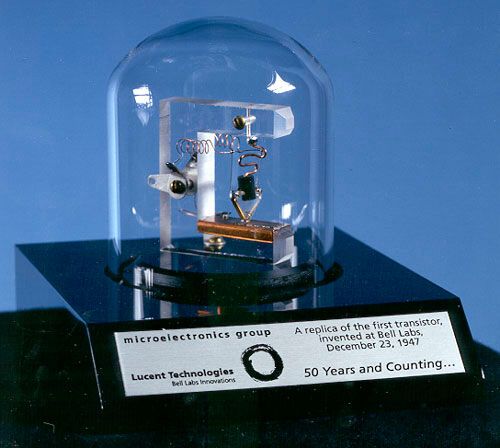
Three Bell Laboratories researchers William Shockley, John Bardeen, and Walter Brattain hold the credit to invent the first point-contact transistor on December 23, 1947. The trio initially went on to invent a germanium diode based on a field effect transistor but ended up constructing a bipolar point contact junction transistor. When the researchers were working on the project, they were enthusiastic about opening a transistor factory and selling voltage rectifiers to the world.
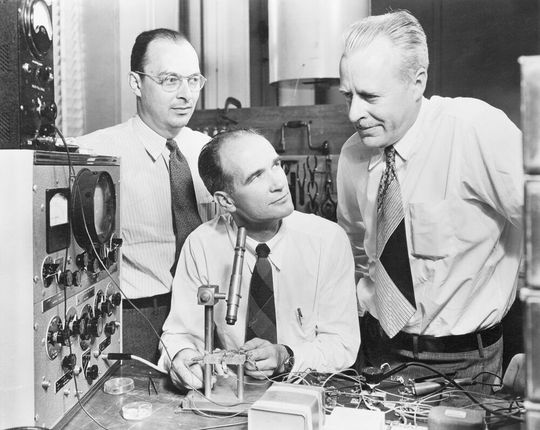
Shockley had been working to develop a transistor-like device or triode for 10 years. All his efforts were unsuccessful. Bardeen and Brattain joined him for engineering. As a result, the project was executed in 3-4 years. The trio faced challenges in understanding electron mobility and current control. They appointed Ralph Bray, a young Purdue University graduate to follow the project. He suspected the concept of minority carrier injection in 1943 but Shockley explained the concept in 1948.
Shortly before the Christmas of 1947, Bardeen discovered the phenomena of ”barriers”. Without informing Shockley, Bardeen and Brattain made a point contact transistor out of germanium. The notes from Brattain’s notebook confirm December 16 to be the invention date. On December 23, Brattain and another colleague H.R Moore demonstrated the transistor operation to other Bell Lab colleagues. The date marks the “official birthday of the transistor”.
Some lesser-known things about transistor invention
The unhappy inventor
Legends have it that Shockley was unhappy due to his lesser involvement and about credits given to Bardeen and Brattain. In his opinion, Bardeen and Brattain were too much ahead of him in the limelight. The relationship between the collaborators was intensely complex and full of ego clashes. Shockley felt underappreciated and believed that the other two were gaining loads of unnecessary attention. There were patent-related disagreements. However, William Shockley, John Bardeen, and Walter Brattain won a Nobel Prize in Physics on November 1, 1956.
As a result, Shockley moved independently to start his own company Shockley Semiconductor Laboratories (SSL) in 1955. Rude-but-genius Shockley went on to invent a bipolar junction transistor in its truest sense, without point contacts. It was a more efficient choice and less prone to failure. Due to his mismanagement, researchers left to start Fairchild Semiconductor. The company is responsible for detailing the most common MOSFET logic— CMOS technology.
:quality(80)/p7i.vogel.de/wcms/f8/20/f8200c20833f88f20ef5ba0f85550259/0110796538.jpeg "A transistor is a semiconductor device used to amplify or switch electronic signals and electrical power. (Source: YouraPechkin - stock.adobe.com)")
BASIC KNOWLEDGE - TRANSISTOR
Transistors: The building blocks of modern electronics
MOSFET and JFET were invented much later
The most popular transistor, whether as a stand-alone component or integrated into billions or trillions, MOSFET was invented 12 years later than the first demonstration of a point-contact transistor. Similarly, JFET, another commonly used transistor, was invented in 1953- 6 years after the first transistor. Junction transistors were prioritized for commercial applications until the late 70s. The VLSI era enabled field effect transistors to gain monopoly to this date.
Late commercialization
The early efforts to build transistors were based on germanium instead of silicon. Western Electric plant began producing the point-contact germanium transistors. Texas Instruments produced the first silicon-based transistor in late 1954.
Transistors could have been called “Triodes”
The engineers at Bell Labs were confused about choosing between multiple names like “Semiconductor Triode”, “Solid Triode”, “Surface State Triode”, and many others. An American Engineer-Author John Robinson Pierce coined the term “Transistor”! The name was chosen because of the device operation of “transconductance”. All transistors transfer the conductance ”transconductance”. The output current changes with respect to changes in the input voltage. The ratio of this is called transconductance.
The ones who talked vs The ones who invented
Physics, electronics to be more precise, looks aesthetically pleasing in theory. However, real-world invention is a different game only engineers can play.
In patent records, an Austrian-Hungarian Physicist Julius Edgar Lilienfeld holds the world’s first description of the field effect transistor principle. The patent was filed in 1925, with no research papers or articles history.
Years later, in 1934, German Physicist Dr Oskar Heil patented a field effect transistor. However, the entire scientific and tech industry ignored the research papers and patents completely because these devices seemed to be hypothetical for real-world construction.
:quality(80):fill(efefef,0)/p7i.vogel.de/wcms/5f/fe/5ffedb2e0ffa6/listing.jpg "listing")
Copy Transistor?
There has been evidence that Shockley’s work was largely inspired by Austrian-Hungarian Physicist Julius Edgar Lilienfeld’s description of the field effect transistor principle. Shockley, with another colleague Gerald Pearson, built an operational device based on the same patent. However, they didn’t bother to credit the physicist for their work.
The story of the transistor invention revolves majorly around Bell Labs
The entire history of transistor invention is related to Bell Labs only. While Shockley, Bardeen, and Brattain invented the point-contact transistor, another group of researchers invented MOSFET at Bell Labs in 1959.
Engineers Mohamed Atalla and Dawson Kahng invented MOSFET in 1959. They extended their invention to PMOS and NMOS MOSFETs. Two Bell Lab researchers Carl Frosch and Lincoln Derick demonstrated a transistor with drain and source terminals. However, they couldn’t showcase a practically reliable version. As a result, the MOSFET invention is largely credited to Atalla and Kahng.
Conclusion: “Transistor Butterfly Effect”
In chaos theory, the butterfly effect is described as an event X, which gives rise to a chain of events. A small event could cause a large change in the entire system. When engineers and researchers at Shockley’s company were unsatisfied, they founded Fairchild Semiconductor. Shockley addressed those employees as “Traitorous Eight”. Out of eight, two notable personalities- Gordon Moore and Robert Noyce were the founding members of the new company.
Everybody knows Noyce and Moore went on to start NM Electronics— Today’s “Intel Corporation” in 1968. In addition, due to the invention of the transistor, the Japanese became truly interested in the devices. Engineers Masaru Ibuka and Akio Morita founded “Sony Electronics” to mass-produce transistor-based radios. In conclusion, it can be said that Fairchild Semiconductor, Intel Corporation, Sony Electronics, and many other companies just exist for and because of transistors!!! But yes, not to forget, modern phones, computers, and many other devices operate because of these tiny devices!
References
Power Electronics in the Energy Transition

The parameters for energy transition and climate protection solutions span education, research, industry, and society. In the new episode of "Sound On. Power On.", Frank Osterwald of the Society for Energy and Climate Protection Schleswig‐Holstein talks about the holistic guidance his organization can provide.
Listen now!
(ID:50244923)
:quality(80)/p7i.vogel.de/wcms/7d/40/7d406bd959b3a9127c33a66157f9030a/0128339184v4.jpeg "The global digital infrastructure depends on the production of advanced semiconductor materials (Source: © uflypro - stock.adobe.com)")
:quality(80)/p7i.vogel.de/wcms/97/19/9719983f8596dcb47f64dba9648c4dc5/0124622838v2.jpeg "Germanium, despite failing as a semiconductor, held a strong market for two decades in the mid-20th century, with legacy texts favoring it over silicon. Today, it's still used with silicon in various applications. Learn more about this here. (Source: Polycrystalline-germanium / Jurii / CC BY 3.0 / Wikimedia Commons)")