


:quality(80)/p7i.vogel.de/wcms/2f/f3/2ff3221bf7665de2d0acf83760bfd1fa/0130031523v2.jpeg "Wolfspeed presents a 300 mm silicon carbide technology platform designed to support advanced packaging and high-efficiency power delivery for AI data center infrastructure. (Source: Wolfspeed)")
:quality(80)/p7i.vogel.de/wcms/c3/16/c316e955a97f5d72d9678297b237b9e5/0129932858v2.jpeg "Left: the single-phase version of the SENTRON ECPD with RCM, right: a model of the future three-phase version of the SENTRON ECPD. (Source: Siemens)")
:quality(80)/p7i.vogel.de/wcms/ef/0a/ef0adb0acf793fe147cc27c21f6a7a67/0129954238v2.jpeg "Empower Semiconductor introduces embedded silicon capacitors designed to improve power delivery and stability in AI and high-performance computing processors. (symbolic image) (Source: © IF.arc - stock.adobe.com)")
:quality(80)/p7i.vogel.de/wcms/53/f9/53f9301dfc9292d02960f7996c79cc6e/0129927601v2.jpeg "Wolfspeed’s new 10 kV SiC MOSFET enables high-voltage power conversion for grid and industrial applications. (symbolic image) (Source: © CREATIVE- 3.4 - stock.adobe.com)")
:quality(80)/p7i.vogel.de/wcms/6e/cd/6ecd41d095d5111cf4ed37b714844487/0129930878v2.jpeg "PCIM Asia Shenzhen provides a platform for industry experts to present new developments in power electronics and electrification technologies. (symbolic image) (Source: © killykoon - stock.adobe.com)")
:quality(80)/p7i.vogel.de/wcms/02/c0/02c0e9722f70b1134dbf96fb59a9c73d/0129655179v2.jpeg "The PCIM Conference 2026 will take place from June 9-11, featuring discussions on power electronics trends, including GaN technology and AI applications. (symbolic image) (Source: © Elmira - stock.adobe.com)")
:quality(80)/p7i.vogel.de/wcms/cc/67/cc670ea2029cd2af5c641af70e1bf734/0129816392v4.jpeg "Fraunhofer IAF coordinates the EU SUPREME project to accelerate GaN and SiC power semiconductor innovation in Europe. (Source: Fraunhofer IAF)")
:quality(80)/p7i.vogel.de/wcms/ea/e6/eae6aee30071e67a5627027974437134/0129544613v2.jpeg "GlobalFoundries and Renesas strengthen their collaboration to support U.S.-based semiconductor production and supply chain resilience. (Source: © ronstik - stock.adobe.com)")
:quality(80)/p7i.vogel.de/wcms/23/1a/231a97643aa7fc3adf2704a6273756c3/0130030642v2.jpeg "Gallium nitride (GaN) power devices are increasingly challenging silicon MOSFETs in low-voltage power conversion by enabling higher efficiency and switching performance. (Source: © Sheraz - stock.adobe.com)")
:quality(80)/p7i.vogel.de/wcms/3c/4b/3c4bbc68dda65c7071b4376fb57423b0/0130030465v2.jpeg "Faraday’s laws explain the fundamental behavior of magnetic fields and electronic devices in dynamic use cases. The operation of transformers, wireless chargers, induction cookers, induction motors, magnetic levitating trains (MAGLEV Trains), electric violin, and many others depends upon Faraday’s laws. (Source: © Sheraz - stock.adobe.com)")
:quality(80)/p7i.vogel.de/wcms/b1/5e/b15ee02b0ba02db70cf61e37d66ad1d3/0129349127v2.jpeg "Vehicle-to-grid (V2G) chargers enable bidirectional energy flow, allowing electric vehicles to act as mobile energy storage systems that can both draw power from and feed power back into the grid. (Source: © medienvirus - stock.adobe.com)")
:quality(80)/p7i.vogel.de/wcms/26/d5/26d591cc340077026eac56a0e7564faf/0129949603v2.jpeg "Flexible: The solid silicone-based electrolyte is elastic, thereby compensating for the voids that form in solid-state batteries during charging and discharging. (Source: Empa)")
:quality(80)/p7i.vogel.de/wcms/be/c8/bec8d43fc0ee73414274be44608b2970/0129748903v2.jpeg "The Infiniium XR804KA real-time oscilloscope delivers faster response time, improved stability, and streamlined workflows for high-speed digital and compliance testing. (Source: Keysight)")
:quality(80)/p7i.vogel.de/wcms/23/ee/23ee4a97790d6009dbfd7d9577ffa723/0129220424v2.jpeg "The R&S FPL1044 with the new RTSA option makes 40 MHz real-time frequency analysis available up to 44 GHz. (Source: Rohde & Schwarz )")
:quality(80)/p7i.vogel.de/wcms/3c/d1/3cd1cacbceb792ba63727199c61ca434/0127801860v2.jpeg "Thanks to cloud technology, users can collaborate on projects from anywhere and always have access to the latest planning data. (Source: SIEMENS)")
:quality(80)/p7i.vogel.de/wcms/5a/a0/5aa0436498af618297961fd54ab36cdf/0126290792v2.jpeg "Siemens accelerates student-led semiconductor innovation across Europe’s leading technical universities through Cre8Ventures’ Open Higher Education Program developed in collaboration with Arm and University of Southampton (Source: Siemens Digital Industries Software)")
GREEN ELECTRONICS Wooden computer mouse made with biodegradable circuit boards
Related Vendors
:fill(fff,0)/p7i.vogel.de/companies/60/7e/607ec89d5d9b5/white-frame.jpg "white frame.jpg (www.rohm.com)")
:fill(fff,0)/p7i.vogel.de/companies/5f/71/5f71d5f92a5f6/2000px-rogers-corporation-logo-svg.png "2000px-Rogers_Corporation_Logo.svg.png (rogers germany)")
:fill(fff,0)/p7i.vogel.de/companies/68/c2/68c2b622b43e1/logo.jpeg "logo (IQ Evolution GmbH)")
Modern printed circuit boards are made from petroleum-based materials and are difficult to recycle. Empa researchers have developed a biodegradable version – an important step toward sustainable electronics. Their biomaterial is based entirely on wood and can be processed into functional circuit boards for electronic devices.
They are the “heart” of every electronic device, from laptops to electric toothbrushes: printed circuit boards, also known as PCBs. These rigid boards are covered with copper traces and soldered electronic components and are usually of a tell-tale green color. They are, however, not exactly environmentally friendly.
The substrate generally used for the traces and components is a laminate made of fiber-reinforced epoxy resin. This composite material is based on petroleum and cannot be recycled. Proper disposal is costly, for example in a special pyrolysis furnace with exhaust air purification – a challenge, given the large quantities of discarded circuit boards that accumulate for disposal each year.
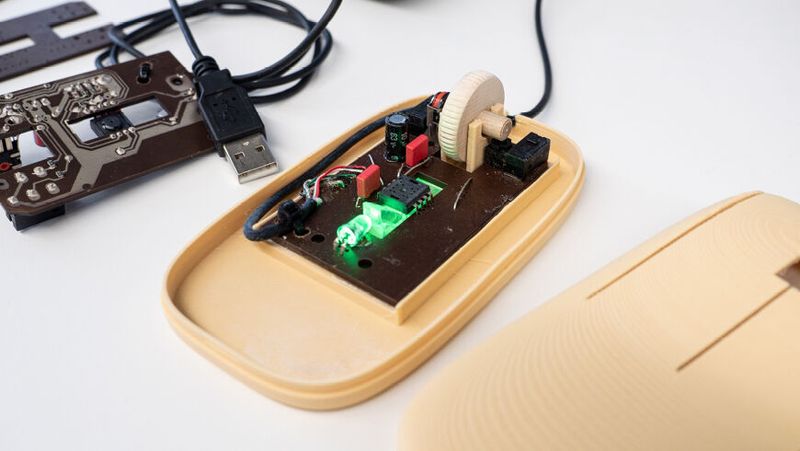
:quality(80)/p7i.vogel.de/wcms/93/13/9313a43a7018a3d839001db379d6e226/0127300059v1.jpeg "The “green” circuit board is actually not green, but brown: On the left is a mouse circuit board made of lignocellulose, on the right is a conventional mouse circuit board made of non-renewable raw materials. Image: Empa (Bild: Empa)")
:quality(80)/p7i.vogel.de/wcms/c6/a7/c6a784efc802c699461bfd00162e3f5c/0127300075v1.jpeg "The biodegradable mouse works just like any other computer mouse. Researchers produced the 3D-printed casing from a mixture of biodegradable plastic and wood fibers. Image: Empa (Bild: Empa)")
:quality(80)/p7i.vogel.de/wcms/3c/ea/3ceaf35213d8d7457344ad0945e171c7/0127300083v1.jpeg "Empa researcher Yuliia Dudnyk with the flaky lignocellulose, the starting material for the circuit board. Image: Empa (Bild: Empa)")
:quality(80)/p7i.vogel.de/wcms/39/fa/39fa3930b417afbd123855e2bcafaa9c/0127300088v1.jpeg "From raw material to finished product: The lignocellulose (left) is ground with water and pressed into hornified plates. The plates are cut to the desired shape and fitted with the conductor tracks and electronic components. Image: Empa (Bild: Empa)")
Researchers led by Thomas Geiger from Empa's Cellulose and Wood Materials laboratory are working on a “green”, i.e., sustainable option – which is actually brown. As part of the EU research project HyPELignum (see box), they developed a wood-based substrate for PCBs that can compete with conventional epoxy resin – and is also completely biodegradable. The researchers have incorporated the boards made from this material into functioning computer mice.
HyPELignum
The EU research project HyPELignum aims to develop a holistic approach to functional, CO₂-neutral electronics. To this end, the international project partners from research and industry are combining wood-based raw materials and transition metals that are as non-critical as possible with additive manufacturing and advanced sustainability analyses. The project is funded under the Horizon Europe program and the State Secretariat for Education, Research, and Innovation (SERI) and will run from October 2022 to September 2026. Researchers at Empa are involved in the development of sustainable printed circuit boards and in life cycle analysis.
Learn more!Dream team of fibrils and lignin
The source for the carrier material is a natural mixture of cellulose with a small amount of lignin. Strictly speaking, it is a waste product. “Our partners at the TNO research institute in the Netherlands have developed a process for extracting the raw materials lignin and hemicellulose from wood,” explains Geiger. “What remains is brownish lignocellulose, for which there has been no use so far.” Geiger, who has a long track record of research into electronics made from cellulose, saw the potential of the raw material.
In order for the flaky lignocellulose to become a high-tech product such as a PCB, it must first be ground by adding water to break down the relatively thick cellulose fibers into thinner fibrils. This creates a fine network of slender fibrils that are interconnected. In a next step, the water is squeezed out of the mixture under high pressure. The fibrils move closer together and dry to form a solid mass. The researchers call this process hornification. “The lignin contained in the material serves as an additional binding agent,” says the Geiger.
The resulting hornified board is almost as resistant as a conventional circuit board made of fiber-reinforced epoxy – almost. This is because the compostable board is still sensitive to water and high humidity. But water is needed because, “if no water can penetrate the carrier material at all, microorganisms such as fungi can no longer grow in it – and it would thus not be biodegradable,” explains Geiger.
:quality(80)/p7i.vogel.de/wcms/49/41/49414aec54b828f2484e3bf80ad0634d/0100423163.jpeg "PCBs are some of the most crucial electronics components in modern devices, so it’s no surprise that their design phase can be complex. (Source: ©spainter_vfx - stock.adobe.com)")
PRINTED CIRCUIT BOARDS
What’s involved in the process of PCB design?
A compostable computer mouse
Nevertheless, the researchers are confident that the resistance of lignocellulose-based biomaterials can be further improved with suitable processing methods. “For certain applications, however, we also need to rethink our relationship with electronics,” says Thomas Geiger. “Many electronic devices are only in use for a few years before they become obsolete – so it doesn't make sense to manufacture them from materials that can last for hundreds of years.”
In collaboration with their industrial partner PROFACTOR GmbH in Austria, the researchers have printed conductive traces on their sustainable circuit boards and fitted them with components to produce functioning electronic devices, such as a computer mouse or an RFID card. At the end of its service life, such a device could be composted given the right conditions. Once the carrier material has decomposed, the metallic and electronic components can be removed from the compost and recycled.
Next, the researchers want to make their biomaterial for circuit boards more resistant without compromising its biodegradability. The project partners also plan to produce further demonstration devices with lignocellulose plates at the end of the HyPELignum project in 2026. Transfer to industry is also a must: “Together with Swiss and European companies, we want to develop further applications for the lignocellulose material,” says Geiger.
(ID:50587927)
:quality(80)/p7i.vogel.de/wcms/c9/83/c98342208a1a08d2a70a9d9210ec52cf/0127808597v2.jpeg "Symbolic image: Lignin based biopolymers powering the future of green energy storage. (Source: © zuriya - stock.adobe.com)")
:quality(80)/p7i.vogel.de/wcms/07/f5/07f5c8697d34baedd103b8a448cbe3b3/0124420955v2.jpeg "Researchers at the Laboratory of Organic Electronics have developed a battery that is soft and malleable. It is based on conductive plastics conjugated polymers and lignin. (Source: Thor Balkhed)")