


:quality(80)/p7i.vogel.de/wcms/40/62/4062c2d596e53b038e0f05f6c3182509/0133843963v2.jpeg "Littelfuse introduces ultra-low-capacitance TVS diode arrays with a 6.5 V clamping voltage for transient protection in automotive and consumer electronics. (Source: Littelfuse)")
:quality(80)/p7i.vogel.de/wcms/e5/9e/e59ecc43d3c278aece316be4209113c9/0133732079v2.jpeg "Renesas introduces its first low-voltage GaN FET family, with 100 V devices for power conversion in AI data centers, robotics and industrial systems. (Source: Renesas)")
:quality(80)/p7i.vogel.de/wcms/c4/a7/c4a7243caa7c26af5fe5108f7894050a/0133626683v2.jpeg "Wolfspeed’s new premium 200 mm SiC substrates are designed to provide more consistent starting material for power semiconductor manufacturing. (Source: © Marina - stock.adobe.com)")
:quality(80)/p7i.vogel.de/wcms/91/8b/918b533161e7327075370338d7af97af/0133589801v2.jpeg "Acbel will present scalable DC charging power modules and an 11kW passively cooled 2-in-1 on-board power solution at New Mobility Congress 2026 in Katowice, covering both charging infrastructure and vehicle applications. (Source: Acbel)")
:quality(80)/p7i.vogel.de/wcms/4f/47/4f473b006be95fb33ec3d8e3fd727b06/0133732443v2.jpeg "SEMI Europe joins the European Commission’s STEAM Executive Panel, bringing the semiconductor industry’s skills needs into discussions on education, training and workforce development. (Source: © phonlamaiphoto - stock.adobe.com)")
:quality(80)/p7i.vogel.de/wcms/c4/59/c459b75bff747399a7a7fd58381f3983/0133731182v2.jpeg "Infineon has completed its acquisition of C2i Semiconductors, adding expertise in software-defined power management and multiphase control for AI data-center power systems. (Source: © InfiniteFlow - stock.adobe.com)")
:quality(80)/p7i.vogel.de/wcms/fd/2c/fd2c2388e7985cd4c75cff39f07f6361/0133676222v2.jpeg "Greenconn expands its connector portfolio with the compact WF28 wire-to-board series and new 25 mm and 30 mm stacking-height options for its GC01 floating connectors. (Source: © Greenconn)")
:quality(80)/p7i.vogel.de/wcms/69/06/6906b5f22bfbb3f8b874ba9e459c7d26/0133675448v2.jpeg "New backend manufacturing hub strengthens and further diversifies Infineon's global production network. (Source: © Apriew - stock.adobe.com)")
:quality(80)/p7i.vogel.de/wcms/b4/93/b493d5ce620cf7eb558ca6bcd9852a1e/0133811655v2.jpeg "The massive integration of utility-scale solar photovoltaics demands BESS platforms equipped with high-power-density inverters to mitigate generation intermittency. (Source: Pixabay)")
:quality(80)/p7i.vogel.de/wcms/f8/cb/f8cbf79cc21d48d7cad08e2b620218f7/0133738515v2.jpeg "Microchip and Navitas are demonstrating a 20 kW reference design that converts an 800 VDC data-center bus to a 6 V server rail, combining GaN power devices with digital control. (Source: © Formoney - stock.adobe.com)")
:quality(80)/p7i.vogel.de/wcms/ee/de/eedef7055c094757eb208a9d181e85dc/0133371000v2.jpeg "Resonac has developed 300 mm SiC single-crystal substrates, advancing larger-diameter wafer technology for next-generation power electronics and other high-performance semiconductor applications. (Source: © Resonac)")
:quality(80)/p7i.vogel.de/wcms/7b/76/7b76005554b556df2a7a3794bdf69d44/0132365246v2.jpeg "Hioki’s ST5680A DC Hipot Tester combines CE/UKCA/CSA compliance, an integrated capacitance‑based contact check and time‑series waveform recording (voltage, leakage current, insulation resistance) to standardize hipot and insulation testing across EV cell, module and pack production lines. (Source: Hioki)")
:quality(80)/p7i.vogel.de/wcms/af/7f/af7f7b0fb7f29219fc991b1130f65477/0132241333v2.jpeg "Comprehensive laboratory testing regimens—combining thermal cycling, high‑current stress, EMC, and accelerated lifetime tests—are essential to validate advanced power designs and ensure reliability in real‑world applications. (Source: PRBX)")
:quality(80)/p7i.vogel.de/wcms/16/3d/163df69363f8125315a9826e13ea4b05/0131927425v2.jpeg "Solution will maximize data center and AI factory profitability while delivering engineering-grade insights to design and operations for more efficient, sustainable, and resilient infrastructure. (Source: Cadence)")
:quality(80)/p7i.vogel.de/wcms/85/b7/85b7e90733a2bd8f21515d8f7137f2fc/0131917677v2.jpeg "Renesas acquires Pictorus to integrate its embedded application software platform with Renesas’ MCU and MPU portfolio, helping developers shorten time‑to‑market and simplify system integration. (Source: © lucadp - stock.adobe.com)")
:quality(80)/p7i.vogel.de/wcms/27/07/2707280c807689b437baed3660257404/0133626052v2.jpeg "The quantum behavior of electrons shapes semiconductor devices—and the power converters that deliver electricity to modern computing systems. (Source: © Celt Studio - stock.adobe.com)")
BATTERY SYSTEMS Energy storage and the rise of power electronics
Related Vendors
:fill(fff,0)/p7i.vogel.de/companies/68/2c/682c3e2e9a195/logotype-rvb.jpeg "logotype-rvb (MERSEN France)")
:fill(fff,0)/p7i.vogel.de/companies/66/8b/668becd1c07eb/dowa-logo-word--1-.jpeg "dowa-logo-word--1- (DOWA)")
Battery energy storage systems (BESS) are rapidly moving to the forefront of modern power grids. Once limited to pilot projects, they now support multi-hundred-megawatt installations that rival traditional generation assets. This shift is transforming the power electronics industry, making inverters, converters, and control platforms essential for grid-scale performance and compliance
The rise of BESS marks a major turning point for energy infrastructure worldwide. What were once niche solutions are now central to the operation and economics of large-scale power grids. As a result, power electronics technology is evolving to meet the demanding requirements of storage applications, from efficiency and reliability to advanced control capabilities.
Storage Growth is Accelerating and Concentrating
Global deployment of battery energy storage has entered a steep growth phase. Annual additions have moved from tens of gigawatt-hours earlier this decade to more than 70 gigawatt hours in 2023, with forecasts pointing to roughly 90 to 100 gigawatts of new capacity per year in the mid-2020s. Near-term growth rates in the 20-30% range are widely expected, driven primarily by grid-connected systems rather than residential or behind-the-meter installations.
Geographically, three regions dominate. China remains the largest single market, accounting for well over half of global grid-scale storage capacity. Policy support, rapid renewable buildout and strong domestic supply chains have enabled projects to move quickly from approval to commissioning. The U.S. follows, with particularly strong deployment in California and Texas, where storage is used to manage solar oversupply, evening peaks and system reliability. Europe is smaller in absolute terms but growing rapidly, with Germany, the UK and parts of Southern Europe pushing storage as a response to renewable intermittency and gas price volatility.
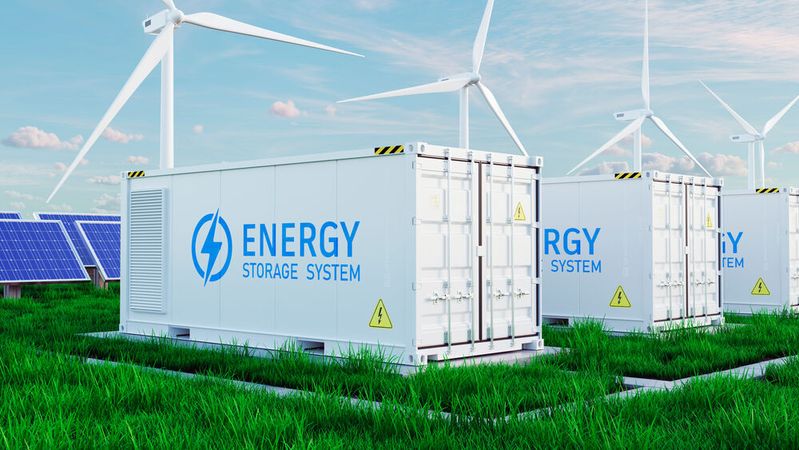
What matters for power electronics is not just the headline growth, but the form that growth is taking. The fastest expansion is occurring at the utility scale, with individual projects increasingly ranging from 50 megawatts to more than 300 megawatts, often with four-hour or longer durations. These sites are built around containerised architectures, where each container includes battery racks, thermal management and one or more power conversion systems rated in the multi-megawatt range.
As project sizes grow, the total amount of conversion hardware deployed per site scales almost linearly with power rating. A 200-megawatt storage plant typically includes dozens of PCS units, plus internal DC/DC stages, isolation, protection and auxiliary power supplies. Even incremental growth in global BESS capacity therefore translates directly into rising demand for high-power semiconductors, gate drivers, magnetics, cooling systems and digital control platforms.
:quality(80)/p7i.vogel.de/wcms/94/63/94637e748c3741a5424a91c7409da4ac/0126292545v2.jpeg "Toyota and Mazda are testing a new energy storage system at Mazda's Hiroshima Plant to enhance battery reuse and contribute to carbon neutrality. (Source: © Kedsara - stock.adobe.com)")
ENERGY STORAGE SYSTEMS
Toyota and Mazda test energy storage with EV batteries
Why BESS is Structurally Different
Power electronics has long been a growth industry, with solar inverters, motor drives and EV charging all contributing volume. BESS, however, places a distinct set of demands on conversion hardware that elevate its strategic importance.
First, storage inverters are inherently bidirectional. Unlike PV inverters, which convert DC to AC in one direction, a PCS must efficiently handle both charge and discharge, often multiple times per day. This doubles the stress on switching devices and thermal systems while raising expectations for lifetime and reliability.
Second, grid-connected storage increasingly provides active grid services rather than passive energy shifting. Frequency regulation, voltage support, fast reserve and black start capability require inverters to respond in milliseconds, inject or absorb reactive power, and operate stably under weak-grid or fault conditions. These functions are implemented almost entirely in power electronics and control software, not in the battery itself.
Third, storage projects are becoming modular by design. Instead of a single large inverter, developers favour multiple smaller PCS units operating in parallel. This improves redundancy and simplifies logistics, but it also increases the total number of conversion stages deployed. From a power electronics perspective, this favours scalable designs built around standardised MW-class modules rather than bespoke central converters.
Finally, grid codes are evolving rapidly. Requirements for fault ride-through, grid-forming operation and dynamic reactive power support are now common in interconnection standards. Compliance depends on sophisticated control algorithms running on DSPs, MCUs or FPGAs tightly integrated with the power stage. The inverter is no longer just a power interface; it is a programmable grid asset.
These factors explain why BESS tends to consume more power electronics value per megawatt than many other applications. The converter is not a commodity box at the edge of the system. It defines what the system can do.
WG and Pushing Past 98% EfficiencyB
The rapid adoption of silicon carbide (SiC) is closely linked to the rise of large-scale storage. SiC MOSFETs and diodes enable higher switching frequencies, lower conduction losses and operation at higher DC bus voltages than traditional silicon IGBTs. In the context of BESS, those attributes translate directly into system-level benefits.
Modern utility-scale PCS units routinely target peak efficiencies above 98%, with some designs approaching 99% under optimal conditions. At tens or hundreds of megawatts, even small efficiency gains have significant economic impact. Reduced losses lower operating costs, shrink cooling requirements and allow higher power density within containerised enclosures.
Higher voltage capability is equally important. Many new storage systems operate at 1,100 VDC or higher on the battery side. This reduces current for a given power level, lowering copper losses and enabling simpler busbar and cable designs. SiC devices are well suited to these voltages, whereas silicon solutions face efficiency and thermal penalties.
The shift to wide-bandgap technology also influences system architecture. Higher switching frequencies allow smaller magnetics and filters, supporting more compact PCS designs. That, in turn, makes modular deployment easier and reduces balance-of-system costs related to footprint and civil works.
GaN devices are beginning to appear in lower-power DC/DC stages within storage systems, particularly where high efficiency and fast transient response are required. While SiC dominates the main inverter stage, GaN is finding a role in auxiliary converters and internal power distribution.
:quality(80)/p7i.vogel.de/wcms/b8/6a/b86a86d21877b046ab53a57cd373e419/0125503442v4.jpeg "NXP Semiconductors' BMx7318/7518 IC family offers a cost-effective 18-channel Li-ion battery cell controller to improve safety and performance in EVs and energy storage, with strong EMI immunity and safety compliance. (Source: © phaisarnwong2517 - stock.adobe.com)")
INTEGRATED CIRCUITS
NXP unveils cost-effective 18-channel Li-ion battery ICs for EVs and energy systems
BESS vs Other Fast-Growing Segments
Energy storage is not the only area driving power electronics demand, but it stands out for a combination of growth rate, scale and technical intensity.
EV fast charging is growing faster in percentage terms, with some segments expanding at 40-50% per year. However, individual chargers are typically rated at hundreds of kilowatts to a few megawatts, and utilisation rates vary widely. Storage projects deploy large amounts of hardware in concentrated sites, creating substantial, predictable demand for MW-class converters.
Solar PV inverters remain a large market but are growing more slowly, often in the high single digits to low teens. Many PV inverter designs are mature, and price pressure is intense. Storage inverters, by contrast, are still evolving rapidly as grid requirements change, supporting higher margins for advanced designs.
Industrial motor drives represent a stable but slower-growing segment, typically expanding at around 5% per year. While technically demanding, they lack the policy-driven acceleration and grid integration complexity that characterise modern BESS.
In that context, BESS is best described as one of the fastest-growing and most strategically important applications for power electronics, even if it is not always the fastest in raw percentage terms.
The Value Centre of Storage Systems
From a business perspective, storage places unusual emphasis on conversion hardware. Batteries account for the largest share of system cost, but they are increasingly commoditised. The ability to extract value from those batteries depends on the PCS and its controls.
Power electronics typically represent 15-25% of total BESS hardware cost, a higher share than in many other energy systems. That share reflects not just materials and manufacturing, but the embedded software, certification effort and engineering required to meet grid and safety standards.
This has encouraged vertical integration. Some suppliers combine battery cells, PCS and EMS into tightly integrated products, optimising performance and simplifying deployment. Others focus on becoming best-in-class inverter and control providers, partnering with cell manufacturers and system integrators. In both cases, the converter sits at the centre of system differentiation.
As grids absorb more variable generation, storage will continue to expand in size and sophistication. Each step in that evolution increases the demands placed on power electronics. The result is a market where growth is driven not just by volume, but by the rising importance of advanced, high-performance conversion hardware.
(ID:50660436)
:quality(80)/p7i.vogel.de/wcms/6e/e5/6ee5ad1dc45fd69a5a5718147605850a/0129347492v2.jpeg "This article introduces the concept of megawatt-hour battery storage systems.
(Source: © malp - stock.adobe.com)")
:quality(80)/p7i.vogel.de/wcms/b4/93/b493d5ce620cf7eb558ca6bcd9852a1e/0133811655v2.jpeg "The massive integration of utility-scale solar photovoltaics demands BESS platforms equipped with high-power-density inverters to mitigate generation intermittency. (Source: Pixabay)")