


:quality(80)/p7i.vogel.de/wcms/2f/f3/2ff3221bf7665de2d0acf83760bfd1fa/0130031523v2.jpeg "Wolfspeed presents a 300 mm silicon carbide technology platform designed to support advanced packaging and high-efficiency power delivery for AI data center infrastructure. (Source: Wolfspeed)")
:quality(80)/p7i.vogel.de/wcms/c3/16/c316e955a97f5d72d9678297b237b9e5/0129932858v2.jpeg "Left: the single-phase version of the SENTRON ECPD with RCM, right: a model of the future three-phase version of the SENTRON ECPD. (Source: Siemens)")
:quality(80)/p7i.vogel.de/wcms/ef/0a/ef0adb0acf793fe147cc27c21f6a7a67/0129954238v2.jpeg "Empower Semiconductor introduces embedded silicon capacitors designed to improve power delivery and stability in AI and high-performance computing processors. (symbolic image) (Source: © IF.arc - stock.adobe.com)")
:quality(80)/p7i.vogel.de/wcms/53/f9/53f9301dfc9292d02960f7996c79cc6e/0129927601v2.jpeg "Wolfspeed’s new 10 kV SiC MOSFET enables high-voltage power conversion for grid and industrial applications. (symbolic image) (Source: © CREATIVE- 3.4 - stock.adobe.com)")
:quality(80)/p7i.vogel.de/wcms/6e/cd/6ecd41d095d5111cf4ed37b714844487/0129930878v2.jpeg "PCIM Asia Shenzhen provides a platform for industry experts to present new developments in power electronics and electrification technologies. (symbolic image) (Source: © killykoon - stock.adobe.com)")
:quality(80)/p7i.vogel.de/wcms/02/c0/02c0e9722f70b1134dbf96fb59a9c73d/0129655179v2.jpeg "The PCIM Conference 2026 will take place from June 9-11, featuring discussions on power electronics trends, including GaN technology and AI applications. (symbolic image) (Source: © Elmira - stock.adobe.com)")
:quality(80)/p7i.vogel.de/wcms/cc/67/cc670ea2029cd2af5c641af70e1bf734/0129816392v4.jpeg "Fraunhofer IAF coordinates the EU SUPREME project to accelerate GaN and SiC power semiconductor innovation in Europe. (Source: Fraunhofer IAF)")
:quality(80)/p7i.vogel.de/wcms/ea/e6/eae6aee30071e67a5627027974437134/0129544613v2.jpeg "GlobalFoundries and Renesas strengthen their collaboration to support U.S.-based semiconductor production and supply chain resilience. (Source: © ronstik - stock.adobe.com)")
:quality(80)/p7i.vogel.de/wcms/b1/5e/b15ee02b0ba02db70cf61e37d66ad1d3/0129349127v2.jpeg "Vehicle-to-grid (V2G) chargers enable bidirectional energy flow, allowing electric vehicles to act as mobile energy storage systems that can both draw power from and feed power back into the grid. (Source: © medienvirus - stock.adobe.com)")
:quality(80)/p7i.vogel.de/wcms/26/d5/26d591cc340077026eac56a0e7564faf/0129949603v2.jpeg "Flexible: The solid silicone-based electrolyte is elastic, thereby compensating for the voids that form in solid-state batteries during charging and discharging. (Source: Empa)")
:quality(80)/p7i.vogel.de/wcms/4d/e0/4de02f76a37cbb3df30dd231de589c8e/0128866890v2.jpeg "Both legacy and vGaN show higher carrier mobility and band gap energies compared to other power semiconductors. (Source: © phonlamaiphoto - stock.adobe.com)")
:quality(80)/p7i.vogel.de/wcms/18/0b/180b7b63afc91e523592d8a5ce161c96/0129847487v2.jpeg "InGaAs-based photodetectors enable sensitive and fast detection in the short-wave infrared spectrum for modern sensing and communication applications. (Source: © VITALII - stock.adobe.com)")
:quality(80)/p7i.vogel.de/wcms/be/c8/bec8d43fc0ee73414274be44608b2970/0129748903v2.jpeg "The Infiniium XR804KA real-time oscilloscope delivers faster response time, improved stability, and streamlined workflows for high-speed digital and compliance testing. (Source: Keysight)")
:quality(80)/p7i.vogel.de/wcms/23/ee/23ee4a97790d6009dbfd7d9577ffa723/0129220424v2.jpeg "The R&S FPL1044 with the new RTSA option makes 40 MHz real-time frequency analysis available up to 44 GHz. (Source: Rohde & Schwarz )")
:quality(80)/p7i.vogel.de/wcms/3c/d1/3cd1cacbceb792ba63727199c61ca434/0127801860v2.jpeg "Thanks to cloud technology, users can collaborate on projects from anywhere and always have access to the latest planning data. (Source: SIEMENS)")
:quality(80)/p7i.vogel.de/wcms/5a/a0/5aa0436498af618297961fd54ab36cdf/0126290792v2.jpeg "Siemens accelerates student-led semiconductor innovation across Europe’s leading technical universities through Cre8Ventures’ Open Higher Education Program developed in collaboration with Arm and University of Southampton (Source: Siemens Digital Industries Software)")
:quality(80)/thumbor.vogel.de/945pzb0o80T2RjQQYBgLdszhUts=/500x500/p7i.vogel.de/wcms/67/50/67503e4ee8acf/headshot-schulz.jpeg "Dr.-Ing. Martin Schulz")
EXPERT OPINION Decarbonizing with H2 needs decarbonizing H2 first
Related Vendors
:fill(fff,0)/p7i.vogel.de/companies/60/7e/607ec89d5d9b5/white-frame.jpg "white frame.jpg (www.rohm.com)")
:fill(fff,0)/p7i.vogel.de/companies/61/dc/61dc0e8c2e420/dspace-logo-1000px-220107.png "dspace-logo-1000px-220107 (dSPACE GmbH)")
:fill(fff,0)/p7i.vogel.de/companies/68/08/6808a2b3b6595/het-logo.jpeg "het-logo (Heraeus Electronics)")
Hydrogen is increasingly promoted as mandatory part of an energy transition towards a zero carbon society. It is supposed to become a fuel for the future, replace natural gas in heating, power vehicles, act as a core component to generate e-fuels to decarbonize aviation and be a seasonal energy storage.
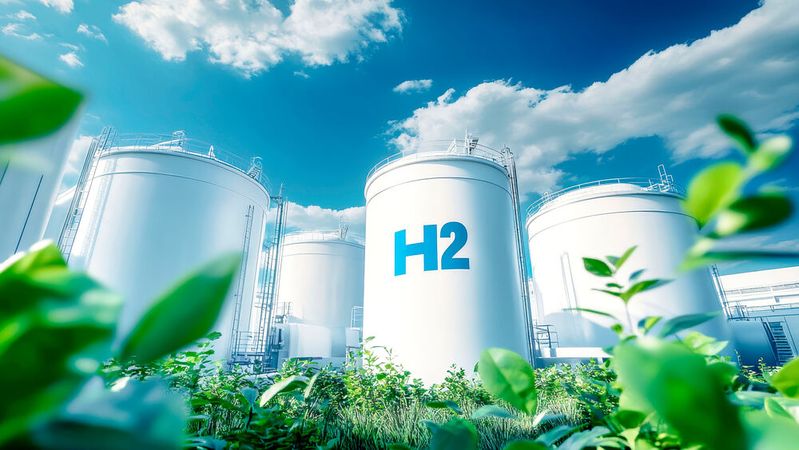
H2 is an important chemical component used in producing fertilizer and many other products from the chemical industry. The world today has an annual demand of roughly 100 million tons of this element, which is repeatedly cited as being the most abundant substance on Earth - and in space. Most of this hydrogen is generated by steam reforming of natural gas with a catastrophic carbon footprint of 10 kg CO2 per kg of hydrogen.
However, hydrogen can be generated from electrolysis using renewable energy sources, resulting in a zero-carbon fuel, right?
This statement is technically correct but as always, there is a catch. With hydrogen, "the catch" is that it needs to be generated using electricity and water. To get 1kg of the gas, 10 liters of water need to be split and on industrial scale, an electrolyzer with 10 MW of power can generate 1,400 tons of hydrogen in one year. This is where the trouble starts as a 10 MW electrolysis, operated one year, consumes as much as 80,000 MWh of electricity. Generating 100 million tons of green hydrogen in one year would demand 68,500 electrolysis facilities, 10 MW each, consuming a mind-boggling 4,180 TWh of electricity. To set this into perspective: The electricity consumption of the United States is about 5,480 TWh.
If hydrogen generation is to be decarbonized by 2040, this means setting up 130 MW of electrolysis every day from now on until December 2040. Every day, every Sunday, Christmas, New Year's Eve and Independence Day. In parallel it would demand a tremendous amount of renewable energy to be set up. Generating this much energy would require 137,000 windmills with 10 MW each in addition to 205,500 solar arrays with 10 MW each.
:quality(80):fill(efefef,0)/p7i.vogel.de/wcms/65/cb/65cb9c3a03849/webinar-efficient-electrolysis-through-comprehensive-power-conversion-solutions-coverbild.jpeg "Webinar_Efficient Electrolysis through Comprehensive Power Conversion Solutions_Coverbild (Infineon)")
GREEN HYDROGEN
Efficient Electrolysis through Comprehensive Power Conversion Solutions
On top of that, an inherent paradox needs to be solved: If hydrogen is used as energy storage, it would be a bad idea, to use this stored energy to generate hydrogen, right? However, to keep the electrolyzers working almost 24/7, fed by zero-carbon energies, there needs to be energy storage. Windmills off-shore will provide about 4000 full-power-equivalent hours per year and solar arrays work in parallel for about 1000 full-power-equivalent hours. So about 50% of the energy needed per year could be taken from those sources directly, the second half would have to be stored. Stored in batteries because storing in H2 to generate H2 is not making sense. Consequently, battery energy storage capacity would need to increase by a staggering amount of 2,740 TWh.
This requires a daily installation of 500GWh of battery capacity from now to December 2040. These mind-blowing numbers reveal that even substituting the fossil hydrogen currently used by green hydrogen represents a global challenge in the true manner of speaking. The benefit would be, that a huge amount of CO2 - 1000 million tons - would not be generated.
:quality(80)/p7i.vogel.de/wcms/91/df/91dfe5fc3d067dad68e2e645ffcccec9/0119994241v2.jpeg "Intelligent power modules not only manage the switching of power but also incorporate fault detection and protection mechanisms, ensuring the longevity and safety of the heat pump system. (Source: EBV Elektronik)")
EBV SHOWCASES ONSEMI'S HEAT PUMP EFFICIENCY SOLUTIONS
How intelligent power modules are revolutionizing heat pumps
However, hydrogen today plays no role as fuel or replacement for natural gas and if it should, it would demand another 100 million tons of it. Moreover, decarbonizing the global steel production would require further 100 million tons of the stuff. So how serious can hydrogen, often nicknamed "hopium" for obvious reasons, could become an energy carrier for the future zero-carbon society?
Wherever fossil hydrogen is used today, it should be replaced by green hydrogen with the correlating CO2 reduction. That's challenging enough for the 20 years ahead of us, most likely for far more than this. Wherever there are better solutions than hydrogen, hydrogen should not be considered. Heating with heat pumps instead of hydrogen, powering vehicles with batteries instead of hydrogen, or use inductive heating in metal melting and treatment instead of burning hydrogen.
(ID:50260823)
:quality(80)/p7i.vogel.de/wcms/7b/cf/7bcf68ed577974a86f4679c4b4b85b46/0128095713v2.jpeg "Symbolic Image: Deployment of heat batteries by Rondo and EDP aims to enhance energy efficiency and sustainability for Heineken's production processes. (Source: © Kittinan - stock.adobe.com)")
:quality(80)/p7i.vogel.de/wcms/6e/fd/6efdf487345688ca2b71ae23a398bc5f/0128553399v2.jpeg "This article explains how hydrogen can contribute to energy storage applications and where power electronics come into play. (Source: © peterschreiber.media - stock.adobe.com)")