


:quality(80)/p7i.vogel.de/wcms/2f/f3/2ff3221bf7665de2d0acf83760bfd1fa/0130031523v2.jpeg "Wolfspeed presents a 300 mm silicon carbide technology platform designed to support advanced packaging and high-efficiency power delivery for AI data center infrastructure. (Source: Wolfspeed)")
:quality(80)/p7i.vogel.de/wcms/c3/16/c316e955a97f5d72d9678297b237b9e5/0129932858v2.jpeg "Left: the single-phase version of the SENTRON ECPD with RCM, right: a model of the future three-phase version of the SENTRON ECPD. (Source: Siemens)")
:quality(80)/p7i.vogel.de/wcms/ef/0a/ef0adb0acf793fe147cc27c21f6a7a67/0129954238v2.jpeg "Empower Semiconductor introduces embedded silicon capacitors designed to improve power delivery and stability in AI and high-performance computing processors. (symbolic image) (Source: © IF.arc - stock.adobe.com)")
:quality(80)/p7i.vogel.de/wcms/53/f9/53f9301dfc9292d02960f7996c79cc6e/0129927601v2.jpeg "Wolfspeed’s new 10 kV SiC MOSFET enables high-voltage power conversion for grid and industrial applications. (symbolic image) (Source: © CREATIVE- 3.4 - stock.adobe.com)")
:quality(80)/p7i.vogel.de/wcms/6e/cd/6ecd41d095d5111cf4ed37b714844487/0129930878v2.jpeg "PCIM Asia Shenzhen provides a platform for industry experts to present new developments in power electronics and electrification technologies. (symbolic image) (Source: © killykoon - stock.adobe.com)")
:quality(80)/p7i.vogel.de/wcms/02/c0/02c0e9722f70b1134dbf96fb59a9c73d/0129655179v2.jpeg "The PCIM Conference 2026 will take place from June 9-11, featuring discussions on power electronics trends, including GaN technology and AI applications. (symbolic image) (Source: © Elmira - stock.adobe.com)")
:quality(80)/p7i.vogel.de/wcms/cc/67/cc670ea2029cd2af5c641af70e1bf734/0129816392v4.jpeg "Fraunhofer IAF coordinates the EU SUPREME project to accelerate GaN and SiC power semiconductor innovation in Europe. (Source: Fraunhofer IAF)")
:quality(80)/p7i.vogel.de/wcms/ea/e6/eae6aee30071e67a5627027974437134/0129544613v2.jpeg "GlobalFoundries and Renesas strengthen their collaboration to support U.S.-based semiconductor production and supply chain resilience. (Source: © ronstik - stock.adobe.com)")
:quality(80)/p7i.vogel.de/wcms/23/1a/231a97643aa7fc3adf2704a6273756c3/0130030642v2.jpeg "Gallium nitride (GaN) power devices are increasingly challenging silicon MOSFETs in low-voltage power conversion by enabling higher efficiency and switching performance. (Source: © Sheraz - stock.adobe.com)")
:quality(80)/p7i.vogel.de/wcms/3c/4b/3c4bbc68dda65c7071b4376fb57423b0/0130030465v2.jpeg "Faraday’s laws explain the fundamental behavior of magnetic fields and electronic devices in dynamic use cases. The operation of transformers, wireless chargers, induction cookers, induction motors, magnetic levitating trains (MAGLEV Trains), electric violin, and many others depends upon Faraday’s laws. (Source: © Sheraz - stock.adobe.com)")
:quality(80)/p7i.vogel.de/wcms/b1/5e/b15ee02b0ba02db70cf61e37d66ad1d3/0129349127v2.jpeg "Vehicle-to-grid (V2G) chargers enable bidirectional energy flow, allowing electric vehicles to act as mobile energy storage systems that can both draw power from and feed power back into the grid. (Source: © medienvirus - stock.adobe.com)")
:quality(80)/p7i.vogel.de/wcms/26/d5/26d591cc340077026eac56a0e7564faf/0129949603v2.jpeg "Flexible: The solid silicone-based electrolyte is elastic, thereby compensating for the voids that form in solid-state batteries during charging and discharging. (Source: Empa)")
:quality(80)/p7i.vogel.de/wcms/be/c8/bec8d43fc0ee73414274be44608b2970/0129748903v2.jpeg "The Infiniium XR804KA real-time oscilloscope delivers faster response time, improved stability, and streamlined workflows for high-speed digital and compliance testing. (Source: Keysight)")
:quality(80)/p7i.vogel.de/wcms/23/ee/23ee4a97790d6009dbfd7d9577ffa723/0129220424v2.jpeg "The R&S FPL1044 with the new RTSA option makes 40 MHz real-time frequency analysis available up to 44 GHz. (Source: Rohde & Schwarz )")
:quality(80)/p7i.vogel.de/wcms/3c/d1/3cd1cacbceb792ba63727199c61ca434/0127801860v2.jpeg "Thanks to cloud technology, users can collaborate on projects from anywhere and always have access to the latest planning data. (Source: SIEMENS)")
:quality(80)/p7i.vogel.de/wcms/5a/a0/5aa0436498af618297961fd54ab36cdf/0126290792v2.jpeg "Siemens accelerates student-led semiconductor innovation across Europe’s leading technical universities through Cre8Ventures’ Open Higher Education Program developed in collaboration with Arm and University of Southampton (Source: Siemens Digital Industries Software)")
MARKET ANALYSIS Semiconductor Memory: An overview and analysis
Related Vendors
:fill(fff,0)/p7i.vogel.de/companies/63/c7/63c7da97be945/diotec.png "diotec (Diotec Semiconductor AG)")
:fill(fff,0)/p7i.vogel.de/companies/60/7e/607ec89d5d9b5/white-frame.jpg "white frame.jpg (www.rohm.com)")
:fill(fff,0)/p7i.vogel.de/companies/68/c2/68c2b622b43e1/logo.jpeg "logo (IQ Evolution GmbH)")
Have you ever wondered if the pen drive you have been using for years could be a semiconductor device? All those computer memories you have been hearing about for years, like RAM, ROM, EPROM, Flash, etc., are semiconductor memories. The article first describes semiconductor memories and presents a market analysis.

A semiconductor memory is a device or an integrated circuit/chip that stores data. Data is stored in the form of bits in various tiny memory cells consisting of several transistors. In simple words, this memory cell is a metal oxide semiconductor (MOS).
Semiconductor memories are the backbone of the data storage industry. Examples include memory chips in your computers, cameras, and appliances. It functions like a modern-day CD. Other common examples of semiconductor memory are pen drives and memory cards or SD cards in your smartphones.
Types
Volatile: Stored data is lost upon removal of the power supply voltage. Example: DRAM.
Non-volatile: Stored data is not lost upon removal of power supply voltage. No refresh operation is required either. Example: NAND Flash.
Market analysis of semiconductor memories
Historical trends
Looking at the historical growth of the VLSI design industry, memory chips have scaled faster than logic chips. Moore’s law has been in accordance with memory chip production. The data storage capacity doubles every two years with a 100x increase in bandwidth allocation to memory.
More transistors are required to store information compared to the number of transistors needed to perform a logic operation. As a result, chip complexity and transistor count (integration density) in memory chips have been significantly higher than in logic chips over the years.
:quality(80):fill(efefef,0)/p7i.vogel.de/wcms/5f/fe/5ffedb2e0ffa6/listing.jpg "listing")
Efficiency
Internally, semiconductor memories are like arrays with a highly regular structure that enables integrating more transistors in lesser areas for interconnects. A semiconductor memory chip must have a large number of stored bits per unit area, and the ability to store/retrieve information in a small time frame. However, such high efficiency is a trade-off for cost per bit and static and dynamic power consumption.
Present market
As of 2024, the semiconductor memory market size stands at USD124.76 billion. The Asia Pacific region, followed by North America, currently stands as the leader in region-based market share of semiconductor memories. Countries like the USA, Canada, Germany, the UK, China, Japan, and India are the top markets with huge growth potential.
Semiconductor memories are used in computer networking, IT, telecommunications, the automotive industry, consumer products, industrial power electronics, aerospace, defense, and many other sectors. Out of all these areas of applications, statistics show that semiconductor memories are heavily used in computer networking technology in the IT and telecommunications industries.
DRAM is a volatile memory chip while NAND flash is a type of non-volatile memory chip. DRAM and NAND technologies are sometimes called “mainstream semiconductor memories”. This is because DRAM and NAND make up more than 90 % of all semiconductor memory chips sold. The diagram below showcases the market share of semiconductor memories from 2022 onwards.
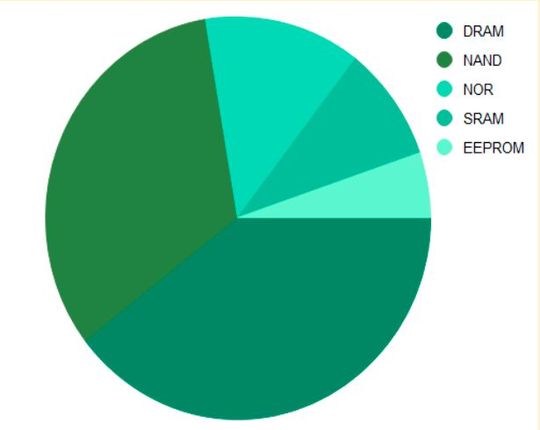
DRAM dominates the semiconductor memory market, followed by NAND flash equally. Most innovation is seen in the NAND flash memory due to the introduction of 3D NAND flash technology. The third rank is for NOR flash memory, followed by SRAM, EEPROM, and emerging non-volatile memory chips. However, NOR flash has witnessed a slight downward sale trend.
The three key players in the semiconductor memory market are Samsung, SK HYNIX INC., and Micron Technology, Inc. These three companies account for more than 95 % of DRAM revenue share and about 70 % share in NAND revenue. Other big manufacturers include TSMC, Toshiba Electronic Devices and Storage Corporation, Texas Instruments, and many more.
If you look at the transistor count, Micron’s V-NAND module contains 5.3 trillion MOSFETs. Since 2022, this flash memory chip has had the highest number of transistor integrations for any existing semiconductor. The expected compound annual growth rate of semiconductor memories is about 11 % from 2024 to 2030. The estimated revenue will be nearly USD240 billion in 2030.
(ID:50133860)
:quality(80)/p7i.vogel.de/wcms/e2/d6/e2d6eadc2e131f89909e587e7ff0f0c5/0126751999v2.jpeg "Between 2023 and 2025, the semiconductor industry experienced profound changes, propelled by AI innovations, with Nvidia's rapid ascent and industry-wide transformations redefining the landscape. (Source: © er - stock.adobe.com)")
:quality(80)/p7i.vogel.de/wcms/2a/cc/2accfd11149a6a051be33cb592c3a9f5/0128517332v2.jpeg "Semiconductor supply chains diverge in late 2025 as power and analog ICs normalize while AI-driven compute remains constrained. (Source: © piggu - stock.adobe.com)")