


:quality(80)/p7i.vogel.de/wcms/2f/f3/2ff3221bf7665de2d0acf83760bfd1fa/0130031523v2.jpeg "Wolfspeed presents a 300 mm silicon carbide technology platform designed to support advanced packaging and high-efficiency power delivery for AI data center infrastructure. (Source: Wolfspeed)")
:quality(80)/p7i.vogel.de/wcms/c3/16/c316e955a97f5d72d9678297b237b9e5/0129932858v2.jpeg "Left: the single-phase version of the SENTRON ECPD with RCM, right: a model of the future three-phase version of the SENTRON ECPD. (Source: Siemens)")
:quality(80)/p7i.vogel.de/wcms/ef/0a/ef0adb0acf793fe147cc27c21f6a7a67/0129954238v2.jpeg "Empower Semiconductor introduces embedded silicon capacitors designed to improve power delivery and stability in AI and high-performance computing processors. (symbolic image) (Source: © IF.arc - stock.adobe.com)")
:quality(80)/p7i.vogel.de/wcms/53/f9/53f9301dfc9292d02960f7996c79cc6e/0129927601v2.jpeg "Wolfspeed’s new 10 kV SiC MOSFET enables high-voltage power conversion for grid and industrial applications. (symbolic image) (Source: © CREATIVE- 3.4 - stock.adobe.com)")
:quality(80)/p7i.vogel.de/wcms/6e/cd/6ecd41d095d5111cf4ed37b714844487/0129930878v2.jpeg "PCIM Asia Shenzhen provides a platform for industry experts to present new developments in power electronics and electrification technologies. (symbolic image) (Source: © killykoon - stock.adobe.com)")
:quality(80)/p7i.vogel.de/wcms/02/c0/02c0e9722f70b1134dbf96fb59a9c73d/0129655179v2.jpeg "The PCIM Conference 2026 will take place from June 9-11, featuring discussions on power electronics trends, including GaN technology and AI applications. (symbolic image) (Source: © Elmira - stock.adobe.com)")
:quality(80)/p7i.vogel.de/wcms/cc/67/cc670ea2029cd2af5c641af70e1bf734/0129816392v4.jpeg "Fraunhofer IAF coordinates the EU SUPREME project to accelerate GaN and SiC power semiconductor innovation in Europe. (Source: Fraunhofer IAF)")
:quality(80)/p7i.vogel.de/wcms/ea/e6/eae6aee30071e67a5627027974437134/0129544613v2.jpeg "GlobalFoundries and Renesas strengthen their collaboration to support U.S.-based semiconductor production and supply chain resilience. (Source: © ronstik - stock.adobe.com)")
:quality(80)/p7i.vogel.de/wcms/3c/4b/3c4bbc68dda65c7071b4376fb57423b0/0130030465v2.jpeg "Faraday’s laws explain the fundamental behavior of magnetic fields and electronic devices in dynamic use cases. The operation of transformers, wireless chargers, induction cookers, induction motors, magnetic levitating trains (MAGLEV Trains), electric violin, and many others depends upon Faraday’s laws. (Source: © Sheraz - stock.adobe.com)")
:quality(80)/p7i.vogel.de/wcms/b1/5e/b15ee02b0ba02db70cf61e37d66ad1d3/0129349127v2.jpeg "Vehicle-to-grid (V2G) chargers enable bidirectional energy flow, allowing electric vehicles to act as mobile energy storage systems that can both draw power from and feed power back into the grid. (Source: © medienvirus - stock.adobe.com)")
:quality(80)/p7i.vogel.de/wcms/26/d5/26d591cc340077026eac56a0e7564faf/0129949603v2.jpeg "Flexible: The solid silicone-based electrolyte is elastic, thereby compensating for the voids that form in solid-state batteries during charging and discharging. (Source: Empa)")
:quality(80)/p7i.vogel.de/wcms/4d/e0/4de02f76a37cbb3df30dd231de589c8e/0128866890v2.jpeg "Both legacy and vGaN show higher carrier mobility and band gap energies compared to other power semiconductors. (Source: © phonlamaiphoto - stock.adobe.com)")
:quality(80)/p7i.vogel.de/wcms/be/c8/bec8d43fc0ee73414274be44608b2970/0129748903v2.jpeg "The Infiniium XR804KA real-time oscilloscope delivers faster response time, improved stability, and streamlined workflows for high-speed digital and compliance testing. (Source: Keysight)")
:quality(80)/p7i.vogel.de/wcms/23/ee/23ee4a97790d6009dbfd7d9577ffa723/0129220424v2.jpeg "The R&S FPL1044 with the new RTSA option makes 40 MHz real-time frequency analysis available up to 44 GHz. (Source: Rohde & Schwarz )")
:quality(80)/p7i.vogel.de/wcms/3c/d1/3cd1cacbceb792ba63727199c61ca434/0127801860v2.jpeg "Thanks to cloud technology, users can collaborate on projects from anywhere and always have access to the latest planning data. (Source: SIEMENS)")
:quality(80)/p7i.vogel.de/wcms/5a/a0/5aa0436498af618297961fd54ab36cdf/0126290792v2.jpeg "Siemens accelerates student-led semiconductor innovation across Europe’s leading technical universities through Cre8Ventures’ Open Higher Education Program developed in collaboration with Arm and University of Southampton (Source: Siemens Digital Industries Software)")
BASIC KNOWLEDGE: INVERTERS CMOS: The most basic inverter
Related Vendors
:fill(fff,0)/p7i.vogel.de/companies/63/c7/63c7da97be945/diotec.png "diotec (Diotec Semiconductor AG)")
:fill(fff,0)/p7i.vogel.de/companies/60/7e/607ec89d5d9b5/white-frame.jpg "white frame.jpg (www.rohm.com)")
:fill(fff,0)/p7i.vogel.de/companies/5f/71/5f71d5f92a5f6/2000px-rogers-corporation-logo-svg.png "2000px-Rogers_Corporation_Logo.svg.png (rogers germany)")
CMOS is the most basic type of inverter. In addition, most legacy chips are manufactured using the CMOS process. CMOS is both a device and a fabrication process. The article talks about CMOS devices and the CMOS fabrication process.

Initially developed as a device, CMOS offered better results compared to p-type and n-type MOSFETs. In the late 1960s, CMOS was commercialized as a manufacturing process to build integrated circuits!
Definition
Complementary Metal Oxide Semiconductor “CMOS” is a type of device that utilizes two pairs of MOSFETs: NMOS (n-type MOSFET) and PMOS (p-type MOSFET) to perform logic functions. In addition, CMOS is also a fabrication process for the manufacturing of integrated circuits. Link hier
CMOS symbol
The CMOS, NOT gate, or any type of inverter has the same circuit symbol. The CMOS symbol is a combination of a triangle and a small circle.
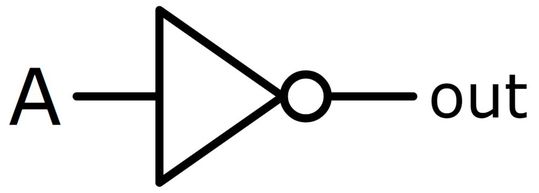
CMOS circuit diagram
In a CMOS circuit, pMOS and nMOS are connected in a complementary fashion. PMOS is connected at the top and NMOS is at the bottom.
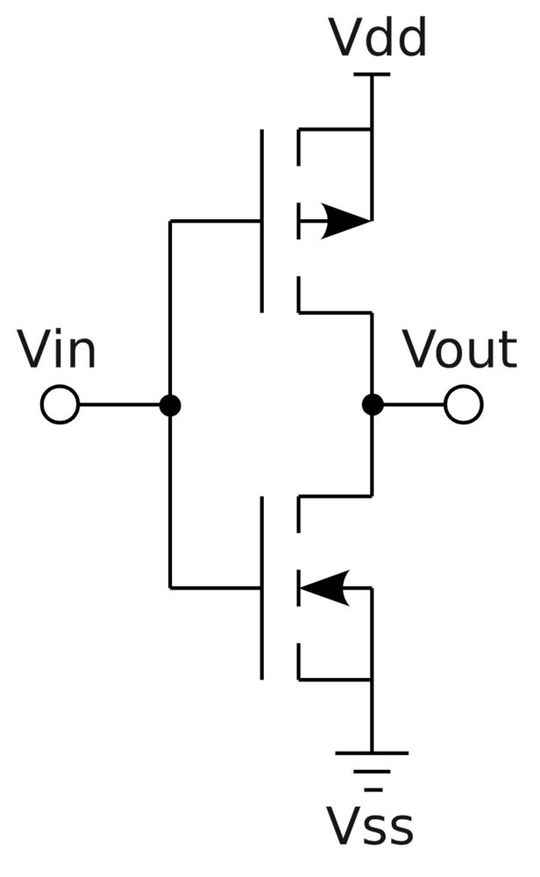
The source terminal of pMOS is connected to the supply voltage and the source terminal of nMOS is grounded. The input signal is given at the gate terminal of both pMOS and nMOS transistors. The drain terminals of both PMOS and NMOS transistors are connected to the output.
CMOS working
CMOS working is explained through the truth table.
CMOS truth table
In digital electronics, the truth table represents the functionality of the circuit. The CMOS truth table represents the action of CMOS. Any input given to the CMOS gets inverted at the output.
For a low (0) input, CMOS generates a high (1) output. Similarly, for a high (1) input, CMOS generates a low (0) output. In simple words, CMOS completely reverses the input signal or complements it!
| Input | Output |
| 1 | 0 |
| 0 | 1 |
CMOS operation
A low voltage signal (0) is given at the input terminal of CMOS. The pMOS turns on and the nMOS turns off. The current flows through the gate channel to produce a high-voltage signal (1) at the output.
A high voltage signal (1) is given at the input terminal of CMOS. The pMOS turns off and the nMOS turns on. No current or extremely small number of electrons flow through the gate channel to produce a low voltage signal (0) at the output.
CMOS fabrication process
CMOS meaning is an inverter as well as a semiconductor manufacturing process. The CMOS fabrication process, called CMOS technology, is used extensively to manufacture chips. The CMOS technology creates the physical structure of the CMOS inverter. In simple words, CMOS technology is a fabrication process to manufacture ICs.
In our semiconductor manufacturing series, the fabrication process is detailed. CMOS n-well process is a common CMOS manufacturing process. The CMOS n-well process starts with the creation of the n-well region over a moderately doped p-type substrate. N-well region defines the creation of pMOS and nMOS transistors.
:quality(80)/p7i.vogel.de/wcms/aa/74/aa7478a3eddbc57bda27210558c8b717/93240376.jpeg "Samsung’s MBCFET GAA, which is formed as a nanosheet. (Source: Samsung)")
FIN FIELD EFFECT TRANSISTORS
Could GAAFETs replace finFETs in power electronics?
CMOS advantages
The benefits of CMOS devices are numerous and far-reaching including:
- CMOS devices offer high speed.
- CMOS devices consume less static power.
- CMOS devices consume reasonable dynamic power for battery applications.
- CMOS devices offer low-power dissipation. Simply put, CMOS devices generate little heat for temperature stability.
- CMOS devices have a high noise immunity.
- CMOS devices are smaller in size.
- CMOS fabrication process is scalable, flexible, and compatible with standard processes.
- CMOS fabrication process offers large-scale and very large-scale integration.
CMOS disadvantages
Despite their widespread use, CMOS devices do have certain drawbacks that need to be considered.
- CMOS devices have high switching speed.
- CMOS devices have a high propagation delay.
- CMOS circuits can be slow.
- CMOS devices have poor analog performance.
- CMOS devices may have a significant amount of leakage currents.
- The CMOS fabrication process is complex.
- The CMOS process is replaced by FinFET, GAAFET, ribbonFET, etc in modern nanometer processes.
CMOS applications
CMOS devices
CMOS means a logic "NOT gate" in digital electronics. A CMOS NOT gate performs the binary functions operations in a variety of applications like computers, cameras, converters, and transceivers. In analog applications, CMOS devices are used in op-amps, sensors, and radio frequency devices.
CMOS fabrication process
The CMOS process is still used in modern LSI and VLSI designs to manufacture ICs like logic circuits, microprocessors, microcontrollers, and semiconductor memories. The CMOS process has been the main process that enables large-scale integration of transistors in VLSI design.
Power Electronics in the Energy Transition
The parameters for energy transition and climate protection solutions span education, research, industry, and society. In the new episode of "Sound On. Power On.", Frank Osterwald of the Society for Energy and Climate Protection Schleswig‐Holstein talks about the holistic guidance his organization can provide.
Listen now!
(ID:50082617)
:quality(80)/p7i.vogel.de/wcms/af/07/af073e302fcca1153bcaca553175006c/0124143921v2.jpeg "Thyristors are power semiconductor devices used in industrial power control applications. These devices are nothing new; they have been on the market for decades. Learn more about them here. (Source: jossbomon - stock.adobe.com)")
:quality(80)/p7i.vogel.de/wcms/b9/18/b918d8d0e447a18f7b9e983c25b96330/0125855402v2.jpeg "LDMOS amplifiers have proved their reliability and safety. They are known to perform well, even in impedance mismatches. GaN devices have now become the backbone of the power and radio frequency industries. The article explains LDMOS technologies and compares them with GaN-based devices. (Source: © Johannes - stock.adobe.com)")