


:quality(80)/p7i.vogel.de/wcms/10/fc/10fcb98e44d61826e641bc8d3f20f616/0133193677v2.jpeg "The new AEVA and AEVB Series aluminum electrolytic capacitors are engineered for harsh industrial environments, delivering high-CV, long-lifetime performance in compact, surface-mount packages that reliably withstand up to 30g acceleration and operating temperatures extending from -55° to +125°C. (Source: Kyocera)")
:quality(80)/p7i.vogel.de/wcms/f7/42/f74208db9f5f87dca384b38b71c4782e/0133196365v2.jpeg "YAGEO’s EC Flat‑Series temperature sensors combine fast, accurate measurement with resistance to vibration, shock, moisture and dust for demanding automotive and industrial applications. (Source: Yageo)")
:quality(80)/p7i.vogel.de/wcms/b2/82/b28212428745dd8a4634ad4f4912012f/0132902689v2.jpeg "New 15 V, 25 V and 40 V eGaN FETs deliver ultra-low on-resistance, high current capability, and exceptional radiation immunity for high-density space power conversion (Source: EPC Space)")
:quality(80)/p7i.vogel.de/wcms/7b/4f/7b4f433302c490cac22eee9c12499e65/0132780211v2.jpeg "Littelfuse introduces the TPSMD‑FL series of high‑power surface‑mount TVS diodes, designed to simplify ISO 7637 load‑dump protection and safeguard automotive electronics against severe voltage transients. (Source: Littlefuse)")
:quality(80)/p7i.vogel.de/wcms/78/38/783841efab284c1b4453777e7ebea26d/0133190419v2.jpeg "Diodes has completed its acquisition of Elevate Semiconductor, expanding its analog and mixed-signal portfolio and strengthening its presence in the high-growth automated test equipment market. (Source: © peopleimages.com - stock.adobe.com)")
:quality(80)/p7i.vogel.de/wcms/1f/79/1f79d69530465de26a832c742fc60319/0133117717v2.jpeg "With 30,000 sqm of exhibition space, 20,157 trade visitors, 271 exhibitors, and 131 expert presentations as part of the conference program, the event sent a strong message about the industry's innovative strength and dynamism. (Source: Mesago Messe Frankfurt GmbH)")
:quality(80)/p7i.vogel.de/wcms/43/4d/434db2291567e847e54332004942a225/0132958267v2.jpeg "GlobalWafers has joined the SEMI Taiwan Materials Alliance, with CEO Doris Hsu serving as co‑chair, to advance critical materials technologies, accelerate collaborative innovation and strengthen global semiconductor supply chain resilience. (Source: © jiwon - stock.adobe.com)")
:quality(80)/p7i.vogel.de/wcms/6f/72/6f72f93d1e4c5a248a97dd3b8f32a336/0132997898v2.jpeg "Infineon plans to acquire C2i Semiconductors to combine software‑defined multiphase control and smart power stages with its broad power‑semiconductor portfolio for intelligent, scalable AI data‑center power delivery. (Source: © Grispb - stock.adobe.com)")
:quality(80)/p7i.vogel.de/wcms/87/97/879728679e7010f81e53a86923cde74c/0133218625v2.jpeg "Conceptual illustration of polar wurtzite niobium aluminum nitride (NbAlN), a transition-metal-containing nitride semiconductor that preserves the crystal structure and polarity of GaN. (Source: Associate Professor Atsushi Kobayashi from Tokyo University of Science, Japan)")
:quality(80)/p7i.vogel.de/wcms/ac/31/ac31c9478d80894d725d02883ae7ed5d/0133176534v2.jpeg "Average models allow power designers to simulate DC‑DC converters and three‑phase PFC circuits quickly, analyse small‑signal behaviour and evaluate loop stability without modelling every switching event. (Source: © AI - stock.adobe.com)")
:quality(80)/p7i.vogel.de/wcms/96/80/9680b468d7f682c8b6c15b07300afbb0/0133177854v2.jpeg "Grid-forming inverters are also known as grid-forming resources and grid-forming IBR. This article explains grid-forming inverters in detail. (Bild: © only_kim - stock.adobe.com)")
:quality(80)/p7i.vogel.de/wcms/57/c6/57c6fa81922a9849a917bdfed82eddf7/0133052494v2.jpeg "Rising demand for high-end materials shifts production toward higher-margin products, reducing output of standard loss materials. (Source: NCAB)")
:quality(80)/p7i.vogel.de/wcms/7b/76/7b76005554b556df2a7a3794bdf69d44/0132365246v2.jpeg "Hioki’s ST5680A DC Hipot Tester combines CE/UKCA/CSA compliance, an integrated capacitance‑based contact check and time‑series waveform recording (voltage, leakage current, insulation resistance) to standardize hipot and insulation testing across EV cell, module and pack production lines. (Source: Hioki)")
:quality(80)/p7i.vogel.de/wcms/af/7f/af7f7b0fb7f29219fc991b1130f65477/0132241333v2.jpeg "Comprehensive laboratory testing regimens—combining thermal cycling, high‑current stress, EMC, and accelerated lifetime tests—are essential to validate advanced power designs and ensure reliability in real‑world applications. (Source: PRBX)")
:quality(80)/p7i.vogel.de/wcms/16/3d/163df69363f8125315a9826e13ea4b05/0131927425v2.jpeg "Solution will maximize data center and AI factory profitability while delivering engineering-grade insights to design and operations for more efficient, sustainable, and resilient infrastructure. (Source: Cadence)")
:quality(80)/p7i.vogel.de/wcms/85/b7/85b7e90733a2bd8f21515d8f7137f2fc/0131917677v2.jpeg "Renesas acquires Pictorus to integrate its embedded application software platform with Renesas’ MCU and MPU portfolio, helping developers shorten time‑to‑market and simplify system integration. (Source: © lucadp - stock.adobe.com)")
CHIP INDUSTRY NEWS Chip industry update: A review of Q2 2025
Related Vendor
:fill(fff,0)/p7i.vogel.de/companies/68/08/6808a2b3b6595/het-logo.jpeg "het-logo (Heraeus Electronics)")
The global semiconductor industry in Q2 2025 saw record-breaking growth driven by AI demand, but this masked widening fractures in traditional markets and supply chains. As geopolitical tensions and infrastructure constraints escalate, the sector faces a future defined as much by strategic resilience as by technological innovation.
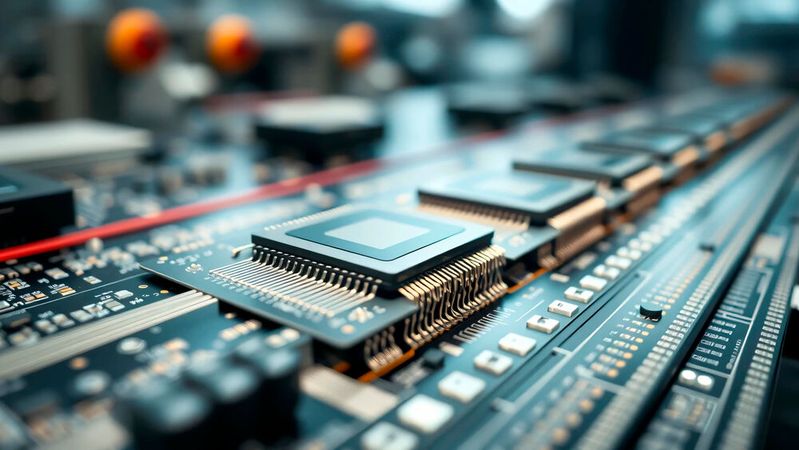
The global semiconductor industry closed out the second quarter of 2025 in a state of paradox. On one hand, it saw record-breaking revenues and continued investment in cutting-edge technologies. On the other, it grappled with bottlenecks, mounting geopolitical pressures, and an emerging shortage that threatens to upend automotive supply chains once again.
At the heart of the story is an increasingly bifurcated market. Explosive growth in AI-centric applications is masking flat or declining performance in traditional sectors like smartphones, PCs, and industrial electronics. While headlines tout a thriving industry, a deeper look reveals a fragile, imbalanced system vulnerable to external shocks and structural blind spots.
AI: The engine driving unprecedented growth
The most visible force in Q2 was the generative AI boom. Demand for GPUs, NPUs, and custom AI chips surged past all expectations, with projected annual sales of AI semiconductors now exceeding $125 billion, accounting for more than 20 % of global chip revenue.
This appetite for compute is not confined to the data center anymore. AI-powered PCs and smartphones, featuring on-device neural processing, are revitalizing mature markets. AI PCs are forecast to make up around 50 % of all units sold in 2025, while AI-infused smartphones are expected to surpass 1.24 billion units globally. However, these gains are modest compared to the surging valuation of AI infrastructure players and suppliers like TSMC and NVIDIA.
:quality(80)/p7i.vogel.de/wcms/87/8d/878d28d85fad10c7debc92446c60146b/0123870413v2.jpeg "Despite record sales in Q1 2025 fueled by surging demand for AI and advanced packaging, the global chip industry faces persistent supply issues due to production challenges and geopolitical constraints. Find out more here. (Source: IM Imagery - stock.adobe.com)")
CHIP INDUSTRY NEWS
Chip industry update: A review of Q1 2025
TSMC, in particular, has responded with unmatched aggression, announcing a $42 billion capex plan and doubling its CoWoS (Chip-on-Wafer-on-Substrate) packaging capacity. Advanced packaging, not just silicon, has become the key battleground for performance and differentiation in AI hardware.
But success has bred pressure. NVIDIA, the undisputed king of AI chips, has stumbled with manufacturing delays on its next-gen Blackwell GPUs, triggering a temporary $300 billion loss in market cap. Meanwhile, hyperscale cloud providers are increasingly exploring alternatives, creating rare competitive openings for challengers like AMD.
Traditional markets show hidden cracks
While AI supercharged one part of the industry, the rest of the chip ecosystem showed only modest gains or, in some cases, signs of stress. Smartphones and PCs saw minimal recovery, and overall wafer shipments declined in 2024 before rebounding narrowly in 2025. The value of the market is now being carried disproportionately by a few high-margin AI components rather than broad-based volume growth.
This asymmetry is fueling a potentially dangerous underinvestment in older process nodes (40nm and above) that still serve vital roles in automotive, industrial, and consumer electronics. The result? A second semiconductor shortage is quietly taking shape. This time, it’s not due to pandemics or panic buying, but because the AI gold rush is pulling foundry capacity away from sectors that can’t match AI’s margins.
Auto manufacturers are bracing for a supply crunch in late 2025 and into 2026, as foundries prioritize newer nodes over mature ones used in MCUs, analog chips, and power components critical to vehicles. Compounding the issue, new U.S. tariffs are expected to increase car prices, recalling the disruptions of 2021.
:quality(80)/p7i.vogel.de/wcms/52/68/5268f0fd0a8708f950ea5377c256d282/0114344070.jpeg "This article mainly discusses silicon wafer production and lists some other wafer materials as well. (Source: ryanking999 - stock.adobe.com)")
PART 2: SEMICONDUCTOR MANUFACTURING
The Semiconductor “Wafers”
Geopolitical upheaval creates new challenges
The return of the Trump administration has introduced a wave of tariff threats and regulatory reversals. A July 9 deadline has been set for new bilateral trade deals, with tariffs on chip materials and equipment looming. These levies could add billions to the cost of projects like TSMC’s Arizona fab, effectively neutralizing the incentive offered by the CHIPS Act.
Simultaneously, the administration rescinded the AI Diffusion Rule, a wide-reaching Biden-era export control measure. The reversal aims to restore market access for U.S. chipmakers like NVIDIA and AMD but introduces fresh legal uncertainty around compliance and enforcement.
The U.S. CHIPS Act, once seen as a game-changer, is now under review. Over 100 semiconductor projects announced under the act are in limbo, with major recipients like Intel experiencing significant delays. Intel’s $20 billion Ohio facility, originally slated for 2026, is now pushed out to 2030–2031.
In contrast, the EU’s Chips Act has mobilized over €80 billion in investment, approving seven new fabs. Yet, an audit by the European Court of Auditors questions whether the EU can realistically meet its goal of capturing 20 % of global market share by 2030.
Asia remains aggressive: China continues its self-sufficiency drive with a $47.5 billion “Big Fund 3.” South Korea’s $450 billion strategy and Japan’s ¥10 trillion commitment are reshaping the regional landscape. Even India is stepping up, easing SEZ rules to fast-track domestic fabs under its India Semiconductor Mission.
:quality(80)/p7i.vogel.de/wcms/74/95/749515300d210014e73afba37eba0f20/0123227790v2.jpeg "The semiconductor foundry market is projected to surge by 20% in 2025, primarily fueled by the booming demand for AI chips and TSMC's dominance in advanced node manufacturing, while mature node recovery remains sluggish and geopolitical factors reshape supply chains. Learn more about this here. (Source: Davin - stock.adobe.com)")
SEMICONDUCTOR INDUSTRY
Foundry market outlook 2025: AI and advanced technologies drive growth
What the big players are currently doing
TSMC remains the clear leader, responding to AI-driven demand with unmatched speed and scale. Its capital expenditure plan for 2025 exceeds $40 billion, with advanced node capacity and packaging facilities scaling rapidly across Taiwan, Japan, Germany, and the U.S. This expansion has fortified its position as the primary supplier of the world's most critical AI hardware, pushing its valuation beyond $1.1 trillion.
Intel, in contrast, is fighting an uphill battle. While it continues to make progress on its 18A process node and remains the first customer for ASML’s High-NA EUV systems, its operational troubles are deep. The firm has announced sweeping layoffs, delayed flagship construction projects, and now faces investor skepticism over whether it can realistically challenge TSMC in foundry services.
Samsung is in a period of strategic reorientation. After lagging its peers in AI-specific packaging and memory optimization, it is moving decisively to reposition its product lines. The company is targeting increased HBM production and exploring a transition to glass interposers by 2028—an engineering bet aimed at winning back design wins from NVIDIA and AMD.
On the fabless side, NVIDIA remains financially dominant but vulnerable. Manufacturing delays in its Blackwell GPUs and a $5.5 billion write-down of Chinese inventory due to export rules have put pressure on its execution. AMD has seized the opportunity, rolling out a broad portfolio across PCs, AI processors, and GPUs, establishing itself as the preferred alternative for many customers wary of supply chain risk or price concentration.
Beyond silicon: The physical constraints of AI expansion
The AI revolution is also facing physical constraints that are increasingly defining the market. Data centers designed to house AI accelerators are now running into power grid limitations. In many regions, new data center construction is limited not by space, but by access to sufficient power infrastructure. Lead times for new transmission lines can exceed four years.
Cooling is another frontier. Traditional air-cooled systems are no longer sufficient to dissipate the heat generated by AI compute racks. Liquid cooling, once a specialty feature, is becoming the default for new builds. In some cases, immersion cooling is being adopted as the only viable solution. Energy is now a gating factor on semiconductor performance.
This constraint is already reshaping strategy. Companies like NVIDIA are investing in nuclear energy partnerships, with small modular reactors emerging as a promising solution for a reliable, scalable, and carbon-neutral energy supply tailored to high-density AI workloads.
:quality(80)/p7i.vogel.de/wcms/19/fa/19fa4e84deac5d78b94929352d3f86a6/0116154310.jpeg "An AI semiconductor chip can perform logic operations and memory functions for AI applications with increased efficiency. (Source: IBEX.Media - stock.adobe.com)")
ARTIFICIAL INTELLIGENCE
AI semiconductors: The talk of the hardware industry
The stakes of an industry in transition
The second quarter of 2025 represents an inflection point for the semiconductor industry. The AI boom has created a gravity well around which the rest of the industry is now forced to orbit. It is driving revenue, innovation, and investment, but also causing underinvestment in legacy sectors and amplifying geopolitical risk.
Traditional market indicators no longer tell the whole story. Growth is no longer broad-based, and supply chain resilience is now as critical as technological capability. Government policy has become a primary market mover, while physical infrastructure is now as decisive as transistor design.
As the industry enters the second half of the year, success will not be determined solely by product roadmaps or quarterly earnings. It will hinge on a company’s ability to navigate a volatile mix of AI ambition, geopolitical turbulence, and structural constraint. The future belongs to those who can move fast, but also build deep, stable foundations in a world that is anything but.
(ID:50459960)
:quality(80)/p7i.vogel.de/wcms/e2/d6/e2d6eadc2e131f89909e587e7ff0f0c5/0126751999v2.jpeg "Between 2023 and 2025, the semiconductor industry experienced profound changes, propelled by AI innovations, with Nvidia's rapid ascent and industry-wide transformations redefining the landscape. (Source: © er - stock.adobe.com)")
:quality(80)/p7i.vogel.de/wcms/2a/cc/2accfd11149a6a051be33cb592c3a9f5/0128517332v2.jpeg "Semiconductor supply chains diverge in late 2025 as power and analog ICs normalize while AI-driven compute remains constrained. (Source: © piggu - stock.adobe.com)")