


:quality(80)/p7i.vogel.de/wcms/99/dd/99dd64ae87c0855129bd405f61d81f81/0133290217v2.jpeg "Microchip’s new 1.2 V SY757xx clock buffers connect modern low-voltage SoCs, FPGAs and AI accelerators with higher-voltage clock components, supporting frequencies up to 250 MHz and additive jitter as low as 26 fs. (Source: Microchip)")
:quality(80)/p7i.vogel.de/wcms/83/d0/83d0b8ea52378c77f98358e29ceccfc0/0133339307v2.jpeg "Capacitors are a critical yet often overlooked component in AI data center power supplies, buffering energy and stabilizing voltage as racks scale toward the megawatt range. (Source: © Parilov - stock.adobe.com)")
:quality(80)/p7i.vogel.de/wcms/10/fc/10fcb98e44d61826e641bc8d3f20f616/0133193677v2.jpeg "The new AEVA and AEVB Series aluminum electrolytic capacitors are engineered for harsh industrial environments, delivering high-CV, long-lifetime performance in compact, surface-mount packages that reliably withstand up to 30g acceleration and operating temperatures extending from -55° to +125°C. (Source: Kyocera)")
:quality(80)/p7i.vogel.de/wcms/f7/42/f74208db9f5f87dca384b38b71c4782e/0133196365v2.jpeg "YAGEO’s EC Flat‑Series temperature sensors combine fast, accurate measurement with resistance to vibration, shock, moisture and dust for demanding automotive and industrial applications. (Source: Yageo)")
:quality(80)/p7i.vogel.de/wcms/57/b6/57b6d33cb929fa4408ad56803ed5f0bc/0133311998v2.jpeg "Elmos and SK keyfoundry are expanding their collaboration on 130 nm technology and have agreed on long-term wafer capacity through 2037 to support reliable automotive semiconductor production. (Source: © remake - stock.adobe.com)")
:quality(80)/p7i.vogel.de/wcms/b4/0a/b40a1de3c8fa631b2aff74ec436c43db/0133314066v2.jpeg "ZF Aftermarket expands its EV service portfolio with new repair kits and solutions for e‑motors, inverters, hybrid modules, mechatronics and electric drive units. (Source: ZF Aftermarket)")
:quality(80)/p7i.vogel.de/wcms/48/e1/48e107b92f976652532facf5ca1e0855/0133290826v2.jpeg "Infineon and SolarEdge are extending their collaboration to develop solid-state protection solutions for 800 VDC AI data centers, aiming to improve fault response, system reliability and power density. (Source: © Grispb - stock.adobe.com)")
:quality(80)/p7i.vogel.de/wcms/99/84/9984f5888ecc71c249f65cea3f0658d1/0133069650v2.jpeg "Yokogawa’s integrated measurement setup helps Vertiv analyse AI-driven pulsed loads, combining power, waveform and thermal data to validate UPS performance and input power smoothing. (Source: YOKOGAWA)")
:quality(80)/p7i.vogel.de/wcms/a4/29/a429b944eb0a69e268015f8300ba8940/0133311989v2.jpeg "Hitachi Energy and Daikin are establishing a German supply of C4‑FN, a specialty insulating gas used in SF₆‑free high‑voltage equipment for more sustainable power grids. (Source: © Ahmed - stock.adobe.com)")
:quality(80)/p7i.vogel.de/wcms/d5/32/d5326e4b05d5cd759e88062f1c0b097a/0133344193v2.jpeg "Co-packaged optics is the latest innovation in data centers where optical modules on silicon chips can assist in scaling megawatt AI infrastructure. (Source: © Rachakrit - stock.adobe.com)")
:quality(80)/p7i.vogel.de/wcms/76/a9/76a9333bc7c6abbf7e29d1b910edb5e2/0133335959v2.jpeg "This article explains PMBus in data center power supplies. (Source: © Gibster - stock.adobe.com)")
:quality(80)/p7i.vogel.de/wcms/35/9c/359cfb6c855204e4d114f88cf5b98b5f/0133078984v2.jpeg "Photonic integrated circuits are next-level chips that will dominate data centers in the upcoming years. (Source: © pier - stock.adobe.com)")
:quality(80)/p7i.vogel.de/wcms/7b/76/7b76005554b556df2a7a3794bdf69d44/0132365246v2.jpeg "Hioki’s ST5680A DC Hipot Tester combines CE/UKCA/CSA compliance, an integrated capacitance‑based contact check and time‑series waveform recording (voltage, leakage current, insulation resistance) to standardize hipot and insulation testing across EV cell, module and pack production lines. (Source: Hioki)")
:quality(80)/p7i.vogel.de/wcms/af/7f/af7f7b0fb7f29219fc991b1130f65477/0132241333v2.jpeg "Comprehensive laboratory testing regimens—combining thermal cycling, high‑current stress, EMC, and accelerated lifetime tests—are essential to validate advanced power designs and ensure reliability in real‑world applications. (Source: PRBX)")
:quality(80)/p7i.vogel.de/wcms/16/3d/163df69363f8125315a9826e13ea4b05/0131927425v2.jpeg "Solution will maximize data center and AI factory profitability while delivering engineering-grade insights to design and operations for more efficient, sustainable, and resilient infrastructure. (Source: Cadence)")
:quality(80)/p7i.vogel.de/wcms/85/b7/85b7e90733a2bd8f21515d8f7137f2fc/0131917677v2.jpeg "Renesas acquires Pictorus to integrate its embedded application software platform with Renesas’ MCU and MPU portfolio, helping developers shorten time‑to‑market and simplify system integration. (Source: © lucadp - stock.adobe.com)")
DATA CENTER PSUs Capacitors gain momentum in AI data center power
Related Vendors
:fill(fff,0)/p7i.vogel.de/companies/62/a0/62a0a0de7d56a/aic-europe-logo.jpeg "aic-europe-logo (AIC Europe)")
:fill(fff,0)/p7i.vogel.de/companies/69/a8/69a8093b1b5e1/hvp-png.png "hvp-png (HVP-Logo)")
:fill(fff,0)/p7i.vogel.de/companies/68/2c/682c3e2e9a195/logotype-rvb.jpeg "logotype-rvb (MERSEN France)")
Capacitors in data centers perform various functions, including multi-layer ceramic capacitors for LLC tank resonant conversion and EMI filtering, film capacitors in DC links, and aluminum electrolytic and polymer capacitors near the load. As capacitors sit next to the PSU, they function as a local energy reservoir to prevent failures. The article explains how capacitors are becoming more important than ever for data center power supplies.
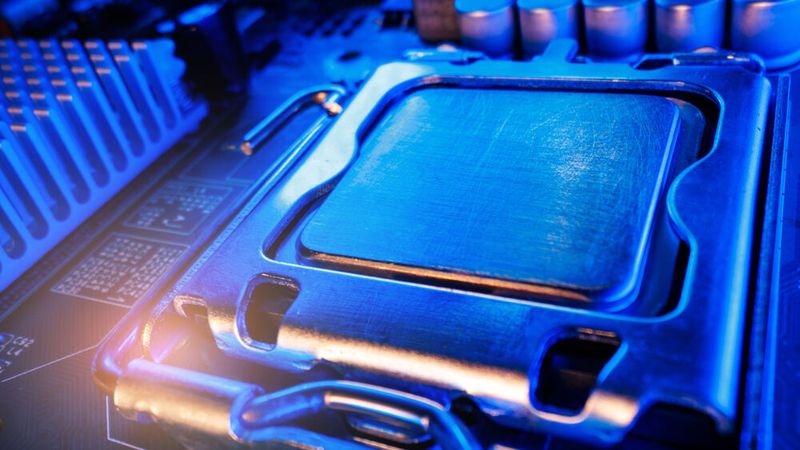
Capacitors for modern data center PSUs
Since 2017, data centers have shifted from 12V to 48V DC. The 380/480V from AC mains is converted to 380/400V DC. The facility-level power distribution unit (PDU) uses heavy-gauge cable and bus bars to power individual racks placed in the data center. Each rack, with its own PDU or power module, converts this 380/400V DC to 48V DC.
Earlier, this 48V DC used to be 12V DC. All thanks to Google in 2017. Due to AI and ML workloads, data center rack levels are being pushed from 48V to 400V to 800V. The 400V in present deployments and 800V proof-of-concept deal with more power transmission within the same conductor size. The entire challenge is placed on the power conversion chain. Capacitors are an integral part of the same.
48V rack conversion: Capacitors sit at the input of the 48V power shelf to absorb energy spikes from the load side and ensure bus stability. These capacitors can help administrators deal with sudden workload swings. The second use is where 48V DC is converted to 12V DC. The down-DC-converter for rack-level components depends upon negative resistance. Capacitor banks ensure impedance values below the negative resistance to keep the bus stable.
Hybrid capacitors: Hybrid capacitors, invented in 1996, pair an anode made from tantalum: a hard transition metal, and a cathode from ruthenium oxide: a rare metal oxide. Why are hybrid capacitors called hybrid? Because they integrate these two different technologies, as the tantalum anode is an electrolytic capacitor and the ruthenium oxide cathode is part of electrochemical or perhaps supercapacitor-type technology.
According to many experts, hybrid capacitors are a reliable candidate for power shelves in the AI era because they exhibit high capacitance density and the ability to operate under high voltages, but with low equivalent series resistance.
Bulk capacitors: When 380/480V from the AC mains is converted to 380/400V DC, ripples occur. The power factor correction (PFC) stage is present to eliminate pulsating DC and correct the power factor. The primary bulk capacitor is connected after the PFC stage. It can reject or accept the output of the PFC stage, particularly rejecting ripple.
In simple words, the bulk capacitor smooths ripple into steady DC, which is actually required. In addition, bulk capacitors function as energy storage buffers and hold-time support. They prevent sudden system crashes. When AC mains drops out, the converter (AC-to-DC) doesn’t die instantly.
The bulk capacitor after the PFC stage keeps it stable due to its stored energy. Thanks to the bulk capacitor, the PSU keeps the output alive after the AC input disappears. This defines hold-up time: the time as long as PSU output voltage stays alive. The bulk capacitor is responsible for the hold-up time, which is measured in milliseconds.
Hold-up time is typically 20 milliseconds for an AC frequency of 50 Hz and 16.7 milliseconds for 60 Hz. Furthermore, bulk capacitors on either 12V or 48V rack-level voltage sit near the converter to keep the bus stable. Moving deeper, bulk capacitors are used to handle current-related low-frequency events such that the control loop remains stable.
Bulk capacitors are aluminum electrolytic capacitors. With the growing demand for AI PSUs, high-end bulk capacitors are becoming expensive. The industry is witnessing their shortage, which continues throughout 2026 into 2027, driven by AI capacity ramps.
The ongoing lead times are about a few weeks, especially from Japanese and Taiwanese suppliers. The industry is already going through a memory shortage. Perhaps data centers might face capacitor shortages in the future.
Decoupling capacitors: Decoupling capacitors sit near GPUs and are useful in handling faster high-frequency transients. As GPUs get smaller, designers aim for fewer capacitors that fit the tight space, whether in the substrate core or in the package close to the die, but with the same operational capabilities.
Supercapacitors: When AI and ML workloads require thousands of GPUs to train together, rack-level current rises in milliseconds. Supercapacitors are present to buffer the mismatch by delivering the response in milliseconds. In conclusion, supercapacitors deployed at the rack offer peak shaving and short-term backup power in data centers.
References
https://www.signalintegrityjournal.com/articles/4037-ai-datacenters-move-capacitors-back-into-the-spotlight
https://blog.knowlescapacitors.com/blog/the-role-of-capacitors-in-powering-ai-at-scale
https://www.aictech-inc.com/en/valuable-articles/capacitor_appllication02.html
https://passive-components.eu/ai-data-centers-push-aluminium-capacitor-prices-higher/
(ID:50953427)
:quality(80)/p7i.vogel.de/wcms/04/cf/04cfeaa8e01a009df9f6142730251a76/0131803674v2.jpeg "This article describes 12V, 48V, 400V, and 800V rack-level distribution voltage in data centers. (Source: © oselote - stock.adobe.com)")
:quality(80)/p7i.vogel.de/wcms/d5/32/d5326e4b05d5cd759e88062f1c0b097a/0133344193v2.jpeg "Co-packaged optics is the latest innovation in data centers where optical modules on silicon chips can assist in scaling megawatt AI infrastructure. (Source: © Rachakrit - stock.adobe.com)")