


:quality(80)/p7i.vogel.de/wcms/2f/f3/2ff3221bf7665de2d0acf83760bfd1fa/0130031523v2.jpeg "Wolfspeed presents a 300 mm silicon carbide technology platform designed to support advanced packaging and high-efficiency power delivery for AI data center infrastructure. (Source: Wolfspeed)")
:quality(80)/p7i.vogel.de/wcms/c3/16/c316e955a97f5d72d9678297b237b9e5/0129932858v2.jpeg "Left: the single-phase version of the SENTRON ECPD with RCM, right: a model of the future three-phase version of the SENTRON ECPD. (Source: Siemens)")
:quality(80)/p7i.vogel.de/wcms/ef/0a/ef0adb0acf793fe147cc27c21f6a7a67/0129954238v2.jpeg "Empower Semiconductor introduces embedded silicon capacitors designed to improve power delivery and stability in AI and high-performance computing processors. (symbolic image) (Source: © IF.arc - stock.adobe.com)")
:quality(80)/p7i.vogel.de/wcms/53/f9/53f9301dfc9292d02960f7996c79cc6e/0129927601v2.jpeg "Wolfspeed’s new 10 kV SiC MOSFET enables high-voltage power conversion for grid and industrial applications. (symbolic image) (Source: © CREATIVE- 3.4 - stock.adobe.com)")
:quality(80)/p7i.vogel.de/wcms/6e/cd/6ecd41d095d5111cf4ed37b714844487/0129930878v2.jpeg "PCIM Asia Shenzhen provides a platform for industry experts to present new developments in power electronics and electrification technologies. (symbolic image) (Source: © killykoon - stock.adobe.com)")
:quality(80)/p7i.vogel.de/wcms/02/c0/02c0e9722f70b1134dbf96fb59a9c73d/0129655179v2.jpeg "The PCIM Conference 2026 will take place from June 9-11, featuring discussions on power electronics trends, including GaN technology and AI applications. (symbolic image) (Source: © Elmira - stock.adobe.com)")
:quality(80)/p7i.vogel.de/wcms/cc/67/cc670ea2029cd2af5c641af70e1bf734/0129816392v4.jpeg "Fraunhofer IAF coordinates the EU SUPREME project to accelerate GaN and SiC power semiconductor innovation in Europe. (Source: Fraunhofer IAF)")
:quality(80)/p7i.vogel.de/wcms/ea/e6/eae6aee30071e67a5627027974437134/0129544613v2.jpeg "GlobalFoundries and Renesas strengthen their collaboration to support U.S.-based semiconductor production and supply chain resilience. (Source: © ronstik - stock.adobe.com)")
:quality(80)/p7i.vogel.de/wcms/3c/4b/3c4bbc68dda65c7071b4376fb57423b0/0130030465v2.jpeg "Faraday’s laws explain the fundamental behavior of magnetic fields and electronic devices in dynamic use cases. The operation of transformers, wireless chargers, induction cookers, induction motors, magnetic levitating trains (MAGLEV Trains), electric violin, and many others depends upon Faraday’s laws. (Source: © Sheraz - stock.adobe.com)")
:quality(80)/p7i.vogel.de/wcms/b1/5e/b15ee02b0ba02db70cf61e37d66ad1d3/0129349127v2.jpeg "Vehicle-to-grid (V2G) chargers enable bidirectional energy flow, allowing electric vehicles to act as mobile energy storage systems that can both draw power from and feed power back into the grid. (Source: © medienvirus - stock.adobe.com)")
:quality(80)/p7i.vogel.de/wcms/26/d5/26d591cc340077026eac56a0e7564faf/0129949603v2.jpeg "Flexible: The solid silicone-based electrolyte is elastic, thereby compensating for the voids that form in solid-state batteries during charging and discharging. (Source: Empa)")
:quality(80)/p7i.vogel.de/wcms/4d/e0/4de02f76a37cbb3df30dd231de589c8e/0128866890v2.jpeg "Both legacy and vGaN show higher carrier mobility and band gap energies compared to other power semiconductors. (Source: © phonlamaiphoto - stock.adobe.com)")
:quality(80)/p7i.vogel.de/wcms/be/c8/bec8d43fc0ee73414274be44608b2970/0129748903v2.jpeg "The Infiniium XR804KA real-time oscilloscope delivers faster response time, improved stability, and streamlined workflows for high-speed digital and compliance testing. (Source: Keysight)")
:quality(80)/p7i.vogel.de/wcms/23/ee/23ee4a97790d6009dbfd7d9577ffa723/0129220424v2.jpeg "The R&S FPL1044 with the new RTSA option makes 40 MHz real-time frequency analysis available up to 44 GHz. (Source: Rohde & Schwarz )")
:quality(80)/p7i.vogel.de/wcms/3c/d1/3cd1cacbceb792ba63727199c61ca434/0127801860v2.jpeg "Thanks to cloud technology, users can collaborate on projects from anywhere and always have access to the latest planning data. (Source: SIEMENS)")
:quality(80)/p7i.vogel.de/wcms/5a/a0/5aa0436498af618297961fd54ab36cdf/0126290792v2.jpeg "Siemens accelerates student-led semiconductor innovation across Europe’s leading technical universities through Cre8Ventures’ Open Higher Education Program developed in collaboration with Arm and University of Southampton (Source: Siemens Digital Industries Software)")
BATTERY TECHNOLOGY Battery market analysis: Present and future trends
Related Vendors
:fill(fff,0)/p7i.vogel.de/companies/63/c7/63c7da97be945/diotec.png "diotec (Diotec Semiconductor AG)")
:fill(fff,0)/p7i.vogel.de/companies/60/7e/607ec89d5d9b5/white-frame.jpg "white frame.jpg (www.rohm.com)")
:fill(fff,0)/p7i.vogel.de/companies/62/95/6295c25c8dc1a/schunk-sonosystems-300dpi.png "schunk-sonosystems-300dpi (Schunk)")
Battery technology is among the strongest contributors to achieving net zero emissions by 2030. This article contains a battery market analysis of the year 2024- collected from various sources. It also includes upcoming battery types that could improve the tech!
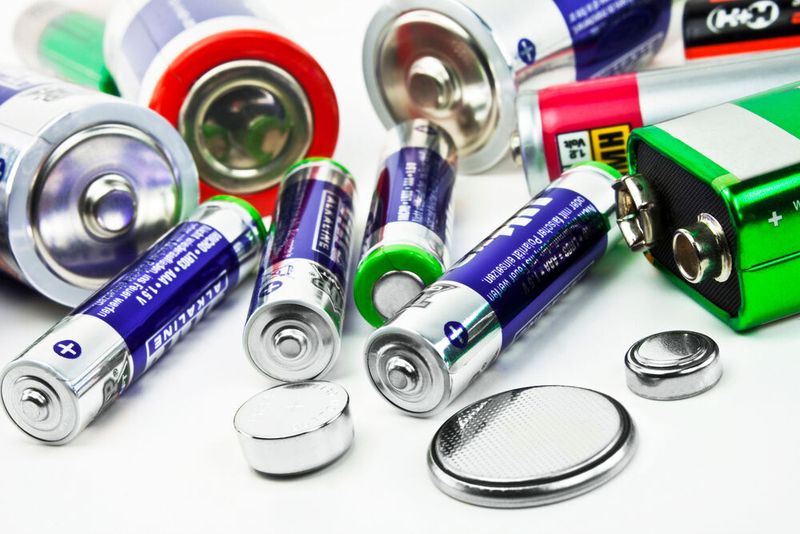
The battery market currently stands at a valuation of more than USD120.74 billion. The expected compound annual growth rate is about 16 %. By 2030, the battery market will reach a valuation of USD424 billion. This means that the battery market would almost quadruple to meet 2030’s net zero goal.
The battery market analysis is based on the following:
- Region
- Application
- Type
By region
The battery market in terms of region share is divided into four categories: North America, Asia Pacific, Europe, and the rest of the world (Latin America, Middle East, and Africa). The rest of the world occupies the smallest share. The diagram below shows the region-based battery market in 2024.
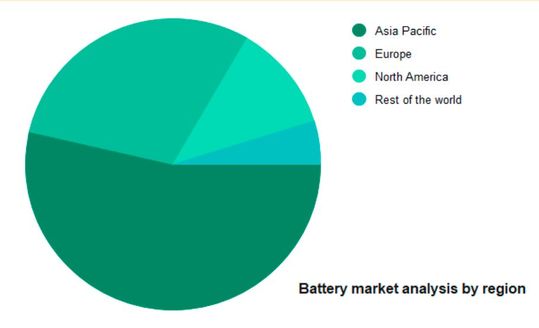
Among region-based classifications, Asia Pacific occupies the highest market share. This is because Asian-Pacific countries like China, India, Indonesia, Japan, Australia, New Zealand, and South Korea have some of the largest resources of lithium, cobalt, nickel, and graphite for battery production.
Europe has the second-largest and the fastest-growing battery market, followed by North America and the rest of the world. In the upcoming years, Asia Pacific will continue to occupy the highest share with Europe at the second and North America at the third position respectively.
By application
It is a well-known fact that battery technology is extensively used in electric vehicles. As a result, the automobile sector occupies the highest market share in the global battery market. The second largest sector is consumer electronics. Batteries are applicable in phones, laptops, lighting, watches, and many more devices.
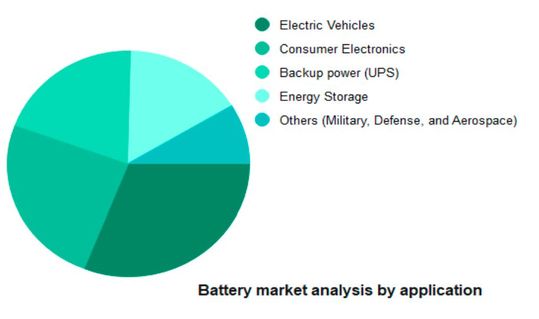
The third category is UPS (Uninterrupted Power Supply) as a backup power system. These backup power systems enable 24/7 electricity supply to industries, medical equipment, data centers, networking devices, firefighting systems, construction manufacturing, and many other sectors.
:quality(80)/p7i.vogel.de/wcms/3d/de/3ddebf253c7959c9d1f9601930be3eda/0118506387v2.jpeg "This article will discuss the Battery backup unit’s electrical and mechanical design considerations. (Source: Adriana - stock.adobe.com)")
ARTICLE SERIES PART 1
Smart battery backup for uninterrupted energy: Electrical and mechanical design
The fourth category is energy storage, in which energy is stored in an ESS (Energy Storage System) for future use. All these battery technologies including lithium-ion, lead-acid, sodium-ion, and others store energy in chemical form. When in use, chemical energy is converted into electrical energy.
By type
In the world of batteries, only two technology types rule the industry- lead-acid and lithium-ion batterieslithium-ion batteries. Lead acid batteries have a major market share compared to lithium-ion batteries. In 2030, lithium-ion batteries are all set to occupy 70 % market share, leaving only 20 % to lead-acid batteries.
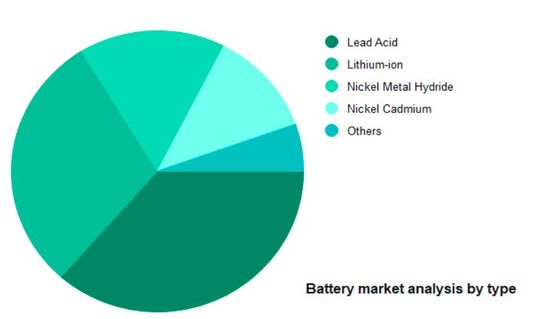
However, the above diagram depicts the battery market for the year 2024. After lead-acid and lithium-ion, battery types include nickel-cadmium, nickel metal hydride, nickel-zinc, lithium titanate oxide, and others. Nickel-cadmium batteries have a higher specific energy and specific power than lithium-ion batteries. This means that a Ni-Cd battery has a faster charging rate and longer runtime.
Nickel metal hydride (NiMH) batteries have similar chemical reactions to that of Ni-Cd batteries at the negative electrode. NiMH batteries have an improved energy density and a much higher specific power compared to NiCd. Lithium titanate oxide (LTO) offers faster charging in commercial EVs.
Upcoming battery technologies to look for
The search for alternatives to traditional lithium-ion batteries is driving innovation across various chemistries, including cobalt-free, sodium-ion, magnesium-ion, saltwater, zinc, and graphene-based options, each with its own potential advantages and challenges.
Cobalt-free battery
Cobalt is used in battery electrodes to improve energy density and voltage stability. In a cobalt-free battery, organic materials replace the less-abundant cobalt. Tesla has already integrated cobalt-free batteries in half of their cars and MIT has also secured a patent for their new development in this technology.
Sodium-ion battery
Sodium-ion batteries are considered a “greener alternative” to lithium-ion batteries because of their non-inflammable nature and stable nature at higher temperatures. In addition, sodium is an abundant and cheaper material than lithium.
Magnesium-ion battery
A magnesium-ion battery utilizes magnesium cations instead of lithium-ion. This technology is in the research and testing phases in terms of rechargeable and non-rechargeable options. Just like sodium, magnesium is also cheaper and abundant.
:quality(80)/p7i.vogel.de/wcms/f7/16/f716e4caf96716250234006898d1aa08/93652669.jpeg "Researchers at the University of Houston, in collaboration with the Toyota Research Institute of North America, say they have developed a new cathode and electrolyte. (Source: gemeinfrei)")
MAGNESIUM BATTERIES
Unlocking new possibilities for magnesium batteries
Saltwater battery
Saltwater batteries simply use salt water to store energy and convert it later to electrical energy for usage. These batteries are recycled to be used in the stainless steel industry. As a result, saltwater batteries tend to reduce manufacturing costs and supply chain issues.
Zinc battery
Zinc batteries use either zinc ions, zinc-manganese dioxide, or zinc-bromine technology. Zinc-based batteries are easily disposable and recyclable. A US-based company is making zinc batteries with a water-electrolyte to avoid fire. Researchers claim that the battery design process is a “relatively new” invention.
Graphene battery
Just like the newly invented graphene semiconductor, graphene-based batteries are expected to be embedded inside consumer electronic devices and EVs. Compared to other technologies, graphene-based batteries are expected to offer higher capacity and faster charging solutions. However, graphene mass production is costly.
Power Electronics in the Energy Transition
The parameters for energy transition and climate protection solutions span education, research, industry, and society. In the new episode of "Sound On. Power On.", Frank Osterwald of the Society for Energy and Climate Protection Schleswig‐Holstein talks about the holistic guidance his organization can provide.
Listen now!
(ID:50114377)
:quality(80)/p7i.vogel.de/wcms/c9/83/c98342208a1a08d2a70a9d9210ec52cf/0127808597v2.jpeg "Symbolic image: Lignin based biopolymers powering the future of green energy storage. (Source: © zuriya - stock.adobe.com)")
:quality(80)/p7i.vogel.de/wcms/85/5d/855d275abd81651c2f68aacdb004afae/0124332478v2.jpeg "The Naxtra sodium-ion battery breakthrough reduces lithium reliance and enhances safety, efficiency, and cost-effectiveness, marking a new era in energy technology. (Source: DimaBerlin - stock.adobe.com)")