


:quality(80)/p7i.vogel.de/wcms/2f/f3/2ff3221bf7665de2d0acf83760bfd1fa/0130031523v2.jpeg "Wolfspeed presents a 300 mm silicon carbide technology platform designed to support advanced packaging and high-efficiency power delivery for AI data center infrastructure. (Source: Wolfspeed)")
:quality(80)/p7i.vogel.de/wcms/c3/16/c316e955a97f5d72d9678297b237b9e5/0129932858v2.jpeg "Left: the single-phase version of the SENTRON ECPD with RCM, right: a model of the future three-phase version of the SENTRON ECPD. (Source: Siemens)")
:quality(80)/p7i.vogel.de/wcms/ef/0a/ef0adb0acf793fe147cc27c21f6a7a67/0129954238v2.jpeg "Empower Semiconductor introduces embedded silicon capacitors designed to improve power delivery and stability in AI and high-performance computing processors. (symbolic image) (Source: © IF.arc - stock.adobe.com)")
:quality(80)/p7i.vogel.de/wcms/53/f9/53f9301dfc9292d02960f7996c79cc6e/0129927601v2.jpeg "Wolfspeed’s new 10 kV SiC MOSFET enables high-voltage power conversion for grid and industrial applications. (symbolic image) (Source: © CREATIVE- 3.4 - stock.adobe.com)")
:quality(80)/p7i.vogel.de/wcms/6e/cd/6ecd41d095d5111cf4ed37b714844487/0129930878v2.jpeg "PCIM Asia Shenzhen provides a platform for industry experts to present new developments in power electronics and electrification technologies. (symbolic image) (Source: © killykoon - stock.adobe.com)")
:quality(80)/p7i.vogel.de/wcms/02/c0/02c0e9722f70b1134dbf96fb59a9c73d/0129655179v2.jpeg "The PCIM Conference 2026 will take place from June 9-11, featuring discussions on power electronics trends, including GaN technology and AI applications. (symbolic image) (Source: © Elmira - stock.adobe.com)")
:quality(80)/p7i.vogel.de/wcms/cc/67/cc670ea2029cd2af5c641af70e1bf734/0129816392v4.jpeg "Fraunhofer IAF coordinates the EU SUPREME project to accelerate GaN and SiC power semiconductor innovation in Europe. (Source: Fraunhofer IAF)")
:quality(80)/p7i.vogel.de/wcms/ea/e6/eae6aee30071e67a5627027974437134/0129544613v2.jpeg "GlobalFoundries and Renesas strengthen their collaboration to support U.S.-based semiconductor production and supply chain resilience. (Source: © ronstik - stock.adobe.com)")
:quality(80)/p7i.vogel.de/wcms/3c/4b/3c4bbc68dda65c7071b4376fb57423b0/0130030465v2.jpeg "Faraday’s laws explain the fundamental behavior of magnetic fields and electronic devices in dynamic use cases. The operation of transformers, wireless chargers, induction cookers, induction motors, magnetic levitating trains (MAGLEV Trains), electric violin, and many others depends upon Faraday’s laws. (Source: © Sheraz - stock.adobe.com)")
:quality(80)/p7i.vogel.de/wcms/b1/5e/b15ee02b0ba02db70cf61e37d66ad1d3/0129349127v2.jpeg "Vehicle-to-grid (V2G) chargers enable bidirectional energy flow, allowing electric vehicles to act as mobile energy storage systems that can both draw power from and feed power back into the grid. (Source: © medienvirus - stock.adobe.com)")
:quality(80)/p7i.vogel.de/wcms/26/d5/26d591cc340077026eac56a0e7564faf/0129949603v2.jpeg "Flexible: The solid silicone-based electrolyte is elastic, thereby compensating for the voids that form in solid-state batteries during charging and discharging. (Source: Empa)")
:quality(80)/p7i.vogel.de/wcms/4d/e0/4de02f76a37cbb3df30dd231de589c8e/0128866890v2.jpeg "Both legacy and vGaN show higher carrier mobility and band gap energies compared to other power semiconductors. (Source: © phonlamaiphoto - stock.adobe.com)")
:quality(80)/p7i.vogel.de/wcms/be/c8/bec8d43fc0ee73414274be44608b2970/0129748903v2.jpeg "The Infiniium XR804KA real-time oscilloscope delivers faster response time, improved stability, and streamlined workflows for high-speed digital and compliance testing. (Source: Keysight)")
:quality(80)/p7i.vogel.de/wcms/23/ee/23ee4a97790d6009dbfd7d9577ffa723/0129220424v2.jpeg "The R&S FPL1044 with the new RTSA option makes 40 MHz real-time frequency analysis available up to 44 GHz. (Source: Rohde & Schwarz )")
:quality(80)/p7i.vogel.de/wcms/3c/d1/3cd1cacbceb792ba63727199c61ca434/0127801860v2.jpeg "Thanks to cloud technology, users can collaborate on projects from anywhere and always have access to the latest planning data. (Source: SIEMENS)")
:quality(80)/p7i.vogel.de/wcms/5a/a0/5aa0436498af618297961fd54ab36cdf/0126290792v2.jpeg "Siemens accelerates student-led semiconductor innovation across Europe’s leading technical universities through Cre8Ventures’ Open Higher Education Program developed in collaboration with Arm and University of Southampton (Source: Siemens Digital Industries Software)")
AI APPLICATIONS 7 use cases of ChatGPT in electronic companies
Related Vendors
:fill(fff,0)/p7i.vogel.de/companies/62/b9/62b980cddf5d6/ceramtec.png "ceramtec (www.ceramtec-group.com)")
:fill(fff,0)/p7i.vogel.de/companies/62/95/6295c25c8dc1a/schunk-sonosystems-300dpi.png "schunk-sonosystems-300dpi (Schunk)")
:fill(fff,0)/p7i.vogel.de/companies/66/9a/669a2816c84be/pcim-logo.png "pcim-logo (PCIM)")
OpenAI tools and other latest AI applications rely on Generative AI. Most enterprises leverage GenAI to boost productivity and automate repetitive tasks. SaaS companies integrate GenAI into their product features, and pharma companies accelerate clinical trials through it. However, electrical and electronics — semiconductor companies lack such use cases. This article explains how GenAI ChatGPT can help electronic companies scale workflow.

How can electrical and electronic companies leverage ChatGPT?
ChatGPT is a desk job. Every professional, whether a part of the marketing, product, or engineering team, is using ChatGPT. Even if enterprises do not push them into it. The latter is true for professionals in the electrical and electronics industries. It is because such enterprises pay less attention to ChatGPT, beyond content creation.
In our 2023 article about ChatGPT, we highlighted its limitations, including a lack of innovation, inability to integrate with other tools, inadequate capabilities for engineering design, failure to recognize past data, and incorrect reference information. All these limitations do not exist in 2025. ChatGPT can generate personalized responses and take image inputs as prompts, showcasing excellent engineering design capabilities.
ChatGPT is not like the 2022-2023 version. OpenAI has refined the model many times. They released various other GenAI software for text-to-image generation (DaLLe3) and text-to-video generation (SoraAI). One of the latest innovations in ChatGPT is video generation with fewer hallucinations. The section suggests seven ways semiconductor companies can leverage ChatGPT!
1. Content marketing
Irrespective of the industry, ChatGPT accelerates marketing efforts. In electronics companies, marketing teams can use ChatGPT for content briefs, keyword research, campaign planning, drafting, content editing, image creation, and much more. Content marketing teams can use such images to engage more followers, attract business, or gain popularity to boost their stocks.
In 2023, ChatGPT was not able to generate images from text prompts. The latest OpenAI model DaLLe3 can generate well-defined images from text-based prompts. In December 2024, OpenAI launched SoraAI for short videos. Both these OpenAI tools can be used with ChatGPT premium plans. ChatGPT can also generate accurate text on images, which most AI models fail to do.
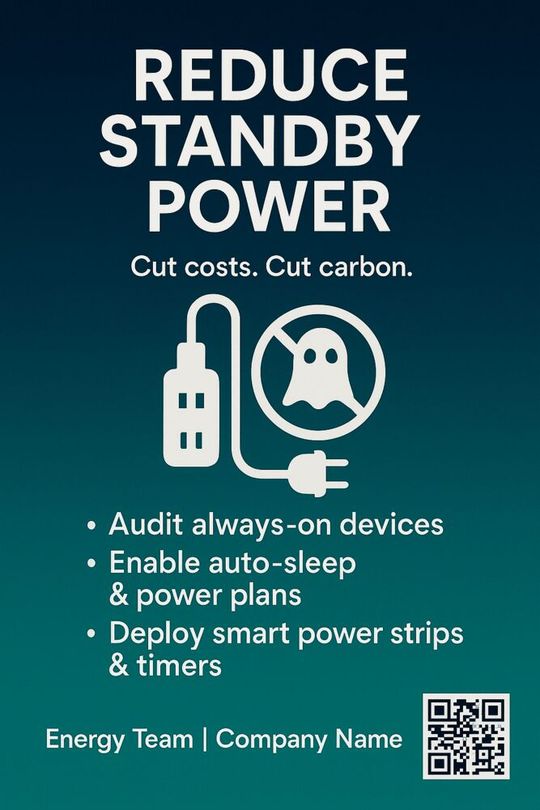
The image below showcases a ChatGPT response. The simple prompt was “Draw a campaign-style image for an enterprise emphasizing reducing standby power.” Surprisingly, no information was fed to write about carbon. The steps mentioned in the image are accurate. The response shows the benefits of ChatGPT for content marketing teams.
2. Design engineering
ChatGPT faced earlier complaints for its engineering mathematics, including vector operations, unit conversions, the Fourier transform, and calculus. The GenAI software would hallucinate false values. The latest ChatGPT model can accurately solve design-based numerical problems, with fewer hallucinations. It can also take image-based input for the problem.
Electronic students are actively using ChatGPT to solve engineering problems for their curriculum and research. Similarly, engineering teams can train ChatGPT to solve basic design engineering problems for their workflows. EDA vendors such as Cadence, Siemens, Synopsys, and many more have released their built-in GenAI copilots.
:quality(80)/p7i.vogel.de/wcms/87/f6/87f68ad872ee667c3805c804b4bc79fe/0117361148.jpeg "Can AI chips replace traditional chips in the future? Read more about their differences and similarities in this article. (Source: flyalone - stock.adobe.com)")
ARTIFICIAL INTELLIGENCE CHIPS
A brief overview of AI chips vs traditional chips
3. Hardware code generation
The IT industry heavily invests time in code generation through ChatGPT. Codex in ChatGPT can help engineers generate and debug code in various programming languages, including those relevant to electrical and electronics companies, C, C #, MATLAB/SIMULINK, Python, and hardware-level languages like Verilog, Systems Verilog, and VHDL.
In electronics design and code generation, ChatGPT responses must be treated as hypotheses. A hybrid pipeline, consisting of various EDA tools along with ChatGPT, must include a human-in-the-loop. Subject matter experts must cross-check values, calculations, designs, and code. Certain software tools can also validate GenAI responses.
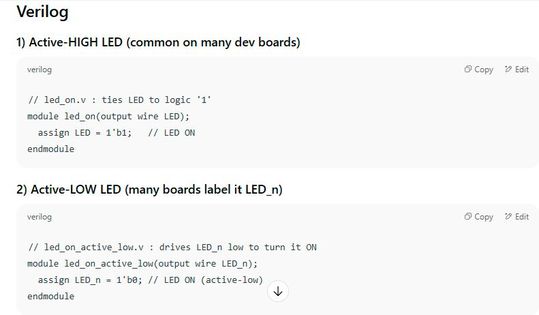
The image below showcases a ChatGPT response when asked to write an HDL code. The prompt was “Generate an HDL code to turn on an LED". ChatGPT gave two answers in Verilog and VHDL, along with a third optional constraint example of Xilinx.
4. Hardware documentation
ChatGPT can create hardware documentation of electronic products, such as chips, power modules, and PCBs. It can also generate troubleshooting guides for engineers in simple language. ChatGPT can create basic circuit diagrams, which engineering and documentation teams can use for their communication, study, and training.
ChatGPT circuits are quicker to create than in EDA tools. Generally, EDA tools exhibit a complex user interface. Engineers get better with time on a specific EDA tool, but using ChatGPT is easier. Hence, novice engineers can use ChatGPT to generate accurate circuits and waveforms with long reports.
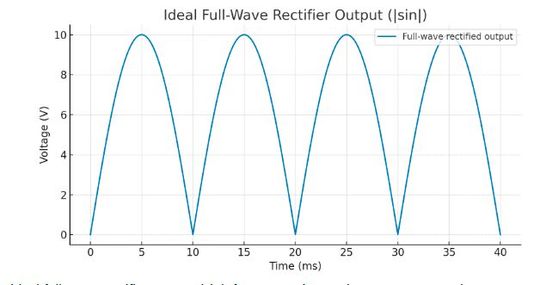
The image below showcases a ChatGPT response when asked to generate the output waveform of a full-wave rectifier. The simple prompt was “Generate the output waveform of a full-wave rectifier”. In contrast, the response is incomplete and not perfectly correct, but rather not wrong, at least.
:quality(80)/p7i.vogel.de/wcms/f0/e0/f0e0561de9eba27f7b1eced122929504/0123679425v2.jpeg "Discover the detailed depth profiles of SiC MOSFETs and the role of AI in improving defect detection within power electronics. (Source: putilov_denis - stock.adobe.com)")
ARTIFICIAL INTELLIGENCE
AI-powered depth profiling: Revolutionizing SiC MOSFET analysis
5. Datasheet assistance
Data sheets are inconsistent. No two enterprises follow a similar structure and design. ChatGPT can generate formats for datasheets, in which engineers can add real values. Simply put, ChatGPT makes datasheet creation easier. However, ChatGPT might hallucinate and mix different parts. On the other hand, ChatGPT can help engineers search for parts in datasheets.
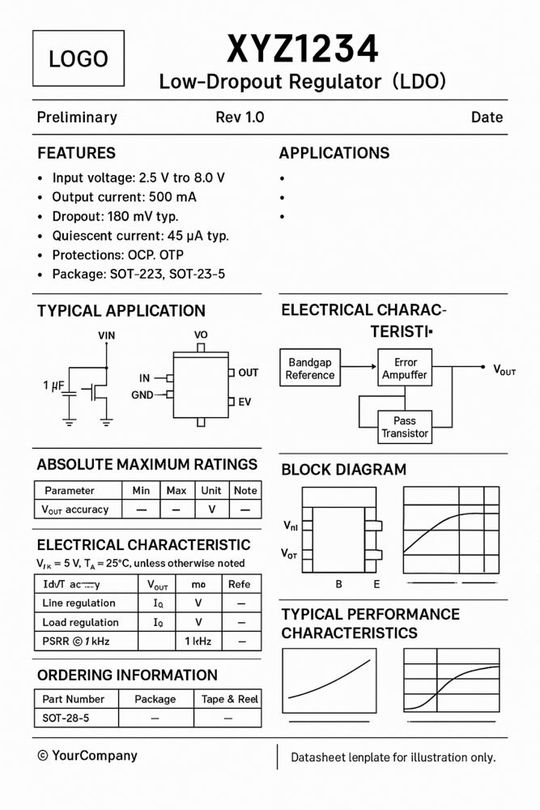
The image below shows a ChatGPT response when asked to generate a datasheet sample. The simple prompt was “Generate a sample datasheet format”. Interestingly, ChatGPT was not asked to generate a datasheet sample for LDO (Low Drop-Out Regulator). Some of the details, like the block diagram at the right and SOT-223-3 packaging details, are correct. However, it contains various inaccuracies.
6. Forecast and research
Most enterprises are already using ChatGPT for research and development, followed by forecasting. ChatGPT, along with advanced ML algorithms, digital twins, and Hardware-in-the-loop simulations, is used to forecast trends for the semiconductor industry. Some examples include trends for yield capacity, fabrication procedures, supply chain risk, and predictive maintenance of electronic equipment on-site.
:quality(80)/p7i.vogel.de/wcms/c6/36/c636981522d4b4716ee1ed8dcfcb3da5/0124856294v2.jpeg "Infineon and NVIDIA are developing an 800V HVDC power architecture for AI data centers to enhance efficiency and reliability. Find out more about this here. (Source: Infineon Technologies AG)")
AI DATA CENTER
Infineon and NVIDIA revolutionize AI server power architecture
7. Contact center
Electrical and electronics companies have their reputable contact centers. They can cut their costs through AI agents. In the absence of team members, agents can assist with customer calls or reply to their queries. Earlier AI models lacked customization. Subject matter experts from engineering teams can train ChatGPT with personas and product information for better responses.
Why do some electronic experts hate it?
Human psychology. According to the Gell-Mann Amnesia effect, experts try to find mistakes in a topic they know well, rather than something they know little about. The more expert a person is in a field, the more likely they are to consider ChatGPT inferior.
A dedicated subreddit thread and various forums facilitate discussion between electrical and electronics enthusiasts for ChatGPT. Reviews are mixed because such enterprises do not glorify GenAI usage, exactly opposite to the IT industry. The opinion is more personal rather than team-based.
Conclusion
The idea of AI for electronics and electrical companies is limited to robots. The hypothetical scenario in which robots manage semiconductor fabrication operations, without human intervention, remains a big industrial dream. GenAI in the context of the semiconductor industry is not well explored.
ChatGPT, through its refined capabilities and support through other OpenAI products, can simplify and accelerate workflows in electronic companies. With time, the GenAI industry is going to experience more innovation — so is ChatGPT — so is the semiconductor and power electronics industry!
(ID:50613086)
:quality(80)/p7i.vogel.de/wcms/13/6f/136ff6c9ecd1ff056414c00b91e0e848/0125348209v2.jpeg "As AI accelerates cyberattacks, the future of power electronics hinges on safeguarding critical infrastructure from evolving digital threats. Learn more about this here. (Source: © MRSUTIN - stock.adobe.com)")
:quality(80)/p7i.vogel.de/wcms/66/2b/662b15dc3b47c5b8a13b9064d54975ff/0123420521v2.jpeg "DeepSeek AI is an AI model based out of China. The hype around DeepSeek AI revolves around its lower training and computational costs. Learn more about this here. (Source: 沈军 贡 - stock.adobe.com)")