


:quality(80)/p7i.vogel.de/wcms/10/fc/10fcb98e44d61826e641bc8d3f20f616/0133193677v2.jpeg "The new AEVA and AEVB Series aluminum electrolytic capacitors are engineered for harsh industrial environments, delivering high-CV, long-lifetime performance in compact, surface-mount packages that reliably withstand up to 30g acceleration and operating temperatures extending from -55° to +125°C. (Source: Kyocera)")
:quality(80)/p7i.vogel.de/wcms/f7/42/f74208db9f5f87dca384b38b71c4782e/0133196365v2.jpeg "YAGEO’s EC Flat‑Series temperature sensors combine fast, accurate measurement with resistance to vibration, shock, moisture and dust for demanding automotive and industrial applications. (Source: Yageo)")
:quality(80)/p7i.vogel.de/wcms/b2/82/b28212428745dd8a4634ad4f4912012f/0132902689v2.jpeg "New 15 V, 25 V and 40 V eGaN FETs deliver ultra-low on-resistance, high current capability, and exceptional radiation immunity for high-density space power conversion (Source: EPC Space)")
:quality(80)/p7i.vogel.de/wcms/7b/4f/7b4f433302c490cac22eee9c12499e65/0132780211v2.jpeg "Littelfuse introduces the TPSMD‑FL series of high‑power surface‑mount TVS diodes, designed to simplify ISO 7637 load‑dump protection and safeguard automotive electronics against severe voltage transients. (Source: Littlefuse)")
:quality(80)/p7i.vogel.de/wcms/78/38/783841efab284c1b4453777e7ebea26d/0133190419v2.jpeg "Diodes has completed its acquisition of Elevate Semiconductor, expanding its analog and mixed-signal portfolio and strengthening its presence in the high-growth automated test equipment market. (Source: © peopleimages.com - stock.adobe.com)")
:quality(80)/p7i.vogel.de/wcms/1f/79/1f79d69530465de26a832c742fc60319/0133117717v2.jpeg "With 30,000 sqm of exhibition space, 20,157 trade visitors, 271 exhibitors, and 131 expert presentations as part of the conference program, the event sent a strong message about the industry's innovative strength and dynamism. (Source: Mesago Messe Frankfurt GmbH)")
:quality(80)/p7i.vogel.de/wcms/43/4d/434db2291567e847e54332004942a225/0132958267v2.jpeg "GlobalWafers has joined the SEMI Taiwan Materials Alliance, with CEO Doris Hsu serving as co‑chair, to advance critical materials technologies, accelerate collaborative innovation and strengthen global semiconductor supply chain resilience. (Source: © jiwon - stock.adobe.com)")
:quality(80)/p7i.vogel.de/wcms/6f/72/6f72f93d1e4c5a248a97dd3b8f32a336/0132997898v2.jpeg "Infineon plans to acquire C2i Semiconductors to combine software‑defined multiphase control and smart power stages with its broad power‑semiconductor portfolio for intelligent, scalable AI data‑center power delivery. (Source: © Grispb - stock.adobe.com)")
:quality(80)/p7i.vogel.de/wcms/87/97/879728679e7010f81e53a86923cde74c/0133218625v2.jpeg "Conceptual illustration of polar wurtzite niobium aluminum nitride (NbAlN), a transition-metal-containing nitride semiconductor that preserves the crystal structure and polarity of GaN. (Source: Associate Professor Atsushi Kobayashi from Tokyo University of Science, Japan)")
:quality(80)/p7i.vogel.de/wcms/ac/31/ac31c9478d80894d725d02883ae7ed5d/0133176534v2.jpeg "Average models allow power designers to simulate DC‑DC converters and three‑phase PFC circuits quickly, analyse small‑signal behaviour and evaluate loop stability without modelling every switching event. (Source: © AI - stock.adobe.com)")
:quality(80)/p7i.vogel.de/wcms/96/80/9680b468d7f682c8b6c15b07300afbb0/0133177854v2.jpeg "Grid-forming inverters are also known as grid-forming resources and grid-forming IBR. This article explains grid-forming inverters in detail. (Bild: © only_kim - stock.adobe.com)")
:quality(80)/p7i.vogel.de/wcms/57/c6/57c6fa81922a9849a917bdfed82eddf7/0133052494v2.jpeg "Rising demand for high-end materials shifts production toward higher-margin products, reducing output of standard loss materials. (Source: NCAB)")
:quality(80)/p7i.vogel.de/wcms/7b/76/7b76005554b556df2a7a3794bdf69d44/0132365246v2.jpeg "Hioki’s ST5680A DC Hipot Tester combines CE/UKCA/CSA compliance, an integrated capacitance‑based contact check and time‑series waveform recording (voltage, leakage current, insulation resistance) to standardize hipot and insulation testing across EV cell, module and pack production lines. (Source: Hioki)")
:quality(80)/p7i.vogel.de/wcms/af/7f/af7f7b0fb7f29219fc991b1130f65477/0132241333v2.jpeg "Comprehensive laboratory testing regimens—combining thermal cycling, high‑current stress, EMC, and accelerated lifetime tests—are essential to validate advanced power designs and ensure reliability in real‑world applications. (Source: PRBX)")
:quality(80)/p7i.vogel.de/wcms/16/3d/163df69363f8125315a9826e13ea4b05/0131927425v2.jpeg "Solution will maximize data center and AI factory profitability while delivering engineering-grade insights to design and operations for more efficient, sustainable, and resilient infrastructure. (Source: Cadence)")
:quality(80)/p7i.vogel.de/wcms/85/b7/85b7e90733a2bd8f21515d8f7137f2fc/0131917677v2.jpeg "Renesas acquires Pictorus to integrate its embedded application software platform with Renesas’ MCU and MPU portfolio, helping developers shorten time‑to‑market and simplify system integration. (Source: © lucadp - stock.adobe.com)")
WPT Wireless power: Present and future developments
Related Vendors
:fill(fff,0)/p7i.vogel.de/companies/63/c7/63c7da97be945/diotec.png "diotec (Diotec Semiconductor AG)")
:fill(fff,0)/p7i.vogel.de/companies/5f/71/5f71d5f92a5f6/2000px-rogers-corporation-logo-svg.png "2000px-Rogers_Corporation_Logo.svg.png (rogers germany)")
:fill(fff,0)/p7i.vogel.de/companies/69/30/693022b11e5db/logo.jpeg "logo (MBS-Hodde GmbH & Co. KG)")
Have you ever heard about an electric pad charging smartphones without a wired cord? The answer is “Wireless Power Transfer”. Once a big project of Nikola Tesla, wireless power was a hypothetical concept in the early nineteenth and twentieth centuries- imagined to empower locomotives. The article explains wireless power with its present status and the scope for future developments.

Wireless Power Transfer or Wireless Power Transmission, abbreviated as WPT, is a process in which electrical energy is transmitted without wires. Wireless power is transmitted as a time-varying electromagnetic field between the source and the receiver. The receiver device extracts power and delivers it to the load.
Wireless power transmission is classified into two types: Near-field (non-radiative) and Far-field (radiative). Far-field wireless power transmission involves microwaves, radio frequencies, radar systems, and satellite communication systems. Far-field wireless power transmission has laid the foundation of modern telecommunication systems. However, the article emphasizes near-field wireless power transfer.
How does near-field wireless power transfer work?
The explanation is based on Faraday’s laws of electromagnetic induction (inductive coupling). Other methods are capacitive and resonant-inductive coupling. An AC current flows in the transmitter coil. It generates a time-varying magnetic field which oscillates at a certain frequency. The magnetic field propagates through space and reaches the receiver.
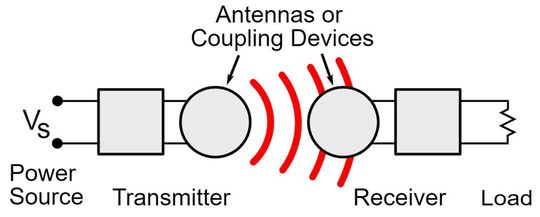
The time-varying magnetic field induces a magnetic flux. As a result, an electromotive force is generated in the receiver coil. To “wirelessly” transfer power from the transmitter to a device, the device must be in direct contact or kept near the transmitter (Typically less than 1 meter).
Present usage: Wireless power integration
Integrating near-field wireless power systems in real-world applications eliminates the need for bulk wiring and metal conductor deployment. It drastically decreases the cost of implementation and improves safety and on-site mobility. From a manufacturer’s perspective, integrating wireless power transmission capabilities offers minimalistic design solutions and cuts down on costs.
Consumer electronics
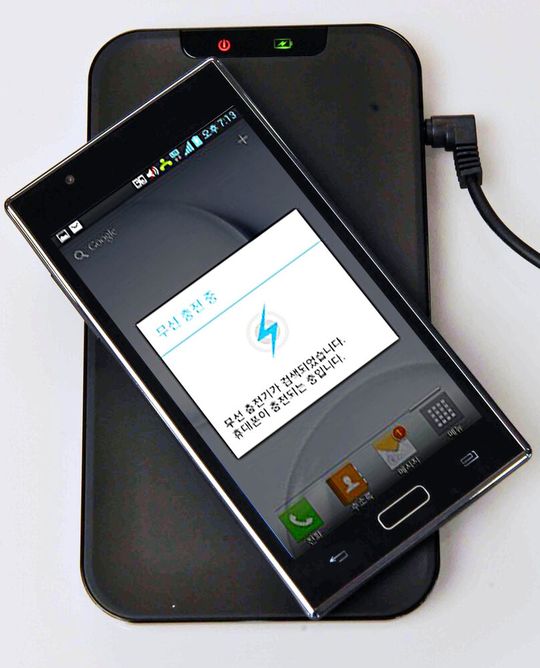
A mainstream wireless power device is a charging pad to charge smartphones, laptops, tablets, computer mice, video game controllers, electric toothbrushes, and electric razors. Both chargers and devices must be compatible and interoperable. Other popular consumer electronic devices include induction cookers and RFID card reading through simple tapping.
Medical equipment
Many under-the-skin implantable biomedical devices including artificial cardiac pacemakers and neiurostimulators are already using near-field wireless power transfer to avoid surgery for replacement. In addition, this technology provides a power supply to a capsule endoscope. Captured images and data enable gastroenterologists to diagnose medical conditions.
Renewables
Wireless power transmission is also known as Wireless Energy Transfer (WET) in renewable applications. Wireless charging infrastructure in parking lots fixes charging coils in the ground. It enables effortless charging of electric trams and vehicles. Recently, a light-duty EV was fully charged, setting up a world record.
:quality(80)/p7i.vogel.de/wcms/61/ab/61ab32248d0c503b19a411c163602cab/94389724v2.jpeg "An electric vehicle can be defined as any vehicle that uses one or more electric or traction motors for propulsion. (Source: gemeinfrei)")
BASIC KNOWLEDGE - ELECTRIC VEHICLES
Electromobility - Electric vehicle basics, how they work, and how they’re powered
Energy harvesting
Energy harvesting is the conversion of ambient energy (heat, vibration, light) into electric power. Applications include kinetic energy-generating bicycles, IoT-based wireless sensor networks, biomedical implants, and wearables. In the case of renewables, wireless power transfer is used with solar cells and piezoelectric devices.
Drones
Wireless power technology is implemented to charge UAVs (Unmanned Aviation Vehicles) or drones. UAVs are needed in the industry to inspect transmission lines and locate faults in high towers. A new technology enables wireless charging of drones through transmission lines to increase flight time.
Present status
The wireless power transfer market is booming. Despite limitations like range and efficiency, innovations like magnetic diodes, dynamic charging for EVs, and solar power satellites are paving the way for a future powered without wires.
Market valuation
Contrary to popular belief, the wireless power transfer market is a billion-dollar business. At present, the wireless power transfer market is valued at USD10.22 billion. By 2031, the market valuation is expected to reach 43.96 billion at a high CAGR of 20 %.
Limitations
Near-field wireless power transfer has a low range and efficiency. In addition, near-field wireless power transmission incurs high losses and EMI (Electromagnetic Interference). In automotive and transportation applications, unreliability cannot be compromised by choosing less wiring as safety is the main concern.
Future developments
Near-field wireless power is growing rapidly in the applications mentioned below. Some of them are in testing phases while others are futuristic.
IoT applications
For IoT-based applications, near-field low-range wireless power transmission is more efficient than far-field wireless power transmission. A coil can be embedded inside a wall or mounted on the ceiling to enable IoT-based home automation. In such cases, LED lights, air conditioners, TVs, music players, and other smart devices can be turned on and off through wireless power solutions.
Industrial IoT applications
SWIPT (Simultaneous Wireless Information and Power Transfer) is a method to transmit information and power without wires. Researchers in South Korea combined SWIPT with NOMA (Non-Orthogonal Frequency Division Multiplexing) in DAS (Distributed Antenna System) to extend the battery life of devices in industrial IoT applications. This technology is somewhat similar to talkative power.
:quality(80)/p7i.vogel.de/wcms/ba/ef/baef3496e4ee9bf88468e08206e8e7e8/88323983.jpeg "The Internet of things (IoT) is a system of interrelated computing devices, mechanical and digital machines provided with unique identifiers (UIDs) and the ability to transfer data over a network without requiring human-to-human or human-to-computer interaction. (Bild: Stock Adobe)")
IoT
How to get power supply for IoT devices right
Magnetic diodes
Recently, Physicists at the University of Innsbruck, Austria, have constructed the world’s first “magnetic diode”. A diode is a device that allows the unidirectional flow of current. This magnetic diode allows magnetic fields to flow in only one direction. The new invention can revolutionize the wireless charging of EVs and improve magnetic coupling elements in MRI machines.
Dynamic charging
Dynamic charging is a concept that enables battery charging while the EV is at rest or still in motion. Wireless power integration at rest decreases reliance on charging stations. When an EV is in motion, dynamic charging can bring effective results to eliminate the tension of repeated temporary halts and improve mobility range.
Power electronics
One of the most critical power electronics issues is to ensure proper heat management. High-current and voltage applications heat the devices and bulky wires. Implementing wireless power transmission with heat sinks is a simple way to maintain safety. At present, wireless power transmission is possible for low-power applications. High-power near-field wireless power transfer is hypothetical.
Solar satellites
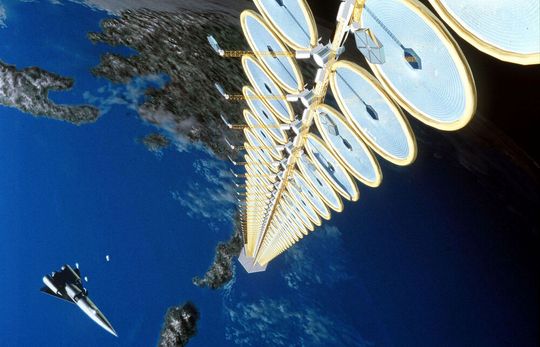
When compared to far-field wireless power, near-field wireless power transfer can be much more powerful in space due to its unique conditions and negligible risk of human intervention. Power beaming is a technology that utilizes solar satellites to collect solar power in space and distribute it to Earth. Such a technology has been in testing phases since the seventies. In 2024, Caltech successfully transmitted wireless power in space with its SSPD launch (Space Solar Power Demonstrator).
Underwater environments
Deploying wired charging cables is not always possible in harsh environments like the underground and deep ocean floors due to extreme pressure conditions. In such cases, wireless power transfer can be beneficial for small underwater devices that have low charging periods such as cameras and sensors. Apart from underwater deployments, humid and coastal areas are also good examples.
References
www.sciencedirect.com
www.mdpi.com
www.uibk.ac.at
www.ornl.gov
www.sciencedaily.com
www.caltech.edu
artsandculture.google.com
(ID:50094343)
:quality(80)/p7i.vogel.de/wcms/4d/39/4d390c935fec4cd94dab8d1ec43fc67d/0128521086v2.jpeg "Symbolic image: A retrofitted EV charges wirelessly via the ground-embedded coil, with the charging process starting automatically once the vehicle is positioned correctly. (Source: © Johnnii - stock.adobe.com)")
:quality(80)/p7i.vogel.de/wcms/3c/4b/3c4bbc68dda65c7071b4376fb57423b0/0130030465v2.jpeg "Faraday’s laws explain the fundamental behavior of magnetic fields and electronic devices in dynamic use cases. The operation of transformers, wireless chargers, induction cookers, induction motors, magnetic levitating trains (MAGLEV Trains), electric violin, and many others depends upon Faraday’s laws. (Source: © Sheraz - stock.adobe.com)")