


:quality(80)/p7i.vogel.de/wcms/7f/4b/7f4b97757cea82c0675209630577dc22/0133974130v2.jpeg "Vox Power’s EIRE600 delivers up to 600 W in a compact 5 × 3-inch package, with forced-air or conduction cooling options for industrial and medical equipment. (Source: Vox Power)")
:quality(80)/p7i.vogel.de/wcms/55/97/5597c3436e3bc92ee7ba23b6f9d289e9/0134032539v2.jpeg "Littelfuse’s TP7.0SMD-XC automotive TVS diode series uses foldback technology to provide low clamping voltage for protecting sensitive vehicle electronics. (Bild: Littelfuse)")
:quality(80)/p7i.vogel.de/wcms/51/f8/51f84448e666230bb11a02566abd1177/0133958187v3.jpeg "Microchip’s radiation-tolerant GaN point-of-load converter supplies up to 20 A for space-based processors, FPGAs, microcontrollers and ASICs. (Source: Microchip)")
:quality(80)/p7i.vogel.de/wcms/0a/7c/0a7c08f368ae1d91f758dd18d2a32e88/0133978423v2.jpeg "EPFL researchers have demonstrated a GaN transistor that withstands nearly 4 kV, using an intrinsic polarization superjunction design to distribute electric fields more evenly. (Source: EPFL)")
:quality(80)/p7i.vogel.de/wcms/5b/94/5b94232ca4183d6fcc2dccc7394d7544/0134041114v4.jpeg "Siemens and NVIDIA are testing AI applications at Siemens’ Erlangen electronics factory, using digital twins to support production planning and prepare inspection systems before physical prototypes are available. (Bild: Siemens)")
:quality(80)/p7i.vogel.de/wcms/b4/1f/b41f2731a07b608e60eca3663e280301/0133980549v2.jpeg "Multi-year agreement with Wolfspeed supports Infineon’s conversion from 150-millimeter to 200-millimeter silicon carbide (SiC) manufacturing (Source: © Ada - stock.adobe.com)")
:quality(80)/p7i.vogel.de/wcms/e3/0a/e30a8813bcf44b16f0dceb63a0747d29/0133984094v2.jpeg "The semiconductor is only one part of the design. Higher voltage, frequency and power density also increase the demands on electronic packaging materials such as die attach, substrates, top-side interconnects and module attach. (Source: Generated by AI)")
:quality(80)/p7i.vogel.de/wcms/5d/fb/5dfba5e5f38daf2b8597b05656af29c0/0133956337v2.jpeg "Wolfspeed has received a conditional commitment for a loan of up to $1.5 billion from the U.S. Department of War to support its domestic wide-bandgap semiconductor supply chain. (Source: © AspctStyle - stock.adobe.com)")
:quality(80)/p7i.vogel.de/wcms/bf/b6/bfb6ac295759be32d567df9849b6767e/0134094495v2.jpeg "Fraunhofer ISE reports that 25 Ah pouch cells with silicon-rich anodes retained more than 83% of their initial capacity after 1,000 cycles when tested under 1,000 kPa axial pressure. (Bild: Fraunhofer ISE)")
:quality(80)/p7i.vogel.de/wcms/16/dc/16dca55e6ef80e6b5da68bc628da2dcc/0133844782v2.jpeg "This article explains virtual power plants in modern renewable-heavy grids. (Source: © M@rketVisualsStudio - stock.adobe.com)")
:quality(80)/p7i.vogel.de/wcms/e8/33/e8330aae4bea3578b98ec2c1403d367a/0133980001v2.jpeg "IRENA’s 2026 World Energy Transition Outlook identifies faster electrification powered by renewables as central to meeting future global energy needs. (Source: Irena)")
:quality(80)/p7i.vogel.de/wcms/6c/b4/6cb405f47d25035e256ae90fe3a66ee6/0134032112v2.jpeg "Sungrow’s PowerTitan 3.0 energy storage platform uses onsemi EliteSiC hybrid power modules, with the companies reporting peak inverter efficiency above 99.3%. (Bild: onsemi)")
:quality(80)/p7i.vogel.de/wcms/7b/76/7b76005554b556df2a7a3794bdf69d44/0132365246v2.jpeg "Hioki’s ST5680A DC Hipot Tester combines CE/UKCA/CSA compliance, an integrated capacitance‑based contact check and time‑series waveform recording (voltage, leakage current, insulation resistance) to standardize hipot and insulation testing across EV cell, module and pack production lines. (Source: Hioki)")
:quality(80)/p7i.vogel.de/wcms/af/7f/af7f7b0fb7f29219fc991b1130f65477/0132241333v2.jpeg "Comprehensive laboratory testing regimens—combining thermal cycling, high‑current stress, EMC, and accelerated lifetime tests—are essential to validate advanced power designs and ensure reliability in real‑world applications. (Source: PRBX)")
:quality(80)/p7i.vogel.de/wcms/16/3d/163df69363f8125315a9826e13ea4b05/0131927425v2.jpeg "Solution will maximize data center and AI factory profitability while delivering engineering-grade insights to design and operations for more efficient, sustainable, and resilient infrastructure. (Source: Cadence)")
:quality(80)/p7i.vogel.de/wcms/85/b7/85b7e90733a2bd8f21515d8f7137f2fc/0131917677v2.jpeg "Renesas acquires Pictorus to integrate its embedded application software platform with Renesas’ MCU and MPU portfolio, helping developers shorten time‑to‑market and simplify system integration. (Source: © lucadp - stock.adobe.com)")
:quality(80)/p7i.vogel.de/wcms/f8/34/f834240d434a0c265a2ccafe614c8cd7/0134032109v4.jpeg "Hard- and soft-switching techniques shape voltage and current during device transitions, influencing switching losses, EMI and thermal performance in power converters. (Bild: © Mrthullab - stock.adobe.com)")
:quality(80)/p7i.vogel.de/wcms/27/07/2707280c807689b437baed3660257404/0133626052v2.jpeg "The quantum behavior of electrons shapes semiconductor devices—and the power converters that deliver electricity to modern computing systems. (Source: © Celt Studio - stock.adobe.com)")
BASIC KNOWLEDGE - AC VS. DC What's the difference between AC and DC power?
Related Vendors
:fill(fff,0)/p7i.vogel.de/companies/69/a8/69a8093b1b5e1/hvp-png.png "hvp-png (HVP-Logo)")
:fill(fff,0)/p7i.vogel.de/companies/5f/71/5f71d5f92a5f6/2000px-rogers-corporation-logo-svg.png "2000px-Rogers_Corporation_Logo.svg.png (rogers germany)")
:fill(fff,0)/p7i.vogel.de/companies/68/2c/682c3e2e9a195/logotype-rvb.jpeg "logotype-rvb (MERSEN France)")
Electricity comes in two forms — alternating current (AC) and direct current (DC). Both are essential to enable the functioning of our electronics, but do you know the difference between AC and DC and what they apply to?

What is AC power?
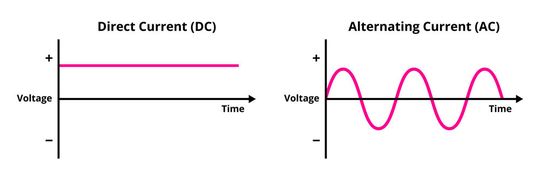
Alternating current (AC) is the standard electricity that comes out of power outlets and is defined as a flow of charge that exhibits a periodic change in direction. AC's current flow changes between positive and negative because of electrons — electrical currents come from the flow of these electrons, which can move in either a positive (upward) or negative (downward) direction. This is known as the sinusoidal AC wave, and this wave is caused when alternators at power plants create AC power.
Alternators create AC power by spinning a wire loop inside a magnetic field. Waves of alternating current are made when the wire moves into areas of different magnetic polarity — for example, the current changes direction when the wire spins from one of the magnetic field's poles to the other. This wave-like motion means that AC power can travel farther than DC power, a huge advantage when it comes to delivering power to consumers via power outlets.
:quality(80):fill(efefef,0)/p7i.vogel.de/wcms/65/69/6569f9912322b/202312-whitepaper-ametek-coverbild.png "202312_Whitepaper Ametek_Coverbild")
What is DC power?
Now that we have explained the most important aspects of AC supply in the section above, you may already be able to guess the answer to the following question: What does DC stand for? If you were thinking of direct current, which is the exact opposite of alternating current, then you're right! Direct current is a linear electrical current — it moves in a straight line. Direct current can come from multiple sources, including batteries, solar cells, fuel cells, and some modified alternators. DC power can also be "made" from AC power by using a rectifier that converts AC to DC.
DC power is far more consistent in terms of voltage delivery, meaning that most electronics rely on it and use DC power sources such as batteries. Electronic devices can also convert AC power from outlets to DC power by using a rectifier, often built into a device's power supply. A transformer will also be used to raise or lower the voltage to a level appropriate for the device in question.
Practical Example of DC: The Car Battery
A common question is: "Is a car battery AC or DC power?" The answer highlights the ubiquity and importance of direct current in our daily lives. Car batteries provide direct current, meaning the electrical current flows in one constant direction. This characteristic is crucial for the functioning of vehicles as it ensures a steady voltage supply for the reliable operation of the vehicle's electrical components. This example demonstrates how DC is used in the automotive industry and underscores its significance for powering a multitude of devices and systems.
Not all electrical devices use DC power, though. Many devices, household appliances, especially, such as lamps, washing machines, and refrigerators, all use alternating power, which is delivered directly from the power grid via power outlets.
AC vs. DC: A comparison
Having discussed the fundamental concepts of AC and DC, the table below presents a concise comparison of the two types of electricity. This summary aims to encapsulate the differences in definition, generation, transmission, usage, and other key aspects at a glance. It illustrates why both forms of electricity are indispensable for powering our modern world.
| Criterion | Alternating Current (AC) | Direct Current (DC) |
|---|---|---|
| Definition | The current periodically changes its direction. | The current flows steadily in one direction. |
| Generation | Generators that convert mechanical energy. | Batteries, solar cells, rectifiers. |
| Transmission | Can be transmitted over long distances with less energy loss. | Less efficient over long distances due to more energy losses. |
| Usage | Widely used for operating household appliances and in industry. | Used in electronics, battery-powered devices, and some rail vehicles. |
| Voltage | Variable, can easily be stepped up or down using transformers. | Constant, changing requires a converter. |
| Efficiency | Efficient in long-distance transmission. | More efficient in applications requiring constant voltage. |
| Applications | Mains power, large motors, lighting. | Electronics, vehicles, low-power applications. |
In conclusion, understanding the difference between AC and DC is crucial for comprehending how our electrical systems and devices operate. This table provides a clear snapshot of the key differences and similarities that define AC and DC power, highlighting their unique roles in our daily lives.
What's the need for two different power types?
Although many of today's electronics and electrical devices prefer DC power because of its smooth flow and even voltage, we could not get by without alternating power. Both types of power are essential; one is not "better" than the other.
In fact, AC dominates the electricity market; all power outlets bring power into buildings in the form of AC, even where the current may need to be immediately converted into DC power. This is because DC is not capable of traveling the same long distances from power plants to buildings that AC is. It is also a lot easier to generate AC than DC due to the way generators turn, and the system is on the whole cheaper to operate — with AC, power can be hauled through national grids via miles and miles of wire and pylons easily.
DC primarily comes into play, where a device needs to store power in batteries for future use. Smartphones, laptops, portable generators, torches, outdoor CCTV camera systems… you name it, anything battery-powered relies on storing DC power. When batteries are charged from the mains supply, AC is converted to DC by a rectifier and stored in the battery.
This is not the only method of charging used, though. If you have ever charged your phone using a power bank, for example, you are using a DC power supply rather than an AC one. In these situations, DC-DC power supplies may need to change the voltage of the output (in this case, the power bank) for the device's (in this case, the phone) use.
(ID:46408650)
:quality(80)/p7i.vogel.de/wcms/7a/a5/7aa50649486f059b1d7111f508c5c6e7/0128629162v2.jpeg "This article explains current transducers and their role in power electronics. (Source: © kwanchanachai - stock.adobe.com)")
:quality(80)/p7i.vogel.de/wcms/0d/d0/0dd02f3d5a1c83c1be444f73910e6b30/0126472071v2.jpeg "Current transducers are essential devices in power electronics, converting high current levels into standardized signals for safe and efficient use across various electronic systems, with applications ranging from motor protection to renewable energy systems and particle accelerators. (Source: © Aimur - stock.adobe.com)")