


:quality(80)/p7i.vogel.de/wcms/10/fc/10fcb98e44d61826e641bc8d3f20f616/0133193677v2.jpeg "The new AEVA and AEVB Series aluminum electrolytic capacitors are engineered for harsh industrial environments, delivering high-CV, long-lifetime performance in compact, surface-mount packages that reliably withstand up to 30g acceleration and operating temperatures extending from -55° to +125°C. (Source: Kyocera)")
:quality(80)/p7i.vogel.de/wcms/f7/42/f74208db9f5f87dca384b38b71c4782e/0133196365v2.jpeg "YAGEO’s EC Flat‑Series temperature sensors combine fast, accurate measurement with resistance to vibration, shock, moisture and dust for demanding automotive and industrial applications. (Source: Yageo)")
:quality(80)/p7i.vogel.de/wcms/b2/82/b28212428745dd8a4634ad4f4912012f/0132902689v2.jpeg "New 15 V, 25 V and 40 V eGaN FETs deliver ultra-low on-resistance, high current capability, and exceptional radiation immunity for high-density space power conversion (Source: EPC Space)")
:quality(80)/p7i.vogel.de/wcms/7b/4f/7b4f433302c490cac22eee9c12499e65/0132780211v2.jpeg "Littelfuse introduces the TPSMD‑FL series of high‑power surface‑mount TVS diodes, designed to simplify ISO 7637 load‑dump protection and safeguard automotive electronics against severe voltage transients. (Source: Littlefuse)")
:quality(80)/p7i.vogel.de/wcms/78/38/783841efab284c1b4453777e7ebea26d/0133190419v2.jpeg "Diodes has completed its acquisition of Elevate Semiconductor, expanding its analog and mixed-signal portfolio and strengthening its presence in the high-growth automated test equipment market. (Source: © peopleimages.com - stock.adobe.com)")
:quality(80)/p7i.vogel.de/wcms/1f/79/1f79d69530465de26a832c742fc60319/0133117717v2.jpeg "With 30,000 sqm of exhibition space, 20,157 trade visitors, 271 exhibitors, and 131 expert presentations as part of the conference program, the event sent a strong message about the industry's innovative strength and dynamism. (Source: Mesago Messe Frankfurt GmbH)")
:quality(80)/p7i.vogel.de/wcms/43/4d/434db2291567e847e54332004942a225/0132958267v2.jpeg "GlobalWafers has joined the SEMI Taiwan Materials Alliance, with CEO Doris Hsu serving as co‑chair, to advance critical materials technologies, accelerate collaborative innovation and strengthen global semiconductor supply chain resilience. (Source: © jiwon - stock.adobe.com)")
:quality(80)/p7i.vogel.de/wcms/6f/72/6f72f93d1e4c5a248a97dd3b8f32a336/0132997898v2.jpeg "Infineon plans to acquire C2i Semiconductors to combine software‑defined multiphase control and smart power stages with its broad power‑semiconductor portfolio for intelligent, scalable AI data‑center power delivery. (Source: © Grispb - stock.adobe.com)")
:quality(80)/p7i.vogel.de/wcms/87/97/879728679e7010f81e53a86923cde74c/0133218625v2.jpeg "Conceptual illustration of polar wurtzite niobium aluminum nitride (NbAlN), a transition-metal-containing nitride semiconductor that preserves the crystal structure and polarity of GaN. (Source: Associate Professor Atsushi Kobayashi from Tokyo University of Science, Japan)")
:quality(80)/p7i.vogel.de/wcms/ac/31/ac31c9478d80894d725d02883ae7ed5d/0133176534v2.jpeg "Average models allow power designers to simulate DC‑DC converters and three‑phase PFC circuits quickly, analyse small‑signal behaviour and evaluate loop stability without modelling every switching event. (Source: © AI - stock.adobe.com)")
:quality(80)/p7i.vogel.de/wcms/96/80/9680b468d7f682c8b6c15b07300afbb0/0133177854v2.jpeg "Grid-forming inverters are also known as grid-forming resources and grid-forming IBR. This article explains grid-forming inverters in detail. (Bild: © only_kim - stock.adobe.com)")
:quality(80)/p7i.vogel.de/wcms/57/c6/57c6fa81922a9849a917bdfed82eddf7/0133052494v2.jpeg "Rising demand for high-end materials shifts production toward higher-margin products, reducing output of standard loss materials. (Source: NCAB)")
:quality(80)/p7i.vogel.de/wcms/7b/76/7b76005554b556df2a7a3794bdf69d44/0132365246v2.jpeg "Hioki’s ST5680A DC Hipot Tester combines CE/UKCA/CSA compliance, an integrated capacitance‑based contact check and time‑series waveform recording (voltage, leakage current, insulation resistance) to standardize hipot and insulation testing across EV cell, module and pack production lines. (Source: Hioki)")
:quality(80)/p7i.vogel.de/wcms/af/7f/af7f7b0fb7f29219fc991b1130f65477/0132241333v2.jpeg "Comprehensive laboratory testing regimens—combining thermal cycling, high‑current stress, EMC, and accelerated lifetime tests—are essential to validate advanced power designs and ensure reliability in real‑world applications. (Source: PRBX)")
:quality(80)/p7i.vogel.de/wcms/16/3d/163df69363f8125315a9826e13ea4b05/0131927425v2.jpeg "Solution will maximize data center and AI factory profitability while delivering engineering-grade insights to design and operations for more efficient, sustainable, and resilient infrastructure. (Source: Cadence)")
:quality(80)/p7i.vogel.de/wcms/85/b7/85b7e90733a2bd8f21515d8f7137f2fc/0131917677v2.jpeg "Renesas acquires Pictorus to integrate its embedded application software platform with Renesas’ MCU and MPU portfolio, helping developers shorten time‑to‑market and simplify system integration. (Source: © lucadp - stock.adobe.com)")
IPM What is an integrated power module? Inside the quiet revolution in motor control
Related Vendors
:fill(fff,0)/p7i.vogel.de/companies/60/7e/607ec89d5d9b5/white-frame.jpg "white frame.jpg (www.rohm.com)")
:fill(fff,0)/p7i.vogel.de/companies/62/a0/62a0a0de7d56a/aic-europe-logo.jpeg "aic-europe-logo (AIC Europe)")
:fill(fff,0)/p7i.vogel.de/companies/68/2c/682c3e2e9a195/logotype-rvb.jpeg "logotype-rvb (MERSEN France)")
IPMs are transforming how engineers approach motor control, power conversion, and inverter design. By combining power switches, gate drivers, protection circuitry, and thermal monitoring in a single, compact package, IPMs simplify development, reduce failure points, and enable faster time-to-market.
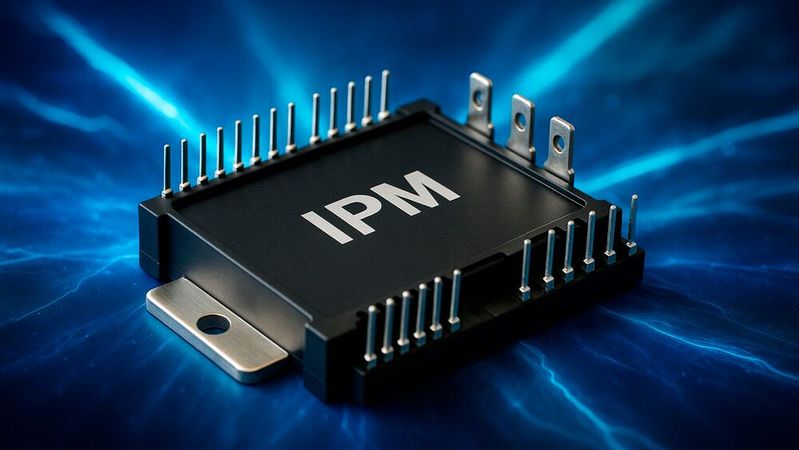
An integrated power module, commonly abbreviated as IPM, is more than just a set of power switches in a box. At its core, it’s a self-contained power stage: a three-phase inverter bridge that comes with all the control, protection, and interface circuitry needed to drop into a motor-drive design. This includes gate drivers, level-shifters, isolation barriers, overcurrent and thermal protection, and in many cases, built-in temperature sensors and fault reporting lines.
For appliance and HVAC manufacturers, this integration is gold. It reduces design complexity, ensures regulatory compliance, and eliminates many of the unknowns around EMI, creepage, and fault protection. It’s why parts like Infineon’s CIPOS, STMicroelectronics’ SLLIMM, and Mitsubishi’s SLIMDIP and DIPIPM families have become standard choices in compressor drives, fan controllers, washing machines, and commercial air-conditioning systems.
IPMs come with many practical advantages, including less time spent debugging switching transients, fewer components on the board, and greater assurance that protection will trigger safely and predictably under fault conditions. It’s no coincidence that IPMs dominate design wins in applications where reliability, size, and cost carry more weight than bleeding-edge switching frequency or custom tuning.
From switches to safety
Most integrated power modules follow a consistent structure. At the heart are six IGBT or MOSFET devices arranged in a three-phase bridge, each paired with a freewheeling diode. Surrounding them is the real value: high-voltage gate driver ICs, often built with built-in level shifting and isolation for the high-side devices. These drivers handle switching control but also embed essential protections such as undervoltage lockout, overcurrent detection (via desaturation or shunt sensing), and thermal shutdown.
Modules like ST’s SLLIMM series include all of this in a compact format, with power ratings that stretch from hundreds of watts to several kilowatts. Infineon’s CIPOS Mini lineup goes even further, integrating bootstrap diodes, fault logic, and thermistors for temperature monitoring, all in a robust, transfer-molded package. This is the level of integration engineers increasingly expect.
Some IPMs, particularly those aimed at higher-power industrial and HVAC applications, also offer expanded topologies. Mitsubishi’s “CIB” variants, for example, integrate not just the inverter bridge but also the rectifier front end and brake chopper, allowing a complete AC-DC-AC drive chain to be handled inside one module. That’s a significant space and cost saving for mid-power motor drives where board real estate is at a premium.
The real performance frontier
As IPMs move into more demanding environments, their success depends less on the silicon itself and more on the package in which it’s embedded. Transfer-molded modules with direct-bonded copper (DBC) substrates are now common in higher-reliability designs, offering improved thermal impedance and isolation. But the real breakthroughs are coming from how the devices inside are connected and cooled.
Wire bonds, once standard for connecting die to leads, are being phased out in favor of wire-bondless architectures and silver sintering techniques. These packaging methods enhance thermal performance and significantly extend power-cycling lifetime, making them ideal for applications where modules must endure thousands of heating and cooling cycles over a decade or more.
This trend parallels a shift in standards. While most IPMs target industrial and consumer markets, they’re increasingly borrowing practices from automotive. The ECPE’s AQG 324 guideline, updated in 2025, has become the reference point for module qualification in EV traction inverters. It codifies power-cycling requirements, thermal modeling expectations, and end-of-life predictions in a way that’s filtering down to appliance-class modules. Engineers designing for long-lived white goods or commercial HVAC are now using the same language of lifetime modeling and safe operating area margins that used to be confined to automotive.
:quality(80):fill(efefef,0)/p7i.vogel.de/wcms/5f/fe/5ffedb2e0ffa6/listing.jpg "listing")
A broader shift in power electronics
The rise of integrated power modules reflects a broader shift in power electronics. Engineers are looking for fewer variables, better protection, and more predictable system behavior. IPMs deliver all three, wrapping complex analog subsystems into a reliable, testable block that can be designed once and reused across platforms.
But as the technology evolves, it’s packaging that now defines the best from the rest. With advanced interconnects, embedded protection, and rigorous qualification, the next generation of IPMs is built as much for endurance as efficiency. In a world where time-to-market is short but product lifetimes stretch longer than ever, that’s a tradeoff power engineers are more than ready to make.
(ID:50568161)
:quality(80)/p7i.vogel.de/wcms/9f/26/9f26e883a4087ed359f21694eb12c443/0127013676v2.jpeg "The booming power module market is shifting focus to innovative packaging solutions to meet growing demands in automotive and renewable energy sectors. (Source: Dall-E)")
:quality(80)/p7i.vogel.de/wcms/d6/9a/d69a90a148ae5222d27ac6b33c228a01/0131921521v2.jpeg "A compact three‑phase inverter platform based on the EPC33110 integrated GaN module delivers high switching frequency and power density for robotic joints and lightweight drone propulsion, combining monolithic half‑bridges, integrated drivers and simplified PCB layout. (Source: © Laura - stock.adobe.com)")