


:quality(80)/p7i.vogel.de/wcms/2f/f3/2ff3221bf7665de2d0acf83760bfd1fa/0130031523v2.jpeg "Wolfspeed presents a 300 mm silicon carbide technology platform designed to support advanced packaging and high-efficiency power delivery for AI data center infrastructure. (Source: Wolfspeed)")
:quality(80)/p7i.vogel.de/wcms/c3/16/c316e955a97f5d72d9678297b237b9e5/0129932858v2.jpeg "Left: the single-phase version of the SENTRON ECPD with RCM, right: a model of the future three-phase version of the SENTRON ECPD. (Source: Siemens)")
:quality(80)/p7i.vogel.de/wcms/ef/0a/ef0adb0acf793fe147cc27c21f6a7a67/0129954238v2.jpeg "Empower Semiconductor introduces embedded silicon capacitors designed to improve power delivery and stability in AI and high-performance computing processors. (symbolic image) (Source: © IF.arc - stock.adobe.com)")
:quality(80)/p7i.vogel.de/wcms/53/f9/53f9301dfc9292d02960f7996c79cc6e/0129927601v2.jpeg "Wolfspeed’s new 10 kV SiC MOSFET enables high-voltage power conversion for grid and industrial applications. (symbolic image) (Source: © CREATIVE- 3.4 - stock.adobe.com)")
:quality(80)/p7i.vogel.de/wcms/6e/cd/6ecd41d095d5111cf4ed37b714844487/0129930878v2.jpeg "PCIM Asia Shenzhen provides a platform for industry experts to present new developments in power electronics and electrification technologies. (symbolic image) (Source: © killykoon - stock.adobe.com)")
:quality(80)/p7i.vogel.de/wcms/02/c0/02c0e9722f70b1134dbf96fb59a9c73d/0129655179v2.jpeg "The PCIM Conference 2026 will take place from June 9-11, featuring discussions on power electronics trends, including GaN technology and AI applications. (symbolic image) (Source: © Elmira - stock.adobe.com)")
:quality(80)/p7i.vogel.de/wcms/cc/67/cc670ea2029cd2af5c641af70e1bf734/0129816392v4.jpeg "Fraunhofer IAF coordinates the EU SUPREME project to accelerate GaN and SiC power semiconductor innovation in Europe. (Source: Fraunhofer IAF)")
:quality(80)/p7i.vogel.de/wcms/ea/e6/eae6aee30071e67a5627027974437134/0129544613v2.jpeg "GlobalFoundries and Renesas strengthen their collaboration to support U.S.-based semiconductor production and supply chain resilience. (Source: © ronstik - stock.adobe.com)")
:quality(80)/p7i.vogel.de/wcms/b1/5e/b15ee02b0ba02db70cf61e37d66ad1d3/0129349127v2.jpeg "Vehicle-to-grid (V2G) chargers enable bidirectional energy flow, allowing electric vehicles to act as mobile energy storage systems that can both draw power from and feed power back into the grid. (Source: © medienvirus - stock.adobe.com)")
:quality(80)/p7i.vogel.de/wcms/26/d5/26d591cc340077026eac56a0e7564faf/0129949603v2.jpeg "Flexible: The solid silicone-based electrolyte is elastic, thereby compensating for the voids that form in solid-state batteries during charging and discharging. (Source: Empa)")
:quality(80)/p7i.vogel.de/wcms/4d/e0/4de02f76a37cbb3df30dd231de589c8e/0128866890v2.jpeg "Both legacy and vGaN show higher carrier mobility and band gap energies compared to other power semiconductors. (Source: © phonlamaiphoto - stock.adobe.com)")
:quality(80)/p7i.vogel.de/wcms/18/0b/180b7b63afc91e523592d8a5ce161c96/0129847487v2.jpeg "InGaAs-based photodetectors enable sensitive and fast detection in the short-wave infrared spectrum for modern sensing and communication applications. (Source: © VITALII - stock.adobe.com)")
:quality(80)/p7i.vogel.de/wcms/be/c8/bec8d43fc0ee73414274be44608b2970/0129748903v2.jpeg "The Infiniium XR804KA real-time oscilloscope delivers faster response time, improved stability, and streamlined workflows for high-speed digital and compliance testing. (Source: Keysight)")
:quality(80)/p7i.vogel.de/wcms/23/ee/23ee4a97790d6009dbfd7d9577ffa723/0129220424v2.jpeg "The R&S FPL1044 with the new RTSA option makes 40 MHz real-time frequency analysis available up to 44 GHz. (Source: Rohde & Schwarz )")
:quality(80)/p7i.vogel.de/wcms/3c/d1/3cd1cacbceb792ba63727199c61ca434/0127801860v2.jpeg "Thanks to cloud technology, users can collaborate on projects from anywhere and always have access to the latest planning data. (Source: SIEMENS)")
:quality(80)/p7i.vogel.de/wcms/5a/a0/5aa0436498af618297961fd54ab36cdf/0126290792v2.jpeg "Siemens accelerates student-led semiconductor innovation across Europe’s leading technical universities through Cre8Ventures’ Open Higher Education Program developed in collaboration with Arm and University of Southampton (Source: Siemens Digital Industries Software)")
BASIC KNOWLEDGE What is a current transducer?
Related Vendors
:fill(fff,0)/p7i.vogel.de/companies/67/e2/67e2a1ef13aba/logo-ab-rgb-1.jpeg "logo-ab-rgb-1 (http://www.arthurbehrens.biz/)")
:fill(fff,0)/p7i.vogel.de/companies/68/2c/682c3e2e9a195/logotype-rvb.jpeg "logotype-rvb (https://www.mersen.com/en)")
:fill(fff,0)/p7i.vogel.de/companies/69/30/693022b11e5db/logo.jpeg "logo (MBS-Hodde GmbH & Co. KG)")
Every electronic device or system operates within its rating. Common devices are not designed to work with high currents. The primary function of a current transducer is to provide a high current signal to all connected devices within a standardized range! So every device in a system can use the same kiloamperes of current, but differently. This article explains current transducers, their operation, use, advantages, and disadvantages.
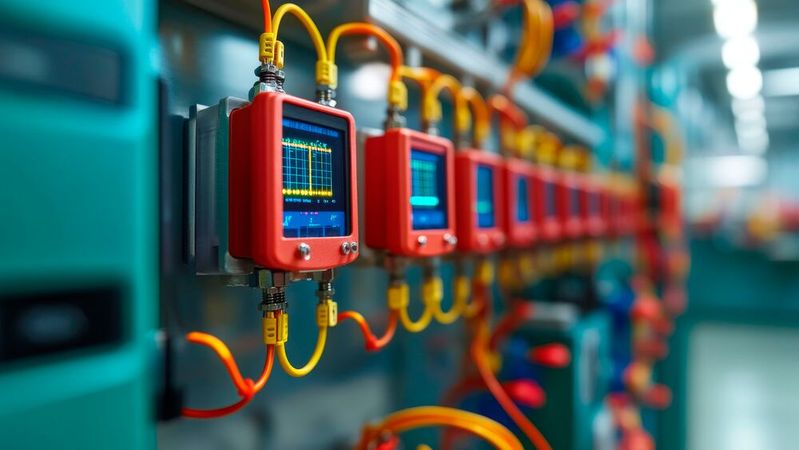
Current transducers are applicable in electronic applications like power conversion, power systems, electrical meters, motor protection, mechanical workshops, data acquisition systems, particle accelerators, and many more.
Current transducer definition
A current transducer is a sensing device that converts the high current, which has to be measured, into a voltage or current in a standardized range. Simply put, a current transducer is a device that measures AC or DC current and generates a corresponding industrial standard signal for it.
Current transducers can measure thousands of amperes and generate outputs in formats like:
- 4 – 20 mA
- 0 – 5 V (DC)
- 0 – 10 V (DC)
- 1 Vac
- 0.333 Vac
For example, a current transducer converts a high current of 5 kA into an output of 2.5 V or 12 mA. Such voltage and current ranges are safe for electronic operations. Unlike industries, not every electronic system can operate on such high-current inputs.
Current transducer symbol
Current transducers use the basic transducer symbol.
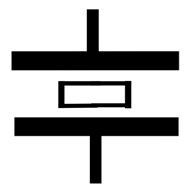
1. Introduction to transducers
Let us go through the basics of transducers to understand current transducers. A transducer is a device that converts energy from one form to another. For example, a transducer converts audio into an electronic signal. An electrical transducer is a sensing device that converts a measurable quantity into an equivalent voltage or current signal. In simple words, an electrical transducer converts the quantity to be measured into a proportionate voltage or current signal.
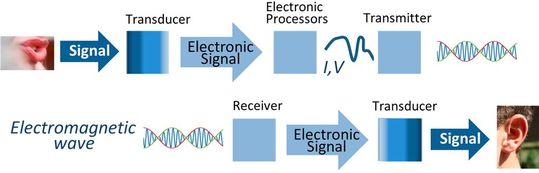
The quantity to be measured can be either physical, mechanical, chemical, acoustic, or optical, such as temperature, pressure, displacement, acceleration, sound, radiation, and many more. The output current or voltage signal from the electrical transducer is directly proportional to the measurable quantity. Microphones, speakers, antennas, galvanometers, and thermocouples are a few examples. A current transducer is a type of electrical transducer.
1.2 Active transducer
An active transducer generates an electrical signal in response to the physical parameter, without relying on an external power supply. These self-generating transducers do not depend on a power supply but on the energy conversion principle. Examples include piezoelectric sensors and photovoltaic solar cells.
1.3 Passive transducer
A passive transducer uses an external supply to generate an electrical signal in response to the physical parameter. These transducers use energy control principles to detect changes in LCR values (inductance, capacitance, and resistance) and generate a standardized output. Examples include thermistors and strain gauges.
:quality(80)/p7i.vogel.de/wcms/de/9f/de9fcb86283d833ee34f18ebade3d86a/0125707890v2.jpeg "Piezoelectric materials occur naturally and can be engineered with precision. Unlike superconductors, piezoelectric materials do not need cold temperatures and high-pressure environments. Instead, piezoelectric materials can be found at room temperature, in consumer devices, and industries. (Source: © POUSEP - stock.adobe.com)")
PIEZOELECTRICITY
The relevance of piezoelectric materials
2. Current transducer types
In general, current transducers are active. However, some of their types are passive transducers. Based on the nature of input-output signals, current transducers are of two types: DC current transducers (DCCT) and AC current transducers (ACCT).
2.1 DC current transducers
A DCCT measures high-value direct current and converts it into a standardized voltage or current signal. Examples include Hall-effect current transducers, shunt resistor-based current transducers, and fluxgate current transducers.
1) Hall-effect sensor
Hall effect sensors are passive DC current transducers based on the Hall effect, an electric field effect discovered by the American physicist Edwin Hall. Hall effect sensors are put inside the air gap in current transducers.
Hall effect: In a conductor, electrons move in a straight line from one side to another. When the conductor is placed in a direction perpendicular to a magnetic field, a force known as the Lorentz force pushes the electrons toward one side of the conductor.
As more electrons gather near one side than the other, a potential difference appears in the device. Hence, a voltage perpendicular to the direction of current and magnetic field is produced.
2) Fluxgate sensor
A fluxgate sensor is a passive DC current transducer that can measure small currents. It is a high-precision magnetic field sensor that consists of a ferromagnetic core made from a highly permeable material. The fluxgate sensor detects the magnetic field and converts it into a standard voltage or current.
3) Shunt resistor
A shunt resistor is a type of active current transducer used for DC applications. No electrical isolation exists between the current transducer and the shunt resistor. It is placed in a separate circuit inside the current transducer. However, shunt-type current transducers are hazardous to use due to the absence of electrical isolation.
The shunt resistor is a low-resistance precision element. It exhibits a small resistance in milliohms. Sometimes, even a micro-ohm is needed to measure high currents over kilo-amperes. The shunt resistance should be designed to offer minimal power loss. Practically, shunt resistors result in power loss.
2.2 AC current transducers
An ACCT measures high-value AC current and converts it into a standardized electrical output. Examples include the current transformer and Rogowski coil.
1) Current transformer
Current transformers (CT) are no different than conventional transformers. Please note that current transducers and current transformers are not the same. Current transformers are active transducers as they are capable of generating an output based on Faraday’s laws of electromagnetic induction.
2) Rogowski coil
A Rogowski coil is a passive AC current transducer. An air-cored coil known as the Rogowski coil is placed around the conductor, in which the input current flows. A Rogowski coil transducer uses an integrator circuit to provide the final output.
3. Current transducer — how it works
A complex mechanism converts high-current signals into standard current or voltage. Let us understand the block diagram of a transducer.
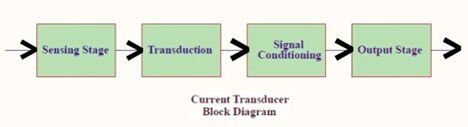
- Sensing element: The sensing element is a sensor that detects high-current flow near the input. In the sensing stage, the sensing element detects the high current.
- Transduction stage:The transduction stage is the response of the sensing element. This stage performs the main transducing action of the transducer, converting a high current signal into a corresponding voltage or current.
- Signal conditioning: The signal conditioning stage consists of components that process the raw signal into a standardized format.
- Output stage: The output stage delivers the final standardized output to connected devices or systems.
Sensing and transducing elements are mostly the same. However, both stages are divided separately to detail the transducer action.
:quality(80)/p7i.vogel.de/wcms/40/3b/403bf07b783e7269d4475e111a084719/0126280451v2.jpeg "Smart meters can not only record energy consumption, but they can also communicate and analyze readings to boost the understanding of customers and simplify the job of utility companies. (Source: © Robert - stock.adobe.com)")
ENERGY MEASUREMENT
How did electric meters become “smart”?
3.1 Sensing element
The sensing element is a part of the current transducer that directly responds to the input current or whatever it aims to measure. In simple words, the sensing element in a transducer is a sensor.
The sensing stage is electrically isolated from the conductor due to safety concerns. A conductor, such as a bus bar, is placed near the magnetic core of the transducer. In some cases, the conductor passes through the center of the magnetic core. The placement magnetically couples them. Initially, the high current, which has to be measured, is made to flow through the conductor.
As per Ampere’s law, current moving through the conductor produces a magnetic field around it. The amount of magnetic field is directly proportional to the amount of current flowing in the conductor. The magnetic field from the conductor soon reaches the magnetic core of the transducer. The magnetic core catches and concentrates the magnetic field.
3.2 Transduction stage
As mentioned above, the sensing and transducing elements are the same. Transduction is the response of a sensor to a high current input. The transduction process in current transducers is based on either electromagnetic induction or Hall voltage. It converts the incoming magnetic field into a standard voltage or current.
Hall effect sensor working
A Hall-effect sensor is kept in a small air gap within the transducer core. It functions as the sensing or transduction element. As mentioned above, the magnetic field penetrates the current transducer and reaches the Hall effect sensor.
A small bias current flows in the Hall effect sensor due to transducer dynamics. As hall sensors rely on this current to generate the output, they are passive current transducers.
The magnetic field is perpendicular to the direction of current flow. Due to the Hall effect, the magnetic field exerts a Lorentz force on the electrons, causing them to deflect. As a result, a Hall voltage appears perpendicular to the direction of the current and magnetic field.
Current transformer working
The current-carrying conductor in the input stage acts as the primary coil of the current transformer. It passes through the magnetic core, on which the secondary coil is wound. Electrical isolation remains between the transformer and the conductor.
The input current, which has to be measured, flows through the conductor. As mentioned above, a time-varying magnetic field is generated across the transformer. The magnetic flux penetrates through the current transformer to reach the secondary coil. As per Faraday’s laws of electromagnetic induction, an AC current is induced across the secondary coil.
The secondary coil functions as the transducing element. The magnitude of the induced secondary current is directly proportional to the primary current in the conductor. A burden resistor scales down this high current to a standard value. As current transformers are capable of producing output signals from self-generated flux, they fall into the category of active current transducers.
Fluxgate sensor working
A magnetic probe coil is wound on the ferromagnetic core of the fluxgate sensor. It is the primary coil of the current transducer. An AC current, generated internally in the transducer, is made to run through the magnetic probe. It excites the magnetic probe.
As the AC current increases further, the magnetic probe enters saturation. The magnetic field no longer increases with the increasing current. Due to the alternating nature of the current, the magnetic probe drives in and out of saturation and desaturation cycles, repeatedly.
The saturation and desaturation cycles continue in the same direction. The external magnetic field from the conductor biases the core. As a result, saturation occurs in one direction and desaturation occurs in the other. It creates an asymmetric flux pattern.
In the absence of the external magnetic field, such a pattern would be symmetrical. The secondary detection coil, wound on the magnetic core, detects changes in the magnetic flux and releases a corresponding voltage or current. As fluxgate sensors rely on additional AC to excite the coil, they become passive current transducers.
Shunt resistor working
The high current signal at the input enters a circuit that contains a shunt resistor. A heat sink is associated with it. The current flows through the circuit. Based on Ohm’s law, a proportionate voltage drop appears across its terminals.
The current is sensed directly, not through magnetic fields. Shunt resistors rely on input current to produce the output signal. They do not need external power to sense the current, making them active current transducers.
Rogowski coil working
A flexible air-cored coil (Rogowski coil) is placed around a conductor (bus bar). AC current flows through the conductor, generating a time-varying magnetic field around it. The magnetic field lines pass through the Rogowski coil turns.
A time-varying magnetic flux is generated across the coil. As the coil does not have a magnetic core, the response becomes linear. A voltage appears across the Rogowski coil. According to Faraday’s mutual induction theory, the voltage across the Rogowski coil is proportional to the derivative of the conductor current.
In calculus (a branch of mathematics), integration is the opposite of differentiation. Hence, the derivative current signal from the Rogowski coil is fed to an op-amp. An op-amp can function as an integrator circuit to perform the mathematical operation of integration. As a result, the Rogowski coil produces an output signal. Simply put, Rogowski coil senses di/dt to produce a voltage.
| Current Transducer Name | Sensing/Transducing element | Type Active = No need for an external supply to work Passive = Needs an external supply to work | Category | Sensing principle | Transducer nature |
| Hall-effect sensor | Hall sensor | Passive | DC current transducer | Hall-effect | Electromagnetic |
| Current transformer | Coil (Secondary) | Active | AC current transducer | Electromagnetic induction | Inductive |
| Fluxgate sensor | Magnetic core | Passive | DC current transducer | Electromagnetic induction | Inductive |
| Shunt resistor | Shunt resistor | Active | DC current transducer | Ohm’s law | Resistive |
| Rogowski coil | Rogowski coil | Partially active (Integrator op-amp needs supply) | AC current transducer | Electromagnetic induction | Inductive |
3.3 Signal conditioning unit
The output signal needs to be usable and understandable enough for end-users. The signal conditioning stage processes the output signal through various efficient components before delivering it as the output of the current transducer.
Linear processing
The signal conditioning unit performs linear operations such as amplification, attenuation, addition, subtraction, integration, differentiation, and many more mathematical functions. Amplifiers boost the amplitude of the signal. Op-amps perform mathematical operations on the signal, such as addition, subtraction, integration, and differentiation. For example, an op-amp integrator fetches the standardized current signal from the raw output of a Rogowski coil-based current transducer.
Non-linear processing
The signal conditioning unit performs non-linear operations on the signal, such as filtering, sampling, clipping, clamping, modulation, demodulation, and many more. For example, a filter removes electrical noise, ripples, and harmonics from the signal.
3.4 Output stage
The output stage delivers the final signal in a converted industry-standard format. It finally displays the numerical value of the measured high current. The output of the current transducer usually goes to a microprocessor, microcontroller, PCB, instrumentation equipment, readout device, control system, or software.
4. Current transducers vs current sensors
The term “current transducer” is often used interchangeably with “current sensor”. A current sensor is a simple and small device that can sense current and deliver an output. It is used as the sensing element in current transducers. A current transducer is a whole system that senses the input, processes it, converts it into a standardized format, and delivers it to the end-user.
The output of a sensor is not processed or standardized. Other devices can be connected to process the output. For example, Hall effect sensors and fluxgate sensors are sensors. When they are integrated into current transducer systems, the entire system comes to be known by their name. Hence, all sensors are transducers, but not all transducers are sensors!
| Feature | Current Transducer | Current Sensor |
| Components | Sensing or transducing element (sensor), signal conditioning, and output stage | Sensing or transducing element (sensor itself) |
| Function | Senses the current signal, processes it, converts it, and delivers it to the connected device | Senses the current and delivers it to the connected component |
| Output type | Industry-standard signal | Unprocessed raw signal that needs conditioning |
| Output usability | Directly usable | Needs extra circuitry to interpret |
| Accuracy | High | Low |
| Size | Large as it is a complete system | Small |
| Safety | Electrical isolation | Safety can be compromised |
| Prone to failure | Least | Likely |
| Cost | High | Low |
| Implementation level | Embedded with components | System-level in industries |
5. How to select a current transducer?
The current transducer needs to be compatible with the application. When selecting a current transducer, consider the following key features.
5.1 Operating range
The current transducer must operate within the required range. It ensures seamless operation and fewer chances of damage.
5.2 Sensitivity
The current transducer should be able to provide a well-established output against a set of specific input ranges. Minimum sensitivity should be considered while selecting the current transducer. Minimum sensitivity is defined as the smallest change in the current that a current transducer can detect easily.
5.3 Accuracy
The accuracy of current transducers is expressed in percentage, such as +/-0.7% or +/-1%. Calibration errors, offset errors, and various other values must be checked before.
5.4 Electrical parameters
For power electronics applications, electrical parameters are critical to choosing current transducers. Important electrical parameters to check are current type, output format, supply requirements, cable specifications, SNR (signal-to-noise ratio), frequency response, resonant frequency, and many more.
5.5 Mounting style
For compact designs, small transducers should be chosen. The mounting style of current transducers should be chosen in accordance with their applications.
5.6 Environmental impact
Environmental compatibility of the current transducer incorporates features like temperature range and pressure limitations.
:quality(80)/p7i.vogel.de/wcms/6d/1a/6d1adcfae7cfacf493a47c6ac3d33120/0124338052v2.jpeg "Power electronics enable efficient, reliable energy harvesting by converting unstable inputs into consistent power. (Source: adilun - stock.adobe.com)")
ENERGY SYSTEMS
The role of power electronics in next-generation energy harvesting systems
6. Current transducer advantages
- Current transducers can handle very high currents, above 1 kA.
- Current transducers provide precision measurement for high currents as real-time data.
- Current transducers can also enhance weak input currents. Such signals can be transmitted up to 1000 m.
- Current transducers can operate in a wide range of temperatures.
- Current transducers provide galvanic isolation between the input stage and the control or measurement stages. They can generate output signals for isolated input or remotely from a distance.
- Current transducers are safe. During distressing periods, current transducers undergo protection mode. They cut off the ongoing sensing or transducing process to maintain safety.
- Current transducers have a signal and conditioning unit to process the output signal as per the application and ratings.
- Current transducers can easily perform signal amplification and attenuation.
- Current transducers are slightly energy-efficient. They do not waste power in inductive setups.
- Current transducers require less maintenance.
7. Current transducer disadvantages
- Some current transducers (shunt resistors) can prove to be hazardous in the absence of isolated sensing units.
- Current transducers consume a lot of power, as some types require an external power supply (Hall sensor and fluxgate sensor).
- Current transducers show a limited frequency response.
- High-precision current transducers are sensitive to temperature variations.
- Current transducers need calibration.
- Current transducers are expensive to install and operate. Current sensors are a cheaper alternative.
8. Current transducer applications
Current transducers can measure both AC and DC currents, whether large enough above kiloamperes or lower in milliamperes, opening a door for a wide variety of applications. Applications of current transducers are listed below.
8.1 Power electronics
In power electronics, current transducers ensure a continuous flow of current in a standardized format that control systems can process. Current transducers are applicable in motor drivers (variable frequency drivers), DC-DC converters, inverters, UPS (Uninterrupted Power Supplies), and SMPS (Switch Mode Power Supplies). They optimize power conversion in DC-DC or DC-AC power converters.
8.2 Power systems
Current transducers are applicable in substation monitoring, HVAC systems, and power quality monitoring systems. The power supply output should be free of harmonics and distortion. The signal conditioning unit of the current transducer ensures power quality.
8.3 SCADA
SCADA system (Supervisory Control and Data Acquisition System) is an industrial control system that monitors and controls industrial processes remotely. In earlier times, mechanical devices, placed near industrial equipment, were used to monitor and control electrical systems. In modern times, SCADA systems use current transducers to take current data from distant points in the setup and send it to different control centers.
8.4 Renewable technologies
Current transducers are used in solar panels, wind power systems, hydro generators, and battery management systems. They ensure current monitoring during charging and discharging cycles to optimize power output delivery and battery performance.
8.5 Electrical meters
An electrical meter on a commercial or residential building measures the amount of electricity consumed. Current transducers are used in electrical meters to convert high current signals from the grid or power station into a standard signal for accurate reading or measurement.
8.6 Electrical safety systems
Current transducers are vital in electrical safety systems to continuously monitor current flow and detect abnormal or dangerous faulty conditions like short circuits or overloads. Once heavy current is detected, current transducers trigger safety relays or circuit breakers.
8.7 Pump systems
Current transducers are used in pump systems along with a PLC (Programmable Logic Controller) for motor protection. If the net current draw in motors drops or increases above a certain level, the current transducer signals a warning to the PLC to prevent further damage.
8.8 Mechanical equipment
Current transducers are used in workshops to monitor net current draw for predictive maintenance. Examples include CNC mills, welding machines, modeling machines, grinders, routers, laser cutting machines, induction heating, and other mechanical equipment.
8.9 Construction
Current transducers are also applicable in the construction industry, a lesser-known application. Continuous monitoring and safe signal delivery prevent on-site safety risks and downtime. Current transducers support efficient electrical load management, power quality analysis, and fault detection at lower costs.
8.10 Particle accelerators
Particle accelerators such as the Large Hadron Collider and TRIUMF Cyclotron incorporate current transducers. DCCT (DC current transducers) are a part of the in-house power conversion systems of such particle accelerators. They handle currents over thousands of amperes in large magnetic coils.
References
(ID:50666488)
:quality(80)/p7i.vogel.de/wcms/0d/d0/0dd02f3d5a1c83c1be444f73910e6b30/0126472071v2.jpeg "Current transducers are essential devices in power electronics, converting high current levels into standardized signals for safe and efficient use across various electronic systems, with applications ranging from motor protection to renewable energy systems and particle accelerators. (Source: © Aimur - stock.adobe.com)")
:quality(80)/p7i.vogel.de/wcms/0c/71/0c7136f0406689ac88a83b3d5c9404c8/0123816960v2.jpeg "Diamond is a good contender for becoming a mainstream semiconductor material in high-power, high-frequency, and high-temperature applications. Due to its exceptional properties, diamond is often explored as a potential alternative to existing semiconductor options. Learn more here. (Source: mjaud - stock.adobe.com)")