


:quality(80)/p7i.vogel.de/wcms/2f/f3/2ff3221bf7665de2d0acf83760bfd1fa/0130031523v2.jpeg "Wolfspeed presents a 300 mm silicon carbide technology platform designed to support advanced packaging and high-efficiency power delivery for AI data center infrastructure. (Source: Wolfspeed)")
:quality(80)/p7i.vogel.de/wcms/c3/16/c316e955a97f5d72d9678297b237b9e5/0129932858v2.jpeg "Left: the single-phase version of the SENTRON ECPD with RCM, right: a model of the future three-phase version of the SENTRON ECPD. (Source: Siemens)")
:quality(80)/p7i.vogel.de/wcms/ef/0a/ef0adb0acf793fe147cc27c21f6a7a67/0129954238v2.jpeg "Empower Semiconductor introduces embedded silicon capacitors designed to improve power delivery and stability in AI and high-performance computing processors. (symbolic image) (Source: © IF.arc - stock.adobe.com)")
:quality(80)/p7i.vogel.de/wcms/53/f9/53f9301dfc9292d02960f7996c79cc6e/0129927601v2.jpeg "Wolfspeed’s new 10 kV SiC MOSFET enables high-voltage power conversion for grid and industrial applications. (symbolic image) (Source: © CREATIVE- 3.4 - stock.adobe.com)")
:quality(80)/p7i.vogel.de/wcms/6e/cd/6ecd41d095d5111cf4ed37b714844487/0129930878v2.jpeg "PCIM Asia Shenzhen provides a platform for industry experts to present new developments in power electronics and electrification technologies. (symbolic image) (Source: © killykoon - stock.adobe.com)")
:quality(80)/p7i.vogel.de/wcms/02/c0/02c0e9722f70b1134dbf96fb59a9c73d/0129655179v2.jpeg "The PCIM Conference 2026 will take place from June 9-11, featuring discussions on power electronics trends, including GaN technology and AI applications. (symbolic image) (Source: © Elmira - stock.adobe.com)")
:quality(80)/p7i.vogel.de/wcms/cc/67/cc670ea2029cd2af5c641af70e1bf734/0129816392v4.jpeg "Fraunhofer IAF coordinates the EU SUPREME project to accelerate GaN and SiC power semiconductor innovation in Europe. (Source: Fraunhofer IAF)")
:quality(80)/p7i.vogel.de/wcms/ea/e6/eae6aee30071e67a5627027974437134/0129544613v2.jpeg "GlobalFoundries and Renesas strengthen their collaboration to support U.S.-based semiconductor production and supply chain resilience. (Source: © ronstik - stock.adobe.com)")
:quality(80)/p7i.vogel.de/wcms/23/1a/231a97643aa7fc3adf2704a6273756c3/0130030642v2.jpeg "Gallium nitride (GaN) power devices are increasingly challenging silicon MOSFETs in low-voltage power conversion by enabling higher efficiency and switching performance. (Source: © Sheraz - stock.adobe.com)")
:quality(80)/p7i.vogel.de/wcms/3c/4b/3c4bbc68dda65c7071b4376fb57423b0/0130030465v2.jpeg "Faraday’s laws explain the fundamental behavior of magnetic fields and electronic devices in dynamic use cases. The operation of transformers, wireless chargers, induction cookers, induction motors, magnetic levitating trains (MAGLEV Trains), electric violin, and many others depends upon Faraday’s laws. (Source: © Sheraz - stock.adobe.com)")
:quality(80)/p7i.vogel.de/wcms/b1/5e/b15ee02b0ba02db70cf61e37d66ad1d3/0129349127v2.jpeg "Vehicle-to-grid (V2G) chargers enable bidirectional energy flow, allowing electric vehicles to act as mobile energy storage systems that can both draw power from and feed power back into the grid. (Source: © medienvirus - stock.adobe.com)")
:quality(80)/p7i.vogel.de/wcms/26/d5/26d591cc340077026eac56a0e7564faf/0129949603v2.jpeg "Flexible: The solid silicone-based electrolyte is elastic, thereby compensating for the voids that form in solid-state batteries during charging and discharging. (Source: Empa)")
:quality(80)/p7i.vogel.de/wcms/be/c8/bec8d43fc0ee73414274be44608b2970/0129748903v2.jpeg "The Infiniium XR804KA real-time oscilloscope delivers faster response time, improved stability, and streamlined workflows for high-speed digital and compliance testing. (Source: Keysight)")
:quality(80)/p7i.vogel.de/wcms/23/ee/23ee4a97790d6009dbfd7d9577ffa723/0129220424v2.jpeg "The R&S FPL1044 with the new RTSA option makes 40 MHz real-time frequency analysis available up to 44 GHz. (Source: Rohde & Schwarz )")
:quality(80)/p7i.vogel.de/wcms/3c/d1/3cd1cacbceb792ba63727199c61ca434/0127801860v2.jpeg "Thanks to cloud technology, users can collaborate on projects from anywhere and always have access to the latest planning data. (Source: SIEMENS)")
:quality(80)/p7i.vogel.de/wcms/5a/a0/5aa0436498af618297961fd54ab36cdf/0126290792v2.jpeg "Siemens accelerates student-led semiconductor innovation across Europe’s leading technical universities through Cre8Ventures’ Open Higher Education Program developed in collaboration with Arm and University of Southampton (Source: Siemens Digital Industries Software)")
BASIC KNOWLEDGE What is a capacitor?
Related Vendors
:fill(fff,0)/p7i.vogel.de/companies/63/c7/63c7da97be945/diotec.png "diotec (Diotec Semiconductor AG)")
:fill(fff,0)/p7i.vogel.de/companies/62/a0/62a0a0de7d56a/aic-europe-logo.jpeg "aic-europe-logo (AIC Europe)")
:fill(fff,0)/p7i.vogel.de/companies/5f/71/5f71d5f92a5f6/2000px-rogers-corporation-logo-svg.png "2000px-Rogers_Corporation_Logo.svg.png (rogers germany)")
Capacitors are small electronic components found in almost all devices. They produce electric fields and store charge in applications like radio circuits, power supplies, induction motors, oscillators, and many more. This article explains capacitors, their symbol, working, types, applications, benefits, and limitations.
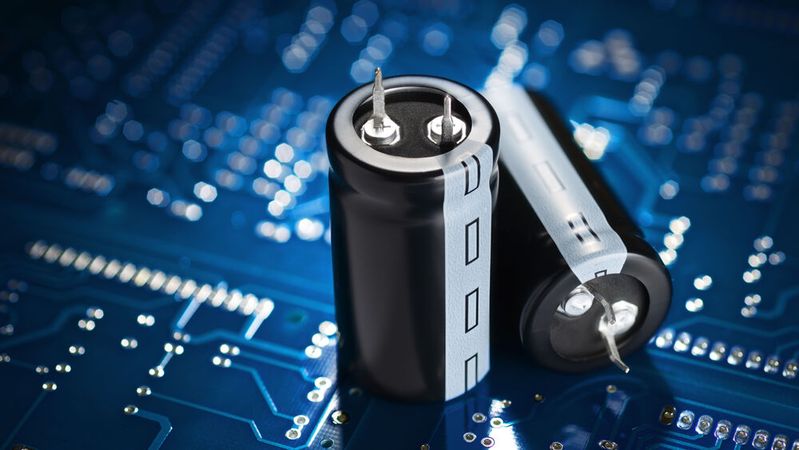
Capacitors are fundamental components in electronics that store and release electrical energy. They play a crucial role in controlling voltage, smoothing signals, and enabling various circuits to function efficiently.
1. Introduction
All capacitors measure “capacitance”. Before diving deep into capacitors, let us understand capacitance. Capacitance is the measure of how much electric charge a material can hold. In simple terms, capacitance is the property of a material that allows it to store electric charge. The SI unit of capacitance is the Farad (F), named in honour of the discoverer Michael Faraday.
2. What is a capacitor?
Capacitors are small electronic components that store electric charge. They are one of the four fundamental electronic components, alongside resistors, inductors, and memristors. Capacitors are considered passive components because they cannot generate their own energy but store the energy supplied from an external source.
3. Capacitor definition
Capacitors are one of the oldest energy storage components. The “first capacitor” was invented several times, in 1745 and 1746, by different researchers in different countries. The inventors received painful shocks to test the reliability of the capacitor operation.
4. Capacitor symbol
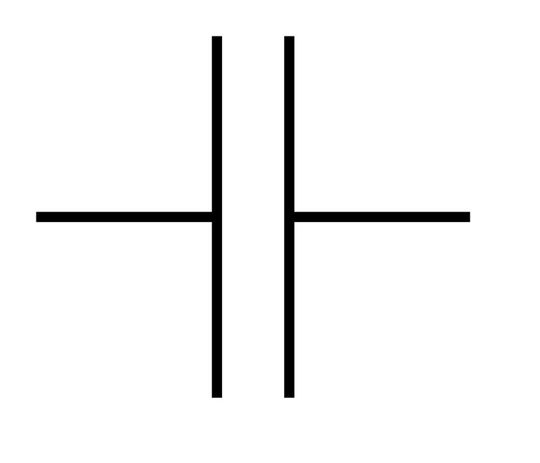
The basic circuit symbol for a capacitor shows two conductive plates, separated by a small distance. The distance represents the insulating medium. The most common capacitor symbol is that of a fixed capacitor.
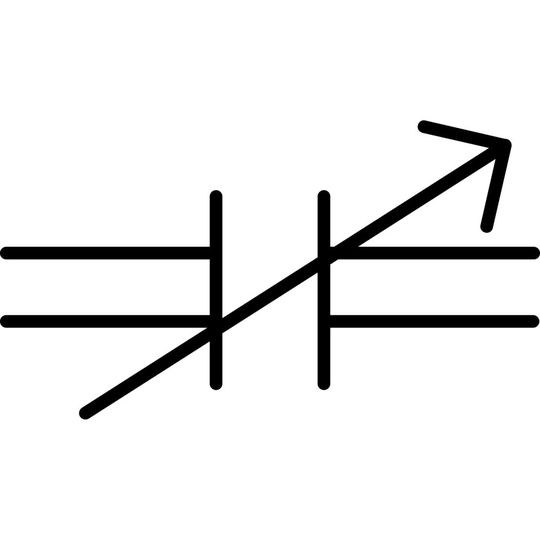
Another circuit symbol for a capacitor shows an arrow crossing the conductor plates. It is the circuit symbol for a capacitor of a variable value, known as a variable capacitor.
5. How does a capacitor work?
Resistors dissipate energy. Inductors store energy in a magnetic field. Capacitors accumulate energy in an electric field. Capacitors store charge during the charging process and release it to the circuit in the discharging process.
A capacitor can supply the stored charge to a connected battery. The battery then converts this incoming electrical energy into chemical energy for storage. Later, during discharge, the capacitor releases its stored energy into the circuit. The battery converts chemical energy back into electrical energy to power the load.
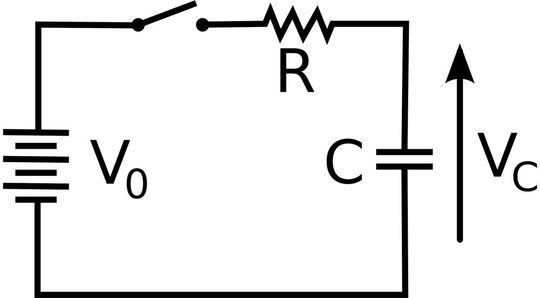
The charging process initiates when the key is turned on.
:quality(80)/p7i.vogel.de/wcms/c2/90/c2900da3fdc8cfaea5c3ac8944ccab86/0127527872v2.jpeg "Capacitors are prone to failure. With the help of a multimeter, you can easily assess their health. (Source: © PoodPhoto - stock.adobe.com)")
OPERATIONAL SAFTEY
How to test a capacitor?
Charging and discharging of a capacitor
Voltage is given to the circuit with a capacitor. The internal structure of a capacitor consists of two conductor plates separated by a distance in a dielectric medium.
A. Charging cycle
The charging cycle describes how a capacitor stores electric charge and its voltage reaches the maximum.
- Step 1: Charge accumulation: The electric charge flows from the source voltage to the two internal conductors — plates. One plate exerts a force on the other plate. It attracts opposite charges and repels like charges. As a result, one of the plates accumulates a positive charge and the other plate accumulates an equal and opposite negative charge. Both plates start to accumulate a significant amount of charge. The dielectric medium develops an electric field. The accumulation of electric charge is known as the charging process. The amount of work done in charging a capacitor is stored as the potential energy. It is supplied to the battery.
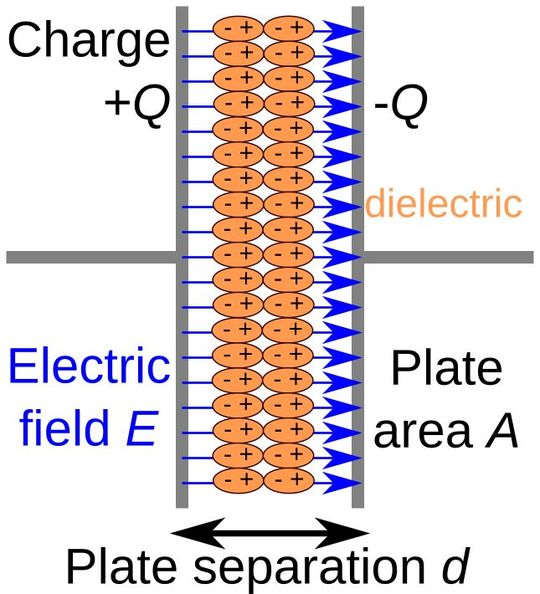
- Step 2: Voltage rise: As two plates accumulate equal and opposite electric charges, a potential difference (V) appears.
V = V2 - V1
When the capacitor stores the electric charge, its internal voltage rises exponentially from zero to the source voltage.
- Step 3: Fully charged capacitor: The capacitor becomes fully charged when the internal voltage of the capacitor equals the supply voltage.
B. Discharging cycle
Just like a capacitor can charge, it can also discharge. The process of discharging a capacitor recovers all the stored energy.
- Step 4: Charge dissipation: When the voltage source is removed, the capacitor starts to release the stored charge back to the circuit. The accumulated charge across both plates starts to flow back into the circuit. The release of electric charge into the circuit is known as the discharging process.
- Step 5: Voltage decay: Initially, the current starts to flow in the opposite direction. It slows down gradually. The high internal voltage of the capacitor exponentially decays to zero.
- Step 6: Fully discharged capacitor The capacitor becomes fully discharged when its internal voltage drops to zero.
Capacitance of a capacitor
In capacitors, an increase in charge accumulation increases the potential difference across the plates. We can deduce a proportional relationship between charge and potential difference.
Q ∝ V
Q = CV
The proportionality constant C is called the capacitance of the conductor. It is the quantity of charge accumulated by the capacitor.
The formula for capacitance becomes
The derivative formula of the capacitors is used in places where capacitance varies with the buildup of charge.
The capacitance of a conductor is the charge stored per unit change in the potential. Practically, when a capacitor transfers 1 Coulomb of charge from one plate to another at a potential difference of 1 Volt, it is said to exhibit a capacitance of 1 Farad.
Capacitors found in laboratories and workplaces typically exhibit small capacitances in the order of pico, micro, or milli Farads. One Farad is a large value for common capacitor use.
:quality(80)/p7i.vogel.de/wcms/8b/ed/8bed230f3f9de9859f94928062984cec/0124637555v2.jpeg "Varactor diodes offer voltage-driven control over the transition capacitance of the junction and provide electrically controllable capacitance in microwave applications. Instead of capacitors, varicaps store charge at high radio frequencies. (Exemplary picture showing various types of diodes) (Source: © Thomas N. - stock.adobe.com)")
BASIC KNOWLEDGE
Varactor diode: Definition, applications and more
Dielectric media
The capacitance depends upon the shape and size of the conductor or the plate. In simple words, it depends upon the active area (A) available for conduction and the distance (d) between the two conductors. More than two conductors can alter the value of capacitance.
We can write an equation where capacitance is directly proportional to the active area of conduction and the distance between the two conductors.
The constant ϵ is called the permittivity of the medium between the conductors. ϵ exhibits different values for different media. It describes the nature of the medium, which must be dielectric. Common insulating media used are ceramics, air, vacuum, thin films, electrolytic oxide layer, and many more.
The non-conductive or insulating medium between the two conductors is a dielectric. It is analogous to the insulating medium formed in MOSFET transistors with the gate oxide (silicon dioxide). A dielectric medium is an insulator that can be polarized in an electric field through a process known as dielectric polarization. Hence, capacitors can store more charge and achieve a very high capacitance in a small volume.
Capacitors in ACV
The previous section explained the capacitor DC operation. Both resistors and capacitors block current flow in DC. In AC circuits, capacitors behave differently. They do not function like resistors. Voltage keeps changing polarity in AC. As a result, capacitors keep on charging and discharging. The current starts to lead the voltage by 90 degrees. However, a capacitor may still oppose voltage changes. The AC capacitance is known as capacitive reactance.
6. Types of capacitors
The list of capacitor types is never-ending. All capacitors are classified based on conductor geometry, connectivity, and capacitance variability.
- Category 1 is based on the geometry of the conductor. It consists of parallel plate, spherical, or cylindrical capacitors.
- Category 2 is based on polarization and non-polarization in capacitors.
- Category 3 is based on the variability of capacitors. It compares fixed and variable capacitors.
Category 1: Conductor geometry
Based on the geometry (shape and size) of conductors, there are three types of capacitors: parallel plate, spherical, and cylindrical.
1. Parallel plate capacitor: The parallel plate capacitor is the most common type. All the above-mentioned operation is explained through the parallel plate capacitor. Just as the name suggests, a parallel plate capacitor has two large plane parallel, conductive plates separated by a small distance.
The separation between the plates is dielectric. A dielectric medium could be ceramic, mica, Teflon, or even air. The supply voltage charges two plates. The upper plate becomes positively charged. The lower plate becomes negatively charged. Both plates exert force on each other, attracting opposite charges and repelling similar charges. As a result, an electric field exists between them.
The electric field in the outer regions, above the upper plate and below the lower plate, cancels out. The inner electric field adds up. The electric field only exists between the sides of two plates that face each other, below the upper plate and above the lower plate.
The direction of the electric field is always from the positively charged plate to the negatively charged plate. The overall electric field is uniform. However, electric field lines bend at the edges. The phenomenon is known as the fringing effect. The reason for non-uniformity at the edges is that these lines extend into the space beyond the area of the plates.
2. Spherical capacitors: Spherical capacitors are not as common as parallel plate capacitors. They are used in research facilities, high-voltage power electronics, and telecommunications. A spherical capacitor contains two concentric hollow spherical shells. The smaller shell is placed inside the bigger shell. A dielectric medium, such as vacuum, exists between them.
No charge exists inside the spherical shells, making the internal electric field also zero. The interior of spherical shells forms a Faraday cage. It remains shielded because of the fact that the electric field and volume charge density vanish inside a hollow conductor of any shape or size.
When a voltage is applied, positive charge gathers on the surface of the bigger spherical shell. It exerts a force on the other shell, which is negatively charged. As a result, an electric field exists in the region between the two shells.
3. Cylindrical capacitors: Cylindrical capacitors, also known as coaxial capacitors, are used in coaxial cables and transmission lines. A cylindrical capacitor is an arrangement of two conductive and coaxial hollow cylinders. The smaller cylinder is placed inside the bigger cylinder. A dielectric medium exists between them.
Due to electrostatic shielding, cylindrical capacitors behave like Faraday’s cage. One of the cylinders accumulates positively charged particles, and the other accumulates negatively charged particles. The electric field exists from positive to negative direction. The operation is quite similar to their spherical counterparts.
Category 2: Polarized vs non-polarized capacitors
Polarized and non-polarized capacitors differ based on their connectivity.
Polarized capacitors
Polarized capacitors have a polarity — positive (+) and negative (-) terminals. The two terminals must be connected at the right places carefully. If they are not connected in the right place, they can fail or undergo permanent damage. Polarized capacitors exhibit high capacitance values.
4. Electrolytic capacitors: Electrolytic capacitors can store large amounts of energy. The internal arrangement of such capacitors is chemical. They contain a positive electrode, which undergoes oxidation to form a dielectric medium. The covering of the oxide layer, whether a solid or gel, functions as the negative electrode.
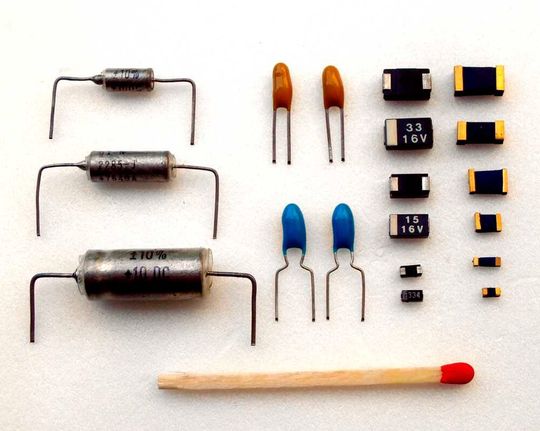
A tantalum capacitor is a popular electrolytic capacitor. Tantalum (Z = 73) is a metal element found in the periodic table. Applications include major power electronic applications such as power supplies, filters, variable frequency drives, power amplifier stages, and lamps.
5. Supercapacitors: Supercapacitors or ultracapacitors are what superconductors are to conductors. Simply put, supercapacitors exhibit large capacitance values up to farads or hundreds of farads. They exhibit low energy density but a higher power density.
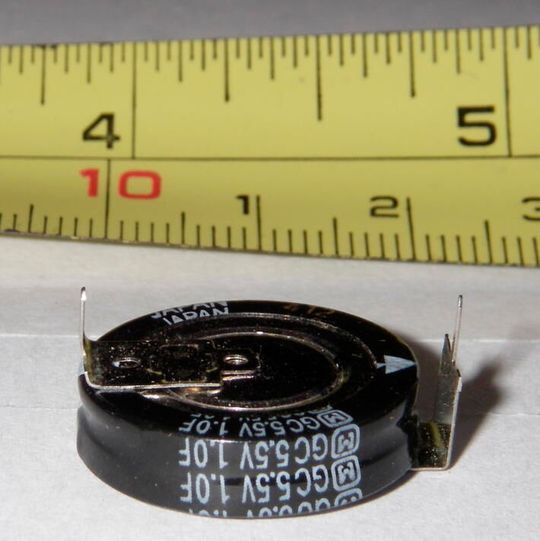
Compared to lithium-ion batteries that tend to degrade after several cycles, supercapacitors can charge and discharge batteries faster for limitless cycles. Supercapacitors are applicable in uninterrupted power supplies, smart meters, regenerative braking, and wireless alarm systems.
Non-polarized capacitors
Non-polarized capacitors do not have a polarity. The electrodes of such capacitors are inserted randomly. As a result, they can be connected either way. They offer small capacitance values in the order of pico or micro Farads with safe operation.
6. Ceramic capacitors: Ceramic capacitors are one of the most common and stable capacitors used in electronic applications. They sandwich ceramics as a dielectric medium between two metal layers. Ceramics can be titanium oxide or ferroelectric barium titanate.
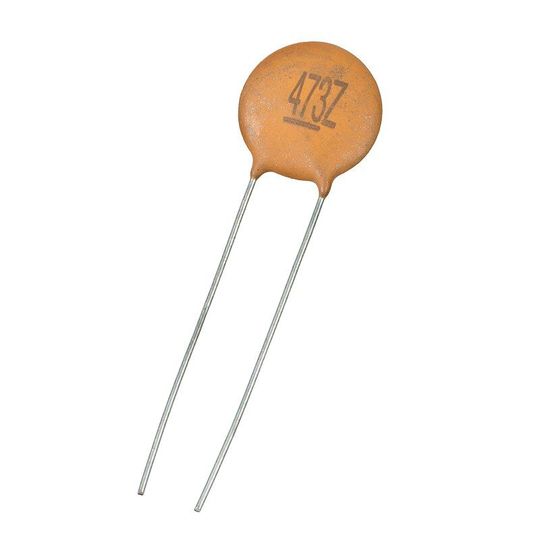
Ceramic capacitors are also used for coupling and decoupling capacitors in microprocessors. They offer capacitances in the order of a few picofarads and microfarads. Common applications include PCBs, DC motors, resonant circuits, RF transmitter stations, audio systems, and many more.
7. Film capacitors: Film capacitors or power film capacitors contain an ultra-thin insulating plastic film as the dielectric material, separating two aluminum or zinc electrodes. These capacitors are physically larger, making them more expensive for use.
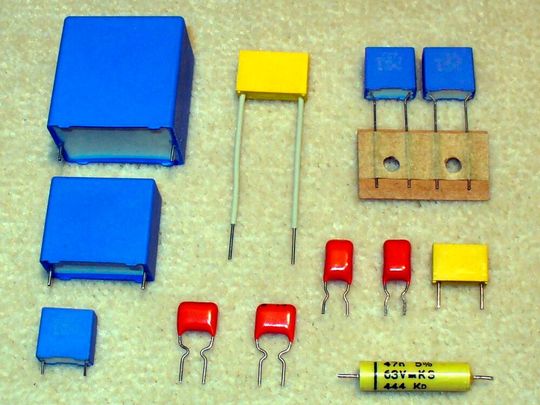
Modern film capacitors are designed to exhibit slightly higher capacitance values for smaller sizes. Applications include sample and hold circuits, analog-to-digital converters, peak voltage detectors, Flyback diode tuning, and snubber circuits.
:quality(80)/p7i.vogel.de/wcms/16/62/16623172b80c3c9a81a9643d7ca16d61/0126331664v2.jpeg "Empa researchers are creating scalable graphene-based supercapacitors to enhance energy density and commercial production viability. (Source: Empa)")
ENERGY STORAGE
Scalable supercapacitor technology made from graphene
Category 3: Fixed vs variable capacitors
The section explains fixed and variable capacitors.
- Fixed capacitors: Fixed capacitors exhibit a constant capacitance. Most capacitors fall into the vast category of fixed capacitors. Ceramic and thin-film capacitors are some examples.
- Variable capacitors: Unlike fixed capacitors, variable capacitors exhibit a varying capacitance. The capacitance of variable capacitors can be repetitively changed.A variable capacitor is similar to a varactor diode (varicap). It is used in LC circuits to set a resonant frequency, tune a radio or TV, impedance matching in antenna tuner devices, and many more.
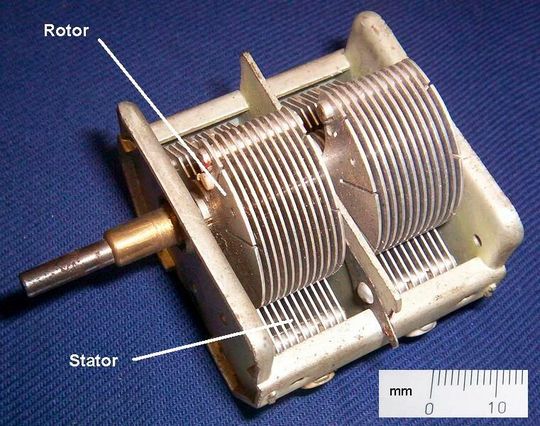
7. Capacitor combinations: Series and parallel
Just like resistors, capacitors can be connected in series and parallel configurations. However, the results of resistor connections are opposite to those of capacitor connections. In the following section, all capacitances are in Farad, potential difference in volt, and charges in coulomb.
Series capacitors
The negative plate of the first capacitor is connected to the positive plate of the second capacitor, the negative plate of the second capacitor is connected to the positive plate of the third capacitor, and so on. The charge on each capacitor is the same, but the potential is different. This arrangement is called a series connection. The capacitors are said to be connected in series.
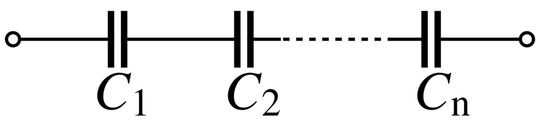
As mentioned above,
Q = CV
In a series connection, all capacitors share a common charge. The potential is different across all the capacitors as follows.
The total potential is equal to the sum of the potential of each capacitor.
As the charge on each capacitor is the same, we can mathematically ignore it. The formula for capacitors in series becomes:
The formula for capacitors in series is similar to the formula for resistors in parallel. It is the reciprocal of the sum of all capacitances. This means the equivalent series capacitance is smaller than any individual capacitance in the network.
Parallel capacitors
The positive plates of all capacitors are connected to one common point. The negative plates of all capacitors are connected to another common point. All capacitors share a common potential difference but a different charge. This arrangement is called a parallel connection. The capacitors are said to be connected in parallel.
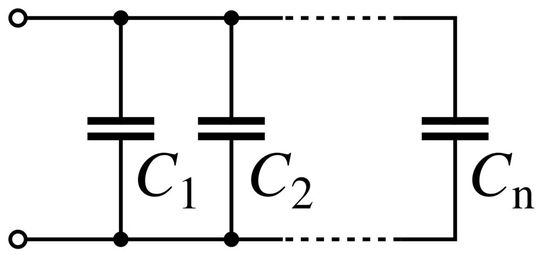
As mentioned above,
Q = CV
In a parallel connection, all capacitors share a common potential. The charge is different on each capacitor as follows.
Q1 = C1V
Q2 = C2V
….QN = CNV
The total charge is equivalent to the sum of all individual charges on capacitors.
Total charge = QP = CPV
QP = Q1+Q2+ ..... QN
CPV = C1V + C2V + ..... CNV
CPV = V (C1 + C2 + ..... CN)
As the potential on each capacitor is the same, we can mathematically ignore it. The formula for capacitors in parallel becomes:
CP = C1+ C2 + ..... CN
The formula for capacitors in parallel is similar to the formula for resistors in series. It means that the equivalent parallel capacitance is a large value, larger than the largest capacitor in the network.
8. What is a capacitor used for?
Capacitors are a part of almost all PCBs. They are used for a variety of applications. Some of them are listed below.
- Energy storage: Capacitors are used to store energy in the form of electricity. They can function as temporary batteries in numerous applications. For example, capacitors are used in computers and smartphones to prevent a power shutdown.
- Power electronics: Capacitors are used to supply power in electrical systems. They function as compensators for lagging currents. Another example is the service extension of an uninterrupted power supply (UPS).
- Power systems: Capacitors are used as capacitor banks in substations. They result in power compensation, power factor correction, voltage stability, voltage regulation, energy savings, and many more benefits.
- Pulsed power applications: Capacitors can supply energy in the form of high current pulses in generators, lasers, and particle accelerators.
- Audio systems: Capacitors are used in audio systems to filter audio signals. Examples include car audio systems, loudspeakers, power amplifiers, woofers, and microphones.
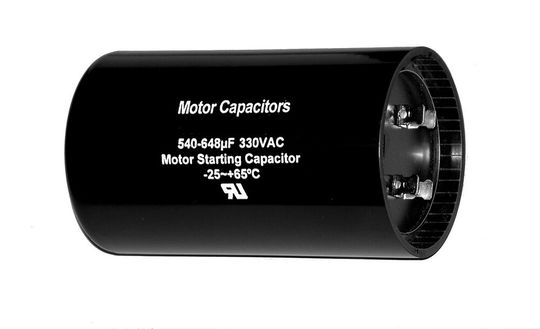
- Home appliances: Capacitors are found in almost all home appliances, including refrigerators, air conditioners, washing machines, heaters, and many more. One of their main operations is to start a motor.
- Medical equipment: Capacitors are a part of medical imaging devices. For example, a part of the circuit that is responsible for releasing energy in defibrillators to restore the heartbeat.
- Radio frequency: Capacitors are used in RF systems to tune circuits of radios and TVs to certain frequencies.
- Signal processing: Capacitors are helpful in signal processing. They are used in high-pass and low-pass filters to pass and block certain frequencies.
- Coupling and decoupling: Capacitors perform signal coupling and decoupling in various applications. In the coupling operation, capacitors pass AC but block DC. They absorb noise and stabilize voltage in decoupling operation.
- Filtering and smoothing circuits: Capacitors are used to filter or suppress undesirable frequencies. Examples include RF filters, arc suppressors in circuit breakers, rectifiers, voltage regulators, and many more
- Telecommunications: Capacitors are used in telecommunications to filter and process signals.
:quality(80)/p7i.vogel.de/wcms/8c/1a/8c1a6f87a2af9653a5df2d5d963915c0/0118206891v2.jpeg "This article presents a scalable and stackable –48 V DC PoL solution that will address the high density power usage situations created by these high density networks from the tremendous growth in network traffic. (Source: Annika - stock.adobe.com)")
MOBILE DATA
Building a better – 48 V DC power supply for 5G and next-generation telecom equipment
9. Capacitor advantages
Capacitors excel in energy storage, adaptability, and safe operation in numerous electronic applications.
- 1. Simple operation: Capacitors are easier to use. They can work with AC and DC circuits.
- 2. Quick energy storage solution: Capacitors can charge and discharge quickly. They can quickly store and release energy.
- 3. Stable performance: Certain capacitors, such as tantalum capacitors, show stable performance over a wide range of temperatures and frequencies.
- 4. 360-degree safety: Capacitors result in lower losses. They are electrically safe to use. When compared to lithium-ion batteries, capacitors are safer for the environment.
- 5. Availability and price: Capacitors are small components. They can be easily found in the market. As a result, capacitors are cheaper. Throughout their operation, capacitors do not require maintenance. It reduces the scope of additional maintenance costs.
10. Capacitor limitations
Capacitors are not perfect energy storage components. Just like any other component, they too incur several limitations.
- Unreliability: Capacitors are not as reliable as batteries. They may not charge up to the supply voltage on the charging cycle, and cannot withstand high voltage. Hence, capacitors cannot be used in EVs.
- Low volumetric efficiency: Most capacitors, especially non-polarized capacitors, provide lower capacitance values for their size. The capacitance-to-size ratio is known as volumetric efficiency. Non-polarized capacitors exhibit a low volumetric efficiency. It means that a small capacitor cannot match the standards of a small battery.
- Limited energy storage: Capacitors store limited energy in pico, micro, or milli Farads. They also cannot store this energy for extended periods.
- Inaccurate results: Capacitors show fluctuation in stored energy. The stored energy depletes over time. As a result, they do not show high accuracy.
- Failure: Capacitors can fail due to noise and electromagnetic interference. They can easily wear out. In case of wrong operation, they break down or explode. However, damage to humans is very minimal in such cases. Hence, capacitors exhibit a small component lifespan.
(ID:50623303)
:quality(80)/p7i.vogel.de/wcms/3c/4b/3c4bbc68dda65c7071b4376fb57423b0/0130030465v2.jpeg "Faraday’s laws explain the fundamental behavior of magnetic fields and electronic devices in dynamic use cases. The operation of transformers, wireless chargers, induction cookers, induction motors, magnetic levitating trains (MAGLEV Trains), electric violin, and many others depends upon Faraday’s laws. (Source: © Sheraz - stock.adobe.com)")
:quality(80)/p7i.vogel.de/wcms/f0/d8/f0d82f06ed1b7abb3245dfc4c317cb55/0127949994v2.jpeg "Visual representation of component ageing in power electronics, highlighting thermal and material stress effects across the system (Bild: © Surya16 - stock.adobe.com)")