


:quality(80)/p7i.vogel.de/wcms/2f/f3/2ff3221bf7665de2d0acf83760bfd1fa/0130031523v2.jpeg "Wolfspeed presents a 300 mm silicon carbide technology platform designed to support advanced packaging and high-efficiency power delivery for AI data center infrastructure. (Source: Wolfspeed)")
:quality(80)/p7i.vogel.de/wcms/c3/16/c316e955a97f5d72d9678297b237b9e5/0129932858v2.jpeg "Left: the single-phase version of the SENTRON ECPD with RCM, right: a model of the future three-phase version of the SENTRON ECPD. (Source: Siemens)")
:quality(80)/p7i.vogel.de/wcms/ef/0a/ef0adb0acf793fe147cc27c21f6a7a67/0129954238v2.jpeg "Empower Semiconductor introduces embedded silicon capacitors designed to improve power delivery and stability in AI and high-performance computing processors. (symbolic image) (Source: © IF.arc - stock.adobe.com)")
:quality(80)/p7i.vogel.de/wcms/53/f9/53f9301dfc9292d02960f7996c79cc6e/0129927601v2.jpeg "Wolfspeed’s new 10 kV SiC MOSFET enables high-voltage power conversion for grid and industrial applications. (symbolic image) (Source: © CREATIVE- 3.4 - stock.adobe.com)")
:quality(80)/p7i.vogel.de/wcms/6e/cd/6ecd41d095d5111cf4ed37b714844487/0129930878v2.jpeg "PCIM Asia Shenzhen provides a platform for industry experts to present new developments in power electronics and electrification technologies. (symbolic image) (Source: © killykoon - stock.adobe.com)")
:quality(80)/p7i.vogel.de/wcms/02/c0/02c0e9722f70b1134dbf96fb59a9c73d/0129655179v2.jpeg "The PCIM Conference 2026 will take place from June 9-11, featuring discussions on power electronics trends, including GaN technology and AI applications. (symbolic image) (Source: © Elmira - stock.adobe.com)")
:quality(80)/p7i.vogel.de/wcms/cc/67/cc670ea2029cd2af5c641af70e1bf734/0129816392v4.jpeg "Fraunhofer IAF coordinates the EU SUPREME project to accelerate GaN and SiC power semiconductor innovation in Europe. (Source: Fraunhofer IAF)")
:quality(80)/p7i.vogel.de/wcms/ea/e6/eae6aee30071e67a5627027974437134/0129544613v2.jpeg "GlobalFoundries and Renesas strengthen their collaboration to support U.S.-based semiconductor production and supply chain resilience. (Source: © ronstik - stock.adobe.com)")
:quality(80)/p7i.vogel.de/wcms/23/1a/231a97643aa7fc3adf2704a6273756c3/0130030642v2.jpeg "Gallium nitride (GaN) power devices are increasingly challenging silicon MOSFETs in low-voltage power conversion by enabling higher efficiency and switching performance. (Source: © Sheraz - stock.adobe.com)")
:quality(80)/p7i.vogel.de/wcms/3c/4b/3c4bbc68dda65c7071b4376fb57423b0/0130030465v2.jpeg "Faraday’s laws explain the fundamental behavior of magnetic fields and electronic devices in dynamic use cases. The operation of transformers, wireless chargers, induction cookers, induction motors, magnetic levitating trains (MAGLEV Trains), electric violin, and many others depends upon Faraday’s laws. (Source: © Sheraz - stock.adobe.com)")
:quality(80)/p7i.vogel.de/wcms/b1/5e/b15ee02b0ba02db70cf61e37d66ad1d3/0129349127v2.jpeg "Vehicle-to-grid (V2G) chargers enable bidirectional energy flow, allowing electric vehicles to act as mobile energy storage systems that can both draw power from and feed power back into the grid. (Source: © medienvirus - stock.adobe.com)")
:quality(80)/p7i.vogel.de/wcms/26/d5/26d591cc340077026eac56a0e7564faf/0129949603v2.jpeg "Flexible: The solid silicone-based electrolyte is elastic, thereby compensating for the voids that form in solid-state batteries during charging and discharging. (Source: Empa)")
:quality(80)/p7i.vogel.de/wcms/be/c8/bec8d43fc0ee73414274be44608b2970/0129748903v2.jpeg "The Infiniium XR804KA real-time oscilloscope delivers faster response time, improved stability, and streamlined workflows for high-speed digital and compliance testing. (Source: Keysight)")
:quality(80)/p7i.vogel.de/wcms/23/ee/23ee4a97790d6009dbfd7d9577ffa723/0129220424v2.jpeg "The R&S FPL1044 with the new RTSA option makes 40 MHz real-time frequency analysis available up to 44 GHz. (Source: Rohde & Schwarz )")
:quality(80)/p7i.vogel.de/wcms/3c/d1/3cd1cacbceb792ba63727199c61ca434/0127801860v2.jpeg "Thanks to cloud technology, users can collaborate on projects from anywhere and always have access to the latest planning data. (Source: SIEMENS)")
:quality(80)/p7i.vogel.de/wcms/5a/a0/5aa0436498af618297961fd54ab36cdf/0126290792v2.jpeg "Siemens accelerates student-led semiconductor innovation across Europe’s leading technical universities through Cre8Ventures’ Open Higher Education Program developed in collaboration with Arm and University of Southampton (Source: Siemens Digital Industries Software)")
BASIC KNOWLEDGE - SNUBBER CIRCUIT What are snubber circuits and why are they used in power electronics
Related Vendors
:fill(fff,0)/p7i.vogel.de/companies/67/e2/67e2a1ef13aba/logo-ab-rgb-1.jpeg "logo-ab-rgb-1 (http://www.arthurbehrens.biz/)")
:fill(fff,0)/p7i.vogel.de/companies/63/c7/63c7da97be945/diotec.png "diotec (Diotec Semiconductor AG)")
:fill(fff,0)/p7i.vogel.de/companies/5f/71/5f71d5f92a5f6/2000px-rogers-corporation-logo-svg.png "2000px-Rogers_Corporation_Logo.svg.png (rogers germany)")
Ensuring the longevity and reliability of components is crucial for maintaining efficient and stable systems. One critical element that contributes to this goal is the snubber circuit. This article explains the construction, functionality, and most common applications of snubber circuits and also highlights alternative protection methods used in modern electronics.
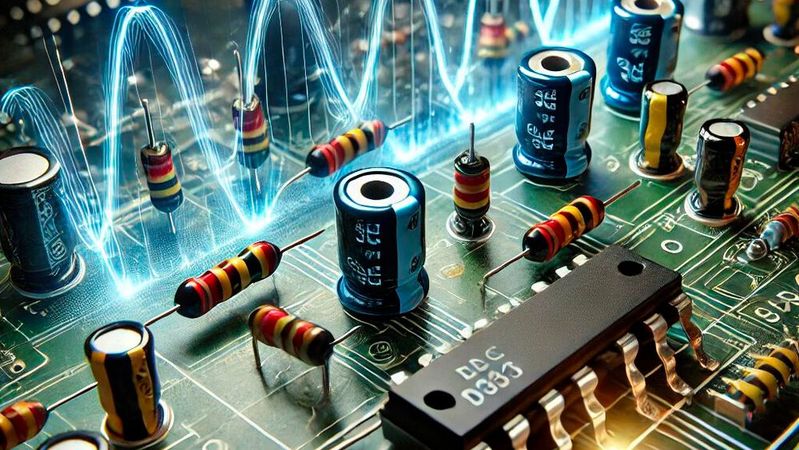
Snubber circuits play a crucial role in protecting and optimizing circuits. These circuits are designed to dampen or absorb unwanted transient voltages and currents caused by rapid switching operations, inductive loads, or capacitive loads. Transient phenomena can significantly impact the performance and lifespan of electronic components and even lead to their failure.
Snubber circuits typically consist of resistors, capacitors, and sometimes diodes, working together to minimize these transient effects. Although alternative solutions are more commonly used today, snubber circuits remain indispensable in many applications. They are particularly useful in systems that require high reliability and stability, such as motor control, inverters for solar installations, and various telecommunications devices.
Snubber Circuit Definition
A snubber circuit is a protective circuit used in electrical and electronic systems to dampen or absorb unwanted transient voltages and currents. These transients can be caused by rapid switching operations, inductances, or capacitive loads and can damage electronic components or impair system performance.
What is a snubber circuit?
The snubber circuit consists of three main components - the resistor (R), the capacitor (C) and the diode (optional). These components work together to dampen transients and protect the circuit's components by reducing the damaging effects of rapid voltage and current changes. To understand how snubber circuits work, the individual components need to be considered in more detail.
Resistor (R): The resistor primarily serves to limit the current and dampen oscillations. It dissipates the energy of the transients by converting it into heat. The resistance value must be chosen so that it effectively dampens oscillations without dissipating too much energy. A resistance value that is too high might reduce the damping effectiveness, while a value that is too low could lead to excessive energy losses. Carbon or wire-wound resistors are commonly used, as they can handle high-energy pulses.
Capacitor (C): The capacitor absorbs and stores energy caused by rapid voltage changes. It provides a path for fast transient currents, thereby reducing voltage spikes across the protected components. The capacitance value must be large enough to absorb transients but not so large that it unnecessarily burdens the circuit. The voltage rating of the capacitor must be higher than the expected transient voltages. Film capacitors or ceramic capacitors are often used, as they can handle high frequencies and energy pulses.
Diode (optional): The diode protects against reverse voltages and diverts inductive kickback currents that can occur when inductive loads are switched off. The diode must have fast switching times and be capable of handling high currents. It must have a sufficient reverse voltage rating to block the highest expected voltages. Fast diodes like Schottky diodes or Ultra-Fast-Recovery diodes are commonly used, known for their fast response times and high current handling capability.
:quality(80):fill(efefef,0)/p7i.vogel.de/wcms/66/4e/664efb5ea2f9e/wp-dc-dc-book-of-knowledge-recom-coverbild.png "WP_DC_DC_Book of knowledge_RECOM_Coverbild")
How does a snubber circuit work?
A snubber circuit works by managing transients and rapid voltage and current changes to protect electronic components and improve system performance. Here is a detailed explanation of the snubber circuit working principle:
- 1. Energy absorption and dissipation: During a rapid voltage rise, the capacitor absorbs the excess energy. This happens by utilizing its capacity to absorb and smooth out the voltage spike, thereby reducing peak values and stabilizing the voltage. The resistor works in conjunction with the capacitor. It dissipates the absorbed energy as heat, preventing the capacitor from being overloaded. The resistor also limits the current spike that could occur during the discharge of the capacitor.
- 2. Damping Oscillations: In a typical Resistor-Capacitor (RC) snubber circuit, the RC network acts as a damper for oscillations caused by switching operations or inductive loads. The resistor reduces the amplitude of the oscillations, while the capacitor absorbs rapid voltage changes.
- 3. Reverse Voltage Protection: For inductive loads (like motors or coils), switching off the load generates a reverse voltage that can damage components. A diode is connected in parallel with the load to divert this reverse voltage and prevent it from reaching the sensitive switching components.
Example of an RC snubber circuit
Suppose we have a simple RC snubber circuit connected in parallel with a switching transistor:
- 1. When the transistor turns on: The transistor switches on and conducts current. The capacitor in the snubber circuit remains unaffected at this moment since no rapid voltage change occurs.
- 2. When the transistor turns off: The transistor switches off, and a rapid voltage change occurs. The capacitor in the snubber circuit absorbs this voltage spike by quickly charging. The resistor helps limit the current spike and dissipates the absorbed energy as heat.
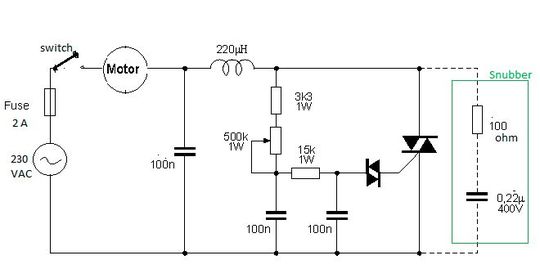
In summary, snubber circuits offer significant benefits by absorbing and damping voltage spikes and current surges, which in turn protect electronic components from potential damage. This proactive energy management improves the overall efficiency of the system by reducing switching losses and preventing overloads. Additionally, snubber circuits help minimize electromagnetic interference (EMI) by damping voltage transients, resulting in better signal quality and fewer disturbances in nearby devices. By ensuring a stable operating environment, snubber circuits extend the lifespan and reliability of electronic components, making them essential in various applications.
Functions and benefits of snubber circuits
Snubber circuits offer significant benefits by absorbing and damping voltage spikes and current surges, which in turn protect electronic components from potential damage. This proactive energy management improves the overall efficiency of the system by reducing switching losses and preventing overloads. Additionally, snubber circuits help minimize electromagnetic interference (EMI) by damping voltage transients, resulting in better signal quality and fewer disturbances in nearby devices. By ensuring a stable operating environment, snubber circuits extend the lifespan and reliability of electronic components, making them essential in various applications.
- Reducing or eliminating voltage and/or current spikes: By mitigating transient spikes, snubber circuits protect components from potential damage due to sudden surges.
- Limiting di/dt or dV/dt: Snubber circuits control the rate of change of current (di/dt) and voltage (dV/dt), preventing excessive stress on electronic components.
- Shaping the load line to keep it within the safe operating area: Ensuring that the operational parameters of the circuit remain within safe limits, thereby protecting the components from operating outside their specified range.
- Reducing total switching losses: By minimizing the energy lost during switching events, snubber circuits improve the overall efficiency of the system.
- Reducing EMI by damping voltage: Snubber circuits help in reducing electromagnetic interference (EMI) by dampening voltage transients, contributing to cleaner signal integrity and less interference with nearby electronic devices.
- Transferring power dissipation from the switch to a resistor (or a useful load): By redirecting the energy dissipation away from the switch and into a resistor or another useful load, snubber circuits help in managing thermal performance and extending the lifespan of the switching components.
:quality(80):fill(efefef,0)/p7i.vogel.de/wcms/60/dd/60ddd8a7327c8/wp-vorschaubild-rohde-schwarz-wp-lg-pb-2021-07-09.png "WP-Vorschaubild_Rohde_Schwarz_WP-LG_PB_2021-07-09")
Snubber circuit design
Designing a snubber circuit involves selecting appropriate components and configuring them to effectively manage transient voltages and currents. The key components in a snubber circuit are resistors, capacitors, and optionally diodes. Here’s a step-by-step guide to designing a snubber circuit:
1. Identify the type of snubber circuit
- RC Snubber: Consists of a resistor and capacitor in series. It is commonly used to suppress oscillations and absorb energy.
- RCD Snubber: Includes a resistor, capacitor, and diode. This configuration provides additional protection against reverse voltages and is often used with inductive loads.
2. Determine the values of components
- Resistor (R): The resistor value is crucial for limiting current and damping oscillations. It should be chosen to balance energy dissipation and damping effectiveness. A typical approach is to start with a value that results in a time constant (R*C) that is about 10 times the switching period of the circuit.
- Capacitor (C): The capacitor value should be large enough to absorb transients but not so large that it burdens the circuit. The capacitance value is often determined based on the maximum voltage the circuit will experience and the energy that needs to be absorbed. A common starting point is to use a value that results in a time constant (R*C) appropriate for the circuit’s frequency.
- Diode (optional): If a diode is used, it should have a fast recovery time and be able to handle the peak current and voltage expected in the circuit. Schottky diodes or ultra-fast recovery diodes are typically used.
3. Calculate power dissipation
- Ensure that the resistor can handle the power dissipation. This can be estimated using the formula P = V^2 / R, where V is the voltage across the resistor.
- Verify that the capacitor and diode (if used) can handle the expected energy levels and peak voltages.
4. Test and Optimize the Design:
- Simulate the snubber circuit using software tools to verify its performance under different operating conditions.
- Prototype the circuit and test it in the actual application to observe its effectiveness and make any necessary adjustments to component values.
5. Consider Practical Constraints:
- Component Ratings: Ensure all components are rated for the maximum voltage and current they will encounter.
- Thermal Management: Include considerations for heat dissipation, especially for the resistor, which may generate significant heat.
- Physical Size: Take into account the physical size of components, especially in space-constrained applications.
Example: Designing an RC snubber circuit
Suppose we have a switching transistor that experiences voltage spikes up to 100V and current spikes up to 5A when switching off. Here’s a simplified design process:
- 1. Choose a Capacitor (C): Start with a 1μF capacitor that can handle voltages higher than 100V (e.g., a 250V rated capacitor).
- 2. Select a Resistor (R): Choose a resistor value that results in a time constant suitable for the application. For instance, if the switching period is 10μs, a time constant of 100μs might be appropriate. Using the formula R = τ / C, where τ = 100μs and C = 1μF, we get R = 100μs / 1μF = 100Ω.
- 3. Verify power dissipation: Ensure the resistor can handle the power. If the voltage across the resistor is up to 100V, the power dissipation would be P = V^2 / R = (100V)^2 / 100Ω = 1W. Use a resistor rated for at least 1W, preferably higher to ensure reliability.
- 4. Test the circuit: Prototype the circuit, test it in the actual application, and adjust the values if necessary based on the observed performance.
By following these steps, you can design an effective snubber circuit tailored to your specific application needs.
Main applications of snubber circuits
Snubber circuits are essential in many areas of power electronics and have various applications, including:
- Motor Control: Used to dampen voltage spikes caused by the inductance of motor windings.
- Inverters: Reduce transients caused by switching power transistors.
- Power Transmission Devices: Protect transformers and other power transfer devices from voltage spikes and switching transients.
- Inductive Loads: Protect against voltage spikes caused by turning off inductive loads (e.g., relays, solenoids).
- Photovoltaic Systems: Reduce transients in inverters and other power electronic components of solar systems.
- LED Drivers: Protect LED drivers from voltage spikes caused by switching.
- Telecommunication Devices: Minimize transients in high-frequency circuits and protect sensitive components.
Snubber circuits in power electronics
In a simple power switching network with a power semiconductor switch and a resistive load, the device voltage and current are large when the power semiconductor is switching between on or off. In essence, this results in high power dissipation across the device and a consequential high loss of energy.
When the switch is open to interrupt the current flow in resistive load, a linear variation of switch voltage and current will be visible in the waveform. The resultant peak power dissipation will be one-quarter of a product of maximum voltage and current, which is very high in high voltage switching circuits. In an inductive load, the dissipation will be larger still.
Using a snubber that is connected across the semiconductor, however, these turn off losses can be minimized.
In this setup, the current is diverted into the snubber - which is initially uncharged - when the switch opens. This diversion slows the build-up of switch voltage and, as a result, the current drops to a low value before the switch voltage has a chance to significantly increase. The effect of this is a slow increase in switch voltage, which produces a reduction in switching energy loss. With this arrangement, snubbers in power electronics can attain a high operation frequency and low switching losses.
The energy in the charged snubber needs to go somewhere, though. When the switch is closed at the start of its conduction angle, the snubber discharges through it, and a small resistor is typically used with the snubber to limit the discharge current.
:quality(80)/p7i.vogel.de/wcms/7c/cb/7ccb277e1236a7e7d469d5e18b89682b/88322653.jpeg "A voltage regulator is a system designed to automatically maintain a constant voltage level. (Source: Adobe Stock)")
BASIC KNOWLEDGE - VOLTAGE REGULATOR
Different types of voltage regulators and working principle
Snubber circuit alternatives
Snubbers are better for some applications than others. Often, snubbers can induce more losses than they prevent. Many engineers suggest that it is easier to manage losses in a transistor than in a resistor. Moreover, alternative methods can sometimes be more efficient. For example, placing a small capacitor in parallel with a transistor can reduce overall losses. In the context of inductive loads, this capacitor may increase turn-on losses because it draws additional current when the transistor switches on. However, it effectively reduces turn-off losses by mitigating voltage spikes when the transistor switches off. This trade-off can be beneficial in applications where turn-off losses are more critical.
Here are some common alternatives for snubber circuits:
- Zener Diodes: Zener diodes clamp voltage spikes precisely and are easy to implement, making them suitable for applications requiring tight voltage regulation. However, they have limited energy absorption capacity and can generate significant heat. Zener diodes are used as voltage regulators and to protect sensitive electronis. For more details, we recommend our article "Zener diode as a voltage regulator".
- Transient Voltage Suppression (TVS) Diodes: TVS diodes respond very quickly to overvoltage conditions and can absorb substantial amounts of energy. They are available in both unidirectional and bidirectional versions to protect against positive and negative transients. Common use cases are surge protection in industrial and automotive applications, and protection of data and signal lines.
- Metal Oxide Varistors (MOVs): MOVs provide effective clamping of transient voltages and can absorb large amounts of energy. They are inexpensive but degrade over time with repeated exposure to surges. Common use cases are surge protection in power distribution systems, and overvoltage protection in consumer electronics.
- RC Filters: RC filters are used to filter out high-frequency noise and transients, improving signal integrity. They are versatile but do not dissipate significant energy and may need to be used alongside other protective devices.
- Advanced semiconductor technologies: Newer components like GaN (gallium nitride) and SiC (silicon carbide) devices offer improved performance, higher efficiency, and better handling of transients. However, they are generally more expensive and less widely available. They are used in high-efficiency power converters, advanced motor drives, and inverters.
(ID:46400636)
:quality(80)/p7i.vogel.de/wcms/90/f4/90f487e51d95ee8cf074826c96b8f6e5/0124400898v2.jpeg "High-power devices like thyristors can fail sometimes. For example, they can turn off abruptly after turning on. High dv/dt and di/dt ratings in thyristors are among the main reasons for failure. Find out more about this here. (Source: ludodesign - stock.adobe.com)")
:quality(80)/p7i.vogel.de/wcms/d9/64/d964e7b776e5905b69d15374f8b8990b/0115795833.jpeg "The article explains power diodes, and their structure, working principles, operation, characteristics, and many more details. (Source: urcis - stock.adobe.com)")