


:quality(80)/p7i.vogel.de/wcms/a4/fd/a4fd7f7a395d6ecb4e79cfc558895b09/0129082772v2.jpeg "CMT-PLA1BL12300MA 1200V/300A Half-Bridge IGBT Power Module. (Source: CISSOID)")
:quality(80)/p7i.vogel.de/wcms/71/fd/71fdcc22d9a9bd2f42985f692c4aefa2/0128924236v2.jpeg "Wolfspeed reported a milestone in silicon carbide manufacturing with the successful production of a single-crystal 300mm SiC wafer. (symbolic image) (Source: © Four888 - stock.adobe.com)")
:quality(80)/p7i.vogel.de/wcms/94/54/94548eaecd020681e558d563bc48ba1d/0128926221v2.jpeg "Harbinger is leveraging its electrification platform technology and battery manufacturing expertise to bring energy storage to Airstream travel trailers. (Source: Harbinger)")
:quality(80)/p7i.vogel.de/wcms/29/99/2999bb9af245dd31f4c837c1d9359046/0128923137v2.jpeg "Trench SiC MOSFET bare dies enable compact, high-performance power semiconductor solutions. (symbolic image) (Source: © ryanking999 - stock.adobe.com)")
:quality(80)/p7i.vogel.de/wcms/67/62/676279913d77e1db48eb5cbe9be4c767/0128937895v2.jpeg "(Bild: © WrightStudio - stock.adobe.com)")
:quality(80)/p7i.vogel.de/wcms/0f/a2/0fa2b5bdc21e408fd73e637d226d5210/0128681532v2.jpeg "Symbolic Image: Wind and solar power lead Germany’s electricity generation in 2025, marking a continued shift toward renewable energy. (Source: © koosy - stock.adobe.com)")
:quality(80)/p7i.vogel.de/wcms/4f/6f/4f6faf0ca6f748a2967d6b5bba7c88e1/0128682406v2.jpeg "Symbolic Image: SoCs for automotive applications enable enhanced performance in advanced driver-assistance systems. (Source: © Sodapeaw - stock.adobe.com)")
:quality(80)/p7i.vogel.de/wcms/ad/52/ad52f7b5542eff15ba54ec354d31b50d/0128681536v4.jpeg "Symbolic Image: This transaction brings battery technology development, manufacturing strategy, and capital-market access together within a single holding structure. (Source: © Sarut - stock.adobe.com)")
:quality(80)/p7i.vogel.de/wcms/1e/9c/1e9c45d6fcf2fb48dc47756e4cb20174/0128931043v2.jpeg "Syensqo and Axens have launched Argylium to support the development and scale-up of solid-state battery materials in Europe. (symbolic image) (Source: © Anastasiia - stock.adobe.com)")
:quality(80)/p7i.vogel.de/wcms/8b/42/8b4271e1bedea432ab03c83959e30431/0128818204v2.jpeg "Rows of batteries on Kauai island provide more than just power: They stabilize the grid. A project between the Kauai Island Utility Cooperative, NLR, and several more partners showed that electronics can offer equal grid strength to spinning resources. (Source: Connor O’Neil, National Laboratory of the Rockies)")
:quality(80)/p7i.vogel.de/wcms/87/5a/875a8fa395c1eec9677e075fae7f5e8e/0128793884v2.jpeg "MEMS-based hot-switched power panels enable compact, high-performance switching solutions for modern electronics. (Symbolic image) (Source: © Best - stock.adobe.com)")
:quality(80)/p7i.vogel.de/wcms/2f/93/2f9364112e8c6ff38c26f9ba34d0f692/0128791306v2.jpeg "Scalable, high-performance SiC MOSFET solutions enable faster development and improved efficiency in power electronics. (Symbolic image) (Source: © metamorworks - stock.adobe.com)")
:quality(80)/p7i.vogel.de/wcms/3c/d1/3cd1cacbceb792ba63727199c61ca434/0127801860v2.jpeg "Thanks to cloud technology, users can collaborate on projects from anywhere and always have access to the latest planning data. (Source: SIEMENS)")
:quality(80)/p7i.vogel.de/wcms/5a/a0/5aa0436498af618297961fd54ab36cdf/0126290792v2.jpeg "Siemens accelerates student-led semiconductor innovation across Europe’s leading technical universities through Cre8Ventures’ Open Higher Education Program developed in collaboration with Arm and University of Southampton (Source: Siemens Digital Industries Software)")
:quality(80)/p7i.vogel.de/wcms/cb/30/cb30ebdca7fcaea281749cb396654eb3/0124716339v2.jpeg "Rolls-Royce unveils Battery Analytics for its mtu EnergyPack, offering real-time insights, predictive maintenance, and enhanced cybersecurity to boost performance and longevity. (Source: Rolls-Royce plc)")
:quality(80)/p7i.vogel.de/wcms/0b/b4/0bb4cdfa862043eac04c6a195e59b3e0/0124131782v2.jpeg "Siemens has completed the acquisition of DownStream Technologies, a leading provider of manufacturing data preparation solutions for printed circuit board design. (Source: Siemens)")
AQUA TECHNOLOGY The challenges and triumphs of underwater electronics
Related Vendors
:fill(fff,0)/p7i.vogel.de/companies/62/b9/62b980cddf5d6/ceramtec.png "ceramtec (www.ceramtec-group.com)")
:fill(fff,0)/p7i.vogel.de/companies/60/7e/607ec89d5d9b5/white-frame.jpg "white frame.jpg (www.rohm.com)")
:fill(fff,0)/p7i.vogel.de/companies/5f/71/5f71d5f92a5f6/2000px-rogers-corporation-logo-svg.png "2000px-Rogers_Corporation_Logo.svg.png (rogers germany)")
How do electronic devices work under deep waters? How do such devices perform efficient operation under high water pressure? The answer is “underwater electronics”. Any device working against the force of water needs exceptional mechanical strength. The article explores the world of electronics beneath the oceans.
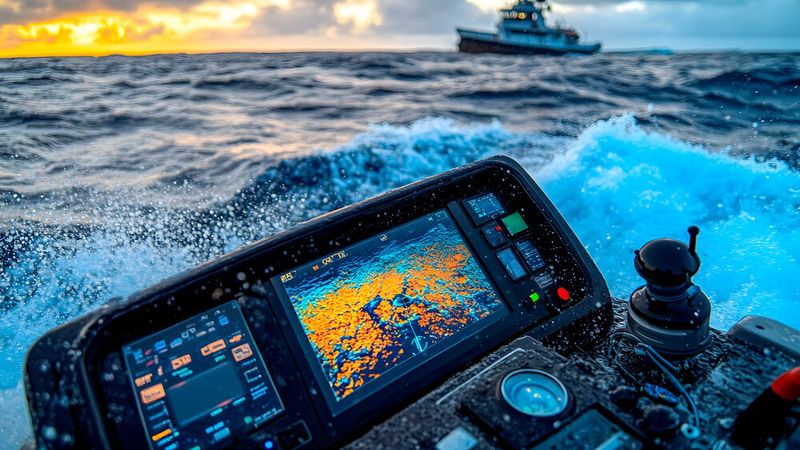
Oceans cover about 71 % of Earth’s surface, holding 96.5 % of the planet’s water. Despite being abundant, ocean exploration is way less than deep space. The Ocean floor holds gifts like oil, natural gas, rich minerals, and unique materials. As you go deeper into the ocean, water pressure increases. About 500 meters into the ocean, atmospheric pressure increases up to 52 times that of air. As a result, going deeper into oceans is challenging for electronic equipment.
How do electronics function underwater?
When under the deep sea, equipment must address two challenges: water ingress and high pressure. Electronics and associated components are engineered for underwater use. Advanced equipment such as cameras, sensors, transducers, meters, sonar, underwater acoustic tools, and video inspection systems are deployed for underwater exploration.
Waterproof enclosures
In general, electronic devices must be waterproof for everyday situations such as rain exposure or immersion in a water body. Similarly, underwater electronics must be put into air-tight waterproof, and water-resistant enclosures, ensuring durability and functionality in deep waters. Air-tight waterproof enclosures are made from strong materials to prevent water ingress. Techniques like vacuum resin filling and specialized coatings protect electronic components against water.
Exceptional mechanical strength
As mentioned above, pressure drastically increases as you go deeper. The ocean floor is always subject to immense pressure. Electronic equipment in ROVs (Remotely Operated Vehicles), AUVs (Autonomous Underwater Vehicles), and even submarines are encased in hard steel alloy-based enclosures, which are typically cylindrical or square in shape to distribute pressure across their entire structure.
:quality(80):fill(efefef,0)/p7i.vogel.de/wcms/66/4e/664efb5ea2f9e/wp-dc-dc-book-of-knowledge-recom-coverbild.png "WP_DC_DC_Book of knowledge_RECOM_Coverbild")
Corrosion-free
Corrosion is faster in waters, especially salt water. Preventing corrosion for underwater electronics eliminates malfunctioning, component degradation, short circuits, and many other problems. A possible solution is using anti-corrosion coatings or corrosion-resistant materials like titanium, stainless steel, or sometimes special types of plastic to enclose electronic components.
Challenges to underwater electronics
The oceanic environment poses inherent risks to electronic devices, equipment, and systems, with four prominent challenges.
Pressure
Inadequate design under the subject of high pressure permanently damages the underwater electronic equipment, compromising time and resources for the engineering team.
Signal interference
In underwater exploration, acoustics is the main facilitator of communication and tracking. Magnetic coupling is also used for wireless power transfer in ROVs and AUVs. Water and marine life can heavily cause signal interference, making communication unreliable.
Darkness
Sunlight does not reach the ocean floor. Cameras, sensors, and other devices must be equipped with the latest LEDs, laser, or optical technology to collect clear image and video data samples.
Equipment lifetime
Most equipment is deployed underwater for longer periods. Power consumption, constant supply, and equipment lifetime remain challenging throughout the mission.
Applications of underwater electronics
Underwater electronic equipment used for deep-sea exploration is applicable in various areas of research and extraction. The following section lists applications of underwater electronic equipment in various fields
:quality(80)/p7i.vogel.de/wcms/0f/3a/0f3ae4f49471286a71edda4ee912a750/0118614288.jpeg "The main reason for sending a chip-making machine to space is to understand the effect of microgravity on the fabrication process. Learn more about it in this article. (Source: Lidok_L - stock.adobe.com)")
SEMICONDUCTOR SPACE MANUFACTURING
NASA sends chip-making machine to space
Marine research
Studying marine life and their ecosystems is critical to protect the planet’s well-being. Researchers use ROVs and AUVs to collect image and video data of marine life for behavioral analysis to achieve milestones in seabed mining, water filtration, agriculture, medicine, and biofouling prevention.
Oceanography
The study of oceans is called oceanography. Various well-known research institutions and bodies are known to carry out deep-sea robotic missions. These missions enable researchers to understand ocean currents, tidal waves, ocean floor, tectonic movements, chemical substances, amount of acidification, climate change, possible disasters, and various other aspects.
Resource extraction
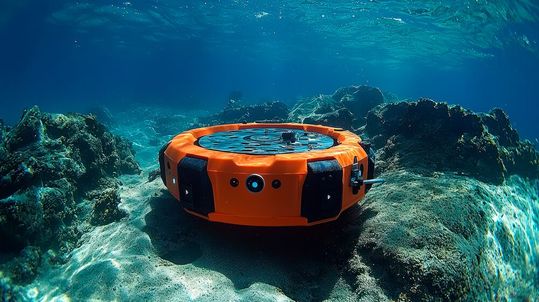
The Ocean floor is a rich source of untapped energy resources like oils, gas, and minerals. Drilling the ocean floor to extract oil and natural gas is known as offshore drilling. Deep-sea mining uses advanced electronic equipment to extract valuable minerals like nickel, cobalt, manganese, and copper. Some companies use seawater to manufacture saltwater battery technology. Other common uses of underwater electronics are using advanced technology for fishing.
Undersea cables
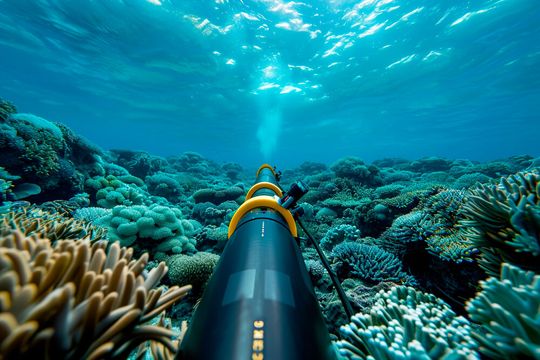
By 2025, a network of 600 active and planned cables, spanning a total length of 1.48 million kilometers, are lying on the ocean floor. Undersea cables contain traditional copper conductors and glass fiber cores with marine-grade polyethylene and hard steel. Telecom providers, multinational companies, and governments own these cables. The reason for laying cables underneath the oceans is to transmit large amounts of data between countries and continents. Undersea cables offer higher bandwidth and lower latency compared to satellite communication.
Future trends
In the 20th century, deep sea exploration was a valued technological field. The focus has shifted to deep space exploration instead. As a result, the innovation, overall investment, and repetitive missions are less. However, there are many emerging trends in equipment used for deep-sea exploration.
Consumer electronics
These days, smartphones are resistant to damage from ocean water. Various news sources cover smartphones of popular brands falling into the sea, remaining there for days, and still being found to be operational!
Emerging wireless technology
Wireless technology is emerging as a new field for underwater exploration. However, radio frequency cannot penetrate deep waters. As a result, GPS cannot be used for underwater tracking. The low-range wireless technology research is still subject to study.
Digital twin
Many software tools simulate or virtually recreate ocean environments for research purposes. Real ocean data is fed to smart sensors or software for best results in hardware-in-the-loop simulation.
Autonomous vehicles
The use of unmanned autonomous vehicles instead of submarines is boosting underwater exploration - a relief for divers and engineers. Low-cost solutions with advanced control systems and AI enable operation without human intervention.
References
Power Electronics in the Energy Transition

The parameters for energy transition and climate protection solutions span education, research, industry, and society. In the new episode of "Sound On. Power On.", Frank Osterwald of the Society for Energy and Climate Protection Schleswig‐Holstein talks about the holistic guidance his organization can provide.
Listen now!
(ID:50308329)
:quality(80)/p7i.vogel.de/wcms/de/9f/de9fcb86283d833ee34f18ebade3d86a/0125707890v2.jpeg "Piezoelectric materials occur naturally and can be engineered with precision. Unlike superconductors, piezoelectric materials do not need cold temperatures and high-pressure environments. Instead, piezoelectric materials can be found at room temperature, in consumer devices, and industries. (Source: © POUSEP - stock.adobe.com)")
:quality(80)/p7i.vogel.de/wcms/74/87/7487f68111f06cf1f558efa0f567bb15/0117517140.jpeg "A bus bar offers a low electrically resistant path to incoming or outgoing currents. Find out more about them in this article. (Source: Chumphon_TH - stock.adobe.com)")