


:quality(80)/p7i.vogel.de/wcms/2f/f3/2ff3221bf7665de2d0acf83760bfd1fa/0130031523v2.jpeg "Wolfspeed presents a 300 mm silicon carbide technology platform designed to support advanced packaging and high-efficiency power delivery for AI data center infrastructure. (Source: Wolfspeed)")
:quality(80)/p7i.vogel.de/wcms/c3/16/c316e955a97f5d72d9678297b237b9e5/0129932858v2.jpeg "Left: the single-phase version of the SENTRON ECPD with RCM, right: a model of the future three-phase version of the SENTRON ECPD. (Source: Siemens)")
:quality(80)/p7i.vogel.de/wcms/ef/0a/ef0adb0acf793fe147cc27c21f6a7a67/0129954238v2.jpeg "Empower Semiconductor introduces embedded silicon capacitors designed to improve power delivery and stability in AI and high-performance computing processors. (symbolic image) (Source: © IF.arc - stock.adobe.com)")
:quality(80)/p7i.vogel.de/wcms/53/f9/53f9301dfc9292d02960f7996c79cc6e/0129927601v2.jpeg "Wolfspeed’s new 10 kV SiC MOSFET enables high-voltage power conversion for grid and industrial applications. (symbolic image) (Source: © CREATIVE- 3.4 - stock.adobe.com)")
:quality(80)/p7i.vogel.de/wcms/6e/cd/6ecd41d095d5111cf4ed37b714844487/0129930878v2.jpeg "PCIM Asia Shenzhen provides a platform for industry experts to present new developments in power electronics and electrification technologies. (symbolic image) (Source: © killykoon - stock.adobe.com)")
:quality(80)/p7i.vogel.de/wcms/02/c0/02c0e9722f70b1134dbf96fb59a9c73d/0129655179v2.jpeg "The PCIM Conference 2026 will take place from June 9-11, featuring discussions on power electronics trends, including GaN technology and AI applications. (symbolic image) (Source: © Elmira - stock.adobe.com)")
:quality(80)/p7i.vogel.de/wcms/cc/67/cc670ea2029cd2af5c641af70e1bf734/0129816392v4.jpeg "Fraunhofer IAF coordinates the EU SUPREME project to accelerate GaN and SiC power semiconductor innovation in Europe. (Source: Fraunhofer IAF)")
:quality(80)/p7i.vogel.de/wcms/ea/e6/eae6aee30071e67a5627027974437134/0129544613v2.jpeg "GlobalFoundries and Renesas strengthen their collaboration to support U.S.-based semiconductor production and supply chain resilience. (Source: © ronstik - stock.adobe.com)")
:quality(80)/p7i.vogel.de/wcms/23/1a/231a97643aa7fc3adf2704a6273756c3/0130030642v2.jpeg "Gallium nitride (GaN) power devices are increasingly challenging silicon MOSFETs in low-voltage power conversion by enabling higher efficiency and switching performance. (Source: © Sheraz - stock.adobe.com)")
:quality(80)/p7i.vogel.de/wcms/3c/4b/3c4bbc68dda65c7071b4376fb57423b0/0130030465v2.jpeg "Faraday’s laws explain the fundamental behavior of magnetic fields and electronic devices in dynamic use cases. The operation of transformers, wireless chargers, induction cookers, induction motors, magnetic levitating trains (MAGLEV Trains), electric violin, and many others depends upon Faraday’s laws. (Source: © Sheraz - stock.adobe.com)")
:quality(80)/p7i.vogel.de/wcms/b1/5e/b15ee02b0ba02db70cf61e37d66ad1d3/0129349127v2.jpeg "Vehicle-to-grid (V2G) chargers enable bidirectional energy flow, allowing electric vehicles to act as mobile energy storage systems that can both draw power from and feed power back into the grid. (Source: © medienvirus - stock.adobe.com)")
:quality(80)/p7i.vogel.de/wcms/26/d5/26d591cc340077026eac56a0e7564faf/0129949603v2.jpeg "Flexible: The solid silicone-based electrolyte is elastic, thereby compensating for the voids that form in solid-state batteries during charging and discharging. (Source: Empa)")
:quality(80)/p7i.vogel.de/wcms/be/c8/bec8d43fc0ee73414274be44608b2970/0129748903v2.jpeg "The Infiniium XR804KA real-time oscilloscope delivers faster response time, improved stability, and streamlined workflows for high-speed digital and compliance testing. (Source: Keysight)")
:quality(80)/p7i.vogel.de/wcms/23/ee/23ee4a97790d6009dbfd7d9577ffa723/0129220424v2.jpeg "The R&S FPL1044 with the new RTSA option makes 40 MHz real-time frequency analysis available up to 44 GHz. (Source: Rohde & Schwarz )")
:quality(80)/p7i.vogel.de/wcms/3c/d1/3cd1cacbceb792ba63727199c61ca434/0127801860v2.jpeg "Thanks to cloud technology, users can collaborate on projects from anywhere and always have access to the latest planning data. (Source: SIEMENS)")
:quality(80)/p7i.vogel.de/wcms/5a/a0/5aa0436498af618297961fd54ab36cdf/0126290792v2.jpeg "Siemens accelerates student-led semiconductor innovation across Europe’s leading technical universities through Cre8Ventures’ Open Higher Education Program developed in collaboration with Arm and University of Southampton (Source: Siemens Digital Industries Software)")
MEASUREMENT SOFTWARE The basics of order analysis with OXYGEN
Sponsored by
:fill(fff,0)/p7i.vogel.de/companies/60/4b/604b5c9692acc/unnamed.png "unnamed.png (DEWETRON GmbH)")
In the world of rotating machines, vibrations tell a silent but powerful story - especially when studied via order analysis. Order analysis gives engineers a variety of insights into the examined system based on vibration and rotation measurements.
What is order analysis?
In the context of rotor dynamics, order analysis refers to studying the noise or vibration in rotating machinery or vibrating components. It is based on vibration and speed measurements with at least one acceleration sensor as well as information about the speed and angular position of the rotor, which is determined using encoders or tachometers. In contrast to frequency analysis, order analysis plots the energy content of the vibrations against the order, which represents the harmonic components that correspond to a multiple of the rotor’s basic speed.
Why is it so important?
In essence, order analysis offers a comprehensive understanding of an entire rotating system. It is a powerful tool, especially for machine diagnostics, and helps to
- detect misalignment and bearing faults,
- determine unbalance in the machinery,
- detect resonances,
- and more
Overall, it allows for easier interpretation of vibrations and makes it possible to diagnose potential problems, optimize performance and ultimately ensure the reliability and efficiency of rotating machinery.
How does order analysis work?
First of all, it is necessary to collect vibration data from the DUT (e.g. engine), for instance with an accelerometer. Secondly, you eliminate the noise from the raw vibration signal to retain only the relevant frequency range. In addition, it is required to obtain the rotational speed of the rotor (e.g. using a tachometer) and synchronize the vibration data with blocks of one rotor revolution. This allows to identify orders corresponding to the harmonic components of the rotating machine. The next step is to track frequency variations.
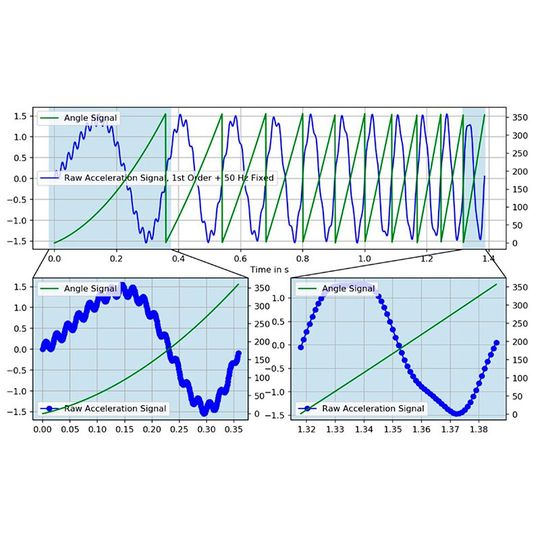
To do so, separate the vibration signal into blocks (Fig. 1), with each block representing one revolution, apply additional filtering and resampling operations to enhance accuracy and transform each individual block into the frequency domain via Fourier transform. Finally, you visualize the result as a 2D-color diagram.
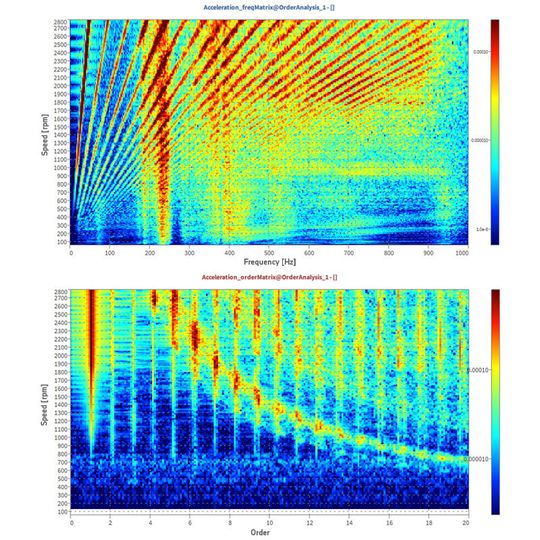
Fig. 2 shows the resulting diagrams obtained with DEWETRON's measurement software OXYGEN. The top panel shows the analysis in the form of a frequency matrix (frequency spectrum vs. rpm), while the bottom panel shows it in the form of the conventional order matrix (order spectrum vs. rpm).
Data interpretation
Clear line patterns can be recognized in both matrices. In the order matrix, vertical lines and curved structures are observed. Vertical lines denote the energy content of the rotating components, remaining constant across the entire rpm range due to each order representing a multiple of the fundamental rotation. Conversely, the curved lines in the order matrix signify the energy content of the structural components, which can vary at different speeds. In the frequency matrix, the pattern is reversed: non-vertical linear lines describe the energy content of the rotating components across multiple frequencies, while vertical lines indicate structural components. The presence of these vertical lines in the frequency matrix is attributed to the dominance of resonance frequencies in the vibration spectrum of structural components, reflecting the influence of normal modes.
Whether in automotive, aerospace, manufacturing or other industries, order analysis with OXYGEN is an always powerful tool. It offers a user-friendly yet highly effective implementation to quickly and comprehensively analyze your system.
(ID:49861906)
:quality(80)/p7i.vogel.de/wcms/f0/e0/f0e0561de9eba27f7b1eced122929504/0123679425v2.jpeg "Discover the detailed depth profiles of SiC MOSFETs and the role of AI in improving defect detection within power electronics. (Source: putilov_denis - stock.adobe.com)")
:quality(80)/p7i.vogel.de/wcms/37/64/376449c482d7bc5493c77d057638fe59/0126287882v2.jpeg "At PCIM 2025, Michael Harrison unveiled Enphase Energy's groundbreaking use of GaN HEMT Bi-Directional Switches in their IQ9 PV microinverter, marking a pivotal advancement in power conversion technology. (Source: © roei - stock.adobe.com)")