


:quality(80)/p7i.vogel.de/wcms/2f/f3/2ff3221bf7665de2d0acf83760bfd1fa/0130031523v2.jpeg "Wolfspeed presents a 300 mm silicon carbide technology platform designed to support advanced packaging and high-efficiency power delivery for AI data center infrastructure. (Source: Wolfspeed)")
:quality(80)/p7i.vogel.de/wcms/c3/16/c316e955a97f5d72d9678297b237b9e5/0129932858v2.jpeg "Left: the single-phase version of the SENTRON ECPD with RCM, right: a model of the future three-phase version of the SENTRON ECPD. (Source: Siemens)")
:quality(80)/p7i.vogel.de/wcms/ef/0a/ef0adb0acf793fe147cc27c21f6a7a67/0129954238v2.jpeg "Empower Semiconductor introduces embedded silicon capacitors designed to improve power delivery and stability in AI and high-performance computing processors. (symbolic image) (Source: © IF.arc - stock.adobe.com)")
:quality(80)/p7i.vogel.de/wcms/53/f9/53f9301dfc9292d02960f7996c79cc6e/0129927601v2.jpeg "Wolfspeed’s new 10 kV SiC MOSFET enables high-voltage power conversion for grid and industrial applications. (symbolic image) (Source: © CREATIVE- 3.4 - stock.adobe.com)")
:quality(80)/p7i.vogel.de/wcms/6e/cd/6ecd41d095d5111cf4ed37b714844487/0129930878v2.jpeg "PCIM Asia Shenzhen provides a platform for industry experts to present new developments in power electronics and electrification technologies. (symbolic image) (Source: © killykoon - stock.adobe.com)")
:quality(80)/p7i.vogel.de/wcms/02/c0/02c0e9722f70b1134dbf96fb59a9c73d/0129655179v2.jpeg "The PCIM Conference 2026 will take place from June 9-11, featuring discussions on power electronics trends, including GaN technology and AI applications. (symbolic image) (Source: © Elmira - stock.adobe.com)")
:quality(80)/p7i.vogel.de/wcms/cc/67/cc670ea2029cd2af5c641af70e1bf734/0129816392v4.jpeg "Fraunhofer IAF coordinates the EU SUPREME project to accelerate GaN and SiC power semiconductor innovation in Europe. (Source: Fraunhofer IAF)")
:quality(80)/p7i.vogel.de/wcms/ea/e6/eae6aee30071e67a5627027974437134/0129544613v2.jpeg "GlobalFoundries and Renesas strengthen their collaboration to support U.S.-based semiconductor production and supply chain resilience. (Source: © ronstik - stock.adobe.com)")
:quality(80)/p7i.vogel.de/wcms/b1/5e/b15ee02b0ba02db70cf61e37d66ad1d3/0129349127v2.jpeg "Vehicle-to-grid (V2G) chargers enable bidirectional energy flow, allowing electric vehicles to act as mobile energy storage systems that can both draw power from and feed power back into the grid. (Source: © medienvirus - stock.adobe.com)")
:quality(80)/p7i.vogel.de/wcms/26/d5/26d591cc340077026eac56a0e7564faf/0129949603v2.jpeg "Flexible: The solid silicone-based electrolyte is elastic, thereby compensating for the voids that form in solid-state batteries during charging and discharging. (Source: Empa)")
:quality(80)/p7i.vogel.de/wcms/4d/e0/4de02f76a37cbb3df30dd231de589c8e/0128866890v2.jpeg "Both legacy and vGaN show higher carrier mobility and band gap energies compared to other power semiconductors. (Source: © phonlamaiphoto - stock.adobe.com)")
:quality(80)/p7i.vogel.de/wcms/18/0b/180b7b63afc91e523592d8a5ce161c96/0129847487v2.jpeg "InGaAs-based photodetectors enable sensitive and fast detection in the short-wave infrared spectrum for modern sensing and communication applications. (Source: © VITALII - stock.adobe.com)")
:quality(80)/p7i.vogel.de/wcms/be/c8/bec8d43fc0ee73414274be44608b2970/0129748903v2.jpeg "The Infiniium XR804KA real-time oscilloscope delivers faster response time, improved stability, and streamlined workflows for high-speed digital and compliance testing. (Source: Keysight)")
:quality(80)/p7i.vogel.de/wcms/23/ee/23ee4a97790d6009dbfd7d9577ffa723/0129220424v2.jpeg "The R&S FPL1044 with the new RTSA option makes 40 MHz real-time frequency analysis available up to 44 GHz. (Source: Rohde & Schwarz )")
:quality(80)/p7i.vogel.de/wcms/3c/d1/3cd1cacbceb792ba63727199c61ca434/0127801860v2.jpeg "Thanks to cloud technology, users can collaborate on projects from anywhere and always have access to the latest planning data. (Source: SIEMENS)")
:quality(80)/p7i.vogel.de/wcms/5a/a0/5aa0436498af618297961fd54ab36cdf/0126290792v2.jpeg "Siemens accelerates student-led semiconductor innovation across Europe’s leading technical universities through Cre8Ventures’ Open Higher Education Program developed in collaboration with Arm and University of Southampton (Source: Siemens Digital Industries Software)")
POWER TRANSFORMERS Step up vs. Step down transformer – what’s the difference?
Related Vendors
:fill(fff,0)/p7i.vogel.de/companies/5f/71/5f71d5f92a5f6/2000px-rogers-corporation-logo-svg.png "2000px-Rogers_Corporation_Logo.svg.png (rogers germany)")
:fill(fff,0)/p7i.vogel.de/companies/68/2c/682c3e2e9a195/logotype-rvb.jpeg "logotype-rvb (https://www.mersen.com/en)")
:fill(fff,0)/p7i.vogel.de/companies/69/30/693022b11e5db/logo.jpeg "logo (MBS-Hodde GmbH & Co. KG)")
Step-up and step-down transformers are used in generators, transmission lines, power systems, distribution networks, microwaves, electronic devices, isolators, and many more applications. The article explains step-up and step-down transformers in brief and lists the differences between them.
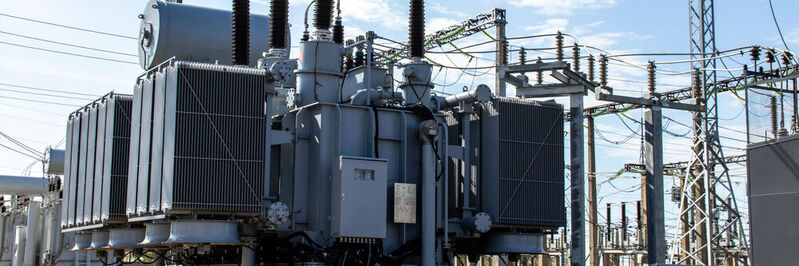
A power transformer is a static electrical device that works on the principle of electromagnetic induction to convert input AC voltage from one level to another at the output. The power transformer can either increase or decrease the input AC voltage level, without changing the frequency. However, it should be noted that the transformer increases or decreases only AC voltage. Unlike a rectifier, a transformer does not convert AC voltage to DC voltage.
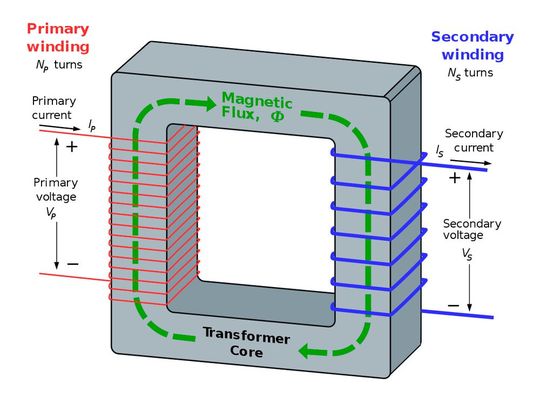
Transformers have primary and secondary windings, each with a different (or same) number of turns to determine the operation. Both windings are embedded in the core but are electrically insulated from each other. The primary winding is at the input and the secondary winding is at the output of the transformer. The primary winding has N1 or Np number of turns and the secondary winding has N2 or Ns number of turns.
There are many types of transformers but two main categories based on the operation, output voltage ratings, and number of turns of windings are- step-up and step-down transformers. Both transformer types are used in a variety of applications such as transmission lines, industries, power electronics, etc.
1. What is a step-up transformer?
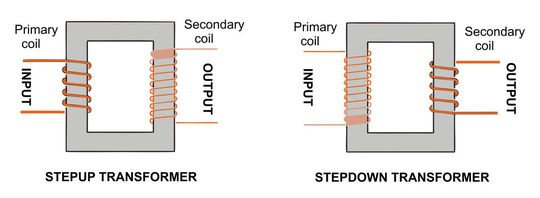
A step-up transformer is an electrical device that “steps up” the input AC voltage. As the name suggests, a step-up transformer converts the input low voltage (LV) and high current (HC) AC signal to the high voltage (HV) and low current (LC) AC signal on the output side.
The number of turns “N1” of the primary coil in a step-up transformer is lesser than the number of turns “N2” of the secondary winding.
N1 < N2
The emf-induced e1 in the primary winding is less than the emf-induced e2 in the secondary winding.
e1 < e2
An input AC voltage is fed to the step-up transformer. According to the law of Faraday’s electromagnetic induction, alternating current produces a varying magnetic field that induces an emf in the windings.
The output voltage directly depends upon the winding ratio-
N2 / N1 = Vo / Vi
Vo = Vi. N2 / N1
As a result of variation in the number of winding turns, a higher AC voltage is seen at the output of the step-up transformer.
Vi < Vo
The transformer ratio (K) must be greater than 1 to design a step-up transformer.
N2 / N1 = e2 / e1 = Vo / Vi > 1
K > 1
2. What does a step-up transformer do?
A step-up transformer is used at the input stage of the transmission line to step-up the input voltage. It enables the transmission line to carry high running voltage. Step-up transformer provides a higher output voltage than the input voltage. The primary voltage ratings in a step-up transformer are 220 V, 415 V, 11 kV, etc. The secondary voltage ratings include 33 kV, 66 kV, 220 kV, 400 kV, etc.
For example, the generating station voltage of 11 kV is stepped-up to 220 kV or 380 kV for effective transmission. The transmission line carries a high voltage to prevent any line losses with increased efficiency. However, each country has different values for generator station voltages and transmission lines.
:quality(80)/p7i.vogel.de/wcms/d1/0e/d10e0c4bd41090bb8393c0ab7f9865aa/96560558.jpeg "At PCIM Digital Days 2021, Seddik Bacha, Scientific Director and Scientific Committee Chair of the Supergrid Architecture & Systems research program at the SuperGrid Institute, presented a keynote titled \"HVDC grid challenges and opportunities\". (Bild: ©alexkich - stock.adobe.com)")
KEYNOTE
PCIM 2021: HVDC grid challenges and opportunities
3. What is a step-down transformer?
A step-down transformer is an electrical device that “steps down” the input AC voltage. In simple words, a step-down transformer converts the high voltage (HV) and low current (LC) input AC signal to the low voltage (LV) and high current (HC) AC signal on the output side.
The number of turns “N1” of the primary coil in a step-down transformer is more than the number of turns “N2” of the secondary winding.
N1 > N2
The emf-induced e1 in the primary winding is more than the emf-induced e2 in the secondary winding.
e1 > e2
An input AC voltage is fed to the step-down transformer. According to the law of Faraday’s electromagnetic induction, alternating current produces a varying magnetic field that induces an emf in the windings.
The output voltage directly depends upon the winding ratio-
N2 / N1 = Vo / Vi
Vo = Vi. N2 / N1
As a result of variation in the number of winding turns, a lower AC voltage is seen at the output of the step-down transformer.
Vi > Vo
To design a step-down transformer, the transformer ratio (K) must be less than 1.
N2 / N1 = e2 / e1 = Vo / Vi < 1
K < 1
4. What does a step-down transformer do?
A step-down transformer provides a lower output voltage than the input voltage. The device is used at the output stage of the transmission line to step-down the input voltage. The high voltage from the transmission line passes through the step-down to safely reach homes and commercial areas.
The primary voltage ratings in a step-down transformer are 33 kV, 66 kV, 132 kV, 220 kV, 400 kV, etc. The secondary voltage ratings include 220 V, 415 V, 11 kV, etc. However, each country has different values for generator station voltages and transmission lines. For example, the transmission line voltage of 220 kV or 380 kV is stepped down to 33 kV or 11 kV or various other required values for safe operation.
5. The difference between a step-up transformer and a step-down transformer at a glance
| Parameter | Step-up Transformer | Step-down Transformer |
|---|---|---|
| Operation | Steps-up or increases input voltage | Steps-down or decreases input voltage |
| Input voltage | Low input voltage | High input voltage |
| Output voltage | High output voltage | Low output voltage |
| Windings | N1 < N2 | N1 > N2 |
| Current | The current in the primary winding is more than the current in the secondary winding i1 > i2 | The current in the primary winding is lesser than the current in the secondary winding i1 < i2 |
| Emf induced in the windings | e1 < e2 | e1 > e2 |
| Transformer ratio (K) | K > 1 | K < 1 |
| Application | Input stage of transmission line Power plant Microwaves | Output stage of transmission line Doorbells Voltage converters |
6. References
- https://www.electrical4u.com/step-up-transformer/
- https://www.electrical4u.com/step-down-transformers/
- https://www.britannica.com/technology/transformer-electronics
(ID:49623386)
:quality(80)/p7i.vogel.de/wcms/0d/d0/0dd02f3d5a1c83c1be444f73910e6b30/0126472071v2.jpeg "Current transducers are essential devices in power electronics, converting high current levels into standardized signals for safe and efficient use across various electronic systems, with applications ranging from motor protection to renewable energy systems and particle accelerators. (Source: © Aimur - stock.adobe.com)")
:quality(80)/p7i.vogel.de/wcms/7a/a5/7aa50649486f059b1d7111f508c5c6e7/0128629162v2.jpeg "This article explains current transducers and their role in power electronics. (Source: © kwanchanachai - stock.adobe.com)")