


:quality(80)/p7i.vogel.de/wcms/2f/f3/2ff3221bf7665de2d0acf83760bfd1fa/0130031523v2.jpeg "Wolfspeed presents a 300 mm silicon carbide technology platform designed to support advanced packaging and high-efficiency power delivery for AI data center infrastructure. (Source: Wolfspeed)")
:quality(80)/p7i.vogel.de/wcms/c3/16/c316e955a97f5d72d9678297b237b9e5/0129932858v2.jpeg "Left: the single-phase version of the SENTRON ECPD with RCM, right: a model of the future three-phase version of the SENTRON ECPD. (Source: Siemens)")
:quality(80)/p7i.vogel.de/wcms/ef/0a/ef0adb0acf793fe147cc27c21f6a7a67/0129954238v2.jpeg "Empower Semiconductor introduces embedded silicon capacitors designed to improve power delivery and stability in AI and high-performance computing processors. (symbolic image) (Source: © IF.arc - stock.adobe.com)")
:quality(80)/p7i.vogel.de/wcms/53/f9/53f9301dfc9292d02960f7996c79cc6e/0129927601v2.jpeg "Wolfspeed’s new 10 kV SiC MOSFET enables high-voltage power conversion for grid and industrial applications. (symbolic image) (Source: © CREATIVE- 3.4 - stock.adobe.com)")
:quality(80)/p7i.vogel.de/wcms/6e/cd/6ecd41d095d5111cf4ed37b714844487/0129930878v2.jpeg "PCIM Asia Shenzhen provides a platform for industry experts to present new developments in power electronics and electrification technologies. (symbolic image) (Source: © killykoon - stock.adobe.com)")
:quality(80)/p7i.vogel.de/wcms/02/c0/02c0e9722f70b1134dbf96fb59a9c73d/0129655179v2.jpeg "The PCIM Conference 2026 will take place from June 9-11, featuring discussions on power electronics trends, including GaN technology and AI applications. (symbolic image) (Source: © Elmira - stock.adobe.com)")
:quality(80)/p7i.vogel.de/wcms/cc/67/cc670ea2029cd2af5c641af70e1bf734/0129816392v4.jpeg "Fraunhofer IAF coordinates the EU SUPREME project to accelerate GaN and SiC power semiconductor innovation in Europe. (Source: Fraunhofer IAF)")
:quality(80)/p7i.vogel.de/wcms/ea/e6/eae6aee30071e67a5627027974437134/0129544613v2.jpeg "GlobalFoundries and Renesas strengthen their collaboration to support U.S.-based semiconductor production and supply chain resilience. (Source: © ronstik - stock.adobe.com)")
:quality(80)/p7i.vogel.de/wcms/23/1a/231a97643aa7fc3adf2704a6273756c3/0130030642v2.jpeg "Gallium nitride (GaN) power devices are increasingly challenging silicon MOSFETs in low-voltage power conversion by enabling higher efficiency and switching performance. (Source: © Sheraz - stock.adobe.com)")
:quality(80)/p7i.vogel.de/wcms/3c/4b/3c4bbc68dda65c7071b4376fb57423b0/0130030465v2.jpeg "Faraday’s laws explain the fundamental behavior of magnetic fields and electronic devices in dynamic use cases. The operation of transformers, wireless chargers, induction cookers, induction motors, magnetic levitating trains (MAGLEV Trains), electric violin, and many others depends upon Faraday’s laws. (Source: © Sheraz - stock.adobe.com)")
:quality(80)/p7i.vogel.de/wcms/b1/5e/b15ee02b0ba02db70cf61e37d66ad1d3/0129349127v2.jpeg "Vehicle-to-grid (V2G) chargers enable bidirectional energy flow, allowing electric vehicles to act as mobile energy storage systems that can both draw power from and feed power back into the grid. (Source: © medienvirus - stock.adobe.com)")
:quality(80)/p7i.vogel.de/wcms/26/d5/26d591cc340077026eac56a0e7564faf/0129949603v2.jpeg "Flexible: The solid silicone-based electrolyte is elastic, thereby compensating for the voids that form in solid-state batteries during charging and discharging. (Source: Empa)")
:quality(80)/p7i.vogel.de/wcms/be/c8/bec8d43fc0ee73414274be44608b2970/0129748903v2.jpeg "The Infiniium XR804KA real-time oscilloscope delivers faster response time, improved stability, and streamlined workflows for high-speed digital and compliance testing. (Source: Keysight)")
:quality(80)/p7i.vogel.de/wcms/23/ee/23ee4a97790d6009dbfd7d9577ffa723/0129220424v2.jpeg "The R&S FPL1044 with the new RTSA option makes 40 MHz real-time frequency analysis available up to 44 GHz. (Source: Rohde & Schwarz )")
:quality(80)/p7i.vogel.de/wcms/3c/d1/3cd1cacbceb792ba63727199c61ca434/0127801860v2.jpeg "Thanks to cloud technology, users can collaborate on projects from anywhere and always have access to the latest planning data. (Source: SIEMENS)")
:quality(80)/p7i.vogel.de/wcms/5a/a0/5aa0436498af618297961fd54ab36cdf/0126290792v2.jpeg "Siemens accelerates student-led semiconductor innovation across Europe’s leading technical universities through Cre8Ventures’ Open Higher Education Program developed in collaboration with Arm and University of Southampton (Source: Siemens Digital Industries Software)")
RENEWABLE ENERGY Solar technology: Innovative, efficient light-collecting system
Related Vendors
:fill(fff,0)/p7i.vogel.de/companies/5f/71/5f71d5f92a5f6/2000px-rogers-corporation-logo-svg.png "2000px-Rogers_Corporation_Logo.svg.png (rogers germany)")
:fill(fff,0)/p7i.vogel.de/companies/61/dc/61dc0e8c2e420/dspace-logo-1000px-220107.png "dspace-logo-1000px-220107 (dSPACE GmbH)")
:fill(fff,0)/p7i.vogel.de/companies/62/95/6295c25c8dc1a/schunk-sonosystems-300dpi.png "schunk-sonosystems-300dpi (Schunk)")
Würzburg researchers from the Bavarian Solar Technologies Go Hybrid network are reporting progress on the road to more efficient utilisation of solar energy: they have developed an innovative light collection system.

In order to convert sunlight into electricity or other forms of energy as effectively as possible, the very first step is to have an efficient light collection system. Ideally, this should be panchromatic, i.e. absorb the entire spectrum of visible light.
The light-collecting antennae of plants and bacteria are a model for this. These capture a broad spectrum of light for photosynthesis, but are very complex in structure and require many different dyes to transmit the energy of the absorbed light and focus it on a central point.
The light-collecting systems developed by humans to date also have disadvantages:
Although inorganic semiconductors such as silicon are panchromatic, they only absorb light weakly. In order to absorb enough light energy, very thick layers of silicon down to the micrometre range are therefore required - making solar cells relatively bulky and heavy.
Organic dyes that are suitable for solar cells are much thinner: their layer thickness is only around 100 nanometres. However, they are barely able to absorb a broad spectral range and are therefore not particularly efficient.
Thin layer absorbs a lot of light energy
Researchers at Julius-Maximilians-Universität (JMU) Würzburg have now presented an innovative light-collecting system in the journal Chem that differs significantly from previous systems.
"Our system has a band structure similar to that of inorganic semiconductors. This means that it absorbs light panchromatically across the entire visible range. And it uses the high absorption coefficients of organic dyes. As a result, it can absorb a great deal of light energy in a relatively thin layer, similar to natural light-collecting systems," says JMU chemistry professor Frank Würthner. His team from the Institute of Organic Chemistry / Centre for Nanosystems Chemistry designed the light-harvesting system at JMU and researched it together with Professor Tobias Brixner's group from the Institute of Physical and Theoretical Chemistry.
:quality(80)/p7i.vogel.de/wcms/0b/ab/0bab17d89b907f36540b899f3d881d73/0105356625.jpeg "As well as photovoltaic, this article covers thermal energy technologies including solar farm power plants, solar Stirling systems, and thermal (or updraft) power plants. (Source: Günter Albers - stock.adobe.com)")
BASIC KNOWLEDGE – SOLAR ENERGY
What is solar energy? Definition, types and more
Four colourants in an ingenious arrangement
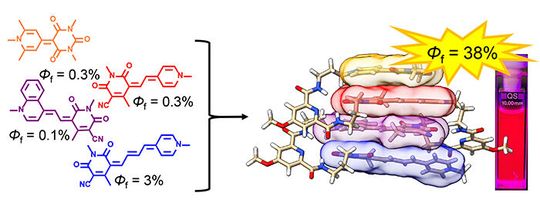
Put simply, the innovative light-collecting antenna from Würzburg consists of four different merocyanine dyes that are folded and stacked closely together. The ingenious arrangement of the molecules enables ultra-fast and efficient energy transport within the light antenna.
The researchers have given the prototype of the new light-collecting system the name URPB. The letters stand for the light wavelengths that are absorbed by the four dye components of the antenna: U for ultraviolet, R for red (red), P for purple (violet), B for blue (blue).
Performance verified via fluorescence
The researchers have demonstrated that their novel light-collecting system works so well by measuring the so-called fluorescence quantum yield. This involves measuring how much energy the system emits in the form of fluorescence. This allows conclusions to be drawn about the amount of light energy that it has previously collected.
The result: the system converts 38 per cent of the light energy irradiated over a broad spectral range into fluorescence - the four dyes alone, on the other hand, manage less than one per cent to a maximum of three per cent. The right combination and skilful spatial arrangement of dye molecules in the stack therefore make a big difference.
(ID:50099175)
:quality(80)/p7i.vogel.de/wcms/12/6e/126e19e3b2f8f9c421235840def1b056/0123920282v2.jpeg "Maria Saladina, Carsten Deibel, and Chen Wang from the Chair of Optics and Photonics of Condensed Matter in front of the Institute of Physics at TU Chemnitz. (Source: Martin Mellendorf)")
:quality(80)/p7i.vogel.de/wcms/7b/2c/7b2c4ddd6c8fd3b44fe8afc18f0d7e40/0115676667.jpeg "The article discusses laser diodes and their theory in detail. (Source: MiguelAngel - stock.adobe.com)")