


:quality(80)/p7i.vogel.de/wcms/64/58/6458e523668e20b377363222fa42a55f/0130220409v2.jpeg "EPC’s Phase 18 report provides new insights into the reliability and robustness of eGaN power devices under real-world operating conditions. (Source: © danter - stock.adobe.com)")
:quality(80)/p7i.vogel.de/wcms/54/4c/544c477d212f04b137d64a4ebcda4222/0130222019v2.jpeg "Microchip’s new BZpack SiC power modules are designed to deliver high efficiency and reliability in demanding power conversion applications. (Source: Microchip)")
:quality(80)/p7i.vogel.de/wcms/da/f4/daf432573fac7d099d1b9fad5196c3f9/0130217438v2.jpeg "Renesas introduces a 650 V bidirectional GaN switch designed to improve efficiency and enable new architectures in power conversion systems for solar, energy storage, and AI data centers. (Source: Renesas)")
:quality(80)/p7i.vogel.de/wcms/58/52/5852190506e6905c28cd76ce374f81cf/0130213855v2.jpeg "Toshiba expands its portfolio of isolators and solid-state relays for reliable switching and signal isolation in industrial and power electronics applications. (Source: Toshiba)")
:quality(80)/p7i.vogel.de/wcms/70/00/7000469e10c35ed7751729db836151d0/0130184622v2.jpeg "Vincent Roche, CEO and Chair of Analog Devices (left), and Wirat Sri-amonkitkul, Managing Director of Analog Devices Thailand (right), at the ribbon-cutting ceremony marking the opening of ADI’s new advanced manufacturing facility in Thailand. (Source: Analog Devices)")
:quality(80)/p7i.vogel.de/wcms/cb/aa/cbaa3bbaed9f2eed05ed6747db579c09/0130182472v2.jpeg "PCIM Europe 2026 will once again bring together industry experts to discuss the latest developments in power electronics, energy management, and intelligent motion. (Source: Mesago Messe Frankfurt GmbH / Arturo Rivas Gonzalez)")
:quality(80)/p7i.vogel.de/wcms/d8/88/d888d47fa237c81aa2e3755df3abaa1e/0130111322v2.jpeg "The BCM6135 is a breakthrough bidirectional 800V-to-48V DC-DC converter that enables lighter, smaller and more efficient power delivery networks in electric vehicles. Its compact size can reduce power system volume by nearly 50%. (Source: Vicor)")
:quality(80)/p7i.vogel.de/wcms/b7/5e/b75e1eedc8b901bbaa392e426a2a702f/0130108005v2.jpeg "Fraunhofer EMFT presents strategic recommendations to strengthen Europe’s semiconductor ecosystem and technological sovereignty. (Source: Fraunhofer EMFT)")
:quality(80)/p7i.vogel.de/wcms/ae/f8/aef812b9e9d135f80060a3c50b03d034/0130157717v2.jpeg "Solid-state transformers (SSTs) promise more flexible and efficient power conversion, but significant technical challenges still limit their large-scale commercial adoption. (Source: © Curie - stock.adobe.com)")
:quality(80)/p7i.vogel.de/wcms/4e/f8/4ef8fb932448610eba4dd3677883262f/0130246966v2.jpeg "Menlo Micro demonstrates scalable MEMS-based power switching technology for high-performance circuit breaker applications. (Source: Menlo Micro)")
:quality(80)/p7i.vogel.de/wcms/ba/48/ba480e85eb43f1969086dfa5b5b75a5b/0130186853v2.jpeg "Before this experiment, the reality of magnetism-based semiconductors did not match the theoretical expectation. Most magnetic semiconductors create a weak magnetic field and show no current variations. However, the new magnetic transistor might change the game… (Source: © Mahmood - stock.adobe.com)")
:quality(80)/p7i.vogel.de/wcms/b9/f2/b9f2b934f2ccfc87ac330e242cd6032b/0130189442v2.jpeg "2D semiconductor fabrication is incompatible with existing procedures and lacks commercialization. A team of researchers from China has solved this problem. (Source: © TheWaterMeloonProjec - stock.adobe.com)")
:quality(80)/p7i.vogel.de/wcms/34/4a/344a3dc5a19429cf6726b7f8f7e2ee32/0130109719v2.jpeg "Hioki’s new measurement solutions enable precise analysis of power electronics systems and energy efficiency. (Source: Hioki)")
:quality(80)/p7i.vogel.de/wcms/be/c8/bec8d43fc0ee73414274be44608b2970/0129748903v2.jpeg "The Infiniium XR804KA real-time oscilloscope delivers faster response time, improved stability, and streamlined workflows for high-speed digital and compliance testing. (Source: Keysight)")
:quality(80)/p7i.vogel.de/wcms/23/ee/23ee4a97790d6009dbfd7d9577ffa723/0129220424v2.jpeg "The R&S FPL1044 with the new RTSA option makes 40 MHz real-time frequency analysis available up to 44 GHz. (Source: Rohde & Schwarz )")
:quality(80)/p7i.vogel.de/wcms/3c/d1/3cd1cacbceb792ba63727199c61ca434/0127801860v2.jpeg "Thanks to cloud technology, users can collaborate on projects from anywhere and always have access to the latest planning data. (Source: SIEMENS)")
POWER CONVERSION Solar power integration in the railway power grid with innovative inverters
Related Vendors
:fill(fff,0)/p7i.vogel.de/companies/63/c7/63c7da97be945/diotec.png "diotec (Diotec Semiconductor AG)")
:fill(fff,0)/p7i.vogel.de/companies/60/7e/607ec89d5d9b5/white-frame.jpg "white frame.jpg (www.rohm.com)")
:fill(fff,0)/p7i.vogel.de/companies/5f/71/5f71d5f92a5f6/2000px-rogers-corporation-logo-svg.png "2000px-Rogers_Corporation_Logo.svg.png (rogers germany)")
Germany's largest rail transport and infrastructure operator is the Deutsche Bahn. The project "PV4Rail" examined how this grid can be utilized for the feed-in of solar power. The consortium lead by Fraunhofer ISE developed and tested an inverter for the direct feed-in of photovoltaic power, analyzed the photovoltaic potential along the tracks, and conducted techno-economic studies of railway power PV systems. These could become an important component of the energy transition.
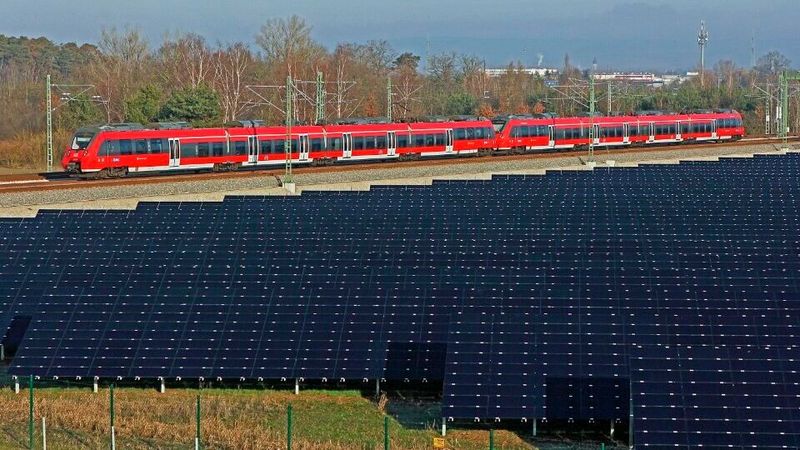
Currently, generating facilities with a capacity of about two gigawatts (GW) are installed on the Deutsche Bahn grid. These are primarily conventional power plants and hydroelectric plants. However, PV systems directly feeding into the railway power grid are not yet in operation in Germany. "A relevant part of the energy demand in the railway power grid could be covered by photovoltaics, as the PV area potential along the railway lines is many times higher than the amount of energy needed in the railway power grid," explains Andreas Hensel, project manager of “PV4Rail” at Fraunhofer ISE. The project team identified suitable areas nationwide and examined their potential with detailed simulations. Even when only areas within a two-kilometer radius of a railway substation were considered, the possible installable rated capacity was 37.6 GWp, and the potential energy yield was 32,920 GWh annually. The electricity demand for train operations in total was around 7,500 GWh in 2023.
Inverters developed for direct feed-in
Since the railway network operates at a frequency of 16.7 Hz instead of the public grid's 50 Hz, the project partner Vensys Elektrotechnik GmbH developed a central inverter with a capacity of 2 MW, which is divided into two symmetrical power parts of 1 MW each. One of the power parts was tested in the multi-megawatt lab at Fraunhofer ISE, achieving an efficiency of 96.6 percent (including self-consumption for cooling, etc.). Fraunhofer ISE also developed regulations for the grid-forming operation of the inverters in the railway grid.
For the connection execution, the team considered various connection configurations depending on the size of the installation: while smaller systems up to 5 MW can feed directly into the overhead line, capacities up to 12 MW are fed into substations via the busbar. This variant shows the least differences in terms of LCOE costs compared to 50 Hz systems. For larger systems up to 40 MW, a dedicated substation with a transformer and switching station must generally be constructed for connection to the 110 kV railway grid.
So far, railway power PV systems in Germany are limited to pilot initiatives. In Austria, several systems with more than 10 MWp capacity have already been put into operation on the grid. However, the grid connection conditions at ÖBB differ from those of Deutsche Bahn. Due to the operational requirements of the railway power grid and the compatibility of inverters with control and safety technology, only grid-forming inverters can be used by DB. Grid-forming behavior has already been tested in a simulation environment by researchers at Fraunhofer ISE and could be implemented in a follow-up project.
(ID:50594879)
:quality(80)/p7i.vogel.de/wcms/0f/a2/0fa2b5bdc21e408fd73e637d226d5210/0128681532v2.jpeg "Symbolic Image: Wind and solar power lead Germany’s electricity generation in 2025, marking a continued shift toward renewable energy. (Source: © koosy - stock.adobe.com)")
:quality(80)/p7i.vogel.de/wcms/de/a5/dea59989dd528b35b1803445d600ef88/0124760917v2.jpeg "Situated in Western Australia, the Mid West Hydrogen Hub at Oakajee is a key strategic area for renewable industry growth, with significant potential for large-scale solar and wind energy production, supporting substantial hydrogen and ammonia exports to meet European demand by 2050. (Source: © AA+W - stock.adobe.com)")