


:quality(80)/p7i.vogel.de/wcms/12/4c/124cb8ed093d9694f8d627f94f1f6254/0130586193v2.jpeg "Littelfuse introduces ultra-miniature DIP switches designed for space-constrained electronic applications. (Source: Littelfuse)")
:quality(80)/p7i.vogel.de/wcms/b9/32/b932b48e411d9f6c41a59522880b1e2c/0130564051v2.jpeg "Infineon's silicon carbide power semiconductors will enhance efficiency, power density and reliability of DG Matrix's solid-state transformer platform
(Source: Infineon)")
:quality(80)/p7i.vogel.de/wcms/b2/96/b296e5c2062f79566ea08574774c6cf4/0130561033v2.jpeg "Bourns introduces high-current shielded power inductors designed for compact, high-density electronic applications. (Source: BOURNS)")
:quality(80)/p7i.vogel.de/wcms/1e/d0/1ed0d794c7c01906cdf1857db64b65de/0130401429v2.jpeg "The new TOPSwitchGaN flyback IC family extends the power range of flyback converters to 440 W—well beyond the limits that traditionally required more complex resonant and LLC topologies. (Source: Power Integrations)")
:quality(80)/p7i.vogel.de/wcms/70/00/7000469e10c35ed7751729db836151d0/0130184622v2.jpeg "Vincent Roche, CEO and Chair of Analog Devices (left), and Wirat Sri-amonkitkul, Managing Director of Analog Devices Thailand (right), at the ribbon-cutting ceremony marking the opening of ADI’s new advanced manufacturing facility in Thailand. (Source: Analog Devices)")
:quality(80)/p7i.vogel.de/wcms/cb/aa/cbaa3bbaed9f2eed05ed6747db579c09/0130182472v2.jpeg "PCIM Europe 2026 will once again bring together industry experts to discuss the latest developments in power electronics, energy management, and intelligent motion. (Source: Mesago Messe Frankfurt GmbH / Arturo Rivas Gonzalez)")
:quality(80)/p7i.vogel.de/wcms/d8/88/d888d47fa237c81aa2e3755df3abaa1e/0130111322v2.jpeg "The BCM6135 is a breakthrough bidirectional 800V-to-48V DC-DC converter that enables lighter, smaller and more efficient power delivery networks in electric vehicles. Its compact size can reduce power system volume by nearly 50%. (Source: Vicor)")
:quality(80)/p7i.vogel.de/wcms/b7/5e/b75e1eedc8b901bbaa392e426a2a702f/0130108005v2.jpeg "Fraunhofer EMFT presents strategic recommendations to strengthen Europe’s semiconductor ecosystem and technological sovereignty. (Source: Fraunhofer EMFT)")
:quality(80)/p7i.vogel.de/wcms/e6/49/e6495c2d66253b8a488f774bed717d0b/0130452223v2.jpeg "Boron nitride has exceptional chemical and thermal properties. When voltage is applied to boron nitride, it emits light. (Source: © kaliel - stock.adobe.com)")
:quality(80)/p7i.vogel.de/wcms/94/c0/94c0221bedb88a883b9d451560a8dd95/0130559763v2.jpeg "The Humpback Creek hydroelectric facility in Cordova, Alaska, was the site of an edge data center pilot project. (Source: Chelsea Haisman via NLR)")
:quality(80)/p7i.vogel.de/wcms/15/ac/15ac0b12b7efcf6aee296745d4686d51/0130461814v2.jpeg "SiC devices are key enablers for higher efficiency and power density in modern electric vehicle systems. (Source: ROHM)")
:quality(80)/p7i.vogel.de/wcms/ae/f8/aef812b9e9d135f80060a3c50b03d034/0130157717v2.jpeg "Solid-state transformers (SSTs) promise more flexible and efficient power conversion, but significant technical challenges still limit their large-scale commercial adoption. (Source: © Curie - stock.adobe.com)")
:quality(80)/p7i.vogel.de/wcms/34/4a/344a3dc5a19429cf6726b7f8f7e2ee32/0130109719v2.jpeg "Hioki’s new measurement solutions enable precise analysis of power electronics systems and energy efficiency. (Source: Hioki)")
:quality(80)/p7i.vogel.de/wcms/be/c8/bec8d43fc0ee73414274be44608b2970/0129748903v2.jpeg "The Infiniium XR804KA real-time oscilloscope delivers faster response time, improved stability, and streamlined workflows for high-speed digital and compliance testing. (Source: Keysight)")
:quality(80)/p7i.vogel.de/wcms/23/ee/23ee4a97790d6009dbfd7d9577ffa723/0129220424v2.jpeg "The R&S FPL1044 with the new RTSA option makes 40 MHz real-time frequency analysis available up to 44 GHz. (Source: Rohde & Schwarz )")
:quality(80)/p7i.vogel.de/wcms/3c/d1/3cd1cacbceb792ba63727199c61ca434/0127801860v2.jpeg "Thanks to cloud technology, users can collaborate on projects from anywhere and always have access to the latest planning data. (Source: SIEMENS)")
ENERGY STORAGE SMES: “Coolest” method to store energy
Related Vendors
:fill(fff,0)/p7i.vogel.de/companies/5f/71/5f71d5f92a5f6/2000px-rogers-corporation-logo-svg.png "2000px-Rogers_Corporation_Logo.svg.png (rogers germany)")
:fill(fff,0)/p7i.vogel.de/companies/68/2c/682c3e2e9a195/logotype-rvb.jpeg "logotype-rvb (https://www.mersen.com/en)")
:fill(fff,0)/p7i.vogel.de/companies/66/8b/668becd1c07eb/dowa-logo-word--1-.jpeg "dowa-logo-word--1- (DOWA)")
In the context of energy storage, mainstream media popularize hydropower and batteries. Little is known about the role of superconducting materials in energy storage. A unique technique, known as superconducting magnetic energy storage (SMES), uses magnetic fields to store energy. Due to the exceptional properties of superconductors, scientists and researchers consider energy storage an essential application.

Superconductors are cryogenic materials known to exhibit zero resistance to current flow. Quantum and supercomputers are primary applications of superconductors.
How does the SMES system work?
Superconducting magnetic energy storage relies on the magnetic field to store energy.
The SMES system consists of four major parts:
- 1. Superconducting coil
- 2. Cryogenically cooled refrigerator
- 3. Power conditioning system (PCS)
- 4. Control unit
Charging: The power conversion stage determines the rated capacity of the SMES system. A rectifier in the PCS converts AC power from an external source to DC and feeds it to the superconducting coil. The power conversion stage incurs some power loss. The voltage increases the current gradually. At this stage, a positive voltage appears across the coil. The SMES system is said to charge.
Superconducting coil: The superconducting coil, made from Niobium and Titanium alloy, is the heart of the SMES system. Coils made from high-temperature superconductors (HTS) can operate at high temperatures, ranging from approximately 20 to 77 Kelvin, still low as per conventional temperatures.
Coils made of low-temperature superconductors (LTS) operate at very low temperatures, around 4-10 Kelvin. The SMES system chose a superconducting toroidal or solenoid coil to maximize energy storage. The size and geometry of the superconducting coil determine the maximum current - energy storage capacity.
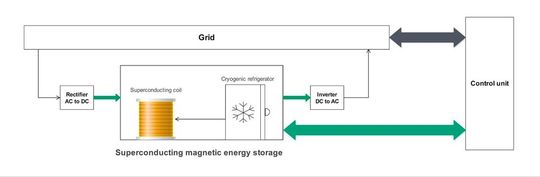
Cryogenic refrigerator: With the help of a cryogenic refrigerator, the coil is cooled to a temperature around 4.5 Kelvin. The low-temperature state is accomplished by choosing liquid helium or liquid nitrogen as the coolant. Coils made from LTS use liquid helium coolant, while HTS coils use liquid helium coolant.
In SMES systems, for example, gaseous helium enters the cold-box, which outputs liquid helium to cool the coil below its critical temperature. The cost of cryogenic refrigeration is still lower than that of superconducting coils.
Working principle: The SMES principle is based on Faraday’s laws of electromagnetic induction. The ability of magnetic fields to store energy is not new. It is a basic principle of inductors. Once current starts flowing in the coil, the magnetic field starts to function like an energy storage tank. The energy can be stored as long as the current stays.
:quality(80):fill(efefef,0)/images.vogel.de/vogelonline/bdb/1783100/1783113/original.jpg "PB_Energy_Storage_Titel_groß")
According to the laws of physics, a moving charge produces a magnetic field. For a straight wire, a concentric magnetic field forms around it. In a coil, each turn of wire produces a magnetic field. All these magnetic fields concentrate to form a strong magnetic field around the center.
SMES enters the persistent mode, which is a strong superconducting mode. The current no longer needs an external power source. As the resistance is zero, the current flows indefinitely without decay in the coil loop. In theory, the perpetual current in superconductors is known as the persistent current, which can continue to flow for 100,000 years!
Discharging: During the discharge cycle, a power inverter stage connects the superconducting coil to the grid or load and applies a negative voltage that causes the current to decrease with the magnetic field. According to Faraday’s laws, the changing magnetic flux induces an EMF that opposes the decreasing current. As the current decreases, the stored magnetic energy flows from the coil to the load.
Power control: The SMES system is connected to a rapid measurement control system that manages dispatch requests from the grid. The control unit functions as a link that maps power flow from the SMES system to real-time demands. Another function of the control unit is to monitor the health of the SMES coil by controlling the cryogenic refrigerator and features self-diagnostic functions for safe use.
:quality(80)/p7i.vogel.de/wcms/3e/99/3e997b758543c9a581667cee711b6938/0129540100v2.jpeg "Power electronics form the technological backbone of battery energy storage systems for renewable energy integration. (Source: © Design Stock - stock.adobe.com)")
BATTREY SYSTEMS
Power electronics in energy storage
Why SMES?
SMES systems enable lossless transmission and storage because the current does not decay in the coil, leading to efficient energy storage. On the other hand, a normal wire resists the current flow, with a constant supply from the source. Energy is delivered to the load, but some of it is dissipated as heat. Simply put, losses occur.
Higher efficiency
The round-trip efficiency of SMES systems is around 95%. The mere 5-6% loss occurs at the power conversion stage, either in inverter or converter units. Other energy storage systems, such as pumped hydropower and lithium-ion batteries, show much lower efficiencies.
Environmentally safe
Even though high-power, SMES systems contain moving parts and environmentally toxic materials. Some real-world implementations have successfully deployed SMES systems underground, with utmost electrical isolation and safety.
High reliability
Superconductors prove to be long-lasting in practical applications. SMES systems last longer than 30 years. However, most applications use SMES systems for short-duration energy storage.
Rapid response
SMES systems exhibit fast response times in milliseconds without material deterioration. There is a negligible time delay in charging and discharging cycles. The charge-discharge cycles can be accelerated as required.
As a result, SMES systems are suitable for fast power delivery and stability control applications. In real-world use cases, SMES systems release megawatts of energy in seconds to combat sudden outages or grid fluctuation.
:quality(80)/p7i.vogel.de/wcms/6e/e5/6ee5ad1dc45fd69a5a5718147605850a/0129347492v2.jpeg "This article introduces the concept of megawatt-hour battery storage systems. (Source: © malp - stock.adobe.com)")
BATTERY STORAGE
MWh battery energy storage: Redefining modern power infrastructure
Some applications include the following:
- Energy storage: SMES systems are used to store megawatts of energy.
- Grid: SMES systems are applicable in modern grids for power control during emergencies. These systems can provide active and reactive power control to stabilize the grid.
- FACTS: Flexible AC transmission systems use SMES systems for grid stability and control. It can also damp low-frequency oscillations.
- Load leveling: Load frequency control during power mismatch.
- Uninterrupted power supply: UPS for backup.
- Circuit breakers reclose for sudden voltage surges.
- SFCL: Superconductive fault current limiters to divert faulty current.
Present scenario
In practical terms, superconductors are expensive to manufacture and deploy. SMES systems incur high upfront and maintenance costs, more than other grid energy storage options. A full-scale setup of cryogenic systems costs thousands, or even millions of dollars. Other barriers to implementation include operational challenges and limited capabilities.
As mentioned above, superconducting coils make up most of the system costs. The higher the amount of energy stored, the larger the size of the superconducting coil. As a result, SMES systems show limited scalability, unlike megawatt-hour battery energy storage systems. While transmission applications have been explored, superconducting-based storage is a field of research.
Although promising, SMES is a relatively new energy storage technique. The industry awaits widespread adoption and commercialization. LTS-based SMES systems are in use. HTS coils are promising but underdeveloped and expensive. Some real projects include Bonneville Power Authority (USA), Northern Wisconsin (USA), and China Pilot systems (Research in China).
References
- https://www.arrow.com/en/research-and-events/articles/superconducting-magentic-energy-storage
- https://www.azom.com/article.aspx?ArticleID=1123
- https://energybases.com/blog/superconducting-magnetic-energy-storage-principles-benefits
(ID:50761672)
:quality(80)/p7i.vogel.de/wcms/0d/d0/0dd02f3d5a1c83c1be444f73910e6b30/0126472071v2.jpeg "Current transducers are essential devices in power electronics, converting high current levels into standardized signals for safe and efficient use across various electronic systems, with applications ranging from motor protection to renewable energy systems and particle accelerators. (Source: © Aimur - stock.adobe.com)")
:quality(80)/p7i.vogel.de/wcms/7a/a5/7aa50649486f059b1d7111f508c5c6e7/0128629162v2.jpeg "This article explains current transducers and their role in power electronics. (Source: © kwanchanachai - stock.adobe.com)")