


:quality(80)/p7i.vogel.de/wcms/2f/f3/2ff3221bf7665de2d0acf83760bfd1fa/0130031523v2.jpeg "Wolfspeed presents a 300 mm silicon carbide technology platform designed to support advanced packaging and high-efficiency power delivery for AI data center infrastructure. (Source: Wolfspeed)")
:quality(80)/p7i.vogel.de/wcms/c3/16/c316e955a97f5d72d9678297b237b9e5/0129932858v2.jpeg "Left: the single-phase version of the SENTRON ECPD with RCM, right: a model of the future three-phase version of the SENTRON ECPD. (Source: Siemens)")
:quality(80)/p7i.vogel.de/wcms/ef/0a/ef0adb0acf793fe147cc27c21f6a7a67/0129954238v2.jpeg "Empower Semiconductor introduces embedded silicon capacitors designed to improve power delivery and stability in AI and high-performance computing processors. (symbolic image) (Source: © IF.arc - stock.adobe.com)")
:quality(80)/p7i.vogel.de/wcms/53/f9/53f9301dfc9292d02960f7996c79cc6e/0129927601v2.jpeg "Wolfspeed’s new 10 kV SiC MOSFET enables high-voltage power conversion for grid and industrial applications. (symbolic image) (Source: © CREATIVE- 3.4 - stock.adobe.com)")
:quality(80)/p7i.vogel.de/wcms/6e/cd/6ecd41d095d5111cf4ed37b714844487/0129930878v2.jpeg "PCIM Asia Shenzhen provides a platform for industry experts to present new developments in power electronics and electrification technologies. (symbolic image) (Source: © killykoon - stock.adobe.com)")
:quality(80)/p7i.vogel.de/wcms/02/c0/02c0e9722f70b1134dbf96fb59a9c73d/0129655179v2.jpeg "The PCIM Conference 2026 will take place from June 9-11, featuring discussions on power electronics trends, including GaN technology and AI applications. (symbolic image) (Source: © Elmira - stock.adobe.com)")
:quality(80)/p7i.vogel.de/wcms/cc/67/cc670ea2029cd2af5c641af70e1bf734/0129816392v4.jpeg "Fraunhofer IAF coordinates the EU SUPREME project to accelerate GaN and SiC power semiconductor innovation in Europe. (Source: Fraunhofer IAF)")
:quality(80)/p7i.vogel.de/wcms/ea/e6/eae6aee30071e67a5627027974437134/0129544613v2.jpeg "GlobalFoundries and Renesas strengthen their collaboration to support U.S.-based semiconductor production and supply chain resilience. (Source: © ronstik - stock.adobe.com)")
:quality(80)/p7i.vogel.de/wcms/23/1a/231a97643aa7fc3adf2704a6273756c3/0130030642v2.jpeg "Gallium nitride (GaN) power devices are increasingly challenging silicon MOSFETs in low-voltage power conversion by enabling higher efficiency and switching performance. (Source: © Sheraz - stock.adobe.com)")
:quality(80)/p7i.vogel.de/wcms/3c/4b/3c4bbc68dda65c7071b4376fb57423b0/0130030465v2.jpeg "Faraday’s laws explain the fundamental behavior of magnetic fields and electronic devices in dynamic use cases. The operation of transformers, wireless chargers, induction cookers, induction motors, magnetic levitating trains (MAGLEV Trains), electric violin, and many others depends upon Faraday’s laws. (Source: © Sheraz - stock.adobe.com)")
:quality(80)/p7i.vogel.de/wcms/b1/5e/b15ee02b0ba02db70cf61e37d66ad1d3/0129349127v2.jpeg "Vehicle-to-grid (V2G) chargers enable bidirectional energy flow, allowing electric vehicles to act as mobile energy storage systems that can both draw power from and feed power back into the grid. (Source: © medienvirus - stock.adobe.com)")
:quality(80)/p7i.vogel.de/wcms/26/d5/26d591cc340077026eac56a0e7564faf/0129949603v2.jpeg "Flexible: The solid silicone-based electrolyte is elastic, thereby compensating for the voids that form in solid-state batteries during charging and discharging. (Source: Empa)")
:quality(80)/p7i.vogel.de/wcms/be/c8/bec8d43fc0ee73414274be44608b2970/0129748903v2.jpeg "The Infiniium XR804KA real-time oscilloscope delivers faster response time, improved stability, and streamlined workflows for high-speed digital and compliance testing. (Source: Keysight)")
:quality(80)/p7i.vogel.de/wcms/23/ee/23ee4a97790d6009dbfd7d9577ffa723/0129220424v2.jpeg "The R&S FPL1044 with the new RTSA option makes 40 MHz real-time frequency analysis available up to 44 GHz. (Source: Rohde & Schwarz )")
:quality(80)/p7i.vogel.de/wcms/3c/d1/3cd1cacbceb792ba63727199c61ca434/0127801860v2.jpeg "Thanks to cloud technology, users can collaborate on projects from anywhere and always have access to the latest planning data. (Source: SIEMENS)")
:quality(80)/p7i.vogel.de/wcms/5a/a0/5aa0436498af618297961fd54ab36cdf/0126290792v2.jpeg "Siemens accelerates student-led semiconductor innovation across Europe’s leading technical universities through Cre8Ventures’ Open Higher Education Program developed in collaboration with Arm and University of Southampton (Source: Siemens Digital Industries Software)")
SENSOR TECHNOLOGY Passive infrared sensor “PIR”
Related Vendors
:fill(fff,0)/p7i.vogel.de/companies/5f/71/5f71d5f92a5f6/2000px-rogers-corporation-logo-svg.png "2000px-Rogers_Corporation_Logo.svg.png (rogers germany)")
:fill(fff,0)/p7i.vogel.de/companies/66/8b/668becd1c07eb/dowa-logo-word--1-.jpeg "dowa-logo-word--1- (DOWA)")
Have you ever wondered what technology could be the reason behind the automatic door opening in recreational areas? The reason is none other than sensing technology. The article explains the PIR sensor in detail with common applications and its use in power electronics.

The usage of motion sensors became popular back in the seventies. Pyroelectricity, the phenomenon of generating an electric signal through the detection of heat is a classic and easy way to detect motion. Based on this principle, a PIR sensor is the most basic sensor that is easier to program and costs less than USD10!
PIR Sensor Definition
Passive Infrared Sensor, commonly called a PIR Sensor, is an electronic device that detects objects in its field by sensing the infrared radiation emitted or reflected by those objects.
How does a PIR sensor work?
All living beings including humans and animals generate heat through internal biological mechanisms. Non-living things (objects) also generate heat by the action of atoms and molecules. In fact, each living being or object with a temperature above absolute zero emits heat in infrared wavelengths, which is not visible to human eyes. An approaching human or object in the PIR sensor’s field view changes the amount of already-present infrared radiation through their own temperature or surface characteristics.
Once the PIR sensor detects an alteration of infrared radiation in its field view, the internal circuitry triggers a change in the sensor’s output voltage. The PIR sensor can notify the user or perform a pre-coded task depending on the application. The word “passive” in a PIR sensor is used because this sensor does not produce any radiation of its own rather it detects changes in the amount of radiation present in its field view.
Working principle of PIR sensors
As mentioned above, PIR sensors are based on the principle of pyroelectricity. A PIR sensor often contains two layers of pyroelectric materials such as lithium tantalate. In contrast, a pyroelectric material is responsible for electrical charging through the application of heat. In simple words, pyroelectric materials convert heat radiation into electrical signals in the PIR circuitry. Sometimes PIR sensors are also called pyroelectric sensors.
PIR sensor construction
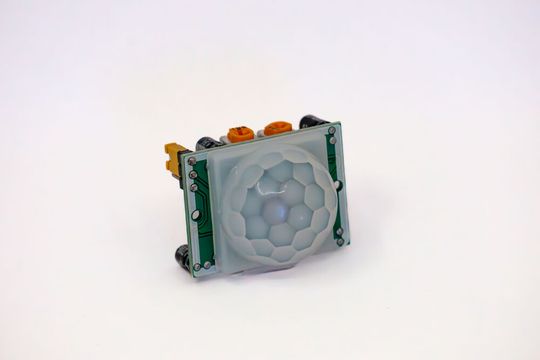
Most PIR sensors are PCB-mounted electronic devices. PIR sensor construction is explained through pins, internal IC, components, and lens.
PIR sensor pins
PIR sensors have three basic pins.
- VCC: The PIR sensor can start operation upon application of supply voltage. A basic PIR sensor allows 3.3 to 5 Volts of DC power supply voltage.
- GND: The GND pin is the ground pin of the PIR sensor.
- OUT: The digital output pin is there to indicate motion detection. It is often connected to the microcontroller. When the PIR sensor detects a person or an object, the output pin goes high (1). Else the output pin stays low (0) for no motion detection.
PIR sensor lens
A PIR sensor can have fresnel lens arrays, mirror segments, or reversible orientation mirrors based on coverage area and application. The reason for using a lens in a PIR sensor is to focus or direct infrared rays onto sensing elements. The intensity of incoming infrared radiation is low as a function of distance. The presence of a lens ensures proper detection of the person or the object. The output from the lens is somehow an input to the main IC used in the PIR sensor for processing. No matter whichever lens type may be used, the PIR sensor lens is always protected under a shield for reliable operation.
Differential amplifier
There are internal amplifiers present in PIR sensor circuits, connected to the IC for motion detection. A differential amplifier disables false triggering due to a change in ambient temperature as it measures the difference between the signals from the paired sensor elements. One input of the differential amplifier measures a change in ambient temperature while the other doesn't. Both inputs, in equal magnitude, cancel each other. Such differential amplifiers have a high CMRR (Common Mode Rejection Ratio).
:quality(80):fill(efefef,0)/p7i.vogel.de/wcms/62/b9/62b963b88d5f2/pcim-europe-2022-keynote-power-electronics-for-a-future-sustainable-society-omura.jpeg "PCIM Europe 2022 Keynote_Power electronics for a future sustainable society_Omura (Adobe Stock)")
KEYNOTE PCIM EUROPE 2022
Power electronics for a future sustainable society
PIR sensor IC
PIR sensor uses IC BISS0001. The BISS0001 chip is a mixed signal IC manufactured using the CMOS process. Simply put, BISS0001 is a motion detector chip. The sensing elements and internal amplifier of the PIR sensor are input to BISS0001 for processing. BISS0001 is responsible for generating high and low outputs at the digital output pin of the sensor. The “TIME” pin on the IC BISS0001 is connected to a capacitor. It can be programmed to control the time for which output stays high after motion detection.
PIR sensor applications
PIR sensors have become ubiquitous in modern life, quietly working behind the scenes to automate our world. From the simple convenience of automatic doors to sophisticated energy-saving systems, these sensors are making a big impact.
Motion detection
The main purpose of PIR sensors is to detect motion. In commercial areas like shopping malls, PIR sensors are implemented in automatic door systems. Moreover, PIR sensors are used in washrooms for automatic water supply.
Home automation
PIR sensors are effectively used in IoT and home automation systems. They are often mounted on ceilings. In such cases, PIR sensors are used for temperature monitoring, light control, and gesture recognition.
Energy saving
In hotels, conference rooms, restaurants, and commercial areas, PIR sensors can detect room occupancy to control temperature, lighting, and other smart features. Implementing PIR sensors is a cheap option to avoid unnecessary power wastage.
Fault detection
In the case of power electronics, heat dissipation is a common problem. Advanced PIR sensors can detect excessively overheated components to avoid any failure of the system, power outages, or accidents.
:quality(80)/p7i.vogel.de/wcms/dc/5f/dc5f612bfe010487a3efb1efb731fff9/0113213124.jpeg "This image shows a motion sensor but there are many more types of sensors which are explained in this article. (Source: Pixel-Shot - stock.adobe.com)")
BASIC KNOWLEDGE – SENSORS
The relative merits of standard sensors and smart sensors
Burglar alarms
PIR sensor-based alarms help notify users about intruders in homes and commercial areas. Burglar alarms are used to detect unauthorized access into restricted areas. In these alarms, PIR sensors are connected to relays and buzzers.
Features of PIR sensors
Despite their compact size, PIR sensors pack a punch when it comes to their capabilities. With wide coverage angles and impressive detection ranges, these sensors are reliable and efficient. Plus, their low power consumption makes them ideal for a variety of applications.
- A PIR sensor detects objects in its area without intentional input of the detectable entity.
- Most PIR sensors have a broad coverage of about 110 degrees wide.
- Advanced PIR sensors have a coverage field of about 180 degrees or even 360 degrees.
- PIR sensors, typically, have a range of about 10 meters.
- Advanced PIR sensors have an extended range of about 150 meters.
- After successful detection, PIR sensors have a short settling time of about 10 to 60 seconds.
- PIR sensors connected to alarms or piezoelectric buzzers can notify the user quickly.
- PIR sensors are small, cost-effective, low power, easy to use, and reliable for multiple uses.
Limitations of PIR sensors
While PIR sensors excel in many areas, they do have their drawbacks. False alarms and limited detection specificity can sometimes be an issue. However, ongoing technological advancements are addressing these challenges, making PIR sensors an increasingly valuable tool in many industries.
Unspecified detection
PIR sensors are not smart enough to specify who or what was detected. However, they can be used along with other intelligent machinery for such purposes.
Short range
PIR sensors are not applicable over long distances and wider angles. This is because lenses used in PIR sensors are not reliable enough even in the protection of the white-colored shield.
Prone to failure
PIR sensors are unreliable for high-current applications as they are prone to failure in high temperatures. Moreover, most PIR sensors are not waterproof.
False triggering
PIR sensors can sometimes trigger false detection signals due to rapid changes in ambient temperature. These temperature changes can occur either in the form of natural air from doors/windows or air from air conditioners/heaters. It is important to note that PIR sensors must not be kept in HVAC areas (Heating Ventilation Air Conditioning).
Power Electronics in the Energy Transition

The parameters for energy transition and climate protection solutions span education, research, industry, and society. In the new episode of "Sound On. Power On.", Frank Osterwald of the Society for Energy and Climate Protection Schleswig‐Holstein talks about the holistic guidance his organization can provide.
Listen now!
(ID:50106860)
:quality(80)/p7i.vogel.de/wcms/0d/d0/0dd02f3d5a1c83c1be444f73910e6b30/0126472071v2.jpeg "Current transducers are essential devices in power electronics, converting high current levels into standardized signals for safe and efficient use across various electronic systems, with applications ranging from motor protection to renewable energy systems and particle accelerators. (Source: © Aimur - stock.adobe.com)")
:quality(80)/p7i.vogel.de/wcms/7a/a5/7aa50649486f059b1d7111f508c5c6e7/0128629162v2.jpeg "This article explains current transducers and their role in power electronics. (Source: © kwanchanachai - stock.adobe.com)")