


:quality(80)/p7i.vogel.de/wcms/2f/f3/2ff3221bf7665de2d0acf83760bfd1fa/0130031523v2.jpeg "Wolfspeed presents a 300 mm silicon carbide technology platform designed to support advanced packaging and high-efficiency power delivery for AI data center infrastructure. (Source: Wolfspeed)")
:quality(80)/p7i.vogel.de/wcms/c3/16/c316e955a97f5d72d9678297b237b9e5/0129932858v2.jpeg "Left: the single-phase version of the SENTRON ECPD with RCM, right: a model of the future three-phase version of the SENTRON ECPD. (Source: Siemens)")
:quality(80)/p7i.vogel.de/wcms/ef/0a/ef0adb0acf793fe147cc27c21f6a7a67/0129954238v2.jpeg "Empower Semiconductor introduces embedded silicon capacitors designed to improve power delivery and stability in AI and high-performance computing processors. (symbolic image) (Source: © IF.arc - stock.adobe.com)")
:quality(80)/p7i.vogel.de/wcms/53/f9/53f9301dfc9292d02960f7996c79cc6e/0129927601v2.jpeg "Wolfspeed’s new 10 kV SiC MOSFET enables high-voltage power conversion for grid and industrial applications. (symbolic image) (Source: © CREATIVE- 3.4 - stock.adobe.com)")
:quality(80)/p7i.vogel.de/wcms/6e/cd/6ecd41d095d5111cf4ed37b714844487/0129930878v2.jpeg "PCIM Asia Shenzhen provides a platform for industry experts to present new developments in power electronics and electrification technologies. (symbolic image) (Source: © killykoon - stock.adobe.com)")
:quality(80)/p7i.vogel.de/wcms/02/c0/02c0e9722f70b1134dbf96fb59a9c73d/0129655179v2.jpeg "The PCIM Conference 2026 will take place from June 9-11, featuring discussions on power electronics trends, including GaN technology and AI applications. (symbolic image) (Source: © Elmira - stock.adobe.com)")
:quality(80)/p7i.vogel.de/wcms/cc/67/cc670ea2029cd2af5c641af70e1bf734/0129816392v4.jpeg "Fraunhofer IAF coordinates the EU SUPREME project to accelerate GaN and SiC power semiconductor innovation in Europe. (Source: Fraunhofer IAF)")
:quality(80)/p7i.vogel.de/wcms/ea/e6/eae6aee30071e67a5627027974437134/0129544613v2.jpeg "GlobalFoundries and Renesas strengthen their collaboration to support U.S.-based semiconductor production and supply chain resilience. (Source: © ronstik - stock.adobe.com)")
:quality(80)/p7i.vogel.de/wcms/b1/5e/b15ee02b0ba02db70cf61e37d66ad1d3/0129349127v2.jpeg "Vehicle-to-grid (V2G) chargers enable bidirectional energy flow, allowing electric vehicles to act as mobile energy storage systems that can both draw power from and feed power back into the grid. (Source: © medienvirus - stock.adobe.com)")
:quality(80)/p7i.vogel.de/wcms/26/d5/26d591cc340077026eac56a0e7564faf/0129949603v2.jpeg "Flexible: The solid silicone-based electrolyte is elastic, thereby compensating for the voids that form in solid-state batteries during charging and discharging. (Source: Empa)")
:quality(80)/p7i.vogel.de/wcms/4d/e0/4de02f76a37cbb3df30dd231de589c8e/0128866890v2.jpeg "Both legacy and vGaN show higher carrier mobility and band gap energies compared to other power semiconductors. (Source: © phonlamaiphoto - stock.adobe.com)")
:quality(80)/p7i.vogel.de/wcms/18/0b/180b7b63afc91e523592d8a5ce161c96/0129847487v2.jpeg "InGaAs-based photodetectors enable sensitive and fast detection in the short-wave infrared spectrum for modern sensing and communication applications. (Source: © VITALII - stock.adobe.com)")
:quality(80)/p7i.vogel.de/wcms/be/c8/bec8d43fc0ee73414274be44608b2970/0129748903v2.jpeg "The Infiniium XR804KA real-time oscilloscope delivers faster response time, improved stability, and streamlined workflows for high-speed digital and compliance testing. (Source: Keysight)")
:quality(80)/p7i.vogel.de/wcms/23/ee/23ee4a97790d6009dbfd7d9577ffa723/0129220424v2.jpeg "The R&S FPL1044 with the new RTSA option makes 40 MHz real-time frequency analysis available up to 44 GHz. (Source: Rohde & Schwarz )")
:quality(80)/p7i.vogel.de/wcms/3c/d1/3cd1cacbceb792ba63727199c61ca434/0127801860v2.jpeg "Thanks to cloud technology, users can collaborate on projects from anywhere and always have access to the latest planning data. (Source: SIEMENS)")
:quality(80)/p7i.vogel.de/wcms/5a/a0/5aa0436498af618297961fd54ab36cdf/0126290792v2.jpeg "Siemens accelerates student-led semiconductor innovation across Europe’s leading technical universities through Cre8Ventures’ Open Higher Education Program developed in collaboration with Arm and University of Southampton (Source: Siemens Digital Industries Software)")
ADVERTORIAL: ELECTRIC VEHICLE BATTERY PROTECTION Next-gen temperature monitoring solution prevents EV battery thermal runaway
Sponsored by
:fill(fff,0)/p7i.vogel.de/companies/60/4a/604a54b5ea863/lf-logo.png "LF_logo.png (LITTELFUSE Europe GMBH)")
Protect EV batteries from dangerous thermal runaway with the TTape™ temperature monitoring solution. Detect overheating before it becomes critical, enhancing safety and extending battery life. Discover how this technology innovation can safeguard your EV design.
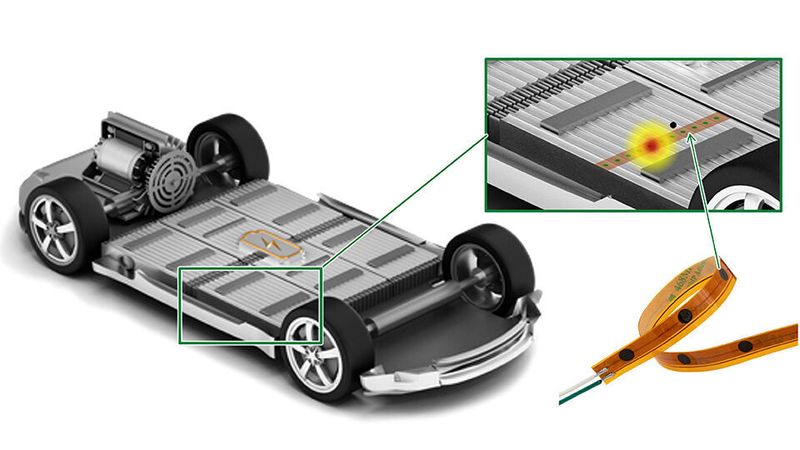
Lithium batteries have the highest power density among battery chemistries, storing more energy in a smaller, lightweight package. This advantage makes them the preferred choice for electric vehicles (EVs). However, they have drawbacks, including the risk of thermal runaway when damaged, overcharged, or exposed to high temperatures. Thermal runaway can generate enough heat to ignite the electrolyte, causing a fire or explosion, which can damage the EV and endanger passengers.
A new technology, the TTape™ Distributed Temperature Monitoring Device, addresses this risk by enabling early detection of localized battery cell overheating. TTape is a strip of tape employing temperature indicators that adhere to battery cells, allowing for high-density monitoring. This innovation prevents thermal runaway by quickly detecting hotspots. Unlike discrete thermistors with limited detection points, TTape ensures comprehensive monitoring across the battery pack.
Watch this video to learn more about Littelfuse TTape™ Distributed Temperature Monitoring Platform:i
TTape description
TTape is a flexible, thin band of printed temperature indicators (PTIs) closely spaced for precise temperature monitoring. With a thickness of less than 500µm, it conforms to any battery pack shape (Figure 1).
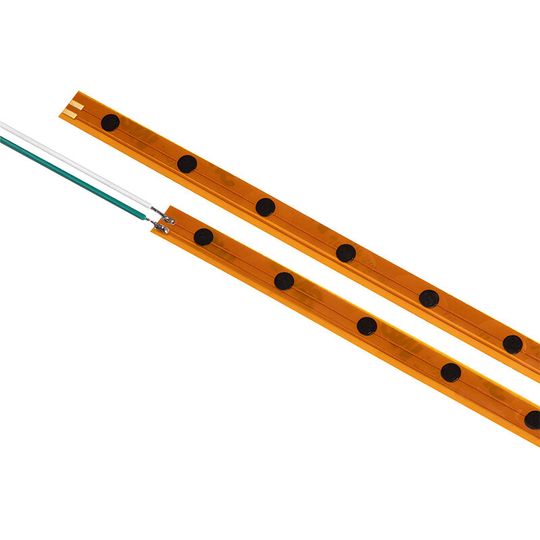
The printed thermal indicators (PTIs) are small dots of polymer positive temperature coefficient material connected in series. When a PTI detects a temperature above the threshold, its resistance increases over 1000 times. TTape comes in 8mm or 10mm widths and standard length of 337mm, with custom designs up to one meter, with sensors about 10mm apart. Pressure-sensitive adhesives allow bonding to metal, polyamide, PET, and polyimide surfaces.
A standard 337mm-length tape includes ten PTIs, with custom designs accommodating up to 50. The PTIs have a maximum diameter of 5mm with 30mm standard spacing, enabling high spatial resolution for monitoring battery packs. Unlike discrete sensors, TTape’s sub-500µm thickness allows it to conform to irregular surfaces, ensuring direct contact with individual cells. TTape connects to an electronic circuit via a 2-wire solder pad interface.
TTape has a 58 ± 3°C trip temperature setpoint, enabling early overheating detection before a battery cell reaches dangerous levels. Lithium-ion batteries can charge / discharge below 60°C before battery management systems intervene. The 58°C setpoint accommodates temperature fluctuations during load or recharging. The PTIs respond in under one second; if the temperature exceeds 58°C for more than one second, TTape will activate.
TTape’s PTI material has hysteresis to prevent rapid cycling near the threshold, thus reducing wear on critical components and avoiding false alarms. This design ensures the system activates only during genuine overtemperature conditions, enhancing battery pack safety and durability.
Circuit implementation
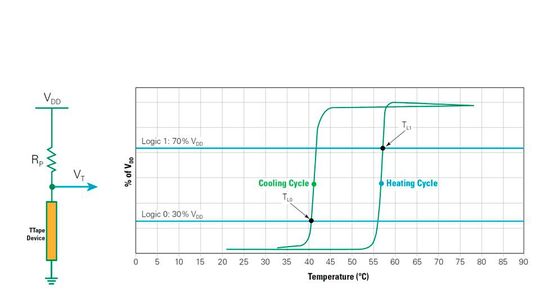
TTape operates with TTL-level, 5V, or 3.3V logic circuits. Figure 2 shows a recommended configuration. VT is logic high when TTape detects a temperature above 58°C, switching to high resistance. It returns to logic low when the temperature drops below 58°C or falls under 42°C after exceeding the threshold. The TTape has a 16°C hysteresis effect, as shown on the right side of Figure 2.
The logic circuit uses a recommended 200KΩ RP value. VT can signal an A/D converter in a microcontroller. When no hotspot is detected, the 5V circuit draws about 25µA, consuming only 125µW. TTape requires just one A/D input on the microcontroller to transmit the battery cell temperature. The microcontroller can either be part of or interface with the battery management system.
Comparison with discrete thermistors
With 30mm spacing between sensors and a flexible tape form factor, TTape can detect temperature rises faster than discrete sensors, unless the rise occurs directly under the discrete sensor. A thermistor one cell away from an overheating cell may take over two minutes to respond, while TTape’s PTIs respond in under one second.
Unlike NTC sensors, TTape sensors operate as a two-state device and require no calibration. The electronics processing TTape sensors also do not need a temperature conversion calibration table.
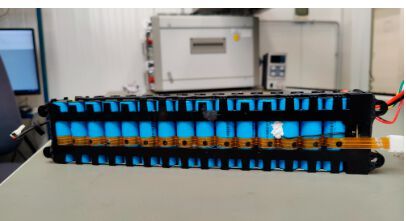
TTape consumes negligible space on the battery pack and enables easy installation. It allows monitoring of any battery pack construction. Figure 3 shows an example TTape monitoring strip installation on a battery pack.
High-density monitoring for enhanced safety
TTape enables high-density temperature monitoring for each group of EV battery cells. It helps detect and prevent hotspots, reduce premature aging, enhance safety, and extend battery life. This low-cost, space-efficient solution is AEC-Q200 qualified for automotive use.
Refer to the Lithium Batteries: Enhancing Protection and Control Presentation and TTape™ Distributed Temperature Monitoring Device Application Note for installation details and circuit implementation.
For technical assistance, visit the TTape product page at www.littelfuse.com.
(ID:50137929)
:quality(80)/p7i.vogel.de/wcms/f0/0e/f00ecb52bd58b1f1f0edcf279ff6dbe7/0123484724v2.jpeg "The critical importance of dependable power backup systems is unmistakable in our modern era, which is distinguished by technical sophistication. (Source: Hikmet - stock.adobe.com)")
:quality(80)/p7i.vogel.de/wcms/7a/a5/7aa50649486f059b1d7111f508c5c6e7/0128629162v2.jpeg "This article explains current transducers and their role in power electronics. (Source: © kwanchanachai - stock.adobe.com)")