


:quality(80)/p7i.vogel.de/wcms/2f/f3/2ff3221bf7665de2d0acf83760bfd1fa/0130031523v2.jpeg "Wolfspeed presents a 300 mm silicon carbide technology platform designed to support advanced packaging and high-efficiency power delivery for AI data center infrastructure. (Source: Wolfspeed)")
:quality(80)/p7i.vogel.de/wcms/c3/16/c316e955a97f5d72d9678297b237b9e5/0129932858v2.jpeg "Left: the single-phase version of the SENTRON ECPD with RCM, right: a model of the future three-phase version of the SENTRON ECPD. (Source: Siemens)")
:quality(80)/p7i.vogel.de/wcms/ef/0a/ef0adb0acf793fe147cc27c21f6a7a67/0129954238v2.jpeg "Empower Semiconductor introduces embedded silicon capacitors designed to improve power delivery and stability in AI and high-performance computing processors. (symbolic image) (Source: © IF.arc - stock.adobe.com)")
:quality(80)/p7i.vogel.de/wcms/53/f9/53f9301dfc9292d02960f7996c79cc6e/0129927601v2.jpeg "Wolfspeed’s new 10 kV SiC MOSFET enables high-voltage power conversion for grid and industrial applications. (symbolic image) (Source: © CREATIVE- 3.4 - stock.adobe.com)")
:quality(80)/p7i.vogel.de/wcms/6e/cd/6ecd41d095d5111cf4ed37b714844487/0129930878v2.jpeg "PCIM Asia Shenzhen provides a platform for industry experts to present new developments in power electronics and electrification technologies. (symbolic image) (Source: © killykoon - stock.adobe.com)")
:quality(80)/p7i.vogel.de/wcms/02/c0/02c0e9722f70b1134dbf96fb59a9c73d/0129655179v2.jpeg "The PCIM Conference 2026 will take place from June 9-11, featuring discussions on power electronics trends, including GaN technology and AI applications. (symbolic image) (Source: © Elmira - stock.adobe.com)")
:quality(80)/p7i.vogel.de/wcms/cc/67/cc670ea2029cd2af5c641af70e1bf734/0129816392v4.jpeg "Fraunhofer IAF coordinates the EU SUPREME project to accelerate GaN and SiC power semiconductor innovation in Europe. (Source: Fraunhofer IAF)")
:quality(80)/p7i.vogel.de/wcms/ea/e6/eae6aee30071e67a5627027974437134/0129544613v2.jpeg "GlobalFoundries and Renesas strengthen their collaboration to support U.S.-based semiconductor production and supply chain resilience. (Source: © ronstik - stock.adobe.com)")
:quality(80)/p7i.vogel.de/wcms/3c/4b/3c4bbc68dda65c7071b4376fb57423b0/0130030465v2.jpeg "Faraday’s laws explain the fundamental behavior of magnetic fields and electronic devices in dynamic use cases. The operation of transformers, wireless chargers, induction cookers, induction motors, magnetic levitating trains (MAGLEV Trains), electric violin, and many others depends upon Faraday’s laws. (Source: © Sheraz - stock.adobe.com)")
:quality(80)/p7i.vogel.de/wcms/b1/5e/b15ee02b0ba02db70cf61e37d66ad1d3/0129349127v2.jpeg "Vehicle-to-grid (V2G) chargers enable bidirectional energy flow, allowing electric vehicles to act as mobile energy storage systems that can both draw power from and feed power back into the grid. (Source: © medienvirus - stock.adobe.com)")
:quality(80)/p7i.vogel.de/wcms/26/d5/26d591cc340077026eac56a0e7564faf/0129949603v2.jpeg "Flexible: The solid silicone-based electrolyte is elastic, thereby compensating for the voids that form in solid-state batteries during charging and discharging. (Source: Empa)")
:quality(80)/p7i.vogel.de/wcms/4d/e0/4de02f76a37cbb3df30dd231de589c8e/0128866890v2.jpeg "Both legacy and vGaN show higher carrier mobility and band gap energies compared to other power semiconductors. (Source: © phonlamaiphoto - stock.adobe.com)")
:quality(80)/p7i.vogel.de/wcms/be/c8/bec8d43fc0ee73414274be44608b2970/0129748903v2.jpeg "The Infiniium XR804KA real-time oscilloscope delivers faster response time, improved stability, and streamlined workflows for high-speed digital and compliance testing. (Source: Keysight)")
:quality(80)/p7i.vogel.de/wcms/23/ee/23ee4a97790d6009dbfd7d9577ffa723/0129220424v2.jpeg "The R&S FPL1044 with the new RTSA option makes 40 MHz real-time frequency analysis available up to 44 GHz. (Source: Rohde & Schwarz )")
:quality(80)/p7i.vogel.de/wcms/3c/d1/3cd1cacbceb792ba63727199c61ca434/0127801860v2.jpeg "Thanks to cloud technology, users can collaborate on projects from anywhere and always have access to the latest planning data. (Source: SIEMENS)")
:quality(80)/p7i.vogel.de/wcms/5a/a0/5aa0436498af618297961fd54ab36cdf/0126290792v2.jpeg "Siemens accelerates student-led semiconductor innovation across Europe’s leading technical universities through Cre8Ventures’ Open Higher Education Program developed in collaboration with Arm and University of Southampton (Source: Siemens Digital Industries Software)")
BASIC KNOWLEDGE The MOSFET Amplifier explained
Related Vendors
:fill(fff,0)/p7i.vogel.de/companies/63/c7/63c7da97be945/diotec.png "diotec (Diotec Semiconductor AG)")
:fill(fff,0)/p7i.vogel.de/companies/5f/71/5f71d5f92a5f6/2000px-rogers-corporation-logo-svg.png "2000px-Rogers_Corporation_Logo.svg.png (rogers germany)")
:fill(fff,0)/p7i.vogel.de/companies/68/2c/682c3e2e9a195/logotype-rvb.jpeg "logotype-rvb (https://www.mersen.com/en)")
All transistors can become amplifiers but all amplifiers are not transistors. MOSFET amplifiers are types of FET small signal linear amplifiers. The article explains MOSFET amplifier types with their circuit diagram and AC equivalent representation. It explains the MOSFET amplifier operating through the common source configuration.
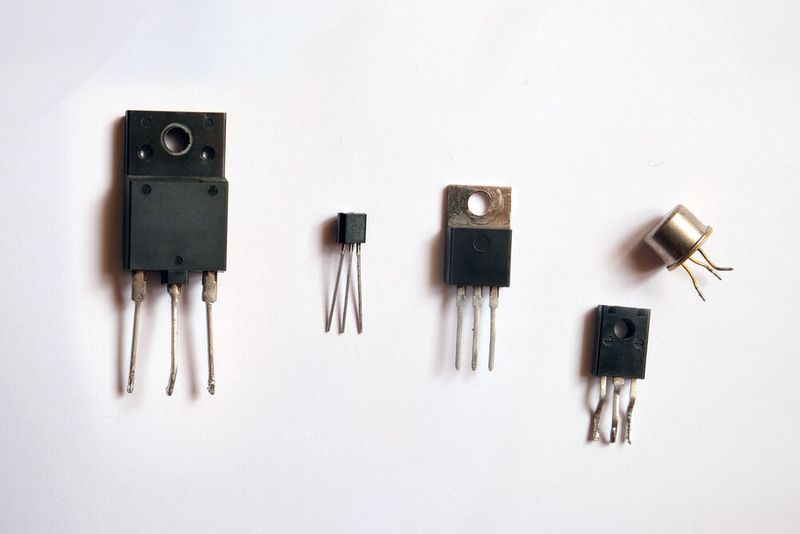
The three main functions of transistors are switching, amplification, and memory/logic operations in semiconductor chips. All amplifiers perform the amplification function in electronic systems. Amplifiers can use transistors, transformers, vacuum tubes, and many other components to amplify signals. These components are known as active components. Transistor amplifiers use transistors like BJTs, JFETs, and MOSFETs as active components to perform amplification.
What is a MOSFET amplifier?
A Metal Oxide Semiconductor Field Effect Transistor or simply MOSFET amplifier is a type of transistor amplifier that uses a MOSFET transistor to amplify signals. It is a voltage-controlled device. Input voltage modulates the current flow through the device. It results in the output voltage change across the output resistance.
MOSFET amplifier types
There are three main types of MOSFET amplifier types:
- Common source (CS)
- Common drain (CD)
- Common gate (CG)
In such topologies, one of the terminals is common while others function to be input and output. MOSFET amplifiers can use n-channel or p-channel. Similarly, MOSFET amplifiers can be of two types, based on construction/mode of operation: depletion mode and enhancement mode.
Working principle of MOSFET amplifiers: Common Source
AC models describe amplifier operation for small signal analysis. The working principle of MOSFET amplifiers is explained through common source configuration.
The direction of the input and output signal shows that the gate is the input terminal and the drain is the output terminal. A CS MOSFET amplifier operates when the gate-to-source voltage exceeds the threshold voltage. The MOSFET operates in the saturation region to amplify the input signal.
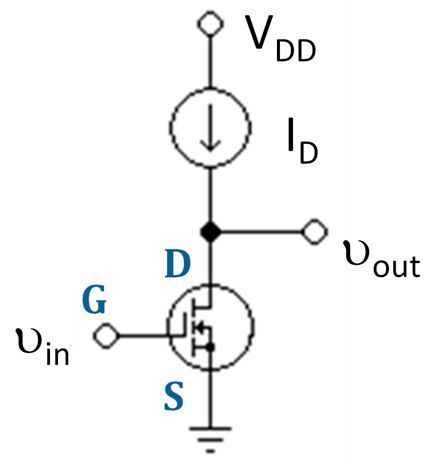
The input signal gets superimposed on gate-to-source voltage above the threshold voltage. As a result, we get amplified but inverted output signals during positive and negative half cycles. There is a 180-degree phase shift between input and output signals. Hence, the CS MOSFET amplifier is an inverting amplifier.
Coupling capacitors are used at the output to reduce the DC component to zero. The small signal AC equivalent circuit of the CS MOSFET amplifier is shown below. The gate terminal isolates due to the presence of the silicon dioxide layer.
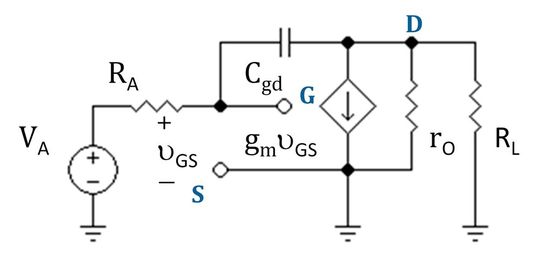
The CS MOSFET amplifier exhibits a high input resistance. The reactance of gate-to-source capacitance is large. Due to gate-to-source voltage being above the threshold voltage, Sometimes source resistance is used to stabilize saturation operation. MOSFET operates as a controlled current source.
Miller’s effect
CS MOSFET amplifiers have a limited high-frequency response. Input capacitance of the transistor increases due to feedback capacitance between input and output terminals. The amplifier gain multiplies The magnitude of parasitic capacitance (gate-to-drain capacitance). It gives rise to an undesirable phenomenon called “the Miller effect”.
For any inverting amplifier, Miller’s effect (increased input capacitance) reduces bandwidth, impedance, slew rate, and overall performance. MOSFET amplifiers combat Miller’s effect in cascode configuration. Compensator networks help to mitigate the increased capacitance for single CS MOSFET amplifier use.
:quality(80):fill(efefef,0)/p7i.vogel.de/wcms/5f/fe/5ffedb2e0ffa6/listing.jpg "listing")
Common Drain
In a CD MOSFET amplifier, the signal is input to the gate terminal, and output is taken out from the source terminal. The drain terminal stays grounded while all voltages are measured across it. The common drain configuration is the same for JFET and MOSFET transistors.
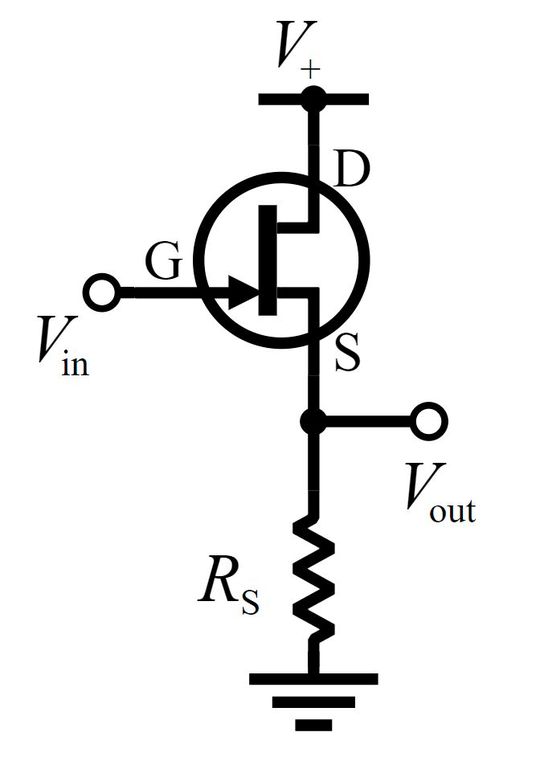
The CD MOSFET amplifier is a non-inverting amplifier, commonly called a source follower, voltage follower, stabilizer, or drain circuit. There is no feedback capacitance between input and output due to grounding an entire side. As a result, Miller’s effect is absent.
Common Gate
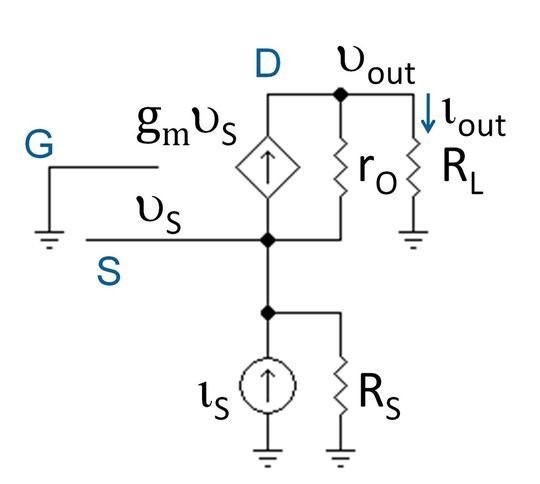
In a CG MOSFET amplifier, the input is the source terminal, and the output is the drain terminal. The gate terminal is common or grounded. A large capacitor connects the gate to the ground for an AC signal. It can also be connected to some DC biasing voltage.
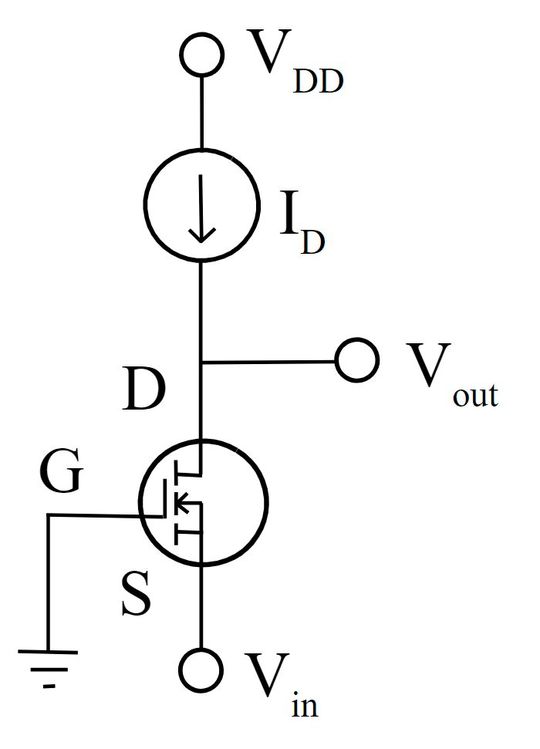
Most of the time, the input given to the CG MOSFET amplifier is a current signal. The AC equivalent circuit shows the current source as the input. As a result, CG MOSFET amplifiers are used as current buffers and in cascode amplifiers and CMOS RF receivers.
Comparing MOSFET amplifier types
The table compares CS, CD, and CG MOSFET amplifiers based on operation, voltage gain, impedances, and Miller’s effect.
The minus sign for the CS MOSFET amplifier showcases its inverting nature. However, it doesn’t imply that it offers the lowest gain. CD MOSFET amplifiers offer the lowest gain among all.
Advantages of MOSFET amplifiers
- Voltage-controlled behavior.
- High input impedance.
- Fast switching speed.
- Low power consumption.
- Small size.
- Thermal stability compared to BJT amplifiers.
Disadvantages of MOSFET amplifiers
- Unsuitable for high-power applications.
- High noise.
- Poor high-frequency operation.
- Presence of leakage currents.
:quality(80)/p7i.vogel.de/wcms/f5/e5/f5e5d9e1e9f0511b1cb1403ba940bccc/87420887.jpeg "While both the MOSFET and BJT are transistors, they work differently and exhibit different behaviours. (Source: Yuriy Zahachevskyy)")
BASIC KNOWLEDGE - MOSFET VS. BJT
What’s the difference between MOSFET and BJT?
Cascode amplifier
A cascode amplifier is a type of two-stage amplifier consisting of a common source amplifier stage followed by a common gate stage. The common source stage “feeds” the common gate stage. A cascode amplifier can also function using BJT amplifiers- common emitter and common base configurations.
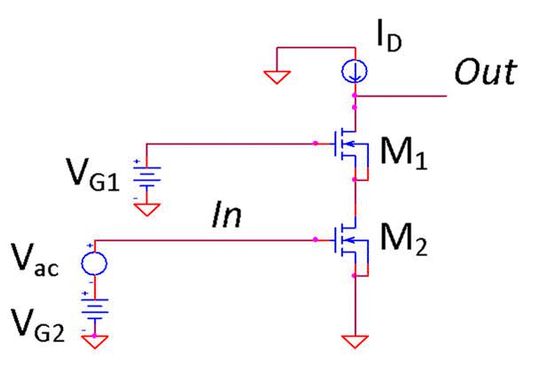
MOSFET Cascode amplifiers improve device performance, bandwidth, gain, slew rate, input and output impedance, stable operation, and isolation capabilities. However, cascode amplifiers need high supply voltage due to the presence of two transistor amplifiers.
Applications of MOSFET amplifiers
N-channel MOSFET amplifiers are more common than P-channel MOSFET amplifiers. This section discusses applications of all types of MOSFET amplifiers.
CS MOSFET amplifiers
CS MOSFET amplifiers are used as voltage amplifiers in electrical and electronics applications like amplification of sensor signals, communication systems, and op-amps.
CD MOSFET amplifiers
CD MOSFET amplifiers are used as a voltage buffer— a voltage amplifier that provides a unity gain. Other applications include low-resistance load, speakers, and signal isolation circuits.
CG MOSFET amplifiers
CG MOSFET amplifiers are less common in use compared to common source and common drain MOSFET amplifiers. However, they are used as current buffers and in cascode configurations for CMOS receivers.
Cascode MOSFET amplifiers
Cascode MOSFET amplifiers are used in voltage regulators, high-voltage transistors, mixer circuits, superheterodyne receivers, tuners, amplitude modulators, ICs, and various applications.
References
Boylestad, R., & Nashelesky, L. (2012). Electronic Devices and Circuits Theory (11th ed.). Pearson Education.
Power Electronics in the Energy Transition

The parameters for energy transition and climate protection solutions span education, research, industry, and society. In the new episode of "Sound On. Power On.", Frank Osterwald of the Society for Energy and Climate Protection Schleswig‐Holstein talks about the holistic guidance his organization can provide.
Listen now!
(ID:50268895)
:quality(80)/p7i.vogel.de/wcms/ce/75/ce7577df9910b5affc25edd24cb853e5/0126456656v2.jpeg "Designing and calculating a basic enhancement-mode MOSFET amplifier requires a clear understanding of the device's operating region, biasing requirements, and key electrical parameters. This article provides a step-by-step guide. (Source: © Dzmitry - stock.adobe.com)")
:quality(80)/p7i.vogel.de/wcms/b9/18/b918d8d0e447a18f7b9e983c25b96330/0125855402v2.jpeg "LDMOS amplifiers have proved their reliability and safety. They are known to perform well, even in impedance mismatches. GaN devices have now become the backbone of the power and radio frequency industries. The article explains LDMOS technologies and compares them with GaN-based devices. (Source: © Johannes - stock.adobe.com)")