


:quality(80)/p7i.vogel.de/wcms/2f/f3/2ff3221bf7665de2d0acf83760bfd1fa/0130031523v2.jpeg "Wolfspeed presents a 300 mm silicon carbide technology platform designed to support advanced packaging and high-efficiency power delivery for AI data center infrastructure. (Source: Wolfspeed)")
:quality(80)/p7i.vogel.de/wcms/c3/16/c316e955a97f5d72d9678297b237b9e5/0129932858v2.jpeg "Left: the single-phase version of the SENTRON ECPD with RCM, right: a model of the future three-phase version of the SENTRON ECPD. (Source: Siemens)")
:quality(80)/p7i.vogel.de/wcms/ef/0a/ef0adb0acf793fe147cc27c21f6a7a67/0129954238v2.jpeg "Empower Semiconductor introduces embedded silicon capacitors designed to improve power delivery and stability in AI and high-performance computing processors. (symbolic image) (Source: © IF.arc - stock.adobe.com)")
:quality(80)/p7i.vogel.de/wcms/53/f9/53f9301dfc9292d02960f7996c79cc6e/0129927601v2.jpeg "Wolfspeed’s new 10 kV SiC MOSFET enables high-voltage power conversion for grid and industrial applications. (symbolic image) (Source: © CREATIVE- 3.4 - stock.adobe.com)")
:quality(80)/p7i.vogel.de/wcms/6e/cd/6ecd41d095d5111cf4ed37b714844487/0129930878v2.jpeg "PCIM Asia Shenzhen provides a platform for industry experts to present new developments in power electronics and electrification technologies. (symbolic image) (Source: © killykoon - stock.adobe.com)")
:quality(80)/p7i.vogel.de/wcms/02/c0/02c0e9722f70b1134dbf96fb59a9c73d/0129655179v2.jpeg "The PCIM Conference 2026 will take place from June 9-11, featuring discussions on power electronics trends, including GaN technology and AI applications. (symbolic image) (Source: © Elmira - stock.adobe.com)")
:quality(80)/p7i.vogel.de/wcms/cc/67/cc670ea2029cd2af5c641af70e1bf734/0129816392v4.jpeg "Fraunhofer IAF coordinates the EU SUPREME project to accelerate GaN and SiC power semiconductor innovation in Europe. (Source: Fraunhofer IAF)")
:quality(80)/p7i.vogel.de/wcms/ea/e6/eae6aee30071e67a5627027974437134/0129544613v2.jpeg "GlobalFoundries and Renesas strengthen their collaboration to support U.S.-based semiconductor production and supply chain resilience. (Source: © ronstik - stock.adobe.com)")
:quality(80)/p7i.vogel.de/wcms/b1/5e/b15ee02b0ba02db70cf61e37d66ad1d3/0129349127v2.jpeg "Vehicle-to-grid (V2G) chargers enable bidirectional energy flow, allowing electric vehicles to act as mobile energy storage systems that can both draw power from and feed power back into the grid. (Source: © medienvirus - stock.adobe.com)")
:quality(80)/p7i.vogel.de/wcms/26/d5/26d591cc340077026eac56a0e7564faf/0129949603v2.jpeg "Flexible: The solid silicone-based electrolyte is elastic, thereby compensating for the voids that form in solid-state batteries during charging and discharging. (Source: Empa)")
:quality(80)/p7i.vogel.de/wcms/4d/e0/4de02f76a37cbb3df30dd231de589c8e/0128866890v2.jpeg "Both legacy and vGaN show higher carrier mobility and band gap energies compared to other power semiconductors. (Source: © phonlamaiphoto - stock.adobe.com)")
:quality(80)/p7i.vogel.de/wcms/18/0b/180b7b63afc91e523592d8a5ce161c96/0129847487v2.jpeg "InGaAs-based photodetectors enable sensitive and fast detection in the short-wave infrared spectrum for modern sensing and communication applications. (Source: © VITALII - stock.adobe.com)")
:quality(80)/p7i.vogel.de/wcms/be/c8/bec8d43fc0ee73414274be44608b2970/0129748903v2.jpeg "The Infiniium XR804KA real-time oscilloscope delivers faster response time, improved stability, and streamlined workflows for high-speed digital and compliance testing. (Source: Keysight)")
:quality(80)/p7i.vogel.de/wcms/23/ee/23ee4a97790d6009dbfd7d9577ffa723/0129220424v2.jpeg "The R&S FPL1044 with the new RTSA option makes 40 MHz real-time frequency analysis available up to 44 GHz. (Source: Rohde & Schwarz )")
:quality(80)/p7i.vogel.de/wcms/3c/d1/3cd1cacbceb792ba63727199c61ca434/0127801860v2.jpeg "Thanks to cloud technology, users can collaborate on projects from anywhere and always have access to the latest planning data. (Source: SIEMENS)")
:quality(80)/p7i.vogel.de/wcms/5a/a0/5aa0436498af618297961fd54ab36cdf/0126290792v2.jpeg "Siemens accelerates student-led semiconductor innovation across Europe’s leading technical universities through Cre8Ventures’ Open Higher Education Program developed in collaboration with Arm and University of Southampton (Source: Siemens Digital Industries Software)")
COOLING SOLUTIONS Maximize Lifetime & Power Density in High Power Semiconductors Modules
Sponsored by
:fill(fff,0)/p7i.vogel.de/companies/60/4a/604a54b5ea863/lf-logo.png "LF_logo.png (LITTELFUSE Europe GMBH)")
Power electronics must achieve higher power in smaller housings, boosting efficiency and reducing costs. SiC-MOSFETs can replace IGBTs but are pricier. Press pack-device approaches and active heat sinks can enhance IGBT designs, improving performance.

Comparing power modules and disc-style devices
The trend of increasing power density in power semiconductors is approaching physical limitations due to isolation requirements. To overcome these limitations, efficient heat extraction methods are essential. Direct liquid cooling combined with advanced chip and interconnection technology offers a promising solution. Shifting from classical isolated assemblies to non-isolated counterparts can increase power density by a factor of 10.

Higher power density results in increased losses per area and elevated temperatures, stressing interconnecting joints. This necessitates replacing soft-soldered connections with sintering for enhanced stability and longevity. Improved cooling is critical, as insulating DCB ceramics limit thermal transfer.
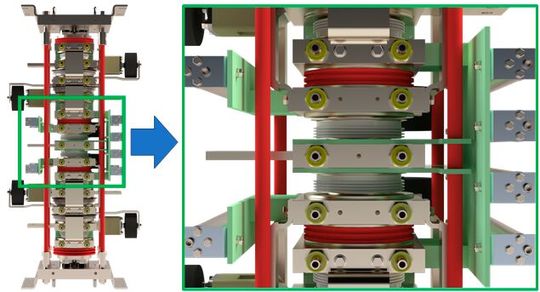
High-power disc devices, unlike power semiconductor modules, utilize electrically active cold plates for efficient cooling and material savings. Figure 1 depicts a typical power semiconductor module, while Figure 2 shows a stack assembly of a 2400 A / 4500 V 3-level phase-leg with active aluminum cold plates, which also serve as terminals and snubber circuit connection points. Efficient thermal management is achieved using non-conducting cooling liquids, such as a deionized water-glycol mixture.
Feasibility Study

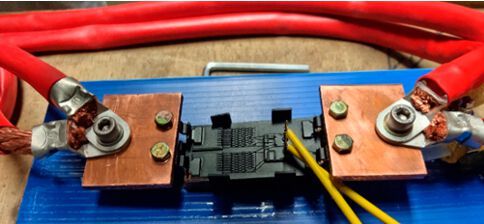
To enhance the thermal resistance by eliminating the direct copper bond (DCB) ceramics, 1200 V/200 A IGBT dies were directly soldered to a liquid-cooled plate. The initial approach utilized bond wires to connect components, leading to the first device under test (DUT), as shown in Figure 3. This 200 A IGBT die employed eight bond wires, each capable of handling 25 A, to link the emitters to the power terminals.
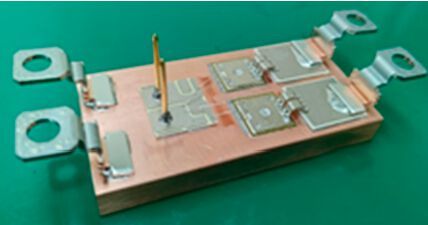
The DUT underwent testing with an infrared (IR) imaging setup, starting at 50 A and increasing in 50 A increments. At 200 A, the chip temperature rose by 70K, while the bond wires exceeded 400°C, as depicted in Figure 5. At 250 A, the bond wires fused, highlighting the limitations of this approach. Consequently, a new design was developed that used clip-soldered connections instead of bond wires, facilitated by a new solderable chip-metallization, as illustrated in Figure 6.

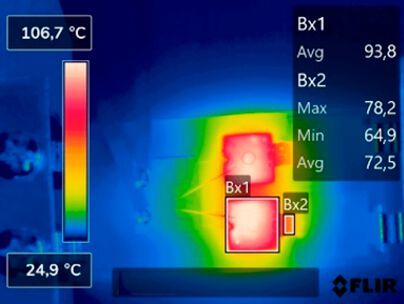
This new design showed significant improvement: at 200 A, the chip temperature reached 94°C, similar to the previous bond wire design. The clip's maximum temperature was 78°C, far below the bond wires' 400°C, as seen in Figure 7. The new design could handle currents exceeding 275 A before reaching an operating temperature of Tvj = 150°C.
An analysis of power loss density indicated that the setup could handle up to 380 W/cm2 at a temperature differential of 100 K, allowing a maximum current of 450 A for the new chip with a 2 cm2 area, and up to 250 A for the 150 A/183 mm2 standard die. These results reflect a marked improvement in thermal management and operational efficiency with the new design.
Electric testing
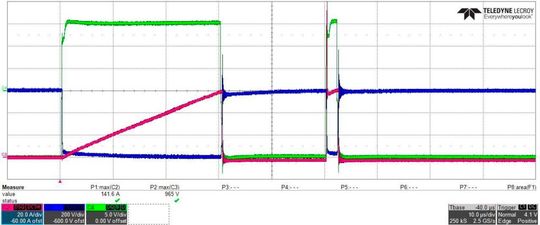
Though the main focus was thermal performance, electrical behaviour was tested. The double-pulse-test summarized in Figure 8 revealed sufficiently clean switching. Despite the non-optimized layout, the results were good enough for potential series development.
Cyclic load testing
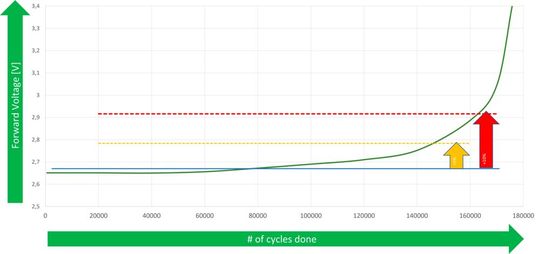
Power electronic components' lifetime is enhanced by outstanding thermal performance. As defined in IEC 60749, a power cycling test, or PCsec, was performed on the pad-and-clip assembly, which is expected to surpass bond-wire systems due to the elimination of bond-lift-off and bond-heel-crack issues. The test subjected several devices to these conditions, and despite the IGBT being rated at 150 A but burdened 250 A, the chips, in a single arrangement, lasted approximately 145,000 cycles before reaching a 5 % forward voltage increase as depicted in Figure 9. This performance is significantly better compared to 80,000 cycles for solder-bond technology, indicating potential for further improvements in chip metallization and solder alloys.
Conclusion
The omnipresent trend of increasing power density in power semiconductors as they are built today starts reaching physical limits due to the isolation requirement. To push these limits further, new methods to extract heat from power semiconductors more efficiently need to be identified.
One way of doing so is direct liquid cooling combined with a suitable chip- and interconnection technology as presented.
The shift from classical isolated assemblies to non-isolated counterparts opens the door to increase power density by a factor of 10, compared to today’s options.
PCIM Expo 2025: Join the industry highlight

Position your company at the forefront of the power electronics industry! Exhibit at the PCIM Expo 2025 in Nuremberg, Germany to showcase your solutions and connect with top decision-makers and innovators driving the industry forward.
Learn more
(ID:50379797)
:quality(80)/p7i.vogel.de/wcms/b1/0a/b10a283cdf3e5f156781a7273c71a7e0/0129107484v2.jpeg "Circular design strategies are increasingly shaping how power electronics are designed, reused, and recovered across their life cycle. (Source: © Enrique - stock.adobe.com)")
:quality(80)/p7i.vogel.de/wcms/f0/a4/f0a4ec50e99b87afad613593f0f0860b/0124997238v4.jpeg "Surface treatments are crucial for automotive power electronics, enhancing durability, thermal management, corrosion resistance, and electrical connectivity, thus ensuring reliable performance and longevity in harsh conditions. (Source: © Alfath - stock.adobe.com)")