


:quality(80)/p7i.vogel.de/wcms/2f/f3/2ff3221bf7665de2d0acf83760bfd1fa/0130031523v2.jpeg "Wolfspeed presents a 300 mm silicon carbide technology platform designed to support advanced packaging and high-efficiency power delivery for AI data center infrastructure. (Source: Wolfspeed)")
:quality(80)/p7i.vogel.de/wcms/c3/16/c316e955a97f5d72d9678297b237b9e5/0129932858v2.jpeg "Left: the single-phase version of the SENTRON ECPD with RCM, right: a model of the future three-phase version of the SENTRON ECPD. (Source: Siemens)")
:quality(80)/p7i.vogel.de/wcms/ef/0a/ef0adb0acf793fe147cc27c21f6a7a67/0129954238v2.jpeg "Empower Semiconductor introduces embedded silicon capacitors designed to improve power delivery and stability in AI and high-performance computing processors. (symbolic image) (Source: © IF.arc - stock.adobe.com)")
:quality(80)/p7i.vogel.de/wcms/53/f9/53f9301dfc9292d02960f7996c79cc6e/0129927601v2.jpeg "Wolfspeed’s new 10 kV SiC MOSFET enables high-voltage power conversion for grid and industrial applications. (symbolic image) (Source: © CREATIVE- 3.4 - stock.adobe.com)")
:quality(80)/p7i.vogel.de/wcms/6e/cd/6ecd41d095d5111cf4ed37b714844487/0129930878v2.jpeg "PCIM Asia Shenzhen provides a platform for industry experts to present new developments in power electronics and electrification technologies. (symbolic image) (Source: © killykoon - stock.adobe.com)")
:quality(80)/p7i.vogel.de/wcms/02/c0/02c0e9722f70b1134dbf96fb59a9c73d/0129655179v2.jpeg "The PCIM Conference 2026 will take place from June 9-11, featuring discussions on power electronics trends, including GaN technology and AI applications. (symbolic image) (Source: © Elmira - stock.adobe.com)")
:quality(80)/p7i.vogel.de/wcms/cc/67/cc670ea2029cd2af5c641af70e1bf734/0129816392v4.jpeg "Fraunhofer IAF coordinates the EU SUPREME project to accelerate GaN and SiC power semiconductor innovation in Europe. (Source: Fraunhofer IAF)")
:quality(80)/p7i.vogel.de/wcms/ea/e6/eae6aee30071e67a5627027974437134/0129544613v2.jpeg "GlobalFoundries and Renesas strengthen their collaboration to support U.S.-based semiconductor production and supply chain resilience. (Source: © ronstik - stock.adobe.com)")
:quality(80)/p7i.vogel.de/wcms/b1/5e/b15ee02b0ba02db70cf61e37d66ad1d3/0129349127v2.jpeg "Vehicle-to-grid (V2G) chargers enable bidirectional energy flow, allowing electric vehicles to act as mobile energy storage systems that can both draw power from and feed power back into the grid. (Source: © medienvirus - stock.adobe.com)")
:quality(80)/p7i.vogel.de/wcms/26/d5/26d591cc340077026eac56a0e7564faf/0129949603v2.jpeg "Flexible: The solid silicone-based electrolyte is elastic, thereby compensating for the voids that form in solid-state batteries during charging and discharging. (Source: Empa)")
:quality(80)/p7i.vogel.de/wcms/4d/e0/4de02f76a37cbb3df30dd231de589c8e/0128866890v2.jpeg "Both legacy and vGaN show higher carrier mobility and band gap energies compared to other power semiconductors. (Source: © phonlamaiphoto - stock.adobe.com)")
:quality(80)/p7i.vogel.de/wcms/18/0b/180b7b63afc91e523592d8a5ce161c96/0129847487v2.jpeg "InGaAs-based photodetectors enable sensitive and fast detection in the short-wave infrared spectrum for modern sensing and communication applications. (Source: © VITALII - stock.adobe.com)")
:quality(80)/p7i.vogel.de/wcms/be/c8/bec8d43fc0ee73414274be44608b2970/0129748903v2.jpeg "The Infiniium XR804KA real-time oscilloscope delivers faster response time, improved stability, and streamlined workflows for high-speed digital and compliance testing. (Source: Keysight)")
:quality(80)/p7i.vogel.de/wcms/23/ee/23ee4a97790d6009dbfd7d9577ffa723/0129220424v2.jpeg "The R&S FPL1044 with the new RTSA option makes 40 MHz real-time frequency analysis available up to 44 GHz. (Source: Rohde & Schwarz )")
:quality(80)/p7i.vogel.de/wcms/3c/d1/3cd1cacbceb792ba63727199c61ca434/0127801860v2.jpeg "Thanks to cloud technology, users can collaborate on projects from anywhere and always have access to the latest planning data. (Source: SIEMENS)")
:quality(80)/p7i.vogel.de/wcms/5a/a0/5aa0436498af618297961fd54ab36cdf/0126290792v2.jpeg "Siemens accelerates student-led semiconductor innovation across Europe’s leading technical universities through Cre8Ventures’ Open Higher Education Program developed in collaboration with Arm and University of Southampton (Source: Siemens Digital Industries Software)")
ENERGY TECHNOLOGY Intel technology helps power solution for a more resilient grid
Related Vendors
:fill(fff,0)/p7i.vogel.de/companies/61/dc/61dc0e8c2e420/dspace-logo-1000px-220107.png "dspace-logo-1000px-220107 (dSPACE GmbH)")
:fill(fff,0)/p7i.vogel.de/companies/68/00/6800eb0040fb9/cobalt-vertical-aligned-bold.png "cobalt-vertical-aligned-bold (CISSOID SA)")
:fill(fff,0)/p7i.vogel.de/companies/68/2c/682c3e2e9a195/logotype-rvb.jpeg "logotype-rvb (https://www.mersen.com/en)")
Intel announced that its technology is helping power the Edge for Smart Secondary Substations (E4S) Alliance’s new solution to modernize the energy grid. The E4S solution disrupts the existing system, helping it move from a proprietary, closed-hardware architecture to an open, flexible, software-defined energy system.

What’s New
In Europe, there are more than 17 million secondary substations, which enable medium- to low-voltage power conversion. This solution digitalizes the next generation of secondary substations with secure, modular, silicon-enhanced technology and is critical to fully unleashing the power of renewable energy resources.
“With almost 30 million substations worldwide, Intel is powering a tremendous opportunity to reduce climate footprints by adopting cleaner energy sources — an important milestone as countries work toward net-zero global greenhouse gas emissions. Our technology jump-starts the evolution of the traditional electric grid to a smarter, more resilient flexible grid capable of successfully integrating large percentages of renewables at the transmission and distribution levels.”, says Mike Bates, general manager of Intel’s Energy Center of Excellence.
About Intel’s Role
Intel is convening industry leaders to shift the energy industry through technology. Intel powers the E4S Alliance with hardware, software, security, applications, artificial intelligence (AI) and communication technology solutions. Some of the world’s largest distribution system operators, including Enedis, E-Redes, Iberdrola and UFD (Naturgy Group), represent the customer point of view, for whom these new E4S specifications are built.
:quality(80):fill(efefef,0)/p7i.vogel.de/wcms/65/69/6569f9912322b/202312-whitepaper-ametek-coverbild.png "202312_Whitepaper Ametek_Coverbild")
Why It Matters
Transition to renewable and clean energy sources is a critical way to reduce greenhouse gas emissions. But energy generated from renewable sources, like solar and wind farms, cannot always be fully deployed on the grid because of its inherent intermittent nature. The E4S power technology at the substation makes the grid more flexible and able to better accommodate more renewable energy sources when available. Implementing the solution at a single substation reduces carbon dioxide by an equivalent of taking as many as 1,800 gasoline-powered cars off the road, based on estimates from the American Council for an Energy-Efficient Economy (ACEEE)1.
Intel has committed to reach 100 % renewable electricity in its own operations by 2030. It ended 2022 at 93 % renewable electricity globally. The company is also supporting its value chain’s transition to renewable electricity.
How It Works
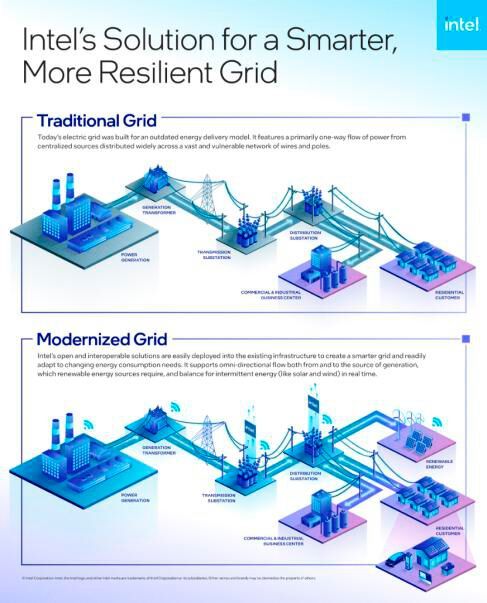
The E4S secondary substation solution is fueled by Intel® Core™ processors and includes AI and Internet of Things capabilities and networking technology. It allows energy providers to adapt to rapidly changing demands, determine the best energy source, and support more renewable and intermittent clean energy sources at the edge of the grid. It also showcases the future of the network by allowing both real-time execution at the edge and real-time radio and cable communications between utilities and their substations. This can enable easier integration of future applications that deepen analytics through data, like weather predictions, maintenance schedules, or the effects of nature and climate change on transmission equipment.
Another important benefit is that the E4S solution helps make the energy grid more resilient, which is imperative in times of natural disaster. For example, utilities can access different energy sources and integrate them into the grid, regardless of their physical location. It can also allow energy providers to determine power allocation more precisely during emergencies. This means that instead of turning off all energy lines or implementing rolling blackouts, operators can readily adapt to changing energy consumption needs during crises and better keep critical areas and customers powered on.
By moving to a virtualized software platform, the E4S solution supports new digital applications that enable advanced management in operations, remote support capabilities, faster application deployment and upgrades, real-time data analytics, and higher levels of cybersecurity. It can perform those functions without sacrificing safety and reliability. It also decreases capital costs by avoiding waste and distributing energy in the most efficient way possible. And it reduces operating costs by offering insight into each substation and supporting predictive maintenance.
A similar version of grid modernization technology for primary substations – the Virtual Protection, Automation and Control (vPAC) solution – is also being deployed in the United States. It is being developed in collaboration with the vPAC Alliance, a consortium of energy ecosystem partners and utilities, including Southern California Edison, Salt River Project and American Electric Power. One partner's version of the technology has already been adopted by nearly 100 utilities across the globe. Predictions released from Salt River Project estimate the vPAC solution will save approximately 50 % on related capital expenditure and 75 % on related operational expenditure once implemented across its grid2.
:quality(80):fill(efefef,0)/p7i.vogel.de/wcms/65/40/6540aa7ec3a0b/whitepaper-littelfuse-coverbild.png "Whitepaper Littelfuse Coverbild")
What’s Next
E4S field trials will be deployed through 2024. Following adoption in Europe, the next target is to have the E4S solution adopted globally. Building off the momentum that began in 2019 with eight companies, these milestones are made possible through the collaboration of the current members of the E4S Alliance: ABB, Ariadna Grid, Barbara, Capgemini, Circutor, Dell Technologies, Enedis, E-REDES, Gridspertise, Iberdrola, Intel, Kalkitech, Labelec, Landis+Gyr, Merytronic, Minsait, Ormazabal, Sagemcom, Schneider Electric, TTTech Industrial, UFD (Grupo Naturgy), VMware and ZIV Automation.
(ID:49825898)
:quality(80)/p7i.vogel.de/wcms/b1/5e/b15ee02b0ba02db70cf61e37d66ad1d3/0129349127v2.jpeg "Vehicle-to-grid (V2G) chargers enable bidirectional energy flow, allowing electric vehicles to act as mobile energy storage systems that can both draw power from and feed power back into the grid. (Source: © medienvirus - stock.adobe.com)")
:quality(80)/p7i.vogel.de/wcms/ea/19/ea199c9380ef3fe0451b96d58576b1cf/0128518937v2.jpeg "From niche deployments to multi-hundred-megawatt projects, BESS reshapes the role of inverters and converters in modern grids. (Source: © Sashkin - stock.adobe.com)")