


:quality(80)/p7i.vogel.de/wcms/a4/fd/a4fd7f7a395d6ecb4e79cfc558895b09/0129082772v2.jpeg "CMT-PLA1BL12300MA 1200V/300A Half-Bridge IGBT Power Module. (Source: CISSOID)")
:quality(80)/p7i.vogel.de/wcms/71/fd/71fdcc22d9a9bd2f42985f692c4aefa2/0128924236v2.jpeg "Wolfspeed reported a milestone in silicon carbide manufacturing with the successful production of a single-crystal 300mm SiC wafer. (symbolic image) (Source: © Four888 - stock.adobe.com)")
:quality(80)/p7i.vogel.de/wcms/94/54/94548eaecd020681e558d563bc48ba1d/0128926221v2.jpeg "Harbinger is leveraging its electrification platform technology and battery manufacturing expertise to bring energy storage to Airstream travel trailers. (Source: Harbinger)")
:quality(80)/p7i.vogel.de/wcms/29/99/2999bb9af245dd31f4c837c1d9359046/0128923137v2.jpeg "Trench SiC MOSFET bare dies enable compact, high-performance power semiconductor solutions. (symbolic image) (Source: © ryanking999 - stock.adobe.com)")
:quality(80)/p7i.vogel.de/wcms/67/62/676279913d77e1db48eb5cbe9be4c767/0128937895v2.jpeg "(Bild: © WrightStudio - stock.adobe.com)")
:quality(80)/p7i.vogel.de/wcms/0f/a2/0fa2b5bdc21e408fd73e637d226d5210/0128681532v2.jpeg "Symbolic Image: Wind and solar power lead Germany’s electricity generation in 2025, marking a continued shift toward renewable energy. (Source: © koosy - stock.adobe.com)")
:quality(80)/p7i.vogel.de/wcms/4f/6f/4f6faf0ca6f748a2967d6b5bba7c88e1/0128682406v2.jpeg "Symbolic Image: SoCs for automotive applications enable enhanced performance in advanced driver-assistance systems. (Source: © Sodapeaw - stock.adobe.com)")
:quality(80)/p7i.vogel.de/wcms/ad/52/ad52f7b5542eff15ba54ec354d31b50d/0128681536v4.jpeg "Symbolic Image: This transaction brings battery technology development, manufacturing strategy, and capital-market access together within a single holding structure. (Source: © Sarut - stock.adobe.com)")
:quality(80)/p7i.vogel.de/wcms/1e/9c/1e9c45d6fcf2fb48dc47756e4cb20174/0128931043v2.jpeg "Syensqo and Axens have launched Argylium to support the development and scale-up of solid-state battery materials in Europe. (symbolic image) (Source: © Anastasiia - stock.adobe.com)")
:quality(80)/p7i.vogel.de/wcms/8b/42/8b4271e1bedea432ab03c83959e30431/0128818204v2.jpeg "Rows of batteries on Kauai island provide more than just power: They stabilize the grid. A project between the Kauai Island Utility Cooperative, NLR, and several more partners showed that electronics can offer equal grid strength to spinning resources. (Source: Connor O’Neil, National Laboratory of the Rockies)")
:quality(80)/p7i.vogel.de/wcms/87/5a/875a8fa395c1eec9677e075fae7f5e8e/0128793884v2.jpeg "MEMS-based hot-switched power panels enable compact, high-performance switching solutions for modern electronics. (Symbolic image) (Source: © Best - stock.adobe.com)")
:quality(80)/p7i.vogel.de/wcms/2f/93/2f9364112e8c6ff38c26f9ba34d0f692/0128791306v2.jpeg "Scalable, high-performance SiC MOSFET solutions enable faster development and improved efficiency in power electronics. (Symbolic image) (Source: © metamorworks - stock.adobe.com)")
:quality(80)/p7i.vogel.de/wcms/3c/d1/3cd1cacbceb792ba63727199c61ca434/0127801860v2.jpeg "Thanks to cloud technology, users can collaborate on projects from anywhere and always have access to the latest planning data. (Source: SIEMENS)")
:quality(80)/p7i.vogel.de/wcms/5a/a0/5aa0436498af618297961fd54ab36cdf/0126290792v2.jpeg "Siemens accelerates student-led semiconductor innovation across Europe’s leading technical universities through Cre8Ventures’ Open Higher Education Program developed in collaboration with Arm and University of Southampton (Source: Siemens Digital Industries Software)")
:quality(80)/p7i.vogel.de/wcms/cb/30/cb30ebdca7fcaea281749cb396654eb3/0124716339v2.jpeg "Rolls-Royce unveils Battery Analytics for its mtu EnergyPack, offering real-time insights, predictive maintenance, and enhanced cybersecurity to boost performance and longevity. (Source: Rolls-Royce plc)")
:quality(80)/p7i.vogel.de/wcms/0b/b4/0bb4cdfa862043eac04c6a195e59b3e0/0124131782v2.jpeg "Siemens has completed the acquisition of DownStream Technologies, a leading provider of manufacturing data preparation solutions for printed circuit board design. (Source: Siemens)")
PID REGULATION How PID controllers contribute to smart grid functionality
Related Vendors
:fill(fff,0)/p7i.vogel.de/companies/5f/71/5f71d5f92a5f6/2000px-rogers-corporation-logo-svg.png "2000px-Rogers_Corporation_Logo.svg.png (rogers germany)")
:fill(fff,0)/p7i.vogel.de/companies/68/2c/682c3e2e9a195/logotype-rvb.jpeg "logotype-rvb (https://www.mersen.com/en)")
:fill(fff,0)/p7i.vogel.de/companies/68/08/6808a2b3b6595/het-logo.jpeg "het-logo (Heraeus Electronics)")
Thanks to ongoing hardware and software development, PID technology continues to evolve and remain relevant; for one example, this article shows how it is being used for various aspects of smart grid management. Yet PID is not the only possibility. The article concludes by discussing how smart grids increasingly rely on AI to either augment or replace PID solutions.

An article recently published in Power & Beyond, titled "Why PID control technology continues to thrive” describes how the technology is rooted in control history, yet continues to thrive because of ever-evolving methods of software and hardware implementation.
So where are these modern PID controllers currently being deployed? This article looks at smart grids as one important example, highlights their multiple benefits and challenges, and shows how PID control can contribute to the factors involved. Yet PID control is not the only game in town, so the article concludes by introducing Artificial Intelligence (AI) and its increasing contribution to smart grid performance and capabilities.
Other articles discussing PID control in different power applications are to follow.
What are smart grids, and why are they important?
The International Energy Agency, or IEA, works with governments and industry to shape a secure and sustainable energy future for all1).
The IEA describes smart grids as electricity networks that use digital and other advanced technologies to monitor and manage the transport of electricity from all generation sources to meet the varying electricity demands of end users. Smart grids co-ordinate the needs and capabilities of all generators, grid operators, end users and electricity market stakeholders to operate all parts of the system as efficiently as possible, minimizing costs and environmental impacts while maximizing system reliability, resilience, flexibility and stability.
Investment in smart grids needs to more than double through to 2030 to get on track with the Net Zero Emissions by 2050 (NZE) Scenario, especially in emerging market and developing economies (EMDEs).
In the IEA’s view, smart grids are important because clean energy transitions entail large increases in electricity demand and the widespread rollout of variable renewables like wind and solar, placing greater demands on power grids. Smart grid technologies can help to manage this transition while reducing the need for costly new grid infrastructure, and can also help to make grids more resilient and reliable.
:quality(80):fill(efefef,0)/p7i.vogel.de/wcms/66/c6/66c600f20a4af/pcim-2024-young-engineer-award-adriana-campos-coverbild.jpeg "PCIM 2024_Young Engineer Award_Adriana Campos_Coverbild")
How smart grids deliver their benefits
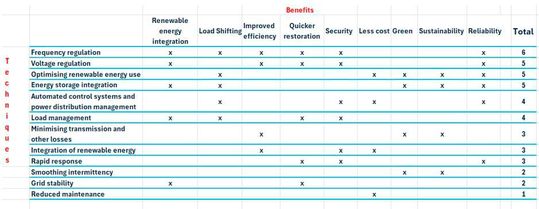
As electrical appliances go, smart grids are large, complex entities with many subsystems, interactions with related systems, and multiple challenges and benefits. Figure 1 below shows these aspects and interdependencies, along with the points where PID controllers can make contributions. The columns show the benefits offered by smart grids, while the rows reveal the techniques available for achieving them. The crosses show the techniques that each benefit does use, through deploying PID technology.
For example, renewable energy integration is an important benefit afforded by smart grids, and they achieve this by using PIDs for frequency regulation, voltage regulation, energy storage integration, load management, and grid stability. Note that, in general, there is some overlap between ‘benefits’ and ‘techniques’: This reflects the interactions between the technologies used within smart grids. Note also the importance of voltage regulation and frequency regulation; in fact, these two techniques are fundamental to the operation of any type of power distribution network. Accordingly, we now take a closer look at both these techniques, and how engineers are using PID controllers to fulfil their implementation.
Voltage regulation
Voltage regulation is a critical aspect of smart grid management, ensuring the stability and reliability of power distribution. With the increasing integration of renewable energy sources and distributed energy resources into the grid, maintaining voltage within desired limits becomes more challenging. Reactive power support from energy storage systems plays a crucial role in voltage regulation, enabling efficient grid operation.
A Research Square research article, titled “PID Control Approach for Optimizing Voltage Regulation in Smart Grids Using Energy Storage Reactive Power” by Jarosz Anna2), proposes one possible approach; this uses a PID controller to optimize voltage regulation in smart grids by leveraging the reactive power capabilities of energy storage systems. The optimized voltage regulation achieved through the PID controller-based approach can help mitigate voltage fluctuations, reduce grid imbalances, and enhance the overall stability and reliability of the smart grid infrastructure.
Reactive power is the component of power that oscillates between the source and load without being consumed. It is essential for voltage control and stability in power systems. Reactive power support involves the provision of reactive power by devices such as energy storage systems, capacitors, and voltage regulators.
The role of reactive power support in voltage regulation is twofold. Firstly, it helps to compensate for the reactive power demand or supply imbalances in the grid. When there is a shortage of reactive power, the grid voltage tends to drop, leading to voltage instability. Reactive power support devices inject reactive power into the grid to maintain voltage levels within acceptable limits. Conversely, when there is an excess of reactive power, the grid voltage tends to rise, which can also lead to instability. Reactive power support devices absorb the excess reactive power, helping to stabilize the voltage.
Secondly, reactive power support devices improve the power factor of the grid. The power factor is a measure of how effectively electrical power is being utilized. A low power factor indicates a high reactive power component, which can result in increased losses and reduced efficiency. By providing reactive power support, devices help to improve the power factor, thereby enhancing the overall efficiency of the grid.
PID control offers a simple yet powerful method for managing voltage regulation in smart grids. By adjusting the PID control parameters, the controller can regulate the energy storage system’s reactive power output to maintain the grid’s desired voltage level.
The suitability of PID control theory for voltage regulation in smart grids lies in its simplicity, effectiveness, and widespread understanding among engineers.
The PID grid voltage controller described in the article comprises energy storage systems, grid voltage monitoring sensors, PID controller, communications interfaces, system optimization and tuning, and safety and protection mechanisms.
Energy storage systems can be based on batteries or supercapacitors. Battery energy storage system control operates in voltage-stabilization mode by balancing the power within the microgrid, provided the available generation lies within their maximum power range. Conversely, supercapacitors can be used for microgrid storage to instantaneously inject power when the demand is high and production dips momentarily. They can also store energy in reverse conditions and provide an immediate voltage buffer to compensate for quick-changing power loads.
:quality(80)/p7i.vogel.de/wcms/50/47/5047818bfeb5d315d1db5c5946dbdeae/0116669487.jpeg "The major development in electrification is seen through the invention and commercialization of electric vehicles. (Source: BillionPhotos.com - stock.adobe.com)")
POWERING THE FUTURE
How electrification is driving the world in 2024
Frequency regulation
The above discussion about voltage regulation refers to reactive power – and both active and reactive grid power varies continuously with changes in both commercial and domestic loads. Accordingly, energy sources, whether conventional or renewable, must be regulated carefully so that effects such as variations in generator speed are prevented from creating changes in power grid frequency.
Smaller variations are permissible, but larger frequency deviations can cause serious damage to consumer equipment. However, minimizing these variations is challenging in large grid environments comprising multiple interconnected systems, and manual regulation is not possible.
A ScienceDirect paper, titled “PID controller design for load frequency control: past, present and future challenges” 3) by Yogesh V. Hote and Shivam Jain looks at the problems related to load frequency control (LFC), and reviews various PID control solutions.
Overall, the solution should be robust, yet simple to design and operate; over 90% of industry still employs PID controllers due to their simplicity, clear functionality, and ease of use. However, many control practitioners have pointed out that conventionally-tuned PID controllers are insufficiently robust. This has led to investigation of more advanced control techniques, such as sliding mode control, H-infinity, Quantitative Feedback Theory (QFT), and Linear Matrix Inequality (LMI).
Although they originally appeared to offer better performance than PID design, users became aware that these controllers were complex and can encounter robustness challenges in an uncertain environment. The paper’s researchers identified a need to combine PID controller simplicity with optimal tuning methods. It was observed that this approach can better handle parametric uncertainties, disturbance rejection, and non-minimum phase behavior.
The various PID control schemes are classified into four types:
- The Internal Model Control (IMC-based control) is a well laid out mechanism for controller design based on the Q parameterization concept and has been developed for integer order (IO) as well as fractional order (FO), SISO (Single input single output) and MIMO (Multiple input multiple output) continuous time and discrete time systems. It provides a good trade-off between a robust controller and an optimal controller.
- Fractional Order PID (FOPID) is a natural extension of traditional PID controllers, which has garnered intense interest since a real world system can be better characterized by an FO differential equation. FOPID has been used extensively in LFC designs.
- Soft Computing techniques belong to the Computational Intelligence (CI) family, which comprises a vast number of innovative heuristic search techniques inspired broadly from mathematics, biology, physics, and chemistry.
- Robust control schemes: Robustness can simply be defined as the system’s ability to withstand changes in parameters, uncertain environment, measurement noise, load disturbances, and other factors. It is the capacity of a system to perform optimally, provided that the uncertain parameters are found within a typically compact set.
- Therefore, trade-off between robustness and performance is one of the key issues of controller design. Various robust techniques include linear quadratic Gaussian (LQG) control, quantitative feedback theory (QFT), H-infinity, Lyapunov based control, and others.
:quality(80):fill(efefef,0)/p7i.vogel.de/wcms/66/c5/66c5de0fac082/pcim-2024-keynote-prof--dr.jpeg "PCIM 2024_Keynote Prof. Dr. Rolf Hellinger_Cover (stock.adobe.com - putilov_denis)")
PCIM 2024 - Keynote
The Impact of AI on the Entire Power Electronics Lifecycle
AI and the future of smart grids
This article has shown how smart grids encompass many benefits and techniques, which can be enabled by PID control. However, PID is not the only technique – Artificial Intelligence (AI) is increasingly contributing to all the aspects described in Figure 1. As AI continues to evolve, smart grids are becoming even more adaptive, predictive, and autonomous, enabling seamless integration of renewable energy and providing a stable energy supply to millions of people4).
Looking ahead, advancements in AI, such as deep learning and machine learning, will further enhance the capabilities of smart grids, allowing them to continuously learn from new data and improve their performance. This will lead to more precise energy forecasting, better demand management, and enhanced grid stability - all of which are essential for building a sustainable energy future.
As the world strives to meet its sustainability goals, the integration of AI with smart grids will play a crucial role in ensuring that energy systems are both efficient and environmentally friendly.
References
1)About - IEA
2)PID Control Approach for Optimizing Voltage Regulation in Smart Grids Using Energy Storage Reactive Power | Research Square
3)main.pdf (sciencedirectassets.com
4)Smart Grids and AI: The Future of Efficient Energy Distribution - IoT Times (eetimes.com)
(ID:50229344)
:quality(80)/p7i.vogel.de/wcms/85/2f/852fc0e2c3933c237dcaf96deea44dc8/0124723432v2.jpeg "Advancements in PID control for EVs integrate AI, fuzzy logic, and fractional calculus to tackle nonlinearities and improve performance, efficiency, and reliability, amid a rapidly expanding global EV market driven by technological innovations and environmental awareness. (Source: © Vittaya_25 - stock.adobe.com)")
:quality(80)/p7i.vogel.de/wcms/ea/3a/ea3acc28d64220584b730f9128ccf30a/0123428746v2.jpeg "To meet growing electricity needs and integrate renewables, the power electronics industry in 2025 will rely on advances in semiconductors, smart grids, and energy storage, as this article details. (Source: Emiliia - stock.adobe.com)")