


:quality(80)/p7i.vogel.de/wcms/2f/f3/2ff3221bf7665de2d0acf83760bfd1fa/0130031523v2.jpeg "Wolfspeed presents a 300 mm silicon carbide technology platform designed to support advanced packaging and high-efficiency power delivery for AI data center infrastructure. (Source: Wolfspeed)")
:quality(80)/p7i.vogel.de/wcms/c3/16/c316e955a97f5d72d9678297b237b9e5/0129932858v2.jpeg "Left: the single-phase version of the SENTRON ECPD with RCM, right: a model of the future three-phase version of the SENTRON ECPD. (Source: Siemens)")
:quality(80)/p7i.vogel.de/wcms/ef/0a/ef0adb0acf793fe147cc27c21f6a7a67/0129954238v2.jpeg "Empower Semiconductor introduces embedded silicon capacitors designed to improve power delivery and stability in AI and high-performance computing processors. (symbolic image) (Source: © IF.arc - stock.adobe.com)")
:quality(80)/p7i.vogel.de/wcms/53/f9/53f9301dfc9292d02960f7996c79cc6e/0129927601v2.jpeg "Wolfspeed’s new 10 kV SiC MOSFET enables high-voltage power conversion for grid and industrial applications. (symbolic image) (Source: © CREATIVE- 3.4 - stock.adobe.com)")
:quality(80)/p7i.vogel.de/wcms/6e/cd/6ecd41d095d5111cf4ed37b714844487/0129930878v2.jpeg "PCIM Asia Shenzhen provides a platform for industry experts to present new developments in power electronics and electrification technologies. (symbolic image) (Source: © killykoon - stock.adobe.com)")
:quality(80)/p7i.vogel.de/wcms/02/c0/02c0e9722f70b1134dbf96fb59a9c73d/0129655179v2.jpeg "The PCIM Conference 2026 will take place from June 9-11, featuring discussions on power electronics trends, including GaN technology and AI applications. (symbolic image) (Source: © Elmira - stock.adobe.com)")
:quality(80)/p7i.vogel.de/wcms/cc/67/cc670ea2029cd2af5c641af70e1bf734/0129816392v4.jpeg "Fraunhofer IAF coordinates the EU SUPREME project to accelerate GaN and SiC power semiconductor innovation in Europe. (Source: Fraunhofer IAF)")
:quality(80)/p7i.vogel.de/wcms/ea/e6/eae6aee30071e67a5627027974437134/0129544613v2.jpeg "GlobalFoundries and Renesas strengthen their collaboration to support U.S.-based semiconductor production and supply chain resilience. (Source: © ronstik - stock.adobe.com)")
:quality(80)/p7i.vogel.de/wcms/b1/5e/b15ee02b0ba02db70cf61e37d66ad1d3/0129349127v2.jpeg "Vehicle-to-grid (V2G) chargers enable bidirectional energy flow, allowing electric vehicles to act as mobile energy storage systems that can both draw power from and feed power back into the grid. (Source: © medienvirus - stock.adobe.com)")
:quality(80)/p7i.vogel.de/wcms/26/d5/26d591cc340077026eac56a0e7564faf/0129949603v2.jpeg "Flexible: The solid silicone-based electrolyte is elastic, thereby compensating for the voids that form in solid-state batteries during charging and discharging. (Source: Empa)")
:quality(80)/p7i.vogel.de/wcms/4d/e0/4de02f76a37cbb3df30dd231de589c8e/0128866890v2.jpeg "Both legacy and vGaN show higher carrier mobility and band gap energies compared to other power semiconductors. (Source: © phonlamaiphoto - stock.adobe.com)")
:quality(80)/p7i.vogel.de/wcms/18/0b/180b7b63afc91e523592d8a5ce161c96/0129847487v2.jpeg "InGaAs-based photodetectors enable sensitive and fast detection in the short-wave infrared spectrum for modern sensing and communication applications. (Source: © VITALII - stock.adobe.com)")
:quality(80)/p7i.vogel.de/wcms/be/c8/bec8d43fc0ee73414274be44608b2970/0129748903v2.jpeg "The Infiniium XR804KA real-time oscilloscope delivers faster response time, improved stability, and streamlined workflows for high-speed digital and compliance testing. (Source: Keysight)")
:quality(80)/p7i.vogel.de/wcms/23/ee/23ee4a97790d6009dbfd7d9577ffa723/0129220424v2.jpeg "The R&S FPL1044 with the new RTSA option makes 40 MHz real-time frequency analysis available up to 44 GHz. (Source: Rohde & Schwarz )")
:quality(80)/p7i.vogel.de/wcms/3c/d1/3cd1cacbceb792ba63727199c61ca434/0127801860v2.jpeg "Thanks to cloud technology, users can collaborate on projects from anywhere and always have access to the latest planning data. (Source: SIEMENS)")
:quality(80)/p7i.vogel.de/wcms/5a/a0/5aa0436498af618297961fd54ab36cdf/0126290792v2.jpeg "Siemens accelerates student-led semiconductor innovation across Europe’s leading technical universities through Cre8Ventures’ Open Higher Education Program developed in collaboration with Arm and University of Southampton (Source: Siemens Digital Industries Software)")
POWERING THE FUTURE How electrification is driving the world in 2024
Related Vendors
:fill(fff,0)/p7i.vogel.de/companies/63/c7/63c7da97be945/diotec.png "diotec (Diotec Semiconductor AG)")
:fill(fff,0)/p7i.vogel.de/companies/61/dc/61dc0e8c2e420/dspace-logo-1000px-220107.png "dspace-logo-1000px-220107 (dSPACE GmbH)")
:fill(fff,0)/p7i.vogel.de/companies/68/2c/682c3e2e9a195/logotype-rvb.jpeg "logotype-rvb (https://www.mersen.com/en)")
Electrification has been called the “biggest engineering achievement of the 20th century”. This article explains the current status of electrification in 2024 through electric vehicles, locomotives, smart grid, and the aviation industry. It highlights the growing demand, market size, physical implementation, and worldwide attention with the latest headlines about funding and statistics.

What is electrification?
Electrification is defined as the implementation of technology that enables an infrastructure, machine, or process to utilize electricity instead of finite non-replenishable resources. The system can initially rely on fossil fuels, internal combustion, natural gas, and other non-renewable resources to generate desirable outputs. Electrification replaces those procedures with electric power generation to reduce reliance on non-renewable resources, carbon footprint, and high costs for improving overall efficiency.
Electrification status quo 2024
Transportation, aviation, manufacturing, construction, maritime, consumer electronics, and many industries rely heavily on fossil fuels for operations. In addition to the overutilization of non-renewable sources, these industries emit enormous amounts of carbon dioxide- a major contributor to global warming. Electrification is important because non-renewable resources will finish in the next century. The section ahead explains electrification in four major sectors: electric vehicles, the aviation industry, electric locomotives, and smart grid.
Electric vehicles
The major development in electrification is seen through the invention and commercialization of electric vehicles. An electric vehicle or an EV can be a scooter, bike, car, truck, bus, or any other vehicle on the road that relies on electric power to run. EVs use batteries, which are chargeable through electric vehicle chargers. Similar to gas stations, EV charging stations are common across streets.
In the 21st century, EVs became excessively popular through government initiatives and climate awareness. Companies like Tesla, BYD, Hyundai, BMW, and many other existing car companies manufacture and sell EVs. In contrast, EVs are available at premium and affordable prices for different sections of society. China has the largest number of EVs in sales and on the road, followed by Europe, the USA, and Germany.
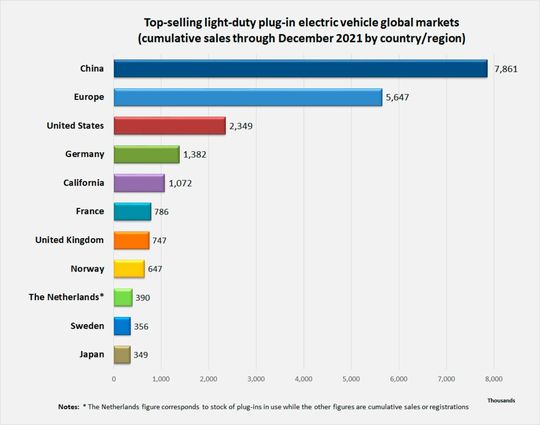
“Powertrain” is a technical term to describe systems, processes, and components that convert an engine’s power to mechanical movement. In addition to fully electric vehicles, there are hybrid vehicles that implement batteries with combustion engineers to run. HEVs (Hybrid Electric Vehicles) implement a “hybrid powertrain” to integrate combustion engines with electric propulsion systems. In the market, BEVs (Battery Electric Vehicles) outperform HEVs and PEVs (Plug-in Electric Vehicles).
The awareness, technology, and affordability of EVs have reached an all-time high- selling 13.9 million units worldwide in 2023. 1.5+ million EVs were sold in December 2023 alone. The number has drastically increased from the preceding year and is expected to surpass two-thirds of global car sales in 2030. Out of all EV car companies, Tesla and BYD currently occupy 35 % EV market share.
The growing market of EVs is gaining the worldwide attention of investors. Similar to dominance in the semiconductor industry, China is the leading supplier of EV batteries. In terms of EV batteries, China is predicted to account for 30 % of manufacturing contribution towards net zero emissions by 2030. Even lesser EV manufacturing countries like India and Indonesia are gearing towards setting up more manufacturing facilities to revolutionize EVs and charging stations.
:quality(80):fill(efefef,0)/p7i.vogel.de/wcms/65/cb/65cb9c3a03849/webinar-efficient-electrolysis-through-comprehensive-power-conversion-solutions-coverbild.jpeg "Webinar_Efficient Electrolysis through Comprehensive Power Conversion Solutions_Coverbild (Infineon)")
GREEN HYDROGEN
Efficient Electrolysis through Comprehensive Power Conversion Solutions
Aviation industry
An aircraft emits 77 % of carbon dioxide out of net emissions. Commercial manned aircraft rely on high quantities of expensive fossil fuels to fly over long distances for prolonged periods. These fuels used in aircraft are non-renewable and have a limited storage time of up to a year. In the next 100-150 years, future generations can face major challenges in operating flights.
Electrification in aircraft is a solution to reduce carbon emissions and noise pollution. The aviation industry has seen the development of electric drones and other UAVs (unmanned aerial vehicles). The key challenges to running an electric aircraft are limited battery capacity, storage, and the need for a strong electricity-powered propulsion system. Unlike EVs, current battery technologies do not enable aircraft to fly for long distances and time.
A hybrid electric plane implements a combination of a traditional fossil fuel-based combustion engine and an electric propulsion system through electric motors. The hybrid vehicle is a step forward from commercial aircraft for a “quieter flight” with reduced carbon emissions. According to a leading aircraft manufacturer and designer AirBus, hybrid planes can reduce carbon emissions by 5 % in commercial aircraft and 10 % in helicopters.
Electric aircraft are in the initial development and testing phases. The advancements in electric aircraft are currently based on hybrid vehicles rather than 100 % electrified aircraft. A major upcoming trend in the near future could be the commercialization of manned hybrid electric planes. There are many start-ups and initiatives that have already started to work on electric aircraft technology.
A US-European start-up Cosmic Aerospace has raised funds to build electricity-powered aircraft that could run 1000 kilometers. Another Swedish start-up Heart Aerospace has also raised a multi-million-dollar fund for its hybrid-electric airplane. The cofounder and CEO Anders Forslund comments “This investment furthers our mission to decarbonize and democratize air travel.” The hybrid electric plane is reportedly able to carry 30 passengers in a flight.
:quality(80):fill(efefef,0)/p7i.vogel.de/wcms/65/95/65952af359336/ametek-whitepaper-programmable-sources-coverbild.png "Ametek Whitepaper Programmable Sources_Coverbild")
Electric train
An electric train is a locomotive powered by electricity from overhead lines, third rail, self-generation, or an onboard energy storage system. The integrated railway systems use both traditional and electric power together. The process of replacing traditional engines with electric power transmission systems in locomotives is called electrification of railways. In present times, electrification of railways is seen in Europe, North America, and Asia.
The electric locomotive market stood at USD8.29 billion in 2023. About 1.3 million kilometers of railway tracks are electrified. The number is expected to increase at a rate of 12.1 % up to 2028. The electric train with an onboard energy storage system uses a battery or supercapacitor to run. The continuous research of achieving room-temperature superconductors can attain ultra-high speeds with electrification and improve overall efficiency.
MAGLEV (Magnetic Levitating) trains are another use case for the electrification of railways. The magnetic properties enable the train to move forward with no contact and attain ultra-high speed. MAGLEV trains do not require fossil fuel-powered engines. There are six commercially operational MAGLEV trains in the world: Three in China, Two in South Korea, and One in Japan. China has reportedly implemented superconducting technologies in a hyperloop train project.
:quality(80):fill(efefef,0)/p7i.vogel.de/wcms/65/69/6569f9912322b/202312-whitepaper-ametek-coverbild.png "202312_Whitepaper Ametek_Coverbild")
Electricity generation
History narrates the plight of mankind without electricity throughout the centuries. In addition to the fact that electricity was historically a technological achievement, electricity brought along a social revolution in the interpersonal lives of humans. The significance of electrification in electricity generation is through renewable resources. The goal of electrification through electricity generation is realized through hydroelectric power plants, solar panels, wind energy, and other renewable sources. There is no meaning of electrification when electricity is generated through traditional combustion and utilization of fossil fuels. The resulting carbon footprint and pollution are not an outcome of electrification.
A smart grid is a solution to expand worldwide electricity reach with the process of electrification. Smart Grid integrates electric generating stations, and users through electricity transmission, distribution, and consumption. In simple words, any electricity generating system, whether at home or a factory can contribute electricity to the smart grid. Vehicle-to-grid (V2G) is a technology that allows electricity from the drive batteries of electric and hybrid cars to be fed back into the smart grid. According to the latest news, ev.energy got USD33 million to integrate electric vehicles and smart grid. The expansion is aimed at scaling electrification in Europe and North America.
Conclusion
The global electrification market size was valued at USD80.8 billion in 2023. The expected growth is about 8.9 % percent across all the verticals. The transport sector (EVs and electric locomotives) occupies a major share in electrification implementation.
(ID:49916946)
:quality(80)/p7i.vogel.de/wcms/9b/b4/9bb4cf010396f5ff49baba8658945ea4/0127009386v2.jpeg "Electric vehicles, viewed as the future of sustainable mobility, offer environmental benefits over combustion engines, despite challenges related to battery production and charging infrastructure. (Source: © Mustafa - stock.adobe.com)")
:quality(80)/p7i.vogel.de/wcms/59/f5/59f550236a2fa3cba563e733637f5e5e/0125753881v2.jpeg "A new study by the International Council on Clean Transportation estimates that battery electric cars sold today in Europe emit nearly 4 times less greenhouse gases over their lifetime than gasoline cars. Find out more about this here. (Source: © Planetz - stock.adobe.com)")