


:quality(80)/p7i.vogel.de/wcms/10/fc/10fcb98e44d61826e641bc8d3f20f616/0133193677v2.jpeg "The new AEVA and AEVB Series aluminum electrolytic capacitors are engineered for harsh industrial environments, delivering high-CV, long-lifetime performance in compact, surface-mount packages that reliably withstand up to 30g acceleration and operating temperatures extending from -55° to +125°C. (Source: Kyocera)")
:quality(80)/p7i.vogel.de/wcms/f7/42/f74208db9f5f87dca384b38b71c4782e/0133196365v2.jpeg "YAGEO’s EC Flat‑Series temperature sensors combine fast, accurate measurement with resistance to vibration, shock, moisture and dust for demanding automotive and industrial applications. (Source: Yageo)")
:quality(80)/p7i.vogel.de/wcms/b2/82/b28212428745dd8a4634ad4f4912012f/0132902689v2.jpeg "New 15 V, 25 V and 40 V eGaN FETs deliver ultra-low on-resistance, high current capability, and exceptional radiation immunity for high-density space power conversion (Source: EPC Space)")
:quality(80)/p7i.vogel.de/wcms/7b/4f/7b4f433302c490cac22eee9c12499e65/0132780211v2.jpeg "Littelfuse introduces the TPSMD‑FL series of high‑power surface‑mount TVS diodes, designed to simplify ISO 7637 load‑dump protection and safeguard automotive electronics against severe voltage transients. (Source: Littlefuse)")
:quality(80)/p7i.vogel.de/wcms/78/38/783841efab284c1b4453777e7ebea26d/0133190419v2.jpeg "Diodes has completed its acquisition of Elevate Semiconductor, expanding its analog and mixed-signal portfolio and strengthening its presence in the high-growth automated test equipment market. (Source: © peopleimages.com - stock.adobe.com)")
:quality(80)/p7i.vogel.de/wcms/1f/79/1f79d69530465de26a832c742fc60319/0133117717v2.jpeg "With 30,000 sqm of exhibition space, 20,157 trade visitors, 271 exhibitors, and 131 expert presentations as part of the conference program, the event sent a strong message about the industry's innovative strength and dynamism. (Source: Mesago Messe Frankfurt GmbH)")
:quality(80)/p7i.vogel.de/wcms/43/4d/434db2291567e847e54332004942a225/0132958267v2.jpeg "GlobalWafers has joined the SEMI Taiwan Materials Alliance, with CEO Doris Hsu serving as co‑chair, to advance critical materials technologies, accelerate collaborative innovation and strengthen global semiconductor supply chain resilience. (Source: © jiwon - stock.adobe.com)")
:quality(80)/p7i.vogel.de/wcms/6f/72/6f72f93d1e4c5a248a97dd3b8f32a336/0132997898v2.jpeg "Infineon plans to acquire C2i Semiconductors to combine software‑defined multiphase control and smart power stages with its broad power‑semiconductor portfolio for intelligent, scalable AI data‑center power delivery. (Source: © Grispb - stock.adobe.com)")
:quality(80)/p7i.vogel.de/wcms/87/97/879728679e7010f81e53a86923cde74c/0133218625v2.jpeg "Conceptual illustration of polar wurtzite niobium aluminum nitride (NbAlN), a transition-metal-containing nitride semiconductor that preserves the crystal structure and polarity of GaN. (Source: Associate Professor Atsushi Kobayashi from Tokyo University of Science, Japan)")
:quality(80)/p7i.vogel.de/wcms/ac/31/ac31c9478d80894d725d02883ae7ed5d/0133176534v2.jpeg "Average models allow power designers to simulate DC‑DC converters and three‑phase PFC circuits quickly, analyse small‑signal behaviour and evaluate loop stability without modelling every switching event. (Source: © AI - stock.adobe.com)")
:quality(80)/p7i.vogel.de/wcms/96/80/9680b468d7f682c8b6c15b07300afbb0/0133177854v2.jpeg "Grid-forming inverters are also known as grid-forming resources and grid-forming IBR. This article explains grid-forming inverters in detail. (Bild: © only_kim - stock.adobe.com)")
:quality(80)/p7i.vogel.de/wcms/57/c6/57c6fa81922a9849a917bdfed82eddf7/0133052494v2.jpeg "Rising demand for high-end materials shifts production toward higher-margin products, reducing output of standard loss materials. (Source: NCAB)")
:quality(80)/p7i.vogel.de/wcms/7b/76/7b76005554b556df2a7a3794bdf69d44/0132365246v2.jpeg "Hioki’s ST5680A DC Hipot Tester combines CE/UKCA/CSA compliance, an integrated capacitance‑based contact check and time‑series waveform recording (voltage, leakage current, insulation resistance) to standardize hipot and insulation testing across EV cell, module and pack production lines. (Source: Hioki)")
:quality(80)/p7i.vogel.de/wcms/af/7f/af7f7b0fb7f29219fc991b1130f65477/0132241333v2.jpeg "Comprehensive laboratory testing regimens—combining thermal cycling, high‑current stress, EMC, and accelerated lifetime tests—are essential to validate advanced power designs and ensure reliability in real‑world applications. (Source: PRBX)")
:quality(80)/p7i.vogel.de/wcms/16/3d/163df69363f8125315a9826e13ea4b05/0131927425v2.jpeg "Solution will maximize data center and AI factory profitability while delivering engineering-grade insights to design and operations for more efficient, sustainable, and resilient infrastructure. (Source: Cadence)")
:quality(80)/p7i.vogel.de/wcms/85/b7/85b7e90733a2bd8f21515d8f7137f2fc/0131917677v2.jpeg "Renesas acquires Pictorus to integrate its embedded application software platform with Renesas’ MCU and MPU portfolio, helping developers shorten time‑to‑market and simplify system integration. (Source: © lucadp - stock.adobe.com)")
ELECTRIC MOBILITY 10 Facts about electric vehicles
Related Vendors
:fill(fff,0)/p7i.vogel.de/companies/68/08/6808a2b3b6595/het-logo.jpeg "het-logo (Heraeus Electronics)")
:fill(fff,0)/p7i.vogel.de/companies/69/30/693022b11e5db/logo.jpeg "logo (MBS-Hodde GmbH & Co. KG)")
The combustion engine-powered automobile is one of the cornerstones of modern society. Once seen as a curiosity, electric vehicles are now regarded as the future of mobility. We’ve compiled some fascinating facts about the newest chapter in transportation.
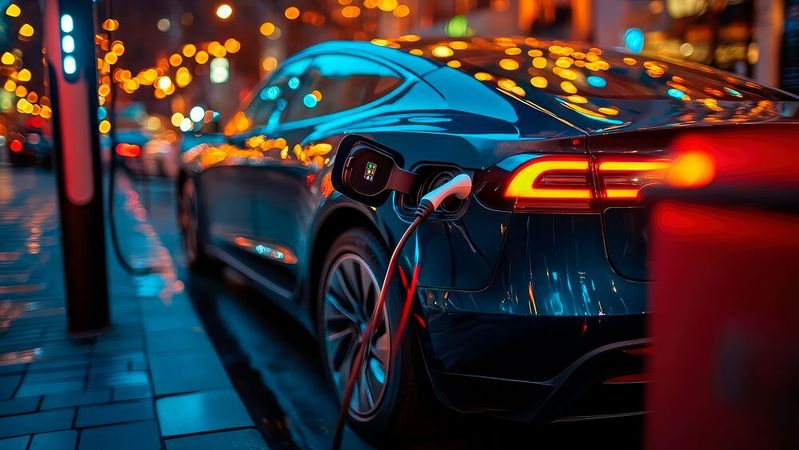
Humanity has always sought to overcome the challenges of distance and satisfy our curiosity and wanderlust. To this end, we committed ourselves to developing increasingly faster and more efficient modes of land transport. This journey has taken us from the domestication of horses to the development of steam locomotives and ultimately to the invention of the automobile.
The automobile has transformed daily life. Cars have shaped how we build our infrastructure. Roads, highways, and parking are now integral to urban planning. Combustion engine-powered vehicles have resulted in the expansion of urban areas, enabled mass industrialisation, and driven massive economic growth across the globe.
There’s no doubt that the combustion engine is one of the most significant inventions of modern civilisation. But harnessing the power of the car has come at a great cost.
A typical passenger car emits 4.6 metric tons of carbon dioxide (CO2) every year. Cars and trucks account for a fifth of greenhouse gas emissions in the United States. According to the International Energy Agency (IEA), the transport sector accounts for approximately 15 % of global greenhouse gas emissions, with road transport contributing about 72 % of these emissions. Despite a slump during the height of the COVID-19 pandemic, CO2 emissions from road vehicles have been increasing at a rate of 1.4 % per year since 2010.
The combustion-engine automobile has given us freedom and prosperity (and lots of cool rock songs), but it’s also a major reason why our planet is in peril.
The idea that modern civilisation could abandon cars is, at present, simply unworkable. However, electric vehicles (EVs) provide us with a cleaner, more sustainable alternative to traditional automobiles. As well as being quieter and more fuel-efficient, electric vehicles are far more environmentally friendly than combustion-engine cars.
To celebrate this technological marvel, we’ve put together some of our favourite facts about electric vehicles. Read on to discover some surprising insights into the future of mobility.
Fact one: Electric vehicles are not a new idea
What do EVs and golf have in common? They’re both older than you might think, and they both originated in Scotland. Golf came about sometime in the 1400s, and while EVs aren’t quite that old, they are older than most people suspect.
Between 1832 and 1839, Scottish inventor Robert Anderson busied himself with developing an electric carriage. Although Anderson’s carriage had a rudimentary design that was impractical for everyday use, it did have an electric engine and was powered by electric batteries. Unfortunately, the batteries could not be recharged, which stopped the electric carriage from becoming a viable option.
Fact two: It’s true: EVs really are more environmentally friendly
It’s important to recognise the fact that EVs are significantly better for the environment than their combustion-engine counterparts. Numerous studies have confirmed that EVs are considerably more climate-friendly over the course of their lifetime.
With zero tailpipe emissions, it’s been shown that EVs emit an average of 50 grams of CO2 per kilometre compared to 165 grams per kilometre for petrol-powered cars and 170 grams per kilometre for diesel cars.
On average, studies have found that an electric vehicle will produce over three times less CO2 than similar petrol cars, even when manufacturing, charging, and driving are all taken into account. EVs also require less maintenance, don’t use engine oil, and are far more fuel efficient.
:quality(80)/p7i.vogel.de/wcms/59/f5/59f550236a2fa3cba563e733637f5e5e/0125753881v2.jpeg "A new study by the International Council on Clean Transportation estimates that battery electric cars sold today in Europe emit nearly 4 times less greenhouse gases over their lifetime than gasoline cars. Find out more about this here. (Source: © Planetz - stock.adobe.com)")
ELECTRIC VEHICLES
Electric cars are the cleanest and getting cleaner faster than expected
Fact three: There are still environmental costs attached to EVs
Despite the benefits, electric cars still have an environmental impact. There are a few criticisms concerning electric batteries: they can’t be recycled, they need to be replaced regularly, and the manufacturing process results in serious environmental damage. While the lifespan and recyclability of electric vehicle batteries have drastically improved, there are still serious issues regarding the raw materials and the manufacturing processes.
Electric car batteries require large amounts of lithium, as well as copper, cobalt, aluminium, nickel, and magnesium. Many of these minerals are sourced from countries with little to no environmental regulations or laws that protect workers.
Then there is the production process. Battery manufacturing is energy-intensive. Producing an EV battery can emit considerably more CO2 than producing an internal combustion engine vehicle’s drivetrain.
And, of course, if the batteries are being charged from electricity derived from fossil fuels, it does diminish the environmental advantage of EVs.
However, it’s important to note that EVs are much better for the environment when considering environmental impact over their entire lifetime. Studies show this is the case even after accounting for the higher environmental cost of battery production.
The actual break-even point for EVs in terms of their production footprint varies depending on the electrical grid. Generally, an electric vehicle will recoup the costs of its production within two to five years, even if it is being charged from a carbon-intensive grid.
Fact four: The combustion engine is being replaced, but it’s not dead yet
Despite having powered our vehicles for decades, it seems like the age of the internal combustion engine is coming to an end. EVs are cheaper, more reliable than ever before, and are being produced in greater numbers than ever before. Countries are ramping up their infrastructure development plans to support EVs and providing incentives encouraging consumers to make the switch from traditional cars to electric or hybrid vehicles. For example, the European Union (EU) is preparing to ban the sale of internal combustion engine-powered vehicles by 2035.
But many analysts believe the internal combustion engine will be with us for some time yet. And there are some compelling arguments why rumours of the death of the combustion engine may be exaggerated.
Firstly, there’s the infrastructure. There’s already an existing network of fuelling stations for combustion engine vehicles that will be hard to replace.
Then, there’s the cost. EVs have fallen in price but are still unaffordable for many consumers, especially those in developing countries. It will also take a great deal of time to phase out the existing combustion engine-powered vehicles on the roads.
And, lastly, it’s not just about mobility. Combustion engines power a wide range of highly specialised equipment and machinery that are crucial to a wide swathe of industries.
Fact five: EVs need to have noisemakers
Ever heard the phrase ‘whispering death’? It’s not a heavy metal song or some hideous disease. No, ‘whispering death’ was first used by Hong Kong citizens to describe the eerily quiet engines of EVs. While often seen as a feature, the whispering nature of an EV engine is a pretty major safety issue. As it turns out, a silent engine is not a great idea for a heavy vehicle with huge amounts of torque and fast acceleration.
In the din of everyday urban traffic and street noise, an approaching EV is almost impossible to hear. The silent nature of EVs caused a dramatic rise in pedestrian/vehicle accidents. In the early 2000s, lobby groups in Asia and Europe began to highlight the hazards of quiet EV engines for pedestrians. Advocates were quick to point out that silent EVs pose a huge risk to sight-impaired people.
The reaction of governments around the world was not exactly swift, but change was enacted. The first law mandating that every EV has to be fitted with an Acoustic Vehicle Alerting System (AVAS) was enacted by the EU in 2014 to take effect in 2019. China and the US soon followed. The basic premise of these regulations was that EVs should emit noise that is comparable in volume and sound to a corresponding combustion engine. While the laws differ from country to country, most EVs now come with a built-in noise maker.
:quality(80)/p7i.vogel.de/wcms/50/47/5047818bfeb5d315d1db5c5946dbdeae/0116669487.jpeg "The major development in electrification is seen through the invention and commercialization of electric vehicles. (Source: BillionPhotos.com - stock.adobe.com)")
POWERING THE FUTURE
How electrification is driving the world in 2024
Fact six: EVs can be used as race cars
In the automotive world, racing cars represent both the pinnacle of engineering and the unbridled muscular power of the combustion engine. Most of us will associate motor sport with massive petrol-driven engines, a barrage of noise, and unthinkable speeds. By comparison to their sleek, snarling motorsport counterparts, EVs seem demure and retiring. Certainly, an EV could never be a match for a supercharged stock car or a cutting-edge Formula One. Or could it?
Advances in battery energy density, materials and integrated battery/inverter designs have led to EVs becoming lighter with more engine power and more range. So much so that in 2014, the international governing body for motorsport, the Fédération Internationale de l’Automobile (FIA), launched Formula E, the electric equivalent of Formula One racing.
Elite racing EVs are quickly bridging the gap between combustion-powered race cars and battery-driven systems. The average top speed of a GEN3 era Formula E racing car is around 320 km/h (200 mph). To compare, a modern Formula One car can exceed 350 km/h (220 mph). So, the combustion engine can get across the finish line faster. For now, anyway.
In August 2025, the Chinese EV company BYD shattered the world speed record for EVs. BYD’s Yangwang U9 Xtreme hit 496 km/h (308 mph) and set a highly competitive lap time of 6 minutes and 59 seconds on the Nürburgring track in Germany.
Petrolheads might need to find another moniker. The future of motorsport could be electric.
Fact seven: EV technology is set to grow wings
Another sector that we don’t often associate with EV technology is the aerospace industry. After all, it takes an enormous amount of energy to propel a jet into the air. And, as we’ve seen, while EV technology is becoming increasingly lighter and more powerful, it doesn’t quite have the muscle to launch an Airbus or a 737. At least, not yet.
During the height of the COVID-19 pandemic, a major event in aviation occurred. Without much fanfare, the European Union Aviation Safety Agency (EASA) certified a small, two-seater aircraft as being safe to fly. The Slovenian Pipistrel Velis Electro was also certified in the US, the UK, and other countries. What made this remarkable was that the Velis Electro is a fully electric aircraft. At the time of writing, the Pipistrel Velis Electro is still the world's first and only fully EASA-certified electric aircraft.
Other companies have big plans for electric aviation. The Dutch startup Elysian has designed a new passenger aircraft that can hold up to 90 people and fly about 800 km (500 miles) without requiring a recharge. Called the E9X, this aircraft is still in the concept stage but could be in the air within the next five years.
Fact eight: China produces the most EVs
Let's bring things back down to Earth with some stats. Have you ever wondered about the figures behind EVs? Sales of EVs hit 17.1 million units in 2024 and are predicted to reach 21 million by the end of 2025. That’s more than double the number of EVs sold in 2022.
So, what country makes the most EVs? China is the world leader when it comes to EV manufacturing. The auto sector analyst Michael Dunne was recently quoted in a BBC article as saying that in terms of EVs “…China is 10 years ahead and 10 times better than any other country.”
As well as having the fastest EV on the road, BYD have also overtaken Tesla as the world’s biggest EV manufacturer. As of early 2025, the Chinese domestic market penetration rate for new EVs was over 50 % for seven consecutive months. 11 million EVs were sold in China in 2024. A conservative estimate credits China with producing almost 60 % of the world’s EVs.
:quality(80):fill(efefef,0)/p7i.vogel.de/wcms/61/09/6109228bdc722/kampagnenbild-webkon-pb-20210831.jpeg "Kampagnenbild_Webkon_PB_20210831 (Pexels)")
WEB CONFERENCE: THE FUTURE OF ENERGY
Renewable energies – chances & challenges for a clean future
Fact nine: EVs just might be a major security concern
Not everyone is happy with this state of affairs. Sir Richard Dearlove, the former head of MI6, has stated that Chinese-made EVs are considerable security risks with the potential to be controlled directly by the Chinese government.
He’s not the only one to raise the alarm about the cybersecurity aspects of EVs. The high-tech interiors of EVs provide them with a myriad of ways to gather information and potentially forward it to malicious third parties, be they nation states or just your run-of-the-mill black hat hacker.
So far, there is no evidence to link Chinese-made EVs with cybercrime or espionage. For its part, BYD has stated that it is “…committed to continuously adhering to and complying with the applicable UK and EU privacy laws and regulations.”
In truth, any high-tech car – or any connected device - can be hacked. But EVs may be especially vulnerable. A recent attack was able to gain access to 116,000 records of sensitive data by exploiting a weak link between EV chargers and Charge Point Operator (CPO) management systems. Hackers have also been able to gain access to the firmware and control systems of EVs.
Some common-sense cyber safety tips can thwart attackers, though. Experts recommend not connecting personal phones to company vehicles, disabling unused wireless features, protecting fobs in metal boxes when not in use, and removing dongles from diagnostics ports when the vehicle is not in use.
Fact ten: Europe is becoming increasingly EV-friendly
Moving away from espionage and continuing with our figures, researchers estimate that there are now over 58 million EVs on the road worldwide. And quite a lot of them are in Europe.
Europe is the world’s second-largest market for EVs, second only to China and ahead of the USA. EU nation states are working overtime to promote the uptake of EVs and expand the charging infrastructure.
Germany offers generous tax breaks for companies that purchase EVS and tax-free benefits for employer-provided workplace charging. Norway and Belgium have even more generous tax incentives for citizens who switch to electric mobility. Norway actually leads the world in terms of EV adoption rates, with EVs accounting for 88.9 % of all new car sales in 2024.
As well as setting its sights on phasing out combustion engine vehicles by 2035, the EU aims to put 30 million zero-emission cars on the roads and have three million public charging points across the continent by 2030. The EU’s target for 2050 is for the overwhelming majority of road vehicles to be zero-emission.
The invention of the internal combustion engine-powered automobile has changed the course of civilisation. But it appears that EVs will continue to drive progress in sustainable mobility and keep us on the road ahead to a cleaner future.
(ID:50569855)
:quality(80)/p7i.vogel.de/wcms/f0/a1/f0a1ae7496e69c9ec84186d7ebdf897d/0130870335v2.jpeg "Semiconductors enable the energy transition but are also associated with significant material and environmental impacts. (Source: AI generated)")
:quality(80)/p7i.vogel.de/wcms/20/fe/20fec76961cdc9c09857d03b6d20c030/0132804783v2.jpeg "Smart grids combine digital sensors, two‑way smart meters, automation and artificial intelligence to manage decentralized renewable energy and prosumer flows in real time, transforming passive power networks into intelligent systems. (Source: © Snide12 - stock.adobe.com)")