


:quality(80)/p7i.vogel.de/wcms/2f/f3/2ff3221bf7665de2d0acf83760bfd1fa/0130031523v2.jpeg "Wolfspeed presents a 300 mm silicon carbide technology platform designed to support advanced packaging and high-efficiency power delivery for AI data center infrastructure. (Source: Wolfspeed)")
:quality(80)/p7i.vogel.de/wcms/c3/16/c316e955a97f5d72d9678297b237b9e5/0129932858v2.jpeg "Left: the single-phase version of the SENTRON ECPD with RCM, right: a model of the future three-phase version of the SENTRON ECPD. (Source: Siemens)")
:quality(80)/p7i.vogel.de/wcms/ef/0a/ef0adb0acf793fe147cc27c21f6a7a67/0129954238v2.jpeg "Empower Semiconductor introduces embedded silicon capacitors designed to improve power delivery and stability in AI and high-performance computing processors. (symbolic image) (Source: © IF.arc - stock.adobe.com)")
:quality(80)/p7i.vogel.de/wcms/53/f9/53f9301dfc9292d02960f7996c79cc6e/0129927601v2.jpeg "Wolfspeed’s new 10 kV SiC MOSFET enables high-voltage power conversion for grid and industrial applications. (symbolic image) (Source: © CREATIVE- 3.4 - stock.adobe.com)")
:quality(80)/p7i.vogel.de/wcms/6e/cd/6ecd41d095d5111cf4ed37b714844487/0129930878v2.jpeg "PCIM Asia Shenzhen provides a platform for industry experts to present new developments in power electronics and electrification technologies. (symbolic image) (Source: © killykoon - stock.adobe.com)")
:quality(80)/p7i.vogel.de/wcms/02/c0/02c0e9722f70b1134dbf96fb59a9c73d/0129655179v2.jpeg "The PCIM Conference 2026 will take place from June 9-11, featuring discussions on power electronics trends, including GaN technology and AI applications. (symbolic image) (Source: © Elmira - stock.adobe.com)")
:quality(80)/p7i.vogel.de/wcms/cc/67/cc670ea2029cd2af5c641af70e1bf734/0129816392v4.jpeg "Fraunhofer IAF coordinates the EU SUPREME project to accelerate GaN and SiC power semiconductor innovation in Europe. (Source: Fraunhofer IAF)")
:quality(80)/p7i.vogel.de/wcms/ea/e6/eae6aee30071e67a5627027974437134/0129544613v2.jpeg "GlobalFoundries and Renesas strengthen their collaboration to support U.S.-based semiconductor production and supply chain resilience. (Source: © ronstik - stock.adobe.com)")
:quality(80)/p7i.vogel.de/wcms/b1/5e/b15ee02b0ba02db70cf61e37d66ad1d3/0129349127v2.jpeg "Vehicle-to-grid (V2G) chargers enable bidirectional energy flow, allowing electric vehicles to act as mobile energy storage systems that can both draw power from and feed power back into the grid. (Source: © medienvirus - stock.adobe.com)")
:quality(80)/p7i.vogel.de/wcms/26/d5/26d591cc340077026eac56a0e7564faf/0129949603v2.jpeg "Flexible: The solid silicone-based electrolyte is elastic, thereby compensating for the voids that form in solid-state batteries during charging and discharging. (Source: Empa)")
:quality(80)/p7i.vogel.de/wcms/4d/e0/4de02f76a37cbb3df30dd231de589c8e/0128866890v2.jpeg "Both legacy and vGaN show higher carrier mobility and band gap energies compared to other power semiconductors. (Source: © phonlamaiphoto - stock.adobe.com)")
:quality(80)/p7i.vogel.de/wcms/18/0b/180b7b63afc91e523592d8a5ce161c96/0129847487v2.jpeg "InGaAs-based photodetectors enable sensitive and fast detection in the short-wave infrared spectrum for modern sensing and communication applications. (Source: © VITALII - stock.adobe.com)")
:quality(80)/p7i.vogel.de/wcms/be/c8/bec8d43fc0ee73414274be44608b2970/0129748903v2.jpeg "The Infiniium XR804KA real-time oscilloscope delivers faster response time, improved stability, and streamlined workflows for high-speed digital and compliance testing. (Source: Keysight)")
:quality(80)/p7i.vogel.de/wcms/23/ee/23ee4a97790d6009dbfd7d9577ffa723/0129220424v2.jpeg "The R&S FPL1044 with the new RTSA option makes 40 MHz real-time frequency analysis available up to 44 GHz. (Source: Rohde & Schwarz )")
:quality(80)/p7i.vogel.de/wcms/3c/d1/3cd1cacbceb792ba63727199c61ca434/0127801860v2.jpeg "Thanks to cloud technology, users can collaborate on projects from anywhere and always have access to the latest planning data. (Source: SIEMENS)")
:quality(80)/p7i.vogel.de/wcms/5a/a0/5aa0436498af618297961fd54ab36cdf/0126290792v2.jpeg "Siemens accelerates student-led semiconductor innovation across Europe’s leading technical universities through Cre8Ventures’ Open Higher Education Program developed in collaboration with Arm and University of Southampton (Source: Siemens Digital Industries Software)")
RENEWABLE ENERGY Harnessing the sun
Sponsored by
:fill(fff,0)/p7i.vogel.de/companies/69/aa/69aa872e5397d/henkel-logo-rgb-red.jpeg "henkel-logo-rgb-red (Henkel)")
Human flourishing depends on three things: water, food, and energy – and their affordable access. The last element of this nexus, energy, is also central to the efficient sourcing, development, and distribution of the other two.

Readily accessible energy, however, is not a reality in all corners of the world. And, even in developed countries with well-established energy grids, we can do better – much better – to make energy generation and use more efficient and sustainable. Alternative energy sources are one piece of the equity and economic puzzle, offering renewable solutions in less-developed regions and supporting sophisticated energy distribution infrastructures with regenerative sources.
Nature’s Abundant Energy, Saved for Later

Our amazing planet produces – and renews – its energy from multiple sources, including wind, sun, water, biomass, and geothermal. Arguably, the two most publicized renewables are wind and solar, both of which have seen steady growth over the last many years, though the energy generated by wind has consistently outpaced solar for three decades. However, solar panels are far more practical for office structures and residential applications due to several factors, not the least of which are their scale and virtually maintenance-free existence compared to turbines. Because the sun isn’t always shining, capturing its direct current (DC) via solar panels, efficiently converting it to usable alternate current (AC), and then storing it for use when required is what makes solar viable.
And all those systems working reliably for a long time is what makes solar efficient, effective, and affordable.
The optimizers and inverters – which are not always paired and of which there are many types – take the panel’s DC power, ensure that the most amount of energy that can be harnessed is captured, then converts (or inverts) the DC to AC power, which is stored for later use. There are many ways to store energy, including lead-acid batteries, lithium-ion (Li-I) batteries, and flywheels, among others. For solar, the most common storage solution is Li-I batteries, like those used in electric vehicles (EVs), mobile phones, and PCs. Their high power density ratings are why they are popular energy storage systems. Plus, in recent years, the cost of Li-I batteries has decreased significantly, contributing to the solar efficiency equation and the list of reasons why reliable energy storage delivers tremendous value. Getting the storage piece right satisfies many objectives:
Economics
Peak generation rates don’t often align with utilization, so generating during abundance, storing, and selling back to the grid at high demand makes good economic sense.
Energy Security
In regions with unstable grid systems, an alternative source as a backup is vital.
Resilience
Even in industrial countries, the loads on energy grids are immense. As demand continues to increase with the addition of EV charging infrastructure and more, alternative energy sourcing and reliable storage help build resilience and robustness into the grid.
Durability and Duration
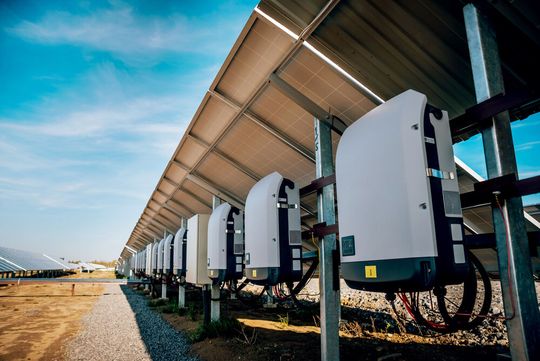
Improving solar energy efficiency and system longevity are key drivers to lowering costs and encouraging widespread adoption. Inverters and battery storage systems have led the charge. Photovoltaic inverters were among the first adopters of gallium nitride (GaN) wide bandgap semiconductors (WBGS) for power conversion. The redesign of inverters with WBGS technology has enabled substantive efficiency gains, allowing operation at higher voltages, currents, and temperatures. Li-I battery designs have also progressed, delivering higher power densities than their predecessors. Advances like these in power switching, storage performance, and dependability improvements are critical for future solar energy success.
With solar arrays expected to last 25 – 30 years and battery storage systems pushing 15 years in some cases, strategies to improve dependable operation and keep elements like dust and moisture out are essential. System design innovations are made even more impactful by performance-enhancing and protective materials integrated to optimize function, safeguard against harsh outdoor environments, and facilitate reliability for lifetime expectancy. For example, thermal management solutions are vital for highperformance power conversion and storage. WBGS run at much higher voltages with very high power densities, necessitating effective heat dissipation. Li-I batteries’ charge and discharge rates also generate substantive heat, requiring displacement of that thermal load to avoid catastrophic events. Thermal interface materials are the go-to heatdissipating solution, enabling thorough heat transfer away from heat-generating components. Likewise, gasketing and sealing materials ensure structures and systems – located in outdoor, unpredictable environments – inside the housing remain robust and protected against the elements by allowing service access, while filling gaps to prevent ingress.
Learn more about the topic
Would you like to learn more about alternative energy conversion and storage? Then listen to the podcast with Justin Kolbe, Director, Market Strategy Power Conversion & Industrial Automation at Henkel.
Listen to the Podcast now!Over the Horizon
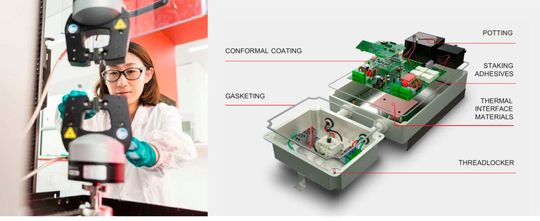
Photovoltaic energy has proven its effectiveness and will continue to expand as an essential piece of the energy supply puzzle. What happens, though, when a solar array’s useful life is complete? Recyclability is clearly the next big hurdle for solar. With more than 850 GW of solar capacity installed globally, a viable recycling strategy is imperative.
Extending the lifetime of solar arrays through reliability and protection improvements has aided in the sustainability of the technology. Indeed, on the materials front, there is progress in this area. Henkel, for example, is committed to innovating materials that provide solar systems developers with formulations that support sustainable practices. Examples include isocyanate-free gasketing materials that reduce exposure to substances of very high concern (SVHCs), using renewable carbon-based feedstocks to replace fossil fuel-based polymer systems, and developing chemistries that enable circularity. Circularity, repairability, and recyclability are the next bridges to cross for solar evolution. The world must contend with the realities of solar panel – and wind turbine, too, for that matter – end-of-life.
Henkel materials have been central to ensuring optimized solar power conversion, storage efficiency, and system reliability, contributing significantly to alternative energy’s advance. We hope to be part of the re-use and safe disposal solution, too, for the good of generations to come.
(ID:49839939)
:quality(80)/p7i.vogel.de/wcms/6e/e5/6ee5ad1dc45fd69a5a5718147605850a/0129347492v2.jpeg "This article introduces the concept of megawatt-hour battery storage systems.
(Source: © malp - stock.adobe.com)")
:quality(80)/p7i.vogel.de/wcms/af/f2/aff2fcbebdde7822fc2ec9a43f06eccc/0125713659v2.jpeg "At PCIM 2025, Professor Kolar showcased the underestimated challenges in the transition to net-zero, highlighting the complexity and costliness due to storage, land, and material needs. Find out more about this here. (Source: © Thanadon88 - stock.adobe.com)")