


:quality(80)/p7i.vogel.de/wcms/2f/f3/2ff3221bf7665de2d0acf83760bfd1fa/0130031523v2.jpeg "Wolfspeed presents a 300 mm silicon carbide technology platform designed to support advanced packaging and high-efficiency power delivery for AI data center infrastructure. (Source: Wolfspeed)")
:quality(80)/p7i.vogel.de/wcms/c3/16/c316e955a97f5d72d9678297b237b9e5/0129932858v2.jpeg "Left: the single-phase version of the SENTRON ECPD with RCM, right: a model of the future three-phase version of the SENTRON ECPD. (Source: Siemens)")
:quality(80)/p7i.vogel.de/wcms/ef/0a/ef0adb0acf793fe147cc27c21f6a7a67/0129954238v2.jpeg "Empower Semiconductor introduces embedded silicon capacitors designed to improve power delivery and stability in AI and high-performance computing processors. (symbolic image) (Source: © IF.arc - stock.adobe.com)")
:quality(80)/p7i.vogel.de/wcms/53/f9/53f9301dfc9292d02960f7996c79cc6e/0129927601v2.jpeg "Wolfspeed’s new 10 kV SiC MOSFET enables high-voltage power conversion for grid and industrial applications. (symbolic image) (Source: © CREATIVE- 3.4 - stock.adobe.com)")
:quality(80)/p7i.vogel.de/wcms/6e/cd/6ecd41d095d5111cf4ed37b714844487/0129930878v2.jpeg "PCIM Asia Shenzhen provides a platform for industry experts to present new developments in power electronics and electrification technologies. (symbolic image) (Source: © killykoon - stock.adobe.com)")
:quality(80)/p7i.vogel.de/wcms/02/c0/02c0e9722f70b1134dbf96fb59a9c73d/0129655179v2.jpeg "The PCIM Conference 2026 will take place from June 9-11, featuring discussions on power electronics trends, including GaN technology and AI applications. (symbolic image) (Source: © Elmira - stock.adobe.com)")
:quality(80)/p7i.vogel.de/wcms/cc/67/cc670ea2029cd2af5c641af70e1bf734/0129816392v4.jpeg "Fraunhofer IAF coordinates the EU SUPREME project to accelerate GaN and SiC power semiconductor innovation in Europe. (Source: Fraunhofer IAF)")
:quality(80)/p7i.vogel.de/wcms/ea/e6/eae6aee30071e67a5627027974437134/0129544613v2.jpeg "GlobalFoundries and Renesas strengthen their collaboration to support U.S.-based semiconductor production and supply chain resilience. (Source: © ronstik - stock.adobe.com)")
:quality(80)/p7i.vogel.de/wcms/3c/4b/3c4bbc68dda65c7071b4376fb57423b0/0130030465v2.jpeg "Faraday’s laws explain the fundamental behavior of magnetic fields and electronic devices in dynamic use cases. The operation of transformers, wireless chargers, induction cookers, induction motors, magnetic levitating trains (MAGLEV Trains), electric violin, and many others depends upon Faraday’s laws. (Source: © Sheraz - stock.adobe.com)")
:quality(80)/p7i.vogel.de/wcms/b1/5e/b15ee02b0ba02db70cf61e37d66ad1d3/0129349127v2.jpeg "Vehicle-to-grid (V2G) chargers enable bidirectional energy flow, allowing electric vehicles to act as mobile energy storage systems that can both draw power from and feed power back into the grid. (Source: © medienvirus - stock.adobe.com)")
:quality(80)/p7i.vogel.de/wcms/26/d5/26d591cc340077026eac56a0e7564faf/0129949603v2.jpeg "Flexible: The solid silicone-based electrolyte is elastic, thereby compensating for the voids that form in solid-state batteries during charging and discharging. (Source: Empa)")
:quality(80)/p7i.vogel.de/wcms/4d/e0/4de02f76a37cbb3df30dd231de589c8e/0128866890v2.jpeg "Both legacy and vGaN show higher carrier mobility and band gap energies compared to other power semiconductors. (Source: © phonlamaiphoto - stock.adobe.com)")
:quality(80)/p7i.vogel.de/wcms/be/c8/bec8d43fc0ee73414274be44608b2970/0129748903v2.jpeg "The Infiniium XR804KA real-time oscilloscope delivers faster response time, improved stability, and streamlined workflows for high-speed digital and compliance testing. (Source: Keysight)")
:quality(80)/p7i.vogel.de/wcms/23/ee/23ee4a97790d6009dbfd7d9577ffa723/0129220424v2.jpeg "The R&S FPL1044 with the new RTSA option makes 40 MHz real-time frequency analysis available up to 44 GHz. (Source: Rohde & Schwarz )")
:quality(80)/p7i.vogel.de/wcms/3c/d1/3cd1cacbceb792ba63727199c61ca434/0127801860v2.jpeg "Thanks to cloud technology, users can collaborate on projects from anywhere and always have access to the latest planning data. (Source: SIEMENS)")
:quality(80)/p7i.vogel.de/wcms/5a/a0/5aa0436498af618297961fd54ab36cdf/0126290792v2.jpeg "Siemens accelerates student-led semiconductor innovation across Europe’s leading technical universities through Cre8Ventures’ Open Higher Education Program developed in collaboration with Arm and University of Southampton (Source: Siemens Digital Industries Software)")
BRIDGE RECTIFIER Graetz bridge for HVDC
Related Vendors
:fill(fff,0)/p7i.vogel.de/companies/63/c7/63c7da97be945/diotec.png "diotec (Diotec Semiconductor AG)")
:fill(fff,0)/p7i.vogel.de/companies/5f/71/5f71d5f92a5f6/2000px-rogers-corporation-logo-svg.png "2000px-Rogers_Corporation_Logo.svg.png (rogers germany)")
Named after German Physicist Leo Graetz, the Graetz bridge is one of the most common rectifiers used in modern electronics. This article explains the Graetz bridge and its use in High-Voltage Direct Current or simply HVDC converters.
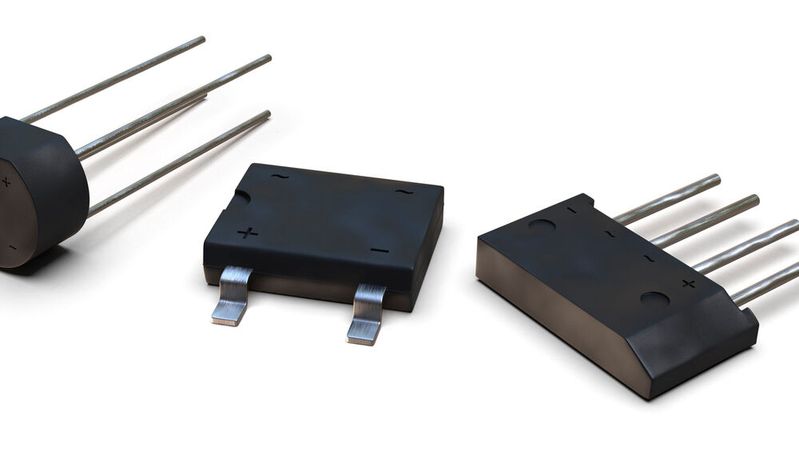
Graetz bridges are essential components in various power electronic systems, offering efficient and reliable AC-to-DC conversion. Understanding the principles and operation of Graetz bridges is crucial for designing and analyzing power circuits.
What is the Graetz bridge and how is it different from other rectifiers?
Graetz bridge is a full-wave typical four or six-diode bridge without a centre-tapped transformer. Similar to other rectifiers, this circuit converts AC into DC. Graetz Bridge does not need a centre-tap transformer because all the diodes in the conduction cycle maintain the current flow in the desirable direction.
4-pulse Graetz bridge
The 4-pulse Graetz bridge uses four diodes. During the positive half cycle, two diodes D1 and D3 remain on while the other two diodes D2 and D4 remain off. Diodes D1 and D3 conduct while diodes D2 and D4 remain in the blocking mode.
During the negative half cycle, two diodes D2 and D4 remain on while the other two diodes D1 and D3 remain off. Diodes D2 and D4 conduct while diodes D1 and D3 remain in the blocking mode.
As a result, diodes conduct current in the desired direction to generate a pulsating DC output. The complete working of bridge rectifiers is explained in our basic knowledge rectifier article.
6-pulse Graetz bridge for HVDC converters
The 6-pulse Graetz bridge uses six diodes in three-phase systems. While each diode in a 4-pulse Graetz bridge conducts for half a cycle or 180 degrees, diodes in a 6-pulse Graetz bridge conduct for less than half a cycle or 120 degrees.
:quality(80)/p7i.vogel.de/wcms/b4/9b/b49b46625712039e0738b55aab6369a3/87458245v2.jpeg "A rectifier diode is a two-lead semiconductor that allows current to pass in only one direction. Generally, P-N junction Diode is formed by joining together n-type and p-type semiconductor materials. (Source: ©YouraPechkin - stock.adobe.com)")
Semiconductors
What are diodes and rectifiers?
Construction
The three-phase AC supply has three voltages: VA (Phase A), VB (Phase B), and VC (Phase C).
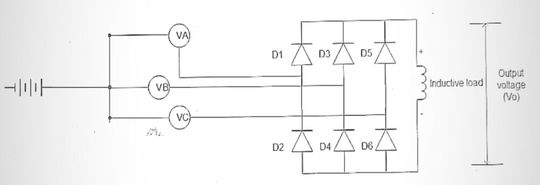
Cathodes of diodes D1, D3, and D5 are connected to the positive terminal of the inductive load. Anodes of diodes D1, D3, and D5 are connected to input AC supply voltages.
Similarly, anodes of diodes D2, D4, and D6 are connected to the negative terminal of the inductive load. Cathodes of diodes D2, D4, and D6 are connected to input AC supply voltages.
Phases
The input voltage is fed from transformer winding arranged in a Wye or Delta configuration. In the general use case at substations, a Delta-Wye or Wye-Delta transformer supplies three-phase voltage to the Graetz bridge. In the above diagram, each voltage phase is connected to the anode of one diode and the cathode of the other diode.
Phase A
The anode of D1 and the cathode of D2 are connected to VA.
Phase B
The anode of D3 and the cathode of D4 are connected to VB.
Phase C
The anode of D5 and the cathode of D6 are connected to VC.
Operation
A diode conducts only when the anode is more positive with respect to the cathode. All six diodes do not conduct at the same time; instead, one pair of diodes conducts while the other remains in the blocking state. As each pair is separated by pi/3 or 60 degrees, each diode conducts for 120 degrees.
Case 1
Diodes D1, D2, D3, and D4 form a bridge rectifier in the phase network of A and B. As VC = 0 V, VA reaches the maximum positive peak voltage and VB reaches the maximum negative peak voltage.
Diodes D4 and D1 become forward-biased while D3 and D2 become reverse-biased. Diodes D3 and D2 function as open circuits. Diodes D4 and D1 form a series connection with the load and start conducting. As a result, we obtain a positive output voltage.
Case 2
Diodes D1, D2, D5, and D6 form a bridge rectifier in a phase network of A and C. As VB = 0 V, VA reaches the maximum positive peak voltage and VC reaches the maximum negative peak voltage.
Diodes D1 and D6 become forward-biased while D2 and D5 become reverse-biased. Diodes D2 and D5 function as open circuits. Diodes D1 and D6 form a series connection with the load and start conducting. As a result, we obtain a positive pulse at the output.
Case 3
Diodes D3, D4, D5, and D6 form a bridge rectifier in a phase network of B and C. As VA = 0 V, VB reaches the maximum positive peak voltage and VC reaches the maximum negative peak voltage.
Diodes D6 and D3 become forward-biased while D5 and D4 become reverse-biased. Diodes D5 and D4 function as open circuits. Diodes D6 and D3 form a series connection with the load and start conducting. As a result, we obtain a positive pulse at the output.
Case 4
Diodes D1, D2, D3, and D4 form a bridge rectifier in the phase network of B and A. As VC = 0 V, VB reaches the maximum positive peak voltage and VA reaches the maximum negative peak voltage.
Diodes D3 and D2 become forward-biased while D4 and D1 become reverse-biased. Diodes D4 and D1 function as open circuits. Diodes D3 and D2 form a series connection with the load and start conducting. As a result, we obtain a positive pulse at the output.
Case 5
Diodes D1, D2, D5, and D6 form a bridge rectifier in a phase network of C and A. As VB = 0 V, VC reaches the maximum positive peak voltage and VA reaches the maximum negative peak voltage.
Diodes D2 and D5 become forward-biased while D1 and D6 become reverse-biased. Diodes D1 and D6 function as open circuits. Diodes D2 and D5 form a series connection with the load and start conducting. As a result, we obtain a positive pulse at the output.
Case 6
Diodes D3, D4, D5, and D6 form a bridge rectifier in a phase network of C and B. As VA = 0 V, VC reaches the maximum positive peak voltage and VB reaches the maximum negative peak voltage.
Diodes D5 and D4 become forward-biased while D6 and D3 become reverse-biased. Diodes D6 and D3 function as open circuits. Diodes D5 and D4 form a series connection with the load and start conducting. As a result, we obtain a positive pulse at the output.
Commutation process
Please note that each diagram may have different names and arrangements of diodes. As a result, the conducting cycle varies from diagram to diagram. However, the operation remains the same. The successive conductive cycles of diode pairs are: D4 and D1, D1 and D6, D6 and D3, D3 and D2, D2 and D5, and D5 and D4. These cycles repeat till the device remains operational.
Initially only one set of diodes conduct while others remain off. When phase voltages of the AC supply change, the same set of diodes enter a blocking mode and another set of diodes start to conduct. The process of sequential switching in which the current flow transitions from one set of diodes to another is called commutation.
The commutation process ensures the stable operation of the 6-pulse Graetz bridge. There is always a pair of conducting diodes at any point in time. The current flow is never interrupted. As a result, this device performs effective rectification by generating a stable pulsating DC voltage at the output.
Graetz bridge in HVDC
12-pulse Graetz diode bridge
Two 6-pulse Graetz bridges are connected to form a 12-pulse Graetz bridge. Simply put, 12 diodes perform conducting-blocking action in this device. Such a configuration improves HVDC converter performance and reduces ripple and harmonic components.
Graetz diode bridges are used with converters and transformers to maintain a safe voltage level at substations. In addition to AC-to-DC power conversion, another common use is to maintain a galvanic separation between the AC and DC parts of an electrical system.
:quality(80)/p7i.vogel.de/wcms/39/06/39064ce5c12dc868466ce49ff01ac0d5/0105592335.jpeg "The overarching goal of high-frequency power conversion is to make power electronics smaller, smarter, and more efficient. (Source: KPixMining - stock.adobe.com)")
PCIM 2022 KEYNOTE
A look at the past, present, and future of power conversion technology
LCC (Line Commutated Converter)
Replacing diodes with Thyristors enables the construction of an LCC device. The presence of Thyristors gives rise to another terminal called the gate. Now there are three terminals: cathode, anode, and gate. The gate terminal trigger turns on the conducting mode.
Firing angle is a term that describes the initiation of the Thyristor-pair conduction cycle. In simple words, it marks the onset of conducting mode. For a smaller firing angle, a Thyristor-based 12-pulse Graetz bridge functions like a diode-based 12-pulse Graetz bridge.
A higher firing angle delays Thyristor conduction mode. Therefore, the DC output waveform can be controlled through the adjustment of the firing angle for the gate terminal. The “natural” commutation causes a delay at the gate terminal and affects the power factor of the device.
VSC (Voltage Source Converter)
Instead of diodes and Thyristor, VSC uses transistor switches like IGBTs (Insulated Bipolar Junction Transistors) and GTOs (Gate Turn-off Thyristors) to overcome the lagging power factor of LCC in HVDC converters.
VSCs do not rely on AC voltage for natural commutation. Instead, VSCs use methods of PWM (Pulse Width Modulation) to implement “forced commutation”, irrespective of AC voltage strength. As a result, these devices operate in all quadrants and handle active and reactive power both with greater control over the output waveform.
References
(ID:50196930)
:quality(80)/p7i.vogel.de/wcms/af/07/af073e302fcca1153bcaca553175006c/0124143921v2.jpeg "Thyristors are power semiconductor devices used in industrial power control applications. These devices are nothing new; they have been on the market for decades. Learn more about them here. (Source: jossbomon - stock.adobe.com)")
:quality(80)/p7i.vogel.de/wcms/3d/21/3d2163e1c620c06fa94740403dd297d1/0123860891v2.jpeg "Explore the structure, operation, advantages, and drawbacks of Silicon Controlled Rectifiers, a type of thyristor invented in 1956, which serve as essential power-switching components alongside MOSFETs. (Source: Poorna Himasha - stock.adobe.com)")