


:quality(80)/p7i.vogel.de/wcms/2f/f3/2ff3221bf7665de2d0acf83760bfd1fa/0130031523v2.jpeg "Wolfspeed presents a 300 mm silicon carbide technology platform designed to support advanced packaging and high-efficiency power delivery for AI data center infrastructure. (Source: Wolfspeed)")
:quality(80)/p7i.vogel.de/wcms/c3/16/c316e955a97f5d72d9678297b237b9e5/0129932858v2.jpeg "Left: the single-phase version of the SENTRON ECPD with RCM, right: a model of the future three-phase version of the SENTRON ECPD. (Source: Siemens)")
:quality(80)/p7i.vogel.de/wcms/ef/0a/ef0adb0acf793fe147cc27c21f6a7a67/0129954238v2.jpeg "Empower Semiconductor introduces embedded silicon capacitors designed to improve power delivery and stability in AI and high-performance computing processors. (symbolic image) (Source: © IF.arc - stock.adobe.com)")
:quality(80)/p7i.vogel.de/wcms/53/f9/53f9301dfc9292d02960f7996c79cc6e/0129927601v2.jpeg "Wolfspeed’s new 10 kV SiC MOSFET enables high-voltage power conversion for grid and industrial applications. (symbolic image) (Source: © CREATIVE- 3.4 - stock.adobe.com)")
:quality(80)/p7i.vogel.de/wcms/6e/cd/6ecd41d095d5111cf4ed37b714844487/0129930878v2.jpeg "PCIM Asia Shenzhen provides a platform for industry experts to present new developments in power electronics and electrification technologies. (symbolic image) (Source: © killykoon - stock.adobe.com)")
:quality(80)/p7i.vogel.de/wcms/02/c0/02c0e9722f70b1134dbf96fb59a9c73d/0129655179v2.jpeg "The PCIM Conference 2026 will take place from June 9-11, featuring discussions on power electronics trends, including GaN technology and AI applications. (symbolic image) (Source: © Elmira - stock.adobe.com)")
:quality(80)/p7i.vogel.de/wcms/cc/67/cc670ea2029cd2af5c641af70e1bf734/0129816392v4.jpeg "Fraunhofer IAF coordinates the EU SUPREME project to accelerate GaN and SiC power semiconductor innovation in Europe. (Source: Fraunhofer IAF)")
:quality(80)/p7i.vogel.de/wcms/ea/e6/eae6aee30071e67a5627027974437134/0129544613v2.jpeg "GlobalFoundries and Renesas strengthen their collaboration to support U.S.-based semiconductor production and supply chain resilience. (Source: © ronstik - stock.adobe.com)")
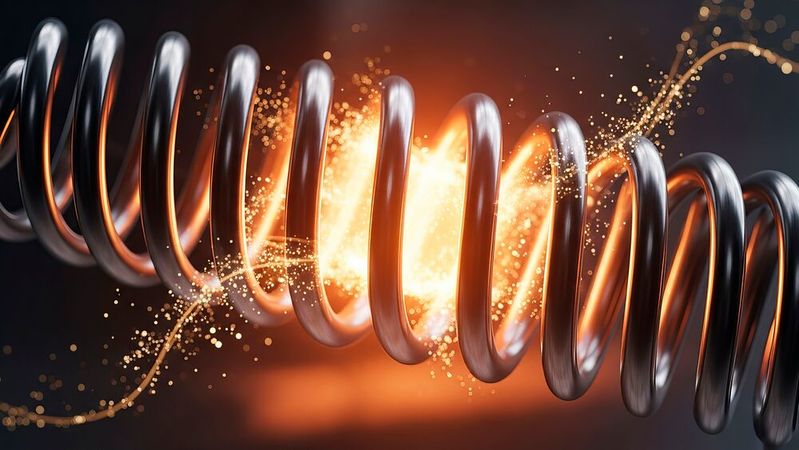
:quality(80)/p7i.vogel.de/wcms/3c/4b/3c4bbc68dda65c7071b4376fb57423b0/0130030465v2.jpeg "Faraday’s laws explain the fundamental behavior of magnetic fields and electronic devices in dynamic use cases. The operation of transformers, wireless chargers, induction cookers, induction motors, magnetic levitating trains (MAGLEV Trains), electric violin, and many others depends upon Faraday’s laws. (Source: © Sheraz - stock.adobe.com)")
:quality(80)/p7i.vogel.de/wcms/b1/5e/b15ee02b0ba02db70cf61e37d66ad1d3/0129349127v2.jpeg "Vehicle-to-grid (V2G) chargers enable bidirectional energy flow, allowing electric vehicles to act as mobile energy storage systems that can both draw power from and feed power back into the grid. (Source: © medienvirus - stock.adobe.com)")
:quality(80)/p7i.vogel.de/wcms/26/d5/26d591cc340077026eac56a0e7564faf/0129949603v2.jpeg "Flexible: The solid silicone-based electrolyte is elastic, thereby compensating for the voids that form in solid-state batteries during charging and discharging. (Source: Empa)")
:quality(80)/p7i.vogel.de/wcms/4d/e0/4de02f76a37cbb3df30dd231de589c8e/0128866890v2.jpeg "Both legacy and vGaN show higher carrier mobility and band gap energies compared to other power semiconductors. (Source: © phonlamaiphoto - stock.adobe.com)")
:quality(80)/p7i.vogel.de/wcms/be/c8/bec8d43fc0ee73414274be44608b2970/0129748903v2.jpeg "The Infiniium XR804KA real-time oscilloscope delivers faster response time, improved stability, and streamlined workflows for high-speed digital and compliance testing. (Source: Keysight)")
:quality(80)/p7i.vogel.de/wcms/23/ee/23ee4a97790d6009dbfd7d9577ffa723/0129220424v2.jpeg "The R&S FPL1044 with the new RTSA option makes 40 MHz real-time frequency analysis available up to 44 GHz. (Source: Rohde & Schwarz )")
:quality(80)/p7i.vogel.de/wcms/3c/d1/3cd1cacbceb792ba63727199c61ca434/0127801860v2.jpeg "Thanks to cloud technology, users can collaborate on projects from anywhere and always have access to the latest planning data. (Source: SIEMENS)")
:quality(80)/p7i.vogel.de/wcms/5a/a0/5aa0436498af618297961fd54ab36cdf/0126290792v2.jpeg "Siemens accelerates student-led semiconductor innovation across Europe’s leading technical universities through Cre8Ventures’ Open Higher Education Program developed in collaboration with Arm and University of Southampton (Source: Siemens Digital Industries Software)")
BASIC KNOWLEDGE Faraday’s laws of electromagnetic induction
Related Vendors
:fill(fff,0)/p7i.vogel.de/companies/62/a0/62a0a0de7d56a/aic-europe-logo.jpeg "aic-europe-logo (AIC Europe)")
:fill(fff,0)/p7i.vogel.de/companies/66/8b/668becd1c07eb/dowa-logo-word--1-.jpeg "dowa-logo-word--1- (DOWA)")
:fill(fff,0)/p7i.vogel.de/companies/68/08/6808a2b3b6595/het-logo.jpeg "het-logo (Heraeus Electronics)")
Did you know that Faraday’s laws enable a magnetic source to induce a current in a nearby electronic device, without having any physical contact? Faraday’s laws can become a futuristic reason to say “goodbye, heavy wires”. This article describes Faraday’s two laws of electromagnetic induction and discusses their significance in the world of electronics.
English chemist Michael Faraday discovered the laws of electromagnetic induction in 1831. A year later, independently, American physicist Joseph Henry discovered them too. However, Faraday’s work was published earlier, leading him to take the credit. Faraday formulated two laws of electromagnetic induction.
Faraday’s First Law
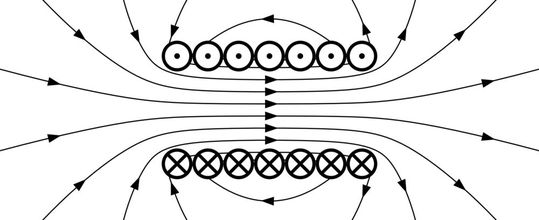
When the magnetic flux associated with a conductor changes, an emf is induced across it. If the conductor is closed-circuited, current flows through it. The action lasts as long as the magnetic flux changes.
Magnetic flux is the strength of a magnetic field passing through a given area. Electromagnetic Force (emf) is the amount of energy transferred to a circuit, measured in volts— emf is voltage. When a conductor is placed in a changing magnetic field, a voltage is induced in it. If the conductor is closed, current flows through it, which is called an induced current. The process continues until the magnetic field varies.
Simple explanation:When a closed conductor is placed in an area where the magnetic field continuously changes, current starts to flow in it.
Faraday’s Second Law
The magnitude of the induced emf is equal to the rate of change of magnetic flux associated with the closed conductor.
For the conductor, the strength of the induced voltage depends on the rate of change of the magnetic field. If the change in magnetic field is large, a large voltage— followed by a high current- flows through the conductor. On the other hand, if there is a small change in the magnetic field— a small emf— a small current flows across the conductor.
:quality(80)/p7i.vogel.de/wcms/39/4f/394faea064dc2a12515d84dbf6c76fe5/0125160070v2.jpeg "Following Moore's Law, technological advancements are revolutionizing healthcare, education, governance, and climate change solutions, with the potential to guide humanity toward a utopian future. (Source: © WrightStudio - stock.adobe.com)")
SEMICONDUCTOR
Can Moore’s Law lead us to utopia?
Are Faraday’s laws complete?
Faraday’s laws were incomplete. Built on Faraday’s work, another physicist, Emil Lenz, formulated another law known as “Lenz’s law” to explain electromagnetic induction. Lenz's law states that the induced current in the conductor, the one produced with respect to changing magnetic flux, opposes its cause.
Explanation: When a closed conductor is placed in a changing magnetic field, an emf is induced in it, followed by a current. The induced current produces a magnetic field of opposite polarity such that it opposes the originally present magnetic field. In simple words, the direction of the induced emf (hence current) is opposite to the direction of changing magnetic flux.
Case 1:If the magnetic flux increases, the induced current flows in such a direction that it produces a magnetic field to oppose the change. The current will try to reduce the original magnetic flux.
Case 2:Similarly, if the magnetic flux decreases, the induced current flows in the same direction to produce a magnetic field that would create more magnetic flux.
Formula for Faraday’s laws
As per Faraday’s second law, the magnitude of the induced emf depends upon the change in magnetic flux.
denotes the value of emf (electromotive force), and denotes the value of magnetic flux. In physics, derivatives determine the rate of change in an entity.
According to Lenz’s law, the direction of the induced emf is opposite to the original magnetic flux.
In most cases, the closed conductor is a coil with N tightly wound turns. Hence, the formula becomes—
If flux changes from ϕ1 to ϕ2 in time t, the formula for induced emf becomes—
- The negative sign shows an opposing effect.
- ξ (emf) is in volts.
- Φ1 and Φ2 (magnetic flux) are in Webers.
- t (time) is in seconds.
- N (coil turns) is only a number.
:quality(80)/p7i.vogel.de/wcms/cb/38/cb38bf951c0af8a8de423fedce2489d8/0129352475v2.jpeg "Honeywell’s hybrid electrification solution combines electrical and thermal energy sources with real-time control to optimize industrial heat processes. (Source: © PRI - stock.adobe.com)")
INDUSTRIAL ELECTRIFICATION
New hybrid solution drives real-time electrification for heat manufacturers
How did Faraday confirm the laws of electromagnetic induction?
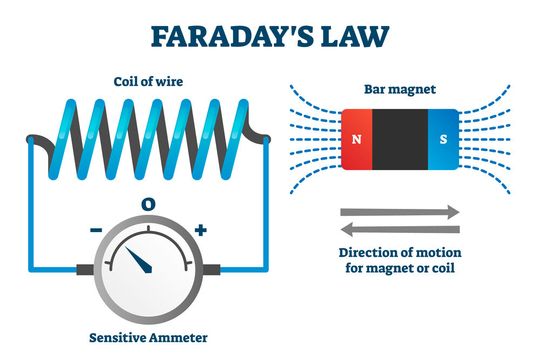
Faraday’s laws of electromagnetic induction are based on a series of experiments Faraday and Henry conducted around 1831-1832. The experiment series confirms a direct relationship between magnetism and current. The experiment involved a magnet, coil, and galvanometer. A galvanometer is a device that can measure small currents with accuracy.
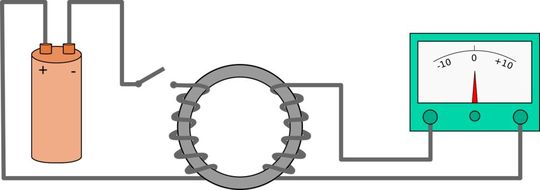
Case 1: Magnet and coil at rest
When the magnet and coil are stationary, the galvanometer shows no reading. The galvanometer needle stays at the center or zero position.
Case 2: Magnet moves towards the coil
When the magnet moves towards the coil, the needle of the galvanometer moves in one direction to show a reading.
If the N-pole of the magnet is moved closer to the coil, the galvanometer needle moves to the right of zero. If the N-pole is taken away from the coil, the galvanometer needle moves towards the left of the zero, in the opposite direction. Similar but opposite results can be obtained by bringing the S-pole of the magnet closer to the coil.
If the S-pole of the magnet is moved closer to the coil, the galvanometer needle moves to the left of zero. If the S-pole is taken away from the coil, the galvanometer needle moves towards the right, in the opposite direction. This shows the current flow in opposite directions.
The reason for the needle movement is the change of magnetic flux in the coil. When the magnet is stationary, the coil contains a similar number of magnetic field lines passing through it. As soon as either of them moves, the number of these magnetic field lines starts to vary.
Case 3: Magnet becomes stationary near the coil
The magnet is held stationary near the coil. The galvanometer needle returns to zero, with no reading.
Case 4: Magnet moves away from the coil
When the magnet moves away from the coil, the galvanometer shows a reading. The needle of the galvanometer deflects in the opposite direction. Results similar to case 2 were obtained. To obtain a galvanometer reading, relative motion is compulsory between the magnet and the coil. It means either of magnet or the coil should move to obtain galvanometer readings.
When the relative motion between the magnet and the coil is large, the galvanometer shows a large variation in the reading. When the relative motion between the magnet and the coil is small, the needle of the galvanometer moves very little to give a small reading.
Case 5: Magnet becomes stationary at some distance from the coil
The magnet is held stationary at a certain distance after the initial motion. The needle of the galvanometer returns to zero. It shows no reading.
Case 6: Mutual induction
In this case, two coils are bound to a cylindrical object. The first coil, known as the primary coil, is connected to the battery and placed away from the galvanometer. The second coil, known as the secondary coil, is connected to the galvanometer.
The primary coil is made to conduct. Current flows across the primary coil. The galvanometer shows no reading. As the current is increased in the primary coil, the induced current starts to flow into the secondary coil. The galvanometer needle shows deflection.
What do Faraday's laws teach?
Faraday’s laws help engineers and physicists predict the magnitude and direction of induced currents. Through these experiments, they can increase the value of the induced current. Increasing the relative motion between the magnetic source and conductor increases the induced current in the desired direction. Another way is to increase the number of turns in the conductor.
:quality(80):fill(efefef,0)/p7i.vogel.de/wcms/5f/fe/5ffedb2e0ffa6/listing.jpg "listing")
Are Faraday’s laws still valid?
Yes, Faraday’s laws are still valid. Faraday’s laws are not an invention but a discovery. The same is true about Lenz’s law. Lenz’s law may appear to be a counterattack on Faraday’s laws. Lenz’s law is a direct consequence of the universal law of conservation of energy. You can’t always produce energy from nothing! It also supports the first law of thermodynamics and Newton’s third law of motion. Applications of Faraday’s laws are listed below.
Power transformers
Power transformers, whether two-phase or three-phase transformers, are constructed using Faraday’s laws. Transformers are used in power generation, power distribution, industrial electrical systems, audio systems, and many other applications.
Induction motors
An induction motor is a type of motor that produces torque from electromagnetic induction. The stator supplies current to the rotor through electromagnetic induction, rather than direct wired connections. Induction motors are used in industries, machines, HVAC systems, pumps, elevators, electric vehicles, and home appliances such as dryers, refrigerators, conditioners, ventilators, and many more.
Induction cookers
An induction cooker is a common application of Faraday’s law, found in our homes. The two-coil experiments of Faraday and Henry can explain power transformer operations. Induced currents heat food (cook it) without fire.
Electric generators
Electric generators rely on Faraday’s laws to convert mechanical energy into electricity. Generators rotate their internal components to change the magnetic field in the coils and induce currents.
Wireless power
Near-field WPT (Wireless Power Transfer) is an emerging technology based on Faraday's laws of electromagnetic induction. Examples include consumer electronics like wireless charging pads, to charge modern smartphones and laptops. They aim to replace AC adapters.
MAGLEV trains
MAGLEV trains (Magnetic Levitation) are super-fast trains that run in a few locations globally. They seem to be a real-time implementation of levitating magnets shown in superconducting experiments. MAGLEV trains use magnets on the track that alter magnetic flux linked with their conductors, hence relying on Faraday’s laws for operation.
References
- https://www.electrical4u.com/faraday-law-of-electromagnetic-induction/#:~:text=Electromagnetic%20Flow%20Meter%20is%20used,the%20velocity%20of%20fluid%20flowing.
- https://resources.pcb.cadence.com/blog/2020-lenz-law-vs-faradays-law-how-do-they-govern-crosstalk-and-emi
(ID:50783051)
:quality(80)/p7i.vogel.de/wcms/0d/d0/0dd02f3d5a1c83c1be444f73910e6b30/0126472071v2.jpeg "Current transducers are essential devices in power electronics, converting high current levels into standardized signals for safe and efficient use across various electronic systems, with applications ranging from motor protection to renewable energy systems and particle accelerators. (Source: © Aimur - stock.adobe.com)")
:quality(80)/p7i.vogel.de/wcms/7a/a5/7aa50649486f059b1d7111f508c5c6e7/0128629162v2.jpeg "This article explains current transducers and their role in power electronics. (Source: © kwanchanachai - stock.adobe.com)")