


:quality(80)/p7i.vogel.de/wcms/2f/f3/2ff3221bf7665de2d0acf83760bfd1fa/0130031523v2.jpeg "Wolfspeed presents a 300 mm silicon carbide technology platform designed to support advanced packaging and high-efficiency power delivery for AI data center infrastructure. (Source: Wolfspeed)")
:quality(80)/p7i.vogel.de/wcms/c3/16/c316e955a97f5d72d9678297b237b9e5/0129932858v2.jpeg "Left: the single-phase version of the SENTRON ECPD with RCM, right: a model of the future three-phase version of the SENTRON ECPD. (Source: Siemens)")
:quality(80)/p7i.vogel.de/wcms/ef/0a/ef0adb0acf793fe147cc27c21f6a7a67/0129954238v2.jpeg "Empower Semiconductor introduces embedded silicon capacitors designed to improve power delivery and stability in AI and high-performance computing processors. (symbolic image) (Source: © IF.arc - stock.adobe.com)")
:quality(80)/p7i.vogel.de/wcms/53/f9/53f9301dfc9292d02960f7996c79cc6e/0129927601v2.jpeg "Wolfspeed’s new 10 kV SiC MOSFET enables high-voltage power conversion for grid and industrial applications. (symbolic image) (Source: © CREATIVE- 3.4 - stock.adobe.com)")
:quality(80)/p7i.vogel.de/wcms/6e/cd/6ecd41d095d5111cf4ed37b714844487/0129930878v2.jpeg "PCIM Asia Shenzhen provides a platform for industry experts to present new developments in power electronics and electrification technologies. (symbolic image) (Source: © killykoon - stock.adobe.com)")
:quality(80)/p7i.vogel.de/wcms/02/c0/02c0e9722f70b1134dbf96fb59a9c73d/0129655179v2.jpeg "The PCIM Conference 2026 will take place from June 9-11, featuring discussions on power electronics trends, including GaN technology and AI applications. (symbolic image) (Source: © Elmira - stock.adobe.com)")
:quality(80)/p7i.vogel.de/wcms/cc/67/cc670ea2029cd2af5c641af70e1bf734/0129816392v4.jpeg "Fraunhofer IAF coordinates the EU SUPREME project to accelerate GaN and SiC power semiconductor innovation in Europe. (Source: Fraunhofer IAF)")
:quality(80)/p7i.vogel.de/wcms/ea/e6/eae6aee30071e67a5627027974437134/0129544613v2.jpeg "GlobalFoundries and Renesas strengthen their collaboration to support U.S.-based semiconductor production and supply chain resilience. (Source: © ronstik - stock.adobe.com)")
:quality(80)/p7i.vogel.de/wcms/b1/5e/b15ee02b0ba02db70cf61e37d66ad1d3/0129349127v2.jpeg "Vehicle-to-grid (V2G) chargers enable bidirectional energy flow, allowing electric vehicles to act as mobile energy storage systems that can both draw power from and feed power back into the grid. (Source: © medienvirus - stock.adobe.com)")
:quality(80)/p7i.vogel.de/wcms/26/d5/26d591cc340077026eac56a0e7564faf/0129949603v2.jpeg "Flexible: The solid silicone-based electrolyte is elastic, thereby compensating for the voids that form in solid-state batteries during charging and discharging. (Source: Empa)")
:quality(80)/p7i.vogel.de/wcms/4d/e0/4de02f76a37cbb3df30dd231de589c8e/0128866890v2.jpeg "Both legacy and vGaN show higher carrier mobility and band gap energies compared to other power semiconductors. (Source: © phonlamaiphoto - stock.adobe.com)")
:quality(80)/p7i.vogel.de/wcms/18/0b/180b7b63afc91e523592d8a5ce161c96/0129847487v2.jpeg "InGaAs-based photodetectors enable sensitive and fast detection in the short-wave infrared spectrum for modern sensing and communication applications. (Source: © VITALII - stock.adobe.com)")
:quality(80)/p7i.vogel.de/wcms/be/c8/bec8d43fc0ee73414274be44608b2970/0129748903v2.jpeg "The Infiniium XR804KA real-time oscilloscope delivers faster response time, improved stability, and streamlined workflows for high-speed digital and compliance testing. (Source: Keysight)")
:quality(80)/p7i.vogel.de/wcms/23/ee/23ee4a97790d6009dbfd7d9577ffa723/0129220424v2.jpeg "The R&S FPL1044 with the new RTSA option makes 40 MHz real-time frequency analysis available up to 44 GHz. (Source: Rohde & Schwarz )")
:quality(80)/p7i.vogel.de/wcms/3c/d1/3cd1cacbceb792ba63727199c61ca434/0127801860v2.jpeg "Thanks to cloud technology, users can collaborate on projects from anywhere and always have access to the latest planning data. (Source: SIEMENS)")
:quality(80)/p7i.vogel.de/wcms/5a/a0/5aa0436498af618297961fd54ab36cdf/0126290792v2.jpeg "Siemens accelerates student-led semiconductor innovation across Europe’s leading technical universities through Cre8Ventures’ Open Higher Education Program developed in collaboration with Arm and University of Southampton (Source: Siemens Digital Industries Software)")
INDUSTRY CONCERNS European electronics decline threatens security and sovereignty
Related Vendors
:fill(fff,0)/p7i.vogel.de/companies/63/c7/63c7da97be945/diotec.png "diotec (Diotec Semiconductor AG)")
:fill(fff,0)/p7i.vogel.de/companies/66/9a/669a2816c84be/pcim-logo.png "pcim-logo (PCIM)")
:fill(fff,0)/p7i.vogel.de/companies/68/08/6808a2b3b6595/het-logo.jpeg "het-logo (Heraeus Electronics)")
The decline of printed circuit board and electronic manufacturing services in Europe is posing significant risks to the continent's security and sovereignty. With only a small fraction of the global production taking place locally, Europe's dependence on foreign suppliers threatens the integrity of its critical infrastructures and defense capabilities. ZVEI is calling for a robust de-risking strategy to bolster domestic manufacturing and protect against potential manipulation and competitive disadvantages.
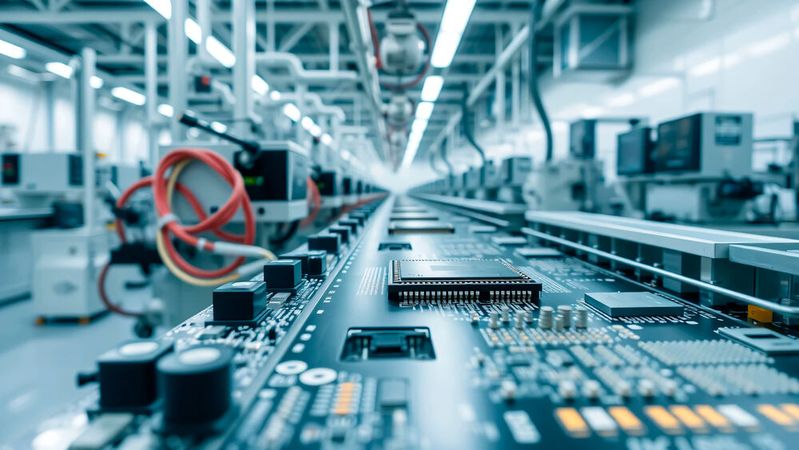
Germany and Europe cannot continue to passively watch the decline of their printed circuit board (PCB) industry and electronic manufacturing service providers (EMS). Currently, only two percent of globally produced PCBs are manufactured in Europe, and the continent's electronics manufacturing accounts for only ten percent of the global market volume. Both PCB and EMS manufacturing are vital for the secure operation of critical infrastructures and the defense industry. The inability of Germany and Europe to rely on their own capacities and expertise poses significant risks: deliveries could be withheld or even manipulated. "We need a reliable de-risking strategy to secure our European interests through targeted measures," demands Wolfgang Weber, Chairman of the ZVEI Management Board.
Given the crucial role of PCB and EMS manufacturing in the microelectronics ecosystem, the new federal government must also address this issue. Increasing dependence on a few suppliers from the Far East, in the current geopolitical context, carries high risks that threaten European security. In the worst-case scenario, manipulation of technical infrastructures and defense technology could occur. These could be achieved, for instance, through "hardware trojans" or hidden backdoors in electronic systems with minimal effort at any stage of manufacturing. Discovering them, however, would be extremely challenging.
Furthermore, the situation could worsen due to tariffs imposed by President Trump on Chinese products. There is a risk that PCBs from low-cost Chinese production could flood the European market, with severe consequences for the competitiveness of local suppliers. Europe must therefore vigorously defend its independence and resilience. This includes particularly strengthening the PCB and EMS manufacturing industry through a combination of trade and industrial policy. "We must examine protective trade instruments — such as anti-subsidy or anti-dumping measures — and impose them where justified," Weber further explains.
:quality(80)/p7i.vogel.de/wcms/dd/02/dd0266e6667a93559f4962b94907b170/0121499277v2.jpeg "Major players in the European PCB industry are not overly optimistic about the future of the European PCB industry. (Source: Екатерина Чумаченко - stock.adobe.com)")
PRINTED CIRCUIT BOARD MARKET
What's driving the European PCB industry crisis?
Additionally, it is crucial to establish trustworthy sources: to protect critical infrastructures and defense, PCBs and electronics manufacturing should only be sourced from reliable and trustworthy providers. Weber states, "We must also consider reducing tariffs on base materials: European PCB manufacturers need to import base materials, which are subject to tariffs, whereas PCBs from China are tariff-free. This is absurd and cannot continue, as it creates a nonsensical competitive disadvantage for European production."
Industrial policy must strategically enhance the competitiveness of PCB manufacturers and electronics manufacturing in the international market. Continuing efforts under the European Chips Act should focus on downstream manufacturing steps (PCB, packaging, advanced packaging, EMS) and consider process know-how in the value chain.
PCIM Expo 2026: Join the leading exhibition!

Lead the future of power electronics! Exhibit your latest solutions, connect with key players, and elevate your brand visibility worldwide at the PCIM Expo from 9 – 11 June 2026 in Nuremberg, Germany. Benefit from our Early Bird discount by 30 June 2025.
Secure your spot now
(ID:50444642)
:quality(80)/p7i.vogel.de/wcms/f2/fe/f2fecc2176293ef8264423953058f53a/0113459766v2.jpeg "Find out more about the top players in the PCB industry. (Source: kody_king - stock.adobe.com)")
:quality(80)/p7i.vogel.de/wcms/73/1b/731b2a2ed1082e7a4bc6971b76566475/0125343087v2.jpeg "In Q2 2025, the semiconductor industry saw unprecedented growth driven by AI demand, but it masked underlying structural strains and geopolitical challenges, setting the stage for a future where resilience is as vital as innovation. (Source: © Rhony - stock.adobe.com)")