


:quality(80)/p7i.vogel.de/wcms/2f/f3/2ff3221bf7665de2d0acf83760bfd1fa/0130031523v2.jpeg "Wolfspeed presents a 300 mm silicon carbide technology platform designed to support advanced packaging and high-efficiency power delivery for AI data center infrastructure. (Source: Wolfspeed)")
:quality(80)/p7i.vogel.de/wcms/c3/16/c316e955a97f5d72d9678297b237b9e5/0129932858v2.jpeg "Left: the single-phase version of the SENTRON ECPD with RCM, right: a model of the future three-phase version of the SENTRON ECPD. (Source: Siemens)")
:quality(80)/p7i.vogel.de/wcms/ef/0a/ef0adb0acf793fe147cc27c21f6a7a67/0129954238v2.jpeg "Empower Semiconductor introduces embedded silicon capacitors designed to improve power delivery and stability in AI and high-performance computing processors. (symbolic image) (Source: © IF.arc - stock.adobe.com)")
:quality(80)/p7i.vogel.de/wcms/53/f9/53f9301dfc9292d02960f7996c79cc6e/0129927601v2.jpeg "Wolfspeed’s new 10 kV SiC MOSFET enables high-voltage power conversion for grid and industrial applications. (symbolic image) (Source: © CREATIVE- 3.4 - stock.adobe.com)")
:quality(80)/p7i.vogel.de/wcms/6e/cd/6ecd41d095d5111cf4ed37b714844487/0129930878v2.jpeg "PCIM Asia Shenzhen provides a platform for industry experts to present new developments in power electronics and electrification technologies. (symbolic image) (Source: © killykoon - stock.adobe.com)")
:quality(80)/p7i.vogel.de/wcms/02/c0/02c0e9722f70b1134dbf96fb59a9c73d/0129655179v2.jpeg "The PCIM Conference 2026 will take place from June 9-11, featuring discussions on power electronics trends, including GaN technology and AI applications. (symbolic image) (Source: © Elmira - stock.adobe.com)")
:quality(80)/p7i.vogel.de/wcms/cc/67/cc670ea2029cd2af5c641af70e1bf734/0129816392v4.jpeg "Fraunhofer IAF coordinates the EU SUPREME project to accelerate GaN and SiC power semiconductor innovation in Europe. (Source: Fraunhofer IAF)")
:quality(80)/p7i.vogel.de/wcms/ea/e6/eae6aee30071e67a5627027974437134/0129544613v2.jpeg "GlobalFoundries and Renesas strengthen their collaboration to support U.S.-based semiconductor production and supply chain resilience. (Source: © ronstik - stock.adobe.com)")
:quality(80)/p7i.vogel.de/wcms/b1/5e/b15ee02b0ba02db70cf61e37d66ad1d3/0129349127v2.jpeg "Vehicle-to-grid (V2G) chargers enable bidirectional energy flow, allowing electric vehicles to act as mobile energy storage systems that can both draw power from and feed power back into the grid. (Source: © medienvirus - stock.adobe.com)")
:quality(80)/p7i.vogel.de/wcms/26/d5/26d591cc340077026eac56a0e7564faf/0129949603v2.jpeg "Flexible: The solid silicone-based electrolyte is elastic, thereby compensating for the voids that form in solid-state batteries during charging and discharging. (Source: Empa)")
:quality(80)/p7i.vogel.de/wcms/4d/e0/4de02f76a37cbb3df30dd231de589c8e/0128866890v2.jpeg "Both legacy and vGaN show higher carrier mobility and band gap energies compared to other power semiconductors. (Source: © phonlamaiphoto - stock.adobe.com)")
:quality(80)/p7i.vogel.de/wcms/18/0b/180b7b63afc91e523592d8a5ce161c96/0129847487v2.jpeg "InGaAs-based photodetectors enable sensitive and fast detection in the short-wave infrared spectrum for modern sensing and communication applications. (Source: © VITALII - stock.adobe.com)")
:quality(80)/p7i.vogel.de/wcms/be/c8/bec8d43fc0ee73414274be44608b2970/0129748903v2.jpeg "The Infiniium XR804KA real-time oscilloscope delivers faster response time, improved stability, and streamlined workflows for high-speed digital and compliance testing. (Source: Keysight)")
:quality(80)/p7i.vogel.de/wcms/23/ee/23ee4a97790d6009dbfd7d9577ffa723/0129220424v2.jpeg "The R&S FPL1044 with the new RTSA option makes 40 MHz real-time frequency analysis available up to 44 GHz. (Source: Rohde & Schwarz )")
:quality(80)/p7i.vogel.de/wcms/3c/d1/3cd1cacbceb792ba63727199c61ca434/0127801860v2.jpeg "Thanks to cloud technology, users can collaborate on projects from anywhere and always have access to the latest planning data. (Source: SIEMENS)")
:quality(80)/p7i.vogel.de/wcms/5a/a0/5aa0436498af618297961fd54ab36cdf/0126290792v2.jpeg "Siemens accelerates student-led semiconductor innovation across Europe’s leading technical universities through Cre8Ventures’ Open Higher Education Program developed in collaboration with Arm and University of Southampton (Source: Siemens Digital Industries Software)")
THYRISTORS Demystifying silicon controlled rectifiers
Related Vendors
:fill(fff,0)/p7i.vogel.de/companies/63/c7/63c7da97be945/diotec.png "diotec (Diotec Semiconductor AG)")
:fill(fff,0)/p7i.vogel.de/companies/5f/71/5f71d5f92a5f6/2000px-rogers-corporation-logo-svg.png "2000px-Rogers_Corporation_Logo.svg.png (rogers germany)")
:fill(fff,0)/p7i.vogel.de/companies/68/00/6800eb0040fb9/cobalt-vertical-aligned-bold.png "cobalt-vertical-aligned-bold (CISSOID SA)")
Silicon-controlled rectifier “SCR” is more of a thyristor than a rectifier. Invented in 1956, SCRs are appropriate power-switching options in addition to MOSFETs. The article explains SCRs through their structure, operation, advantages, and drawbacks.
Often misunderstood as merely another type of rectifier, silicon-controlled rectifiers (SCRs) stand out as a specialized type of thyristor known for efficiently controlling power flow in a variety of industrial applications. This piece breaks down the complexities of SCRs, offering insight into their unique design and the role they play in modern power electronics.
What is an SCR?
SCR was invented within a year of theoretical and experimental research. A group of power engineers at Bell Laboratories Scientists invented SCRs in 1956. A year later, the device was commercialized — a decade after the invention of the transistor.
SCR definition
Silicon-controlled rectifier, popularly known as SCR, is a four-layer three-terminal solid-state current-controlled device used in high-power switching and various other applications. General Electric used the silicon-controlled rectifier (SCR) as a trade name for the device. Since then, the term SCR entered the mainstream electronics industry.
SCR symbol
Silicon-controlled rectifiers are three-terminal devices. The three terminals are the cathode, anode, and gate.
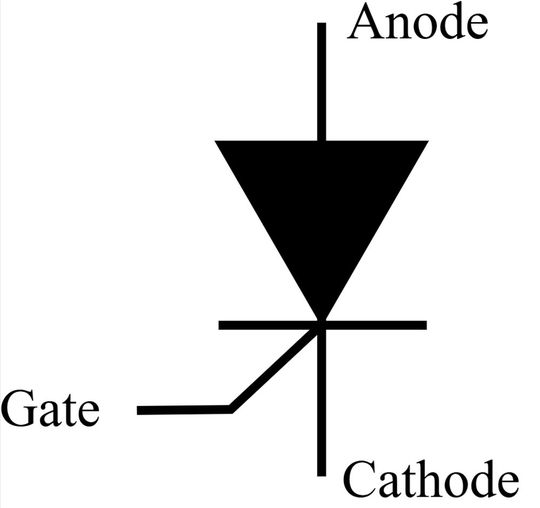
The SCR symbol resembles a diode but with a gate terminal. The cathode and anode terminals handle power flow. The gate terminal offers controlling and switching capabilities.
:quality(80)/p7i.vogel.de/wcms/b4/9b/b49b46625712039e0738b55aab6369a3/87458245v2.jpeg "A rectifier diode is a two-lead semiconductor that allows current to pass in only one direction. Generally, P-N junction Diode is formed by joining together n-type and p-type semiconductor materials. (Source: ©YouraPechkin - stock.adobe.com)")
Semiconductors
What are diodes and rectifiers?
Is the silicon-controlled rectifier and thyristor the same?
The term “Thyristor” is interchangeably used for silicon-controlled rectifiers. However, both devices are not the same — they are similar. Silicon-controlled rectifiers are a subset of thyristors. Both devices are similar in structure and are used in the same applications.
SCR structure
Silicon-controlled rectifiers have four layers of semiconductors: PNPN. SCR consists of four alternating PNPN layers to exhibit switching behavior and serve power control applications. A heavily doped P layer is placed towards the anode. Similarly, the heavily doped N layer is placed towards the cathode. The other N layer is very lightly doped and the other P layer is moderately doped.
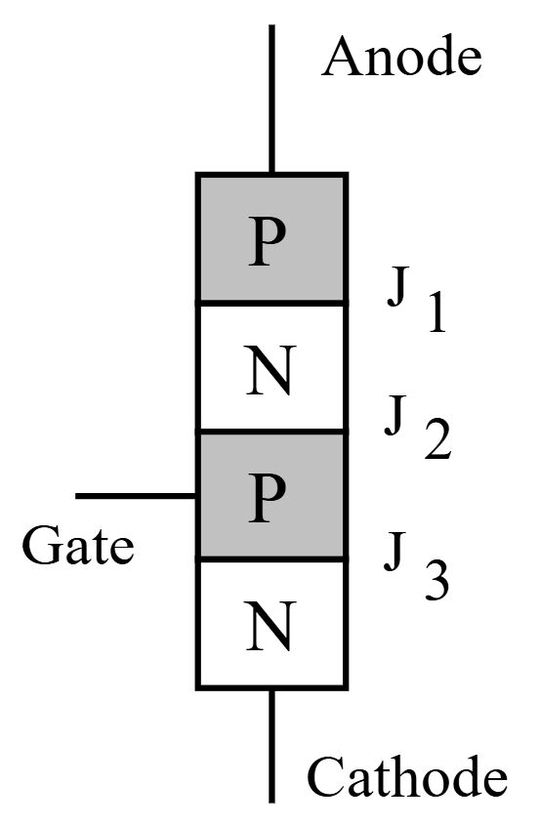
The heavily doped P and lightly doped N layers form junction J1 (PN). The lightly doped N and moderately doped P layers form junction J2 (NP). Lastly, the moderately doped P and heavily doped N layers form junction J3 (PN).
Due to the PNPN structure, SCR internally contains two transistors- PNP and NPN. Heavily doped P, lightly doped N, and moderately doped P layers form a PNP transistor (T1). Similarly, the heavily doped N, moderately doped P, and lightly doped N layers form an NPN transistor (T2).
:quality(80)/p7i.vogel.de/wcms/6b/d6/6bd6cd7a7e0f98bea4b5a1d63f5f9f8e/0122124466v2.jpeg "MOSFETs are small, energy-efficient transistors used in countless electronic devices, from smartphones to power systems. Learn more about this here. (Source: Kuzmick - stock.adobe.com)")
BASIC KNOWLEDGE – MOSFET
MOSFET – The most popular transistor explained
SCR operation
SCR operates in three modes: Forward blocking mode (off state), forward conduction mode (on state), and reverse blocking mode (off state).
Forward blocking mode
The SCR is forward biased— The positive terminal of the battery is connected to the anode and the negative terminal of the battery is connected to the cathode. The gate is kept at zero potential— no voltage is applied to the gate.
Junctions J1 and J3 become forward-biased. Junction J2 becomes reverse-biased, preventing current flow from the anode to the cathode. A very small leakage current flows in the SCR. The SCR remains off, even though the anode and cathode are forward-biased.
Forward conduction mode
Once an SCR turns on during forward bias, it is said to enter forward conduction mode. There are two methods to put an SCR into forward conduction mode: Increasing applied voltage beyond breakover voltage and triggering the gate terminal.
Beyond breakover voltage
A simple method to turn on the SCR is to apply a voltage higher than the breakover voltage. In silicon-controlled rectifiers, breakover voltage is the maximum amount of applied voltage required to turn on the device. Once the applied voltage exceeds the breakover voltage, junction J2 undergoes avalanche breakdown.
All three junctions start conducting — turning the SCR on. However, the breakover voltage method is not preferred because it can create heavy current surges and damage the device. It is applicable in systems where gate triggering is not feasible.
Gate triggering
The most common method used for SCR turn-on is gate triggering. The anode and cathode terminals remain forward-biased. A positive voltage pulse is applied across the gate terminal. It injects charge carriers into the junction J2. The injection of charge carriers weakens the reverse bias, initiating the conduction. As a result, SCR turns on.
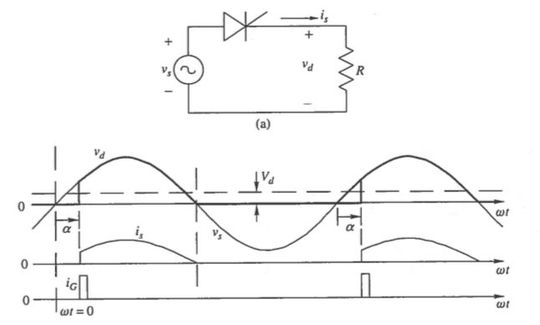
Once the SCR starts to conduct, it no longer requires the positive gate pulse to remain on. The PNPN structure generates a feedback loop consisting of two transistors PNP and NPN. The regenerative feedback sustains the on-state to prevent the SCR from turning off. Simply put, the gate loses the ability to control the device.
:quality(80):fill(efefef,0)/p7i.vogel.de/wcms/5f/fe/5ffedb2e0ffa6/listing.jpg "listing")
Reverse blocking mode
In this mode, SCR is reverse-biased. The anode is connected to the negative terminal, and the cathode is to the positive terminal. Junction J1 and J3 become reverse biased but junction J2 becomes forward biased. Due to the reverse biasing of two major junctions, the SCR remains off.
Minimal leakage current flows due to minority charge carriers in the J2 junction. SCR functions like two diodes connected in a series configuration. Simply put, SCR behaves like an open-switch. If the reverse voltage exceeds the breakdown voltage, junctions J1 and J3 undergo avalanche breakdown.
The reverse current increases and SCR suffers permanent damage. Hence, SCR is only designed to be conducted in forward mode. Modern silicon-controlled rectifiers are designed with capabilities to withstand reverse voltage, known as reverse blocking mode.
Reverse voltage and forward voltage drop ratings are similar in most SCR types used in current source inverters. Other SCR types have low reverse voltage ratings. However, they are used in applications that do not encounter reverse voltages. Other types include connecting an external parallelly connected diode to combat reverse voltage.
SCR turn-off
The SCR can be called an “always turned on” device because it “latches” into the conduction state. The minimum amount of current that enables the SCR to remain latched “on” is called latching current. Holding current is the minimum amount required to keep the SCR on.
SCR turn-off is a tough process. There are two ways to turn off the SCR. Reducing the value of the latching current below the holding current turns off the SCR. Another way to turn off the SCR is to short-circuit the anode and cathode with a push-button switch.
SCR applications
Silicon-controlled rectifiers are used in a variety of high-power applications. These devices are capable of handling high voltages and currents. Some of them are mentioned below.
Power electronics
SCRs are used in high-power applications like power switching, motor speed control, phase control, inverters, rectifiers, and power regulation.
:quality(80)/p7i.vogel.de/wcms/f9/29/f92903189bb36304a6bbc7ca5ba8e3fc/0117522391.jpeg "Read more about the differences between inverters and converters in this article. (Source: BORIS - stock.adobe.com)")
POWER ELECTRONICS
Inverter vs converter: What's the difference?
Power control
The most common use of silicon-controlled rectifiers is power control applications like motor control, heating control, and lighting control.
Power conversion
SCRs enable the rectification of high-power AC in HVDC power transmission. They are also inverter circuits that convert AC to DC.
Various
SCRs are used in various applications like dim lighting, medical equipment, aerospace, welding machines, railway traction, crowbars, EVs, and overvoltage protection systems.
SCR advantages
SCRs offer several key advantages that make them a preferred choice in various electronic applications.
- SCRs have high power handling capabilities.
- Moderate switching speed.
- Low forward voltage drop.
- Silicon-controlled rectifiers use simple gate circuitry.
SCR disadvantages
Despite their benefits, silicon-controlled rectifiers also have certain drawbacks that should be considered in their application.
- Silicon-controlled rectifiers are sensitive to rapid changes in voltage and current.
- SCRs require gate current to focus.
- SCRs can suffer permanent damage through reverse blocking operations.
- Silicon-controlled rectifiers need snubber diodes.
References
PCIM Expo 2025: Join the industry highlight

Position your company at the forefront of the power electronics industry! Exhibit at the PCIM Expo 2025 in Nuremberg, Germany to showcase your solutions and connect with top decision-makers and innovators driving the industry forward.
Learn more
(ID:50366397)
:quality(80)/p7i.vogel.de/wcms/af/07/af073e302fcca1153bcaca553175006c/0124143921v2.jpeg "Thyristors are power semiconductor devices used in industrial power control applications. These devices are nothing new; they have been on the market for decades. Learn more about them here. (Source: jossbomon - stock.adobe.com)")
:quality(80)/p7i.vogel.de/wcms/21/7f/217fcc66cf062b3e3212dcb6c2d53992/0124480366v4.jpeg "Discover the DIAC, a bidirectional semiconductor device blending diode and thyristor properties, revolutionizing AC circuits with its unique structure, operation, and applications. (Source: © Hseyin - stock.adobe.com)")