


:quality(80)/p7i.vogel.de/wcms/2f/f3/2ff3221bf7665de2d0acf83760bfd1fa/0130031523v2.jpeg "Wolfspeed presents a 300 mm silicon carbide technology platform designed to support advanced packaging and high-efficiency power delivery for AI data center infrastructure. (Source: Wolfspeed)")
:quality(80)/p7i.vogel.de/wcms/c3/16/c316e955a97f5d72d9678297b237b9e5/0129932858v2.jpeg "Left: the single-phase version of the SENTRON ECPD with RCM, right: a model of the future three-phase version of the SENTRON ECPD. (Source: Siemens)")
:quality(80)/p7i.vogel.de/wcms/ef/0a/ef0adb0acf793fe147cc27c21f6a7a67/0129954238v2.jpeg "Empower Semiconductor introduces embedded silicon capacitors designed to improve power delivery and stability in AI and high-performance computing processors. (symbolic image) (Source: © IF.arc - stock.adobe.com)")
:quality(80)/p7i.vogel.de/wcms/53/f9/53f9301dfc9292d02960f7996c79cc6e/0129927601v2.jpeg "Wolfspeed’s new 10 kV SiC MOSFET enables high-voltage power conversion for grid and industrial applications. (symbolic image) (Source: © CREATIVE- 3.4 - stock.adobe.com)")
:quality(80)/p7i.vogel.de/wcms/6e/cd/6ecd41d095d5111cf4ed37b714844487/0129930878v2.jpeg "PCIM Asia Shenzhen provides a platform for industry experts to present new developments in power electronics and electrification technologies. (symbolic image) (Source: © killykoon - stock.adobe.com)")
:quality(80)/p7i.vogel.de/wcms/02/c0/02c0e9722f70b1134dbf96fb59a9c73d/0129655179v2.jpeg "The PCIM Conference 2026 will take place from June 9-11, featuring discussions on power electronics trends, including GaN technology and AI applications. (symbolic image) (Source: © Elmira - stock.adobe.com)")
:quality(80)/p7i.vogel.de/wcms/cc/67/cc670ea2029cd2af5c641af70e1bf734/0129816392v4.jpeg "Fraunhofer IAF coordinates the EU SUPREME project to accelerate GaN and SiC power semiconductor innovation in Europe. (Source: Fraunhofer IAF)")
:quality(80)/p7i.vogel.de/wcms/ea/e6/eae6aee30071e67a5627027974437134/0129544613v2.jpeg "GlobalFoundries and Renesas strengthen their collaboration to support U.S.-based semiconductor production and supply chain resilience. (Source: © ronstik - stock.adobe.com)")
:quality(80)/p7i.vogel.de/wcms/3c/4b/3c4bbc68dda65c7071b4376fb57423b0/0130030465v2.jpeg "Faraday’s laws explain the fundamental behavior of magnetic fields and electronic devices in dynamic use cases. The operation of transformers, wireless chargers, induction cookers, induction motors, magnetic levitating trains (MAGLEV Trains), electric violin, and many others depends upon Faraday’s laws. (Source: © Sheraz - stock.adobe.com)")
:quality(80)/p7i.vogel.de/wcms/b1/5e/b15ee02b0ba02db70cf61e37d66ad1d3/0129349127v2.jpeg "Vehicle-to-grid (V2G) chargers enable bidirectional energy flow, allowing electric vehicles to act as mobile energy storage systems that can both draw power from and feed power back into the grid. (Source: © medienvirus - stock.adobe.com)")
:quality(80)/p7i.vogel.de/wcms/26/d5/26d591cc340077026eac56a0e7564faf/0129949603v2.jpeg "Flexible: The solid silicone-based electrolyte is elastic, thereby compensating for the voids that form in solid-state batteries during charging and discharging. (Source: Empa)")
:quality(80)/p7i.vogel.de/wcms/4d/e0/4de02f76a37cbb3df30dd231de589c8e/0128866890v2.jpeg "Both legacy and vGaN show higher carrier mobility and band gap energies compared to other power semiconductors. (Source: © phonlamaiphoto - stock.adobe.com)")
:quality(80)/p7i.vogel.de/wcms/be/c8/bec8d43fc0ee73414274be44608b2970/0129748903v2.jpeg "The Infiniium XR804KA real-time oscilloscope delivers faster response time, improved stability, and streamlined workflows for high-speed digital and compliance testing. (Source: Keysight)")
:quality(80)/p7i.vogel.de/wcms/23/ee/23ee4a97790d6009dbfd7d9577ffa723/0129220424v2.jpeg "The R&S FPL1044 with the new RTSA option makes 40 MHz real-time frequency analysis available up to 44 GHz. (Source: Rohde & Schwarz )")
:quality(80)/p7i.vogel.de/wcms/3c/d1/3cd1cacbceb792ba63727199c61ca434/0127801860v2.jpeg "Thanks to cloud technology, users can collaborate on projects from anywhere and always have access to the latest planning data. (Source: SIEMENS)")
:quality(80)/p7i.vogel.de/wcms/5a/a0/5aa0436498af618297961fd54ab36cdf/0126290792v2.jpeg "Siemens accelerates student-led semiconductor innovation across Europe’s leading technical universities through Cre8Ventures’ Open Higher Education Program developed in collaboration with Arm and University of Southampton (Source: Siemens Digital Industries Software)")
ELECTRONICS HISTORY Without blue, no white: How the blue LED changed the tech world
Related Vendors
:fill(fff,0)/p7i.vogel.de/companies/68/00/6800eb0040fb9/cobalt-vertical-aligned-bold.png "cobalt-vertical-aligned-bold (CISSOID SA)")
:fill(fff,0)/p7i.vogel.de/companies/66/9a/669a2816c84be/pcim-logo.png "pcim-logo (PCIM)")
:fill(fff,0)/p7i.vogel.de/companies/66/8b/668becd1c07eb/dowa-logo-word--1-.jpeg "dowa-logo-word--1- (DOWA)")
It was a breakthrough that was long in coming, but when it finally arrived, it changed not just the world of lighting but also the way we experience technology. This is the story of the blue light-emitting diode (LED), a tale filled with challenges and innovations.
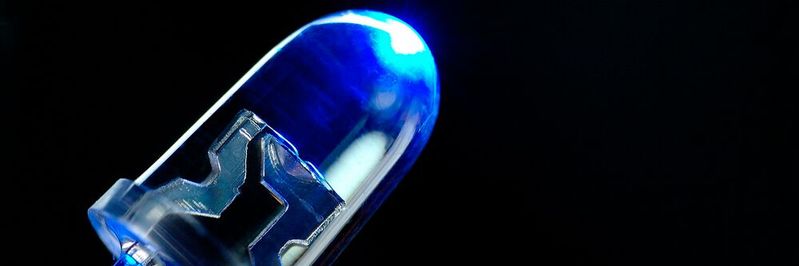
While red and green LEDs were harnessed relatively early in the history of semiconductors, the blue LED remained an elusive goal for a longer time. But why was the blue LED so difficult to realize?
Materials and bandgap: The first hurdle
The biggest challenge in developing the blue LED was finding a suitable semiconductor material. LEDs produce light when electrons fall through a bandgap, releasing energy in the form of light. The size of this bandgap determines the color of the light. To generate blue light, a larger bandgap (2,6 to 3,4 eV, depending on the blue tone) is needed than for red or green light. Gallium arsenide (GaAs, 1,42 eV) and gallium phosphide (GaP, 2,26 eV), used for red and green LEDs, were unsuitable for blue light.
The breakthrough comes with Gallium Nitride
The turning point came with the discovery of gallium nitride (GaN, 3,37 eV) as the ideal material for blue LEDs. GaN has the necessary large bandgap to produce blue light. Pioneers of this technology, Isamu Akasaki, Hiroshi Amano, and Shuji Nakamura, not only mastered the challenges of producing GaN crystals but also developed innovative methods for doping the material to create efficient p-n junctions. Their groundbreaking work ultimately led to the breakthrough in blue LED technology and was honored with the Nobel Prize in Physics in 2014.
Thanks to these three pioneers, we can use blue LEDs in our daily lives:
:quality(80)/p7i.vogel.de/wcms/63/ed/63edc17ef34c640caf7da7a70d7399f9/0117773523.jpeg "Isamu Akasaki produced blue light-emitting diodes for the first time in 1989. In 2014, he was honoured with the Nobel Prize in Physics for his work. (Source: Isamu Akasaki 201111 / / CC BY 4.0)")
:quality(80)/p7i.vogel.de/wcms/1e/28/1e287109090c804f6e1778c920e94805/0117773534.jpeg "Hiroshi Amano, Director of Akasaki Research Center, Nagoya University, was given Nobel Prize in Physics on 2014.(Source: Hiroshi Amano 20141211 / / CC BY 4.0)")
:quality(80)/p7i.vogel.de/wcms/5c/6d/5c6dcfb261a739c3da7c1d065999e2bc/0117773543.jpeg "Shuji Nakamura is a professor at the University of California, Santa Barbara and was awarded the 2014 Nobel Prize in Physics.(Source: Shuji Nakamura /Ladislav Markuš / CC BY-SA 4.0)")
The blue LED and its impact
The introduction of the blue LED has had far-reaching impacts on the world of technology and beyond. With the combination of red, green, and blue LEDs, it is now possible to create white light, leading to a revolution in the lighting industry. Energy-saving LED bulbs gradually replaced traditional incandescent and fluorescent lamps. But the applications of the blue LED extend far beyond lighting. They are crucial for the production of flat-screen displays, serve as the basis for developing lasers for Blu-ray players, and have medical applications in photodynamic therapy.
The development of the blue LED is a prime example of how basic research and perseverance can shift technological boundaries. Today, years after this breakthrough, scientists continue to research semiconductor materials and technologies to develop even more efficient and durable LEDs. The journey of the blue LED is far from over; it paves the way for future innovations in the world of optoelectronics and beyond.
:quality(80):fill(efefef,0)/p7i.vogel.de/wcms/60/c3/60c369eb6262f/sochor-paul-infineon.jpeg "Sochor_Paul_Infineon")
(ID:49996927)
:quality(80)/p7i.vogel.de/wcms/0e/13/0e132310ca94e4d27cfc167cbcf567f9/0128546543v2.jpeg "GaN, SiC, and AI are reshaping power electronics in 2025, responding to rising energy demand and the rapid expansion of data centers, EVs, and electrification. (Source: © Dreamy Shots - stock.adobe.com)")
:quality(80)/p7i.vogel.de/wcms/7d/40/7d406bd959b3a9127c33a66157f9030a/0128339184v4.jpeg "The global digital infrastructure depends on the production of advanced semiconductor materials (Source: © uflypro - stock.adobe.com)")