


:quality(80)/p7i.vogel.de/wcms/2f/f3/2ff3221bf7665de2d0acf83760bfd1fa/0130031523v2.jpeg "Wolfspeed presents a 300 mm silicon carbide technology platform designed to support advanced packaging and high-efficiency power delivery for AI data center infrastructure. (Source: Wolfspeed)")
:quality(80)/p7i.vogel.de/wcms/c3/16/c316e955a97f5d72d9678297b237b9e5/0129932858v2.jpeg "Left: the single-phase version of the SENTRON ECPD with RCM, right: a model of the future three-phase version of the SENTRON ECPD. (Source: Siemens)")
:quality(80)/p7i.vogel.de/wcms/ef/0a/ef0adb0acf793fe147cc27c21f6a7a67/0129954238v2.jpeg "Empower Semiconductor introduces embedded silicon capacitors designed to improve power delivery and stability in AI and high-performance computing processors. (symbolic image) (Source: © IF.arc - stock.adobe.com)")
:quality(80)/p7i.vogel.de/wcms/53/f9/53f9301dfc9292d02960f7996c79cc6e/0129927601v2.jpeg "Wolfspeed’s new 10 kV SiC MOSFET enables high-voltage power conversion for grid and industrial applications. (symbolic image) (Source: © CREATIVE- 3.4 - stock.adobe.com)")
:quality(80)/p7i.vogel.de/wcms/6e/cd/6ecd41d095d5111cf4ed37b714844487/0129930878v2.jpeg "PCIM Asia Shenzhen provides a platform for industry experts to present new developments in power electronics and electrification technologies. (symbolic image) (Source: © killykoon - stock.adobe.com)")
:quality(80)/p7i.vogel.de/wcms/02/c0/02c0e9722f70b1134dbf96fb59a9c73d/0129655179v2.jpeg "The PCIM Conference 2026 will take place from June 9-11, featuring discussions on power electronics trends, including GaN technology and AI applications. (symbolic image) (Source: © Elmira - stock.adobe.com)")
:quality(80)/p7i.vogel.de/wcms/cc/67/cc670ea2029cd2af5c641af70e1bf734/0129816392v4.jpeg "Fraunhofer IAF coordinates the EU SUPREME project to accelerate GaN and SiC power semiconductor innovation in Europe. (Source: Fraunhofer IAF)")
:quality(80)/p7i.vogel.de/wcms/ea/e6/eae6aee30071e67a5627027974437134/0129544613v2.jpeg "GlobalFoundries and Renesas strengthen their collaboration to support U.S.-based semiconductor production and supply chain resilience. (Source: © ronstik - stock.adobe.com)")
:quality(80)/p7i.vogel.de/wcms/3c/4b/3c4bbc68dda65c7071b4376fb57423b0/0130030465v2.jpeg "Faraday’s laws explain the fundamental behavior of magnetic fields and electronic devices in dynamic use cases. The operation of transformers, wireless chargers, induction cookers, induction motors, magnetic levitating trains (MAGLEV Trains), electric violin, and many others depends upon Faraday’s laws. (Source: © Sheraz - stock.adobe.com)")
:quality(80)/p7i.vogel.de/wcms/b1/5e/b15ee02b0ba02db70cf61e37d66ad1d3/0129349127v2.jpeg "Vehicle-to-grid (V2G) chargers enable bidirectional energy flow, allowing electric vehicles to act as mobile energy storage systems that can both draw power from and feed power back into the grid. (Source: © medienvirus - stock.adobe.com)")
:quality(80)/p7i.vogel.de/wcms/26/d5/26d591cc340077026eac56a0e7564faf/0129949603v2.jpeg "Flexible: The solid silicone-based electrolyte is elastic, thereby compensating for the voids that form in solid-state batteries during charging and discharging. (Source: Empa)")
:quality(80)/p7i.vogel.de/wcms/4d/e0/4de02f76a37cbb3df30dd231de589c8e/0128866890v2.jpeg "Both legacy and vGaN show higher carrier mobility and band gap energies compared to other power semiconductors. (Source: © phonlamaiphoto - stock.adobe.com)")
:quality(80)/p7i.vogel.de/wcms/be/c8/bec8d43fc0ee73414274be44608b2970/0129748903v2.jpeg "The Infiniium XR804KA real-time oscilloscope delivers faster response time, improved stability, and streamlined workflows for high-speed digital and compliance testing. (Source: Keysight)")
:quality(80)/p7i.vogel.de/wcms/23/ee/23ee4a97790d6009dbfd7d9577ffa723/0129220424v2.jpeg "The R&S FPL1044 with the new RTSA option makes 40 MHz real-time frequency analysis available up to 44 GHz. (Source: Rohde & Schwarz )")
:quality(80)/p7i.vogel.de/wcms/3c/d1/3cd1cacbceb792ba63727199c61ca434/0127801860v2.jpeg "Thanks to cloud technology, users can collaborate on projects from anywhere and always have access to the latest planning data. (Source: SIEMENS)")
:quality(80)/p7i.vogel.de/wcms/5a/a0/5aa0436498af618297961fd54ab36cdf/0126290792v2.jpeg "Siemens accelerates student-led semiconductor innovation across Europe’s leading technical universities through Cre8Ventures’ Open Higher Education Program developed in collaboration with Arm and University of Southampton (Source: Siemens Digital Industries Software)")
ELECTROMAGNETIC COMPATIBILITY 12 ways to improve EMC performance
Related Vendors
:fill(fff,0)/p7i.vogel.de/companies/63/c7/63c7da97be945/diotec.png "diotec (Diotec Semiconductor AG)")
:fill(fff,0)/p7i.vogel.de/companies/62/a0/62a0a0de7d56a/aic-europe-logo.jpeg "aic-europe-logo (AIC Europe)")
:fill(fff,0)/p7i.vogel.de/companies/5f/71/5f71d5f92a5f6/2000px-rogers-corporation-logo-svg.png "2000px-Rogers_Corporation_Logo.svg.png (rogers germany)")
Electromagnetic Compatibility (EMC) ensures the efficient operation of electrical and electronic devices, equipment, and systems within their intended electromagnetic environment. EMC tests are run to check whether a system emits electromagnetic radiation or is affected by it. Without EMC, electrical and electronic systems are prone to failure and damage. The article discusses 12 ways to improve EMC performance.
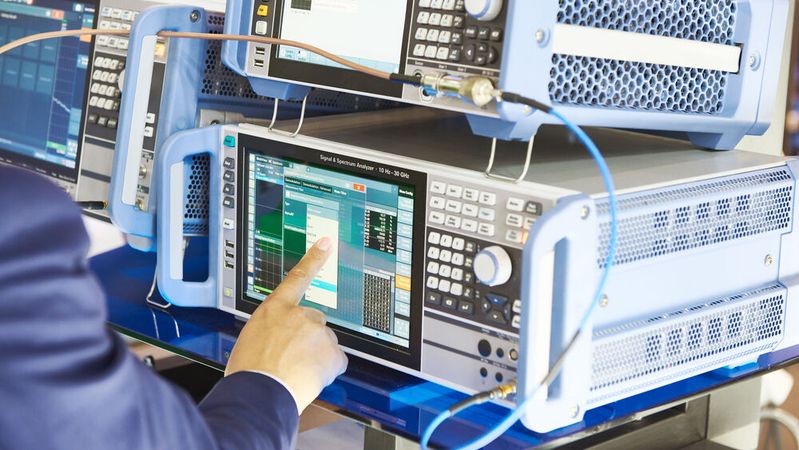
Enterprises spend millions of dollars to run EMC tests. Globally, the EMC testing market is a USD2.4 billion industry. EMC test purpose is to assess the functionality within the intended electromagnetic environment by minimizing EMI and maximizing compatibility. EMC tests determine manufacturing success, signal integrity, information transfer, and the impact of the device on the environment. The section lists twelve ways to succeed in EMC tests.
#1 Use noise-suppressing bridge rectifiers
Historically, bridge rectifiers generated loads of heat during operation. A 1000 V bridge rectifier family in the surface-mount package shows exceptional reverse recovery time and thermal management. These modules eliminate the need to use heat sinks and additional materials for manufacturing, showing a significant reduction in parts per count.
The bridge rectifier family contributes to EMC through a built-in noise suppressor. The reverse recovery of about 300 nanoseconds minimizes conducted emissions in the form of high-frequency noise signals. The thermal management without heat sinks dissipates a lesser amount of heat, which could affect EMC.
#2 Reduce speed
The clock frequency is the main frequency that determines how quickly a device can execute instructions or process all real-time tasks. A low clock frequency indicates the slowness of a system to perform operations. A high clock frequency corresponds to a faster speed and shorter wavelength signals.
Choosing a high clock frequency leads to impedance mismatch with increased radiation, switching noise, and power consumption. After estimating a system’s required clock frequency, increasing it just by 20-30 % promotes efficient and safe operation. Implementing a low slew rate or managing a high slew rate also ensures EMC.
#3 Choose components wisely
Auxiliary peripherals like I/O USB cables, adapters, printers, and storage units enable testing devices for EMC. Even these auxiliary peripherals should be EMC-compliant for better performance. Manufacturers design main components to have low EMI emissions. Ferrite beads, filters, decoupling capacitors, high-quality oscillators, and optocouplers are some low-EMI components.
Address latches, buffers, and memories are slower technology components that use PWM for regulation, signal conditioning, conversion, and efficiency. These components have wider pulse widths and low transition sharpness to prevent high-frequency noise generation. However, slow controllers can also fail EMC tests.
:quality(80)/p7i.vogel.de/wcms/10/0f/100f1e48052460656a8140b9ec4fc3d6/87204556.jpeg "Electromagnetic compatibility (EMC) is an important concept of electrical engineering. (Source: ©LanaPo - stock.adobe.com)")
BASIC KNOWLEDGE - EMC
Basics for electromagnetic compatibility (EMC) of power electronics
#4 Use filters
Using an EMI filter, a type of low pass filter blocks noise. A filter prevents components from releasing high-frequency radiation. In simple words, filtering rejects frequencies out of a predefined operation range.
Cables and connections have built-in filters to prevent noise. Ferrite beads, single-stage or two-stage LC circuits, and common-mode chokers are some examples. To avoid EMC issues in power lines, power sources should be filtered with AC line filters.
Generally, grouped components are placed together. For example: there are separate groups of digital circuits, analog circuits, high-speed signals, and low-speed signals. Filters are placed between such different groups to maintain EMC.
#5 Maintain proper grounding
Ground planes function like a buffer to shunt EMI and reduce loop inductance. A simple method is to implement single-point grounding to prevent ground loops. Ground planes must surround high-speed clock signals. Sometimes the design structure does not allow using ground planes. Ground grids can be chosen instead.
Maintain separate groups for analog and digital parts of the circuit with their respective grounds. However, it is important to connect their grounds to a single point. Other methods include grounding copper-filled areas and using a Faraday’s guard ring for isolation.
#6 Implement shielding
Shielding is a classic mechanical technique that protects electronic circuitry from EMI. Conductive shielding involves placing devices or circuitry in a metal enclosure made from copper, aluminum, steel, or any other alloy. Such enclosures are connected to the ground from the front and back to avoid EMC issues.
Shielded devices reflect most of the radiation to protect themselves. The remaining radiation is absorbed and dissipated as heat. It also prevents self-generated noise from escaping the device. Shielded twisted pair cables are extensively used in the industry to maintain compatibility.
#7 Use decoupling capacitors
A decoupling capacitor, also known as a bypass capacitor, “decouples'' or shunts energy transfer from high-impedance components to the sensitive parts of the circuit like the CPU and sensors. To weaken the effects of the magnetic field, these capacitors tend to minimize the size of current loops.
Decoupling capacitors are placed near power pins to suppress voltage spikes, transient current surges, magnetic fields, and noise propagation through the supply rails. However, decoupling capacitors are only effective in low-to-medium frequencies. In high frequencies, these capacitors behave as resistors or inductors instead.
:quality(80):fill(efefef,0)/p7i.vogel.de/wcms/62/61/6261784dda7bd/web-vorschaubild-webkon-pb-2021-05-24.jpeg "WEB-Vorschaubild_Webkon_PB_2021-05-24 (Adobe Stock)")
WEB CONFERENCE: ELECTROMAGNETIC COMPATIBILITY
Towards an EMC compliant design in power electronics
#8 Minimize parasitic inductance
Parasitic inductance is an unwanted inductance that arises due to signal traces, wires, and nearby components. It consists of self-inductance of conductors and mutually induced inductance between nearby conductors. Keeping signal traces close to the ground effectively reduces parasitic inductance.
The power and ground traces must be identical to reduce the effect of overall total inductance. Close spacing of the track reduces the size of magnetic field loops and parasitic inductance. Using ground and power planes, instead of just paths, enables high-speed signal processing and parasitic inductance reduction.
#9 Cancel magnetic field
One of the most important ways to attain EMC is to reduce magnetic field strength in a PCB. As mentioned above, large decoupling capacitors effectively reduce the surface of magnetic loops.
Another method is to place VCC (positive supply) and VSS (negative supply) pins close together. These two pins generate opposite magnetic fields which cancel out each other.
Choosing such packages with multiple VCC and VSS pins reduces the strength of magnetic fields. In addition, minimizing paths around the oscillator and crystal reduces magnetic loop size and parasitic inductance.
#10 Optimize signal traces
Designers follow some trace-related thumb rules to prevent noise and maintain EMC. A common method is to route carefully across continuous plane layers and reduce the chances of coupling with nearby components. In low-frequency operations, wider traces tend to reduce voltage drops in PCB.
Although high clock frequency generates EMI, many applications require a clock frequency in MHz. In such cases, keeping the high-speed signal traces evenly spaced and short, about 3W, prevents coupling. These traces must be separated from I/O connections or critical components.
:quality(80)/p7i.vogel.de/wcms/e4/f1/e4f165f878335bb2fd3df7c8e9cfafe8/0118955190v2.jpeg "Don't let electrical noise disrupt your circuits! Learn how to minimize EMI caused by PWM in this informative article. (Source: Natalia S. - stock.adobe.com)")
ELECTROMAGNETIC INTERFERENCE
PWM Noise: EMI challenges due to PWM
#11 Choose small-size vias and stubs
Vias tend to induce parasitic capacitances and inductances in the PCB. Signals moving on the supply rails reflect from vias due to impedance mismatching. Hence, avoiding vias ensures compatibility. However, some designs require vias. In such cases, choose a fewer number of vias in smaller sizes.
Ground via must be placed in close proximity to signal via. Decoupling capacitors can also be placed near ground and signal vias. Similarly, choosing smaller size stubs or avoiding them completely in the design reduces the chances of signal reflections in PCB.
#12 Avoid long current return paths
A current signal always reflects from the load to the source. It is a fact that the current takes the lowest resistance path to reach its destination. At higher frequencies, the current takes the lowest impedance return path. At lower frequencies, the current takes the lowest loop inductance path.
In such cases, the return path is sensitive to EMI due to the presence of nearby components. An optimal solution is to keep the shortest non-complex routing path in non-continuous layers, avoid irregularities, gaps, or cuts, and reduce the loop area.
(ID:50128191)
:quality(80)/p7i.vogel.de/wcms/52/ba/52bad13a953b2f02f0344af930d198a1/0123734944v2.jpeg "Explore the complexities of power supply loop stability through the examination of unusual Bode plots, uncovering their root causes and utilizing Nyquist criteria for improved stability assessment. (Source: Marlon - stock.adobe.com)")
:quality(80)/p7i.vogel.de/wcms/b0/ef/b0ef0ff0d070954c6d09418740c6242a/0123681509v2.jpeg "Explore how Bode plots and lab testing enhance performance, and find out how LTpowerCAD simplifies your design process for optimal efficiency. (Source: KanawatTH - stock.adobe.com)")