


:quality(80)/p7i.vogel.de/wcms/2f/f3/2ff3221bf7665de2d0acf83760bfd1fa/0130031523v2.jpeg "Wolfspeed presents a 300 mm silicon carbide technology platform designed to support advanced packaging and high-efficiency power delivery for AI data center infrastructure. (Source: Wolfspeed)")
:quality(80)/p7i.vogel.de/wcms/c3/16/c316e955a97f5d72d9678297b237b9e5/0129932858v2.jpeg "Left: the single-phase version of the SENTRON ECPD with RCM, right: a model of the future three-phase version of the SENTRON ECPD. (Source: Siemens)")
:quality(80)/p7i.vogel.de/wcms/ef/0a/ef0adb0acf793fe147cc27c21f6a7a67/0129954238v2.jpeg "Empower Semiconductor introduces embedded silicon capacitors designed to improve power delivery and stability in AI and high-performance computing processors. (symbolic image) (Source: © IF.arc - stock.adobe.com)")
:quality(80)/p7i.vogel.de/wcms/53/f9/53f9301dfc9292d02960f7996c79cc6e/0129927601v2.jpeg "Wolfspeed’s new 10 kV SiC MOSFET enables high-voltage power conversion for grid and industrial applications. (symbolic image) (Source: © CREATIVE- 3.4 - stock.adobe.com)")
:quality(80)/p7i.vogel.de/wcms/6e/cd/6ecd41d095d5111cf4ed37b714844487/0129930878v2.jpeg "PCIM Asia Shenzhen provides a platform for industry experts to present new developments in power electronics and electrification technologies. (symbolic image) (Source: © killykoon - stock.adobe.com)")
:quality(80)/p7i.vogel.de/wcms/02/c0/02c0e9722f70b1134dbf96fb59a9c73d/0129655179v2.jpeg "The PCIM Conference 2026 will take place from June 9-11, featuring discussions on power electronics trends, including GaN technology and AI applications. (symbolic image) (Source: © Elmira - stock.adobe.com)")
:quality(80)/p7i.vogel.de/wcms/cc/67/cc670ea2029cd2af5c641af70e1bf734/0129816392v4.jpeg "Fraunhofer IAF coordinates the EU SUPREME project to accelerate GaN and SiC power semiconductor innovation in Europe. (Source: Fraunhofer IAF)")
:quality(80)/p7i.vogel.de/wcms/ea/e6/eae6aee30071e67a5627027974437134/0129544613v2.jpeg "GlobalFoundries and Renesas strengthen their collaboration to support U.S.-based semiconductor production and supply chain resilience. (Source: © ronstik - stock.adobe.com)")
:quality(80)/p7i.vogel.de/wcms/23/1a/231a97643aa7fc3adf2704a6273756c3/0130030642v2.jpeg "Gallium nitride (GaN) power devices are increasingly challenging silicon MOSFETs in low-voltage power conversion by enabling higher efficiency and switching performance. (Source: © Sheraz - stock.adobe.com)")
:quality(80)/p7i.vogel.de/wcms/3c/4b/3c4bbc68dda65c7071b4376fb57423b0/0130030465v2.jpeg "Faraday’s laws explain the fundamental behavior of magnetic fields and electronic devices in dynamic use cases. The operation of transformers, wireless chargers, induction cookers, induction motors, magnetic levitating trains (MAGLEV Trains), electric violin, and many others depends upon Faraday’s laws. (Source: © Sheraz - stock.adobe.com)")
:quality(80)/p7i.vogel.de/wcms/b1/5e/b15ee02b0ba02db70cf61e37d66ad1d3/0129349127v2.jpeg "Vehicle-to-grid (V2G) chargers enable bidirectional energy flow, allowing electric vehicles to act as mobile energy storage systems that can both draw power from and feed power back into the grid. (Source: © medienvirus - stock.adobe.com)")
:quality(80)/p7i.vogel.de/wcms/26/d5/26d591cc340077026eac56a0e7564faf/0129949603v2.jpeg "Flexible: The solid silicone-based electrolyte is elastic, thereby compensating for the voids that form in solid-state batteries during charging and discharging. (Source: Empa)")
:quality(80)/p7i.vogel.de/wcms/be/c8/bec8d43fc0ee73414274be44608b2970/0129748903v2.jpeg "The Infiniium XR804KA real-time oscilloscope delivers faster response time, improved stability, and streamlined workflows for high-speed digital and compliance testing. (Source: Keysight)")
:quality(80)/p7i.vogel.de/wcms/23/ee/23ee4a97790d6009dbfd7d9577ffa723/0129220424v2.jpeg "The R&S FPL1044 with the new RTSA option makes 40 MHz real-time frequency analysis available up to 44 GHz. (Source: Rohde & Schwarz )")
:quality(80)/p7i.vogel.de/wcms/3c/d1/3cd1cacbceb792ba63727199c61ca434/0127801860v2.jpeg "Thanks to cloud technology, users can collaborate on projects from anywhere and always have access to the latest planning data. (Source: SIEMENS)")
:quality(80)/p7i.vogel.de/wcms/5a/a0/5aa0436498af618297961fd54ab36cdf/0126290792v2.jpeg "Siemens accelerates student-led semiconductor innovation across Europe’s leading technical universities through Cre8Ventures’ Open Higher Education Program developed in collaboration with Arm and University of Southampton (Source: Siemens Digital Industries Software)")
RENEWABLE ENERGY Storing the sun's heat at 1200 degrees
Related Vendors
:fill(fff,0)/p7i.vogel.de/companies/62/b9/62b980cddf5d6/ceramtec.png "ceramtec (www.ceramtec-group.com)")
:fill(fff,0)/p7i.vogel.de/companies/5f/71/5f71d5f92a5f6/2000px-rogers-corporation-logo-svg.png "2000px-Rogers_Corporation_Logo.svg.png (rogers germany)")
:fill(fff,0)/p7i.vogel.de/companies/68/08/6808a2b3b6595/het-logo.jpeg "het-logo (Heraeus Electronics)")
The ETH spin-off Synhelion has recently inaugurated the world's first industrial plant for the production of solar fuels in Germany. The heart of the plant contains a piece of Empa technology: Together with Synhelion, Empa researchers have developed a material for the high-temperature thermal energy storage system that allows the plant to remain in operation 24/7.
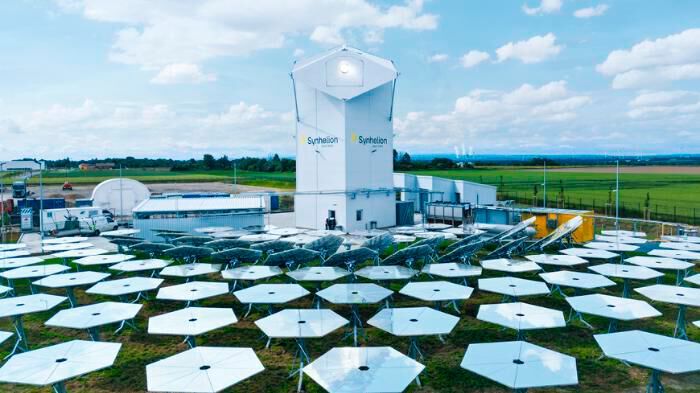
Closing the CO2 cycle by converting climate-damaging carbon dioxide back into kerosene, gasoline and diesel: That is the idea behind Synhelion. The ETH spin-off uses the heat of the sun to produce synthetic fuels (Synfuels) from CO2 and water. In June 2024, in the German city of Jülich, Synhelion inaugurated DAWN: the world's first industrial plant for the production of solar fuels. Thanks to a collaboration with the Empa Laboratory for High-Performance Ceramics, DAWN can produce renewable fuels around the clock – even at night.
To turn CO2 and water back into fuels, DAWN needs one thing above all: energy. A large mirror field focuses the sunlight onto a single point on the solar receiver. The steam inside reaches a temperature of up to 1,200 degrees Celsius thanks to the concentrated energy of the sun. This high-temperature process heat is used to operate the reactor, while the surplus is fed into the thermal energy storage: a chamber several cubic meters in size, filled with very special bricks. These bricks – a joint development by Empa and Synhelion – serve as temporary storage for the enormous heat. Overnight, it is this heat reservoir that supplies the reactor with energy and keeps it running.
:quality(80)/p7i.vogel.de/wcms/0b/ab/0bab17d89b907f36540b899f3d881d73/0105356625.jpeg "As well as photovoltaic, this article covers thermal energy technologies including solar farm power plants, solar Stirling systems, and thermal (or updraft) power plants. (Source: Günter Albers - stock.adobe.com)")
BASIC KNOWLEDGE – SOLAR ENERGY
What is solar energy? Definition, types and more
Wanted: the "super-brick"
At 1200 degrees, though, not all bricks are created equal. In direct contact with the ultra-high temperature steam, even ceramics corrode. None of the refractory bricks available on the market were designed for these extreme conditions, so Synhelion approached Empa. "The research group led by Empa researcher Gurdial Blugan is one of the few to study the corrosion behavior of ceramics at such high temperatures", says Lukas Geissbühler, Head Thermal Systems at Synhelion.
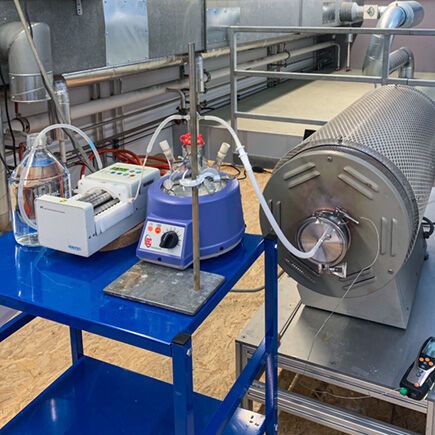
In a two-year project funded by Innosuisse, Blugan and Empa scientist Sena Yüzbasi, together with Synhelion, set out to find a suitable ceramic. Corrosion resistance was only one aspect. The material also had to have a high heat capacity, be mechanically robust and withstand thermal shocks that can occur when the system is powered down. It also had to be inexpensive to produce, because the plant in Jülich is just the beginning for Synhelion.
The researchers designed their own high-temperature tube furnace together with the Empa workshop and Synhelion. In it, they exposed different ceramic samples to the corrosive steam atmosphere – for up to 500 hours. "It got pretty hot in our lab during these experiments," says Blugan. But the sweating was worth it: The researchers were able to find a material that could withstand the extreme conditions.
:quality(80):fill(efefef,0)/p7i.vogel.de/wcms/62/a0/62a08b6a6fb27/keynote-pcim-2022-hydrogen---key-element-to-achieve-net-zero-co2.jpeg "Keynote PCIM 2022_Hydrogen - Key Element to Achieve Net Zero CO2 (Hyeyoon - stock.adobe.com)")
KEYNOTE PCIM EUROPE 2022
Hydrogen - Key element to achieve net zero CO²
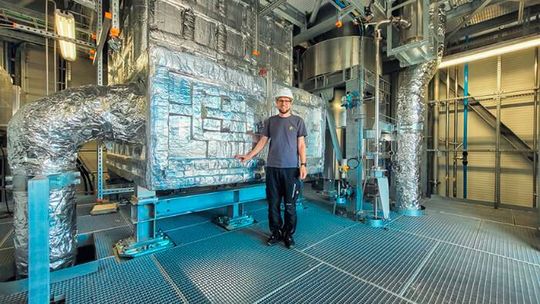
Together with their project partners, they refined the material composition and optimized the manufacturing process in order to further improve the material properties and reduce costs. The bricks were then produced by a partner company in Germany and installed in Jülich. "As a researcher, it's not often that you get to see your research applied on such a scale, it is quite a unique experience," says Yüzbasi. The scientist, who now works in the energy industry herself, is particularly pleased that her work is being used in the renewable energy sector for climate protection.
Forging on together
"Empa has made a valuable contribution to the development of our thermal storage unit and was able to respond to Synhelion's specific requirements thanks to its flexibility," says Lukas Geissbühler. While DAWN is going into operation, Synhelion and Empa are already planning their next joint project. For future plants, they want to further develop the material and make it even more durable. Synhelion's second plant for the production of solar fuel is to be built in Spain from 2025. The goal: even larger heat storage units, even higher temperatures. Since the higher the temperature, the more efficient the fuel production.
Power Electronics in the Energy Transition

The parameters for energy transition and climate protection solutions span education, research, industry, and society. In the new episode of "Sound On. Power On.", Frank Osterwald of the Society for Energy and Climate Protection Schleswig‐Holstein talks about the holistic guidance his organization can provide.
Listen now!
(ID:50190133)
:quality(80)/p7i.vogel.de/wcms/7b/cf/7bcf68ed577974a86f4679c4b4b85b46/0128095713v2.jpeg "Symbolic Image: Deployment of heat batteries by Rondo and EDP aims to enhance energy efficiency and sustainability for Heineken's production processes. (Source: © Kittinan - stock.adobe.com)")
:quality(80)/p7i.vogel.de/wcms/99/c9/99c9a4799394750fd1a9a51890c948ad/0124997234v2.jpeg "Surface treatments in power electronics enhance performance and reliability by preventing corrosion, improving thermal efficiency, and ensuring strong bonds, making them essential for the durability and functionality of components in demanding conditions. (Source: © At My Hat - stock.adobe.com)")