


:quality(80)/p7i.vogel.de/wcms/10/fc/10fcb98e44d61826e641bc8d3f20f616/0133193677v2.jpeg "The new AEVA and AEVB Series aluminum electrolytic capacitors are engineered for harsh industrial environments, delivering high-CV, long-lifetime performance in compact, surface-mount packages that reliably withstand up to 30g acceleration and operating temperatures extending from -55° to +125°C. (Source: Kyocera)")
:quality(80)/p7i.vogel.de/wcms/f7/42/f74208db9f5f87dca384b38b71c4782e/0133196365v2.jpeg "YAGEO’s EC Flat‑Series temperature sensors combine fast, accurate measurement with resistance to vibration, shock, moisture and dust for demanding automotive and industrial applications. (Source: Yageo)")
:quality(80)/p7i.vogel.de/wcms/b2/82/b28212428745dd8a4634ad4f4912012f/0132902689v2.jpeg "New 15 V, 25 V and 40 V eGaN FETs deliver ultra-low on-resistance, high current capability, and exceptional radiation immunity for high-density space power conversion (Source: EPC Space)")
:quality(80)/p7i.vogel.de/wcms/7b/4f/7b4f433302c490cac22eee9c12499e65/0132780211v2.jpeg "Littelfuse introduces the TPSMD‑FL series of high‑power surface‑mount TVS diodes, designed to simplify ISO 7637 load‑dump protection and safeguard automotive electronics against severe voltage transients. (Source: Littlefuse)")
:quality(80)/p7i.vogel.de/wcms/78/38/783841efab284c1b4453777e7ebea26d/0133190419v2.jpeg "Diodes has completed its acquisition of Elevate Semiconductor, expanding its analog and mixed-signal portfolio and strengthening its presence in the high-growth automated test equipment market. (Source: © peopleimages.com - stock.adobe.com)")
:quality(80)/p7i.vogel.de/wcms/1f/79/1f79d69530465de26a832c742fc60319/0133117717v2.jpeg "With 30,000 sqm of exhibition space, 20,157 trade visitors, 271 exhibitors, and 131 expert presentations as part of the conference program, the event sent a strong message about the industry's innovative strength and dynamism. (Source: Mesago Messe Frankfurt GmbH)")
:quality(80)/p7i.vogel.de/wcms/43/4d/434db2291567e847e54332004942a225/0132958267v2.jpeg "GlobalWafers has joined the SEMI Taiwan Materials Alliance, with CEO Doris Hsu serving as co‑chair, to advance critical materials technologies, accelerate collaborative innovation and strengthen global semiconductor supply chain resilience. (Source: © jiwon - stock.adobe.com)")
:quality(80)/p7i.vogel.de/wcms/6f/72/6f72f93d1e4c5a248a97dd3b8f32a336/0132997898v2.jpeg "Infineon plans to acquire C2i Semiconductors to combine software‑defined multiphase control and smart power stages with its broad power‑semiconductor portfolio for intelligent, scalable AI data‑center power delivery. (Source: © Grispb - stock.adobe.com)")
:quality(80)/p7i.vogel.de/wcms/87/97/879728679e7010f81e53a86923cde74c/0133218625v2.jpeg "Conceptual illustration of polar wurtzite niobium aluminum nitride (NbAlN), a transition-metal-containing nitride semiconductor that preserves the crystal structure and polarity of GaN. (Source: Associate Professor Atsushi Kobayashi from Tokyo University of Science, Japan)")
:quality(80)/p7i.vogel.de/wcms/ac/31/ac31c9478d80894d725d02883ae7ed5d/0133176534v2.jpeg "Average models allow power designers to simulate DC‑DC converters and three‑phase PFC circuits quickly, analyse small‑signal behaviour and evaluate loop stability without modelling every switching event. (Source: © AI - stock.adobe.com)")
:quality(80)/p7i.vogel.de/wcms/96/80/9680b468d7f682c8b6c15b07300afbb0/0133177854v2.jpeg "Grid-forming inverters are also known as grid-forming resources and grid-forming IBR. This article explains grid-forming inverters in detail. (Bild: © only_kim - stock.adobe.com)")
:quality(80)/p7i.vogel.de/wcms/57/c6/57c6fa81922a9849a917bdfed82eddf7/0133052494v2.jpeg "Rising demand for high-end materials shifts production toward higher-margin products, reducing output of standard loss materials. (Source: NCAB)")
:quality(80)/p7i.vogel.de/wcms/7b/76/7b76005554b556df2a7a3794bdf69d44/0132365246v2.jpeg "Hioki’s ST5680A DC Hipot Tester combines CE/UKCA/CSA compliance, an integrated capacitance‑based contact check and time‑series waveform recording (voltage, leakage current, insulation resistance) to standardize hipot and insulation testing across EV cell, module and pack production lines. (Source: Hioki)")
:quality(80)/p7i.vogel.de/wcms/af/7f/af7f7b0fb7f29219fc991b1130f65477/0132241333v2.jpeg "Comprehensive laboratory testing regimens—combining thermal cycling, high‑current stress, EMC, and accelerated lifetime tests—are essential to validate advanced power designs and ensure reliability in real‑world applications. (Source: PRBX)")
:quality(80)/p7i.vogel.de/wcms/16/3d/163df69363f8125315a9826e13ea4b05/0131927425v2.jpeg "Solution will maximize data center and AI factory profitability while delivering engineering-grade insights to design and operations for more efficient, sustainable, and resilient infrastructure. (Source: Cadence)")
:quality(80)/p7i.vogel.de/wcms/85/b7/85b7e90733a2bd8f21515d8f7137f2fc/0131917677v2.jpeg "Renesas acquires Pictorus to integrate its embedded application software platform with Renesas’ MCU and MPU portfolio, helping developers shorten time‑to‑market and simplify system integration. (Source: © lucadp - stock.adobe.com)")
Basic Knowledge - PCB The Printed Circuit Board: Definition, types, and more
Related Vendors
:fill(fff,0)/p7i.vogel.de/companies/62/b9/62b980cddf5d6/ceramtec.png "ceramtec (www.ceramtec-group.com)")
:fill(fff,0)/p7i.vogel.de/companies/5f/71/5f71d5f92a5f6/2000px-rogers-corporation-logo-svg.png "2000px-Rogers_Corporation_Logo.svg.png (rogers germany)")
:fill(fff,0)/p7i.vogel.de/companies/66/8b/668becd1c07eb/dowa-logo-word--1-.jpeg "dowa-logo-word--1- (DOWA)")
Much of the technology we use daily would not be possible without the invention of the Printed Circuit Board (PCB). Not only did the printed circuit board make it possible to downsize electronic equipment, but they also made the manufacture of powerful circuitry more cost effective. Today, printed circuit boards are found everywhere — and while their physical characteristics vary enormously, they still conform to a few basic design principles.
What is a Printed Circuit Board (PCB)?
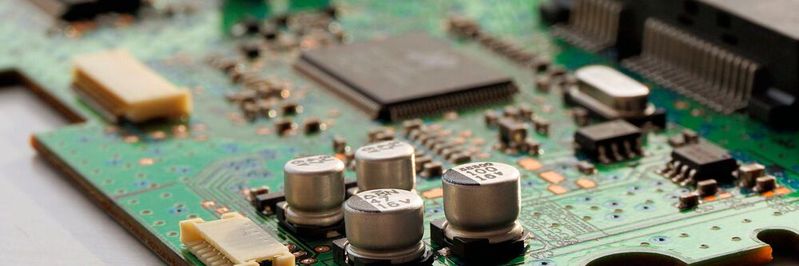
Printed circuit boards are used to mechanically support and electrically connect electronic components. PCBs use conductive pathways, tracks or signal traces etched from copper sheets laminated onto a non-conductive substrate that does not conduct electricity. Electronic components are then added to the board and etchings are made on its surface, which allow the current to flow through the copper from component to component.
While the PCB is of the key concepts in electronics today, it’s important to remember that this hasn’t always been the case. The PCB revolutionized electrical engineering when it was invented back in 1936. To put it simply, the PCB made it possible to mass-produce electronic devices for the first time.
Printed circuit board is the most common name but may also be called "printed wiring boards" or "printed wiring cards".
PCB Definition
Printed Circuit Boards (PCBs) are essential for modern electronics, acting as platforms for mounting and connecting components. Made of conductive tracks on a non-conductive substrate, PCBs enable electrical signal flow in devices. They range from simple, single-layer boards for basic devices to complex, multilayered assemblies in advanced technology. The design and material of PCBs critically influence the performance and reliability of electronic products.
PCB history: The circuit board that changed the world
Prior to 1936, electronic circuits were wired “point-to-point” onto a chassis (often a wooden box). Each component was connected to the others using copper wire as part of a long, labor-intensive process. PCBs changed all that. Able to be printed in vast numbers using machines, this sped up production massively and made them cheap enough to use in all manner of products.
The first PCBs were used for radios and other military applications. After the end of World War Two, they found their way into industry and ultimately the fledgling market for consumer electronics. Today, PCBs can be found everywhere we look, from PC motherboards and memory sticks to mobile devices and controllers in household appliances. As a basis of modern electronics, printed circuit boards are present in medical devices such as scanning equipment and digital measuring devices. They are used in manufacturing machinery, from switches and controllers to monitoring equipment—and even the machines used to design and make more PCBs. From consumer electronics and home appliances to automotive and aerospace applications, it is impossible to imagine the modern world without PCBs.
:quality(80)/p7i.vogel.de/wcms/ac/c6/acc69b572603f02f24280aea5cdba9b2/96788278.jpeg "Deciding which PCB design software package is best depends very much on your personal perspective: the complexity and size of your project, your budget, your expertise, and whether you are working alone or as part of a team are all factors. (Source: ©Lev - stock.adobe.com)")
PCB DESIGN PACKAGES
How to choose the right printed circuit board design package
How do printed circuit boards work?
The functioning of PCBs is a complex process that requires detailed design and careful manufacturing to ensure that electronic devices work as intended. Therefore, it is beneficial to first examine the structural composition of printed circuit boards before explaining the working principles of PCBs.
The structural composition of PCBs
PCBs consist of multiple layers that serve different functions:
- Conductive Layers: These layers are typically made of copper foil and form the electrical connections between the various components on the PCB. The copper is etched in specific patterns known as "traces." These traces are the electronic equivalent of wires in a traditional wiring harness and allow electrical signals and power to flow between the components.
- Insulating Layers: Between the conductive layers are insulating layers, also referred to as the dielectric. These layers prevent short circuits between the different conductive layers. They are mostly made from a material like FR4, a composite of fiberglass and epoxy resin.
- Solder Pads and Vias: On the surface of the PCB are areas known as solder pads. These pads are where electronic components (such as resistors, capacitors, and integrated circuits) are attached and soldered. Vias, or through-hole connections, are small holes filled or coated with conductive material that allow electrical connection between the different layers of the PCB.
- Protective Layers: A protective layer, often referred to as "solder mask," is applied to the PCB to protect the conductive traces and prevent solder from flowing where it is not desired. This aids in the precision of soldering components.
Do you want to know how PCBs are manufactured? Then watch this video to get the PCB manufacturing process explained:
The working principles of printed circuit boards
When an electronic component is placed on a PCB and properly soldered, it becomes part of an electrical circuit. The traces on the PCB allow electrical signals and current to flow from one component to another, based on the circuit design. The components on the PCB work together to perform a specific function. For example, a microcontroller on a PCB might read signals from sensors, process them, and then send output signals to other components such as LEDs or motors. PCBs make it possible to design complex circuits in a compact and reliable way. Through precise control of electrical connections and the physical proximity of components to one another, PCBs can support efficient and highly functional electronic devices.
Different types of printed circuit boards
There are various types of printed circuit boards that meet the diverse requirements of different electronic devices and applications. Each PCB type differs in terms of specific characteristics and advantages, making them particularly suitable for certain applications. The choice of the right circuit board can depend on factors such as the complexity and functionality of the electronic device, but the size of the PCBs and heat dissipation also play an important role.
Here is a listing of the 5 main types of PCBs:
- 1. Single-Layer PCBs: Composed of a single layer of conductive material, typically copper, on one side of an insulating substrate. They are used in simple electronic devices, such as calculators and radios.
- 2. Double-Layer PCBs: Have conductive layers on both sides of the substrate. Connections between the sides can be made through holes (vias). This type of PCB is used in more complex devices like power supplies and LED lighting.
- 3. Multilayer PCBs: Consist of multiple layers of conductive material, separated by insulating layers. They can include four, six, eight, or more layers and are used in highly complex devices such as computers, smartphones, and medical devices. They offer better space savings and electromagnetic shielding.
- 4. Flexible PCBs (Flex-PCBs): Use flexible material, often polyimide or similar, as the substrate, making the PCB bendable. Such PCBs are used in devices where the PCB needs to be bent or folded, such as in cameras, portable electronic devices, and some medical devices.
- 5. Rigid-Flex PCBs: Combine the characteristics of rigid and flexible PCBs. They consist of areas that are rigid and those that are flexible. They are ideal for advanced electronic applications that require the benefits of both types, such as in aerospace engineering, military technology, and high-end consumer electronics devices.
- 6. High Frequency PCBs: Specially designed to operate at high frequencies (over 1 GHz). They are made of materials that minimize electromagnetic losses. This type is used in high-frequency applications such as mobile phone base stations, microwave communication, and fast data transmission systems.
Fun Fact: Why are Printed Circuit boards green?
Have you ever wondered, why a PCB is always green? Let's answer this question quickly: The green color comes from the solder mask, which is applied to the PCB to protect the copper circuits from short circuits, soldering errors, and to prevent oxidation. Historically, green became the standard color due to the original materials used in the solder mask, which were naturally green.
Even though PCBs are now available in other colors, the electronics industry has standardized on green PCBs, making it a convention that persists due to familiarity and established manufacturing processes.
Applications of printed circuit boards
Applications of Printed Circuit Boards extend far beyond their traditional roles, reaching into innovative and demanding fields where performance and reliability are paramount. Among the diverse materials employed, aluminum stands out for its use in insulated metal substrates (IMS) or aluminum-backed PCBs, particularly favored in sectors requiring superior heat management. These PCBs are indispensable in high-power applications, from efficient LED lighting systems to robust power switches, where they ensure optimal performance by dissipating heat effectively. For applications demanding even higher current capacities, PCBs with a heavy copper layer become the solution of choice. By increasing the copper thickness to over three ounces per square foot, these boards excel in heat dissipation, making them suitable for industrial power supplies and automotive applications, where reliability under high power is crucial.
However, the realm of PCB applications is not limited to rigid constructions. The advent of flexible PCBs has revolutionized design possibilities, especially in wearables and flexible electronics. By mounting the copper layer on high-temperature resistant materials like Pyralux foil or Kapton, these flexible PCBs combine durability with the essential ability to conform to various shapes and sizes. This adaptability, coupled with resistance to extreme conditions, makes them ideal for innovative medical devices, foldable technology, and aerospace applications. The diversity of substrate materials available today mirrors the vast array of PCB applications, highlighting the technology's versatility and its critical role in advancing modern electronics."
:quality(80)/p7i.vogel.de/wcms/ce/87/ce87fe736989818001cf1bbec58f76fc/0111695582.jpeg "EDA tools save time and cost and enable the production of efficient electronic products. (Source: Sunshine Seeds - stock.adobe.com)")
ELECTRONIC DESIGN AUTOMATION
Five EDA tools to empower your next PCB design
How to design a PCB?
The design of printed circuit boards (PCBs) is a complex process that includes creating schematics, placing components, routing connections, defining the PCB outlines, and checking for defects. These steps are crucial for ensuring the functionality and reliability of PCBs in modern electronic devices. Advances in technology, such as rollable smartphones, necessitate flexible and innovative approaches in PCB design to accommodate new applications.
Learn more about the PCB Design process in this article:
:quality(80)/p7i.vogel.de/wcms/49/41/49414aec54b828f2484e3bf80ad0634d/0100423163.jpeg "PCBs are some of the most crucial electronics components in modern devices, so it’s no surprise that their design phase can be complex. (Source: ©spainter_vfx - stock.adobe.com)")
PRINTED CIRCUIT BOARDS
What’s involved in the process of PCB design?
The PCB market that keeps on growing
It is now more than 80 years since the invention of the PCB, yet the worldwide market is continuing to grow - with China being the export country number 1. According to Lucintel’s Printed Circuit Board (PCB) Market Report 2019, the global PCB market is predicted to reach USD89.7 billion by 2024, driven by a compound annual growth rate (CAGR) of 4.3 % in the coming years.
As robotics, artificial intelligence, and the internet of things continue to transform our lives, the demand for digital electronic devices will keep growing, which suggests a bright future for PCBs. It seems safe to assume that this venerable technology will be in service for many years yet.
(ID:46300264)
:quality(80)/p7i.vogel.de/wcms/55/73/557330d07780d6c9b04e438e7df6b737/0127296438v1.jpeg "Not only is the casing of this computer mouse made from biodegradable material, but so is its circuit board. Image: Empa (Source: Empa)")
:quality(80)/p7i.vogel.de/wcms/2d/39/2d39834eb64770ed52ca5dcef528fbcb/0132499809v2.jpeg "Sintered die attach, copper interconnects and ceramic‑brazed substrates replace solder and wire bonds to dramatically extend SiC/GaN module lifetime, reduce thermal resistance and cut commutation inductance for next‑gen high‑speed switching. (Source: © yasna - stock.adobe.com)")