


:quality(80)/p7i.vogel.de/wcms/c4/a7/c4a7243caa7c26af5fe5108f7894050a/0133626683v2.jpeg "Wolfspeed’s new premium 200 mm SiC substrates are designed to provide more consistent starting material for power semiconductor manufacturing. (Source: © Marina - stock.adobe.com)")
:quality(80)/p7i.vogel.de/wcms/91/8b/918b533161e7327075370338d7af97af/0133589801v2.jpeg "Acbel will present scalable DC charging power modules and an 11kW passively cooled 2-in-1 on-board power solution at New Mobility Congress 2026 in Katowice, covering both charging infrastructure and vehicle applications. (Source: Acbel)")
:quality(80)/p7i.vogel.de/wcms/f4/4b/f44b9261224e3ca11e192af6efd69f77/0133585612v2.jpeg "Diodes Incorporated introduces field-plated super barrier rectifiers designed to improve efficiency and reliability in automotive power circuits. (symbolic image) (Source: © Natalia - stock.adobe.com)")
:quality(80)/p7i.vogel.de/wcms/ba/85/ba857c3717c65949ba410b1be3feb221/0133616146v2.jpeg "Two TESVOLT FORTON Battery Storage Systems Shave Peak Loads at the Pschorr-Bräurosl Festival Tent at Oktoberfest. (Source: TESVOLT AG)")
:quality(80)/p7i.vogel.de/wcms/69/06/6906b5f22bfbb3f8b874ba9e459c7d26/0133675448v2.jpeg "New backend manufacturing hub strengthens and further diversifies Infineon's global production network. (Source: © Apriew - stock.adobe.com)")
:quality(80)/p7i.vogel.de/wcms/b0/02/b002b3cb7aea4dfdf92a46bb18cf0283/0133588910v2.jpeg "Mitutoyo expands its semiconductor metrology activities with a new competence center in Dresden. (Source: © ryanking999 - stock.adobe.com)")
:quality(80)/p7i.vogel.de/wcms/5e/f4/5ef48dd7abee0653f5336af22540f3fa/0133369680v2.jpeg "SEMI Europe has joined the ReSiLient consortium to strengthen Europe’s silicon and silicon carbide raw-material value chains and develop more sustainable, resilient supply routes for semiconductor and power-device manufacturing. (Source: © Suriyo - stock.adobe.com)")
:quality(80)/p7i.vogel.de/wcms/75/7c/757ceee412480cb1afe734223dce3db5/0133371917v2.jpeg "Magnetics has acquired the Western Division of Magnetic Metals, expanding its U.S. manufacturing capabilities and portfolio of high-permeability magnetic components, powder cores, ferrite cores and strip-wound cores. (Source: © WesJVR/peopleimages.com - stock.adobe.com)")
:quality(80)/p7i.vogel.de/wcms/ee/de/eedef7055c094757eb208a9d181e85dc/0133371000v2.jpeg "Resonac has developed 300 mm SiC single-crystal substrates, advancing larger-diameter wafer technology for next-generation power electronics and other high-performance semiconductor applications. (Source: © Resonac)")
:quality(80)/p7i.vogel.de/wcms/85/fb/85fb707b75a2f58a5b5809fba66e8713/0133372184v2.jpeg "INFAC integrates an isolated and regulated 800 V-to-48 V DC‑DC converter into the EV battery pack, using the existing cooling system while reducing high-voltage cabling, external components and packaging requirements. (symbolic image) (Source: © NAMONA_Design - stock.adobe.com)")
:quality(80)/p7i.vogel.de/wcms/a4/29/a429b944eb0a69e268015f8300ba8940/0133311989v2.jpeg "Hitachi Energy and Daikin are establishing a German supply of C4‑FN, a specialty insulating gas used in SF₆‑free high‑voltage equipment for more sustainable power grids. (Source: © Ahmed - stock.adobe.com)")
:quality(80)/p7i.vogel.de/wcms/d5/32/d5326e4b05d5cd759e88062f1c0b097a/0133344193v2.jpeg "Co-packaged optics is the latest innovation in data centers where optical modules on silicon chips can assist in scaling megawatt AI infrastructure. (Source: © Rachakrit - stock.adobe.com)")
:quality(80)/p7i.vogel.de/wcms/7b/76/7b76005554b556df2a7a3794bdf69d44/0132365246v2.jpeg "Hioki’s ST5680A DC Hipot Tester combines CE/UKCA/CSA compliance, an integrated capacitance‑based contact check and time‑series waveform recording (voltage, leakage current, insulation resistance) to standardize hipot and insulation testing across EV cell, module and pack production lines. (Source: Hioki)")
:quality(80)/p7i.vogel.de/wcms/af/7f/af7f7b0fb7f29219fc991b1130f65477/0132241333v2.jpeg "Comprehensive laboratory testing regimens—combining thermal cycling, high‑current stress, EMC, and accelerated lifetime tests—are essential to validate advanced power designs and ensure reliability in real‑world applications. (Source: PRBX)")
:quality(80)/p7i.vogel.de/wcms/16/3d/163df69363f8125315a9826e13ea4b05/0131927425v2.jpeg "Solution will maximize data center and AI factory profitability while delivering engineering-grade insights to design and operations for more efficient, sustainable, and resilient infrastructure. (Source: Cadence)")
:quality(80)/p7i.vogel.de/wcms/85/b7/85b7e90733a2bd8f21515d8f7137f2fc/0131917677v2.jpeg "Renesas acquires Pictorus to integrate its embedded application software platform with Renesas’ MCU and MPU portfolio, helping developers shorten time‑to‑market and simplify system integration. (Source: © lucadp - stock.adobe.com)")
PRINTED CIRCUIT BOARD DESIGN PCB Layout: Tips to reduce your manufacturing costs
Related Vendors
:fill(fff,0)/p7i.vogel.de/companies/5f/71/5f71d5f92a5f6/2000px-rogers-corporation-logo-svg.png "2000px-Rogers_Corporation_Logo.svg.png (rogers germany)")
:fill(fff,0)/p7i.vogel.de/companies/60/21/60214fbbcc5e0/index.png "index.png (Kundenwebsite)")
:fill(fff,0)/p7i.vogel.de/companies/68/08/6808a2b3b6595/het-logo.jpeg "het-logo (Heraeus Electronics)")
PCB manufacturing costs rely on the number of orders received, board size, complexity, mechanical processing, and various other factors. Did you know, for example, that you should avoid non-green PCBs to save money? This article explains the reasons and lists further tips that you should take into account for cost-optimized PCB manufacturing.
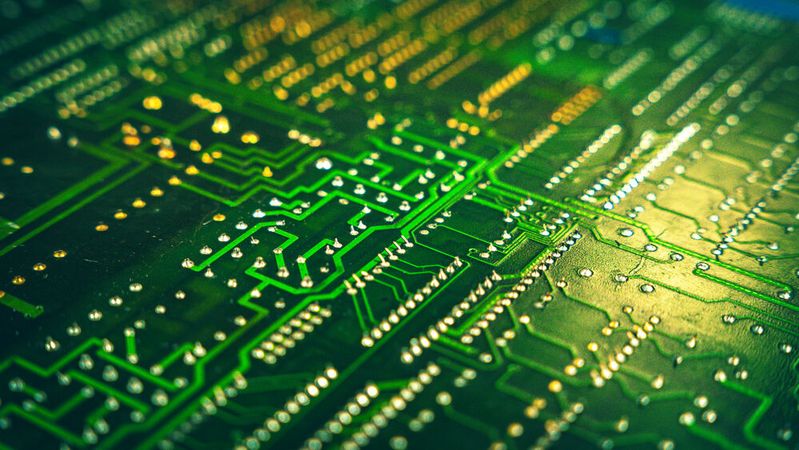
In the high-tech factories of our time, Printed Circuit Boards (PCBs) are not just made — they are crafted with precision and assembled with care. Every PCB manufacturing facility adheres to strict ISO certifications, a commitment to top quality that goes beyond mere compliance. In this era of technology, PCB production is based on advanced, automated processes. Modern machines and sophisticated software work hand in hand to design boards, place components, and ultimately realize cost-effective PCBs.
Yet behind every efficiently manufactured PCB stand two fundamental principles: DFM (Design For Manufacturability) and DFA (Design for Assembly). These guidelines form the foundation on which manufacturing facilities build their own, customized guidelines to enhance efficiency and optimize manufacturing costs. DFM and DFA serve to not only refine and simplify processes but also ensure that each design fulfills its function without unnecessary revisions and costs.
Building on this understanding of the basic principles in PCB manufacturing, the next section outlines targeted strategies that not only improve quality but also enable significant cost savings. These specific methods provide practical solutions for a more efficient and economical production of printed circuit boards.
14 Tips to reduce PCB manufacturing costs
1. Stick to design rules
When in the design phase, engineers should adhere to design rules. Complex board designs that go beyond design rules tend to increase the cost per PCB. Such deviations from design rules require additional material, extra precision, and more mechanical support. Complex routing mechanically increases the cost per PCB. Designers must optimize PCB cost in the design phase by strictly following design rules. Another option is to refer to open-source designs and prototypes for simplifying the design that replicates existing designs.
:quality(80)/p7i.vogel.de/wcms/49/41/49414aec54b828f2484e3bf80ad0634d/0100423163.jpeg "PCBs are some of the most crucial electronics components in modern devices, so it’s no surprise that their design phase can be complex. (Source: ©spainter_vfx - stock.adobe.com)")
PRINTED CIRCUIT BOARDS
What’s involved in the process of PCB design?
2. Optimize manufacturing panels
Similar to semiconductor wafers, PCB manufacturing panels account for overall yield. A PCB manufacturing panel has a well-defined standardized area and diameter for European and American manufacturers. PCBs are always mass-manufactured in a group. A PCB array is a group of identical PCBs that are sent for the production process. Multiple PCB arrays are stacked up on one another during the manufacturing process to shorten the production cycle.
3. Reduce PCB size
Every inch of the area on the manufacturing panel increases costs. It is advisable to utilize the maximum area on the manufacturing panel for better PCB manufacturing cost optimization. There should not be a wide distance between PCBs on a manufacturing panel. The key to reducing costs and increasing the efficiency of any electronic component, PCB, for that matter, incorporates miniaturization. Adding more PCBs to the manufacturing panel reduces production costs.
A smaller PCB offers space to other PCBs on a manufacturing panel. Yield is defined as the number of PCBs produced without defect out of all the PCBs on the manufacturing panel. More PCBs on a manufacturing panel increase yield per PCB. The higher number of PCBs on a manufacturing panel reduces proneness to errors, producing fewer defective pieces than efficient ones. Simply put, smaller PCBs decrease extra resources to produce the desired quality of PCBs. The array size should be based on the thickness of PCBs. Thinner PCBs are flexible enough to become unstable during handling. As a result, thinner arrays require additional material to stabilize and are prone to instability.
4. Implement V-scoring
Whether routed or V-scored, a stack of PCB arrays is put on a manufacturing panel. Placing more arrays on the panel increases yield per PCB. Some designers consider V-scoring to potentially reduce PCB manufacturing costs rather than routing.
V-scoring closely places multiple PCBs on a manufacturing panel. Most rectangular PCBs and specific shapes defined per the application are suitable for V-scoring. However, V-scoring may allow the breaking of components on a PCB board. Routing increases the distance between each PCB in an array. On the other hand, V-scoring decreases it. In simple words, V-scoring increases production volume by placing more PCBs on a manufacturing panel to reduce the manufacturing cost.
5. Design optimization
Choose a smaller number of vias for design optimization. Even filling microvias tends to increase manufacturing costs. Designers must choose from buried, blind, micro, staggered, and many more types. Through-hole vias cost the lowest in terms of manufacturing. Choose standard pad sizes compared to oversized pads to reduce manufacturing costs. It is important to keep track width shorter for a cost-effective design. The width of the track must meet impedance requirements to maintain connectivity between components. A low layer count is a big factor in optimizing PCB manufacturing costs. There are various types of PCBs in terms of layers such as single-layer, double-layer, and multi-layer PCB. With each layer, PCB manufacturing cost increases.
:quality(80)/p7i.vogel.de/wcms/ce/87/ce87fe736989818001cf1bbec58f76fc/0111695582.jpeg "EDA tools save time and cost and enable the production of efficient electronic products. (Source: Sunshine Seeds - stock.adobe.com)")
ELECTRONIC DESIGN AUTOMATION
Five EDA tools to empower your next PCB design
6. Choose the correct shape
Manufacturing Square or rectangular PCBs is common in the market. Irregular board outlines tend to increase manufacturing costs sequentially. Designers should aim to avoid internal PCB cuts and keep enough space between components to eliminate interconnections. A smarter design minimizes the number of components on a board without introducing unnecessary cuts and drills. Unconventional board shapes with additional cuts and drills are invoiced to customers, i.e. increasing the overall buying cost.
Castellated holes increase the PCB manufacturing cost. Smaller castellated holes require more filling which leads to a more mechanical and routing process. If castellated holes are necessary for the application, designers should adhere to castellated hole design rules.
Another factor is the PCB package choice which depends upon the application and requirements of the project. Choosing between SMT, THT or various types of packages can create massive price differences during the assembly process.
7. Define the thickness
As mentioned above, smaller and more complex PCBs increase manufacturing costs. Manufacturers need to choose the correct size with a suitable thickness. Side/edge plating needs more routing that goes on to add extra cost. If the thickness of the copper layer measured in ounces per square foot increases for a PCB, overall PCB thickness increases.
The price increases with thickness due to the need for additional material stack up. However, the price may not always increase with the thickness. The price for PCBs with extremely low thickness requires large handling, processing, and price of materials involved. Simply put, neither too thin nor too thick PCBs have decent pricing.
8. Material selection
FR-4 is the most common PCB substrate material type. The material should be chosen based on mechanical, physical, and electrical characteristics. Among all, temperature tolerance is also a critical factor in selecting the right material for PCB. Copper traces are used in PCBs to create conductive paths that carry current to various components. According to Altium, each PCB contains about 1 oz of copper material on each layer.
Copper was priced at $ 0.18 per ounce in 2018 and is currently priced at $ 0.24 per ounce on December 01 2023. In simple words, the copper price for an ounce increased up to 33 % in five years. Copper is among the costliest materials used in PCB manufacturing. It is important to note that copper is not the only material used in PCB manufacturing. The materials in surface finish play an active role in PCB production costs.
:quality(80)/p7i.vogel.de/wcms/f2/fe/f2fecc2176293ef8264423953058f53a/0113459766v2.jpeg "Find out more about the top players in the PCB industry. (Source: kody_king - stock.adobe.com)")
PRINTED CIRCUIT BOARDS
PCB Manufacturing: These are the biggest players
9. Surface finish
A PCB needs a surface finish to protect bare copper from oxidation and offer better capability for soldering to create reliable connections. The surface finish materials have different physical properties and cost involved but they facilitate their end goal of protecting the surface for optimal performance. ENIG (Electroless Nickel Immersion Gold), Electroplated gold, ENEPIG (Electroless Nickel Electroless Palladium Immersion Gold), HASL (Hot Air Solder Levelling), and OSP (Organic Solderability Preservatives) are some methods for surface finish. To reduce PCB costs, HASL and OSP are optimal choices.
10. Careful mechanical processing
Lamination is a procedure in mechanical processing where multiple layers are bonded to integrate a single cohesive PCB. The number of sequential laminations increases the PCB manufacturing cost. Single lamination has the lowest cost compared to two-layer mounted three-layer lamination. Even a multilayer PCB with a large number of components cannot occupy 100 % of the board space. Every PCB has non-usable open space for bordering, registering, labeling, and drilling holes for connections with other electronic devices. The number of drills in a PCB sequentially increases its price.
Multiple manufacturing panels should stack up together to be drilled through the machine. Thinner holes can’t be drilled in the PCB panel stack-up because thinner drilling bit incurs more deflection. Moreover, thinner drilling bits create small-sized holes and rings that are delicate to handle during the assembly process. Manufacturing units prefer wide-diameter drillers. A thicker drilling bit makes more strokes in a PCB. More strokes require more drilling tools. Simply put, a thicker drilling machine drastically reduces the drilling time of a PCB panel stack-up.
Reducing drilling time reduces the cost per PCB and machine cost. However, the driller should not be wide enough to increase the size of the hole. A large hole or ring in a PCB eventually increases the area. Thick drillers in such cases can contradict the very first requirement of miniaturization to reduce costs.
11. Avoid non-green PCBs
The choice of solder mask color for Printed Circuit Boards (PCBs) might surprisingly have a significant impact on production costs and efficiency. While PCBs can be manufactured in a variety of colors, green has become the industry standard for good reasons.
The green color provides enhanced visibility of traces and solder joints, which significantly facilitates fault finding and quality control. This improved visibility can lead to a reduction in the error rate during manufacturing and assembly, ultimately lowering overall costs. Moreover, adhering to the industry standard ensures better compatibility with existing production lines and testing equipment, further enhancing efficiency.
Since green PCBs are produced in mass production, manufacturers benefit from economies of scale, leading to lower costs per unit. In contrast, specific color requests for non-green PCBs can incur higher production costs, as these may need to be manufactured in smaller batches and require additional adjustments in the manufacturing process. Thus, producing PCBs in non-standard colors can not only be more expensive but also more time-consuming, as it can slow down production workflows.
The high demand for green PCBs ensures that they are readily available, leading to faster delivery times. This supports a more efficient production chain, as waiting times for material procurement are reduced, thus allowing for quicker completion of projects. Choosing green PCBs can help avoid supply chain bottlenecks and shorten the time to market for new products.
By opting for green PCBs, one chooses a proven path that is not only cost-efficient but also compatible with most manufacturing and testing standards. This decision supports seamless integration into existing production processes and helps to maximize the overall efficiency and cost-effectiveness of PCB manufacturing.
:quality(80):fill(efefef,0)/p7i.vogel.de/wcms/60/c2/60c259c900a1f/wp-vorschaubild-analog-devices-wp-lg-pb-2021.png "WP_Vorschaubild_Analog_Devices_WP_LG_PB_2021")
12. Refer to the relevant files
The design team (or client) must hand over the final Gerber file (design file), BOM file, and all other files to the manufacturing department. The Bill of Materials (BOM file) contains the list of all components with part numbers, supplier details, and descriptions required for PCB assembly.
An inaccurate BOM file results in the misplacement of components. However, BOM file errors are not typically subjected to manufacturing teams. Adding unique components, conventionally rare ICs, and components increases manufacturing costs due to unavailability with the manufacturing department.
13. Don’t skip inspection
At the end of the manufacturing process, PCB inspection is a critical stage for quality assurance, testing procedures, and eliminating defects. The inspection process tests the PCB quality through visual analysis, documentation checks, and automated procedures based on lasers or X-rays. A test coupon is a small test-purpose PCB with predefined dimensions and electrical properties to detect manufacturing defects. However, special types of coupon testing need manual inspection, which goes on to increase costs for the buyer.
14. Volume of orders
The PCB manufacturing industry benefits from “economies of scale”. A single PCB manufactured in a factory costs much more than bulk PCB manufacturing. The higher the volume of PCBs manufactured, the lower the cost per PCB. Usually, PCB manufacturers process high-volume orders with ease. A single complex-special application PCB can cost USD 500 but ordering the same PCB in bulk (about hundreds) could account for a total order value of up to USD 1000. The just-in-time PCB manufacturing cost in such cases relies directly on the classical principle of demand and supply.
Conclusion
The PCB manufacturing process is less complex and cheaper than - for example - semiconductor manufacturing. Billion dollars are spent in setting up a semiconductor foundry. Owing to the high cost of setup and fabrication, only seven countries are currently manufacturing semiconductors. On the other hand, even countries with smaller manufacturing facilities like Indonesia, India or Malaysia are manufacturing PCBs. In conclusion, keeping the design less complex and following these above-mentioned tips can effectively reduce your next PCB’s price!
(ID:49985889)
:quality(80)/p7i.vogel.de/wcms/e5/98/e598a234169e77a2f62fdd26bb0dfdb6/0133071181v2.jpeg "While the electronics industry has focused primarily on semiconductors in recent years, the next critical supply bottleneck has already emerged in the background: PCB base materials are becoming scarce worldwide. (Source: Hürth Elektronik)")
:quality(80)/p7i.vogel.de/wcms/f0/a1/f0a1ae7496e69c9ec84186d7ebdf897d/0130870335v2.jpeg "Semiconductors enable the energy transition but are also associated with significant material and environmental impacts. (Source: AI generated)")