


:quality(80)/p7i.vogel.de/wcms/7f/4b/7f4b97757cea82c0675209630577dc22/0133974130v2.jpeg "Vox Power’s EIRE600 delivers up to 600 W in a compact 5 × 3-inch package, with forced-air or conduction cooling options for industrial and medical equipment. (Source: Vox Power)")
:quality(80)/p7i.vogel.de/wcms/55/97/5597c3436e3bc92ee7ba23b6f9d289e9/0134032539v2.jpeg "Littelfuse’s TP7.0SMD-XC automotive TVS diode series uses foldback technology to provide low clamping voltage for protecting sensitive vehicle electronics. (Bild: Littelfuse)")
:quality(80)/p7i.vogel.de/wcms/51/f8/51f84448e666230bb11a02566abd1177/0133958187v3.jpeg "Microchip’s radiation-tolerant GaN point-of-load converter supplies up to 20 A for space-based processors, FPGAs, microcontrollers and ASICs. (Source: Microchip)")
:quality(80)/p7i.vogel.de/wcms/0a/7c/0a7c08f368ae1d91f758dd18d2a32e88/0133978423v2.jpeg "EPFL researchers have demonstrated a GaN transistor that withstands nearly 4 kV, using an intrinsic polarization superjunction design to distribute electric fields more evenly. (Source: EPFL)")
:quality(80)/p7i.vogel.de/wcms/5b/94/5b94232ca4183d6fcc2dccc7394d7544/0134041114v4.jpeg "Siemens and NVIDIA are testing AI applications at Siemens’ Erlangen electronics factory, using digital twins to support production planning and prepare inspection systems before physical prototypes are available. (Bild: Siemens)")
:quality(80)/p7i.vogel.de/wcms/b4/1f/b41f2731a07b608e60eca3663e280301/0133980549v2.jpeg "Multi-year agreement with Wolfspeed supports Infineon’s conversion from 150-millimeter to 200-millimeter silicon carbide (SiC) manufacturing (Source: © Ada - stock.adobe.com)")
:quality(80)/p7i.vogel.de/wcms/e3/0a/e30a8813bcf44b16f0dceb63a0747d29/0133984094v2.jpeg "The semiconductor is only one part of the design. Higher voltage, frequency and power density also increase the demands on electronic packaging materials such as die attach, substrates, top-side interconnects and module attach. (Source: Generated by AI)")
:quality(80)/p7i.vogel.de/wcms/5d/fb/5dfba5e5f38daf2b8597b05656af29c0/0133956337v2.jpeg "Wolfspeed has received a conditional commitment for a loan of up to $1.5 billion from the U.S. Department of War to support its domestic wide-bandgap semiconductor supply chain. (Source: © AspctStyle - stock.adobe.com)")
:quality(80)/p7i.vogel.de/wcms/bf/b6/bfb6ac295759be32d567df9849b6767e/0134094495v2.jpeg "Fraunhofer ISE reports that 25 Ah pouch cells with silicon-rich anodes retained more than 83% of their initial capacity after 1,000 cycles when tested under 1,000 kPa axial pressure. (Bild: Fraunhofer ISE)")
:quality(80)/p7i.vogel.de/wcms/16/dc/16dca55e6ef80e6b5da68bc628da2dcc/0133844782v2.jpeg "This article explains virtual power plants in modern renewable-heavy grids. (Source: © M@rketVisualsStudio - stock.adobe.com)")
:quality(80)/p7i.vogel.de/wcms/e8/33/e8330aae4bea3578b98ec2c1403d367a/0133980001v2.jpeg "IRENA’s 2026 World Energy Transition Outlook identifies faster electrification powered by renewables as central to meeting future global energy needs. (Source: Irena)")
:quality(80)/p7i.vogel.de/wcms/6c/b4/6cb405f47d25035e256ae90fe3a66ee6/0134032112v2.jpeg "Sungrow’s PowerTitan 3.0 energy storage platform uses onsemi EliteSiC hybrid power modules, with the companies reporting peak inverter efficiency above 99.3%. (Bild: onsemi)")
:quality(80)/p7i.vogel.de/wcms/7b/76/7b76005554b556df2a7a3794bdf69d44/0132365246v2.jpeg "Hioki’s ST5680A DC Hipot Tester combines CE/UKCA/CSA compliance, an integrated capacitance‑based contact check and time‑series waveform recording (voltage, leakage current, insulation resistance) to standardize hipot and insulation testing across EV cell, module and pack production lines. (Source: Hioki)")
:quality(80)/p7i.vogel.de/wcms/af/7f/af7f7b0fb7f29219fc991b1130f65477/0132241333v2.jpeg "Comprehensive laboratory testing regimens—combining thermal cycling, high‑current stress, EMC, and accelerated lifetime tests—are essential to validate advanced power designs and ensure reliability in real‑world applications. (Source: PRBX)")
:quality(80)/p7i.vogel.de/wcms/16/3d/163df69363f8125315a9826e13ea4b05/0131927425v2.jpeg "Solution will maximize data center and AI factory profitability while delivering engineering-grade insights to design and operations for more efficient, sustainable, and resilient infrastructure. (Source: Cadence)")
:quality(80)/p7i.vogel.de/wcms/85/b7/85b7e90733a2bd8f21515d8f7137f2fc/0131917677v2.jpeg "Renesas acquires Pictorus to integrate its embedded application software platform with Renesas’ MCU and MPU portfolio, helping developers shorten time‑to‑market and simplify system integration. (Source: © lucadp - stock.adobe.com)")
:quality(80)/p7i.vogel.de/wcms/f8/34/f834240d434a0c265a2ccafe614c8cd7/0134032109v4.jpeg "Hard- and soft-switching techniques shape voltage and current during device transitions, influencing switching losses, EMI and thermal performance in power converters. (Bild: © Mrthullab - stock.adobe.com)")
:quality(80)/p7i.vogel.de/wcms/27/07/2707280c807689b437baed3660257404/0133626052v2.jpeg "The quantum behavior of electrons shapes semiconductor devices—and the power converters that deliver electricity to modern computing systems. (Source: © Celt Studio - stock.adobe.com)")
CURRENT AMPLIFIER Novosense launches current sense amplifiers to address PWM transient interference
Related Vendors
:fill(fff,0)/p7i.vogel.de/companies/5f/71/5f71d5f92a5f6/2000px-rogers-corporation-logo-svg.png "2000px-Rogers_Corporation_Logo.svg.png (rogers germany)")
:fill(fff,0)/p7i.vogel.de/companies/68/2c/682c3e2e9a195/logotype-rvb.jpeg "logotype-rvb (MERSEN France)")
NOVOSENSE announced the launch of its new bidirectional current sense amplifier series, NSCSA240-Q, covering both industrial and automotive versions, designed for high-voltage PWM systems in vehicles and industrial equipments. The series integrates enhanced PWM rejection technology, supporting bidirectional current sensing with exceptional transient immunity, automotive-grade precision, and flexible configurability.
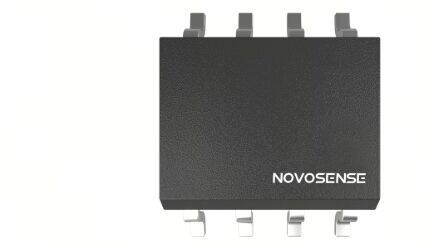
Featuring an ultra-wide input common-mode range from –4V to 80V, a typical input offset voltage of ±5μV, and a 135dB DC Common-Mode Rejection Ratio (CMRR). This series effectively tackles the challenge of high-frequency transient interference in PWM systems, providing a highly reliable current monitoring solution for automotive electronic power steering (EPS), motor drive, industrial automation and other applications. The NSCSA240-Q series meets the AEC-Q100 automotive reliability standard.
Superior transient immunity: reliable performance in high-voltage PWM environments
In PWM systems, rapid switching can cause severe common-mode voltage fluctuations that distort output signals in conventional amplifiers. The NSCSA240-Q series achieves an AC CMRR of 90dB at 50kHz, effectively suppressing ΔV/Δt transients. Its proprietary transient suppression design reduces output disturbances by up to 80%, achieving a recovery time of less than 10μs under 80V common-mode voltage transients. With a bandwidth ranging from 450kHz to 600kHz (gain-dependent), it supports both high-speed overcurrent protection and accurate low-frequency PWM signal capture—ensuring stable, low-noise signal performance for EPS, motor drive and industrial motor control systems. The wide –4V to 80V input common-mode range offers broad dynamic capability and robust tolerance across 12V, 24V, and 48V vehicle power architectures. Furthermore, ±2000V ESD protection (HBM/CDM) enhances resistance to external electrical disturbances, ensuring overall system reliability.
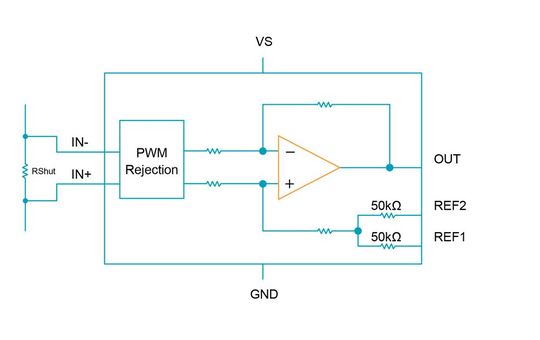
Automotive-grade precision
Designed to meet the increasingly stringent current measurement requirements of automotive electronics, the NSCSA240-Q series delivers exceptional measurement stability. It features a typical input offset voltage of only ±5μV (maximum ±25μV) and achieves ±0.1% accuracy over a wide temperature range (–40°C to 125°C). With a typical gain error of 0.05%, it ensures reliable and consistent current monitoring even under harsh conditions. Fully qualified to the AEC-Q100 automotive standard, the series guarantees long-term reliability in demanding in-vehicle environments.
Flexible integration: multiple gain and package options for design optimization
As automotive systems trend toward miniaturization and integration, the NSCSA240-Q series is engineered for flexible and space-efficient design. It offers four fixed gain options—20V/V, 50V/V, 100V/V, and 200V/V—supporting shunt resistors ranging from 10mΩ to 0.1mΩ for flexible current detection. The series is available in two compact packages: SOIC-8 (4.9mm × 3.91mm) and TSSOP-8 (3mm × 4.4mm), allowing easy integration into space-constrained motor controller PCBs and helping designers optimize system layouts within limited board area
(ID:50630897)
:quality(80)/p7i.vogel.de/wcms/d3/6e/d36e9c4a220dd970bd5c615f776178be/0128114533v2.jpeg "Symbolic image: Automotive taillights featuring advanced backlighting from Diodes' new boost controller (Source: © Kara - stock.adobe.com)")
:quality(80)/p7i.vogel.de/wcms/34/4a/344a3dc5a19429cf6726b7f8f7e2ee32/0130109719v2.jpeg "Hioki’s new measurement solutions enable precise analysis of power electronics systems and energy efficiency. (Source: Hioki)")